For Dior’s Refreshed NYC Flagship, Peter Marino Sought Luxury T…

Michelle Duncan

The architect curated an intimate domestic atmosphere—then amped it up with floriculture
On a crisp September evening in Manhattan, venerable French maison Christian Dior celebrated the latest refresh of its New York City flagship—which features the ready-to-wear pieces and fine jewelry the brand is known for, alongside unexpected treats like the house’s first permanent spa in the US and a tea salon—with a champagne-soaked celebration. Stepping into the store’s latest iteration, fashion luminaries found themselves enveloped in an atmosphere more reminiscent of a well-appointed town house than that of a typical boutique.
Maintaining those inviting residential qualities was definitely on Peter Marino’s mind as he crafted the reimagined Dior, the architect tells AD. Marino, who’s become synonymous with luxury retail’s look, has been Dior’s trusted boutique designer for decades. “I really feel the challenge of luxury brands is to keep things at what I call a ‘boutique feel.’ The town house is a very human scale, and this is a series of human-scale rooms I purposely divided into a men’s town house and a women’s town house,” he says, referring to the location’s side-by-side men’s and women’s boutiques, the result of merging two buildings with separate entrances but fluid interiors.
Adding to the domestic feel are custom artworks, like the metal door panels by Nancy Lorenz and Claude Lalanne’s bloom-lined Ginko Bench stationed near the entrance. Salon furniture and large area rugs by Marino anchor the shopping spaces. A majestic floor-to-ceiling garden column bursting with 12 different varieties of greenery, imagined by Belgian landscaper Peter Wirtz in collaboration with Marino, is inescapable upon entering the first floor. “In all of his three homes, Mr. Dior had very beautiful gardens that he designed himself,” Marino notes.
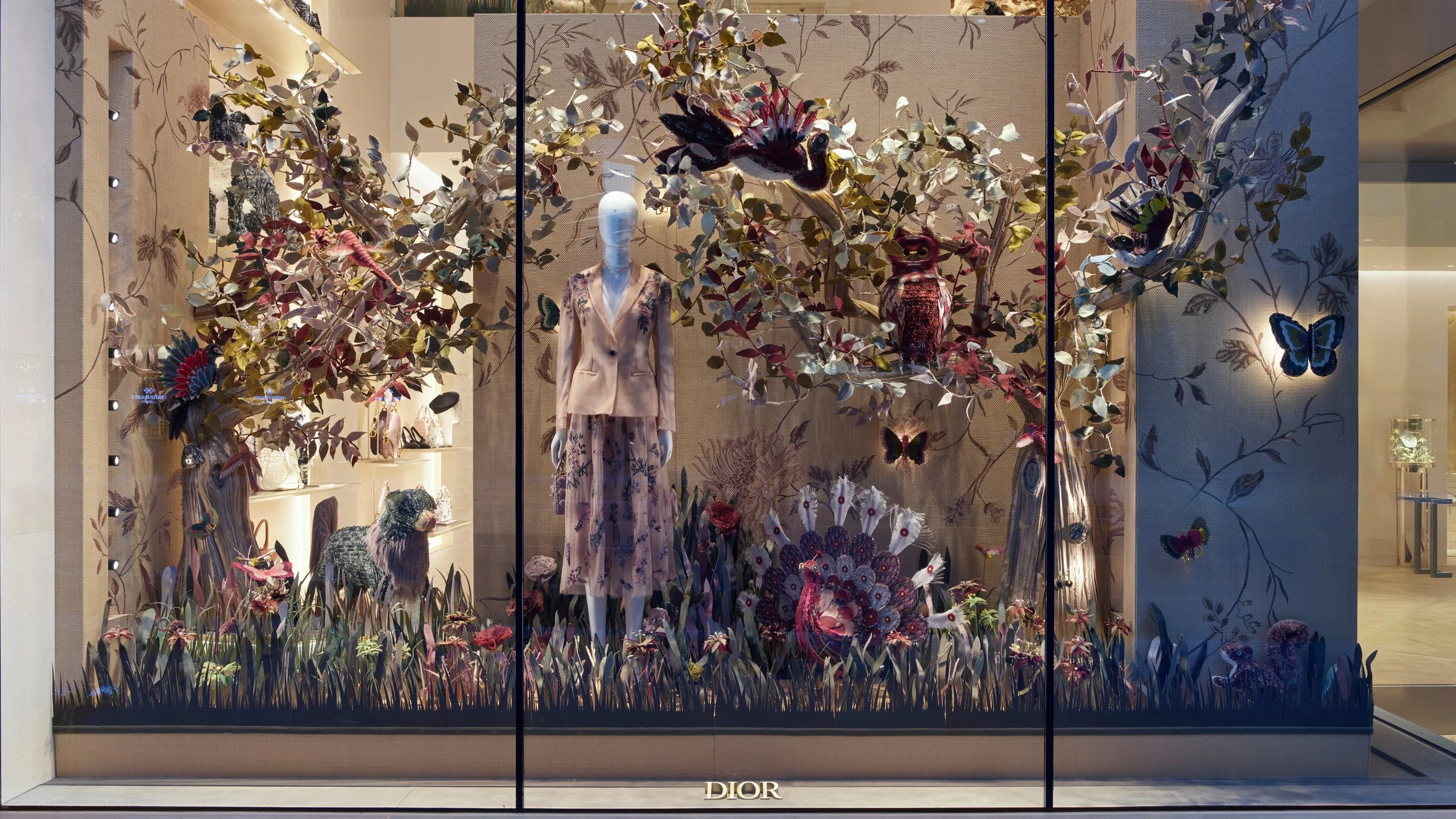
The homage to Dior’s floriculture obsession continues with a display of elaborate gardens created from upcycled materials in the all-glass storefront, clearly visible from the sidewalk. “I wanted the windows to be full of trees,” says Marino, who believes that contemporary boutique façades suffer from sameness. “Everything else is like regular old windows. They all look the same. I wanted all glass and to put the garden on the street.”
Despite describing the work of modernizing the boutique’s 1895 building as “architecturally challenging,” Marino’s fusion of contemporary and historical elements feels effortless in its execution. For this effect, he leans on a proven formula. “There is a classic recipe for Dior. It’s always been a mix of Mr. Dior’s favorite French period—which was at the end of the 18th century, although he preferred clean paneling to that of Rococo—with elements from his period of design 1947 to 1957, and modern me. So you get a third of Dior, a third of his favorite design period, and a third of me. I would never put anything from 1975 in a Dior boutique.”
So don’t expect anything harkening to the disco era, but do expect the proliferation of little details—like the leather-clad staircase railings, hand-embroidered wall paneling in the spa, and reproduced Dior textiles—to make a big impact. This is, after all, a Peter Marino production.
Like this project
Posted Oct 28, 2025
Got to interview THE Peter Marino for Dior's 5th Avenue refresh
Likes
0
Views
6