Full-Stack Mobile App - Fitness Tracker Design & Development

Muhammad Ashraf Khan


A Full-Stack Fitness App Built from the Ground Up: React Native Front End, Node.js Backend, Firebase Database, and a Complete UI/UX Overhaul
How I redesigned and built an end-to-end fitness tracking app with React Native, Node.js, and Firebase, from broken UI to a launch-ready product.
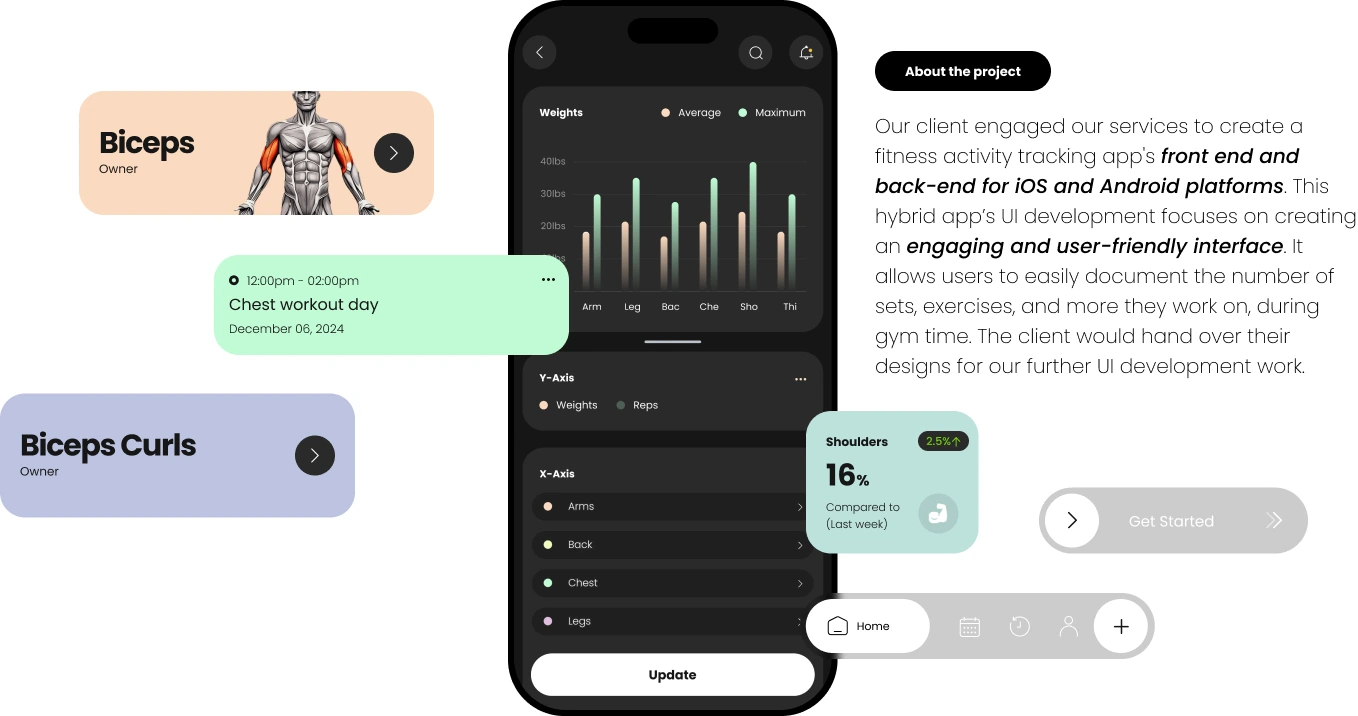
I was brought on to build a fitness activity-tracking app for iOS and Android: a hybrid mobile product designed to help users log workouts, track progress, and stay motivated through personalized plans, coaching, and community features. What started as a narrow, front-end-only engagement evolved into a complete end-to-end product build: UI/UX design, full front-end and back-end development, and deployment for both platforms.
The Challenge
The client came to me mid-project. They had already commissioned design work elsewhere and had reached the end of that collaboration; their previous provider had delivered their best version of the work, with no further revisions on offer.
When I audited what existed, I found several structural flaws and strategic gaps in the designs: inconsistent UI patterns, unclear information architecture, and front-end components that wouldn't scale into a real, functioning product. I shared these findings with the client, and they agreed with my assessment, but there was no path back to the original team for fixes.
That left the client in a difficult spot: a promising app idea, a design that wasn't production-ready, and no clear way forward. Without a focused plan for immediate design improvement, the project risked stalling out entirely.
My Approach
I proposed a phased solution that met the client where they were, rather than asking them to start over:
Stabilize the design first. My initial scope was a custom redesign: a "whole new look" for the app in Figma, fixing the structural issues I'd identified while preserving the product vision the client had already invested in.
Earn the bigger scope through delivery. As the design work progressed and trust built, the client expanded my role to cover the initiative end-to-end: front-end build, backend architecture, API development, and deployment.
Design and build in parallel where possible. Rather than treating UI and engineering as fully sequential phases, I ran front-end component work alongside backend planning so integration could happen early and often.
The result: a single, accountable point of contact taking the project from "needs a tighter UI" to a fully working, store-ready application.
The Build
Core feature set
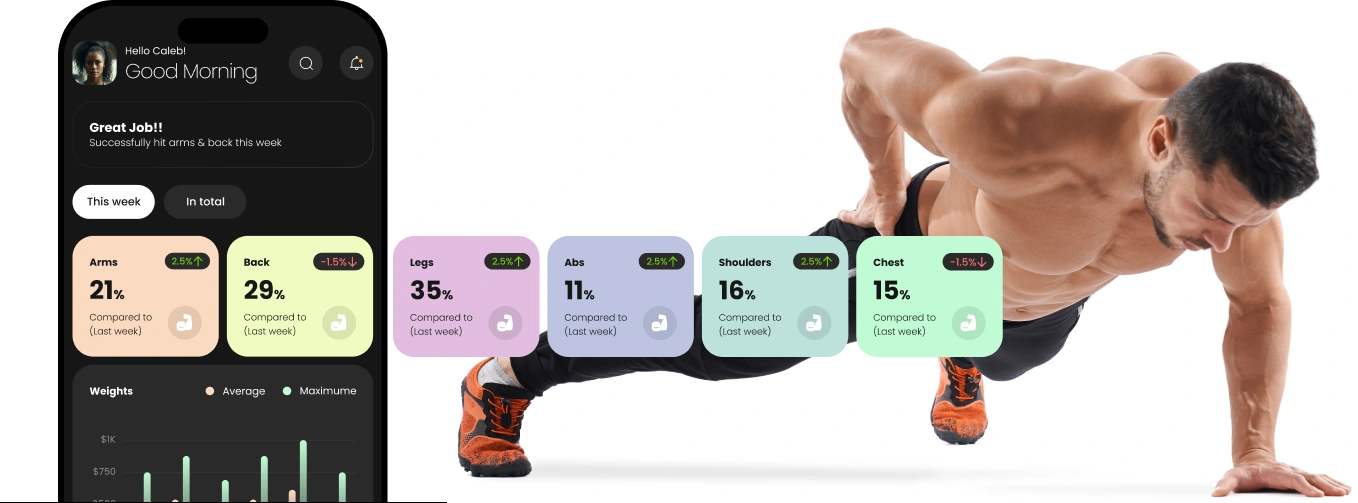
Fitness Tracking: workout logging by muscle group, exercise variation, equipment, and machine, with single/both-side rep tracking.
Nutrition Dashboard & Meal Plan: calorie, macro, and fasting tracking alongside meal planning tools.
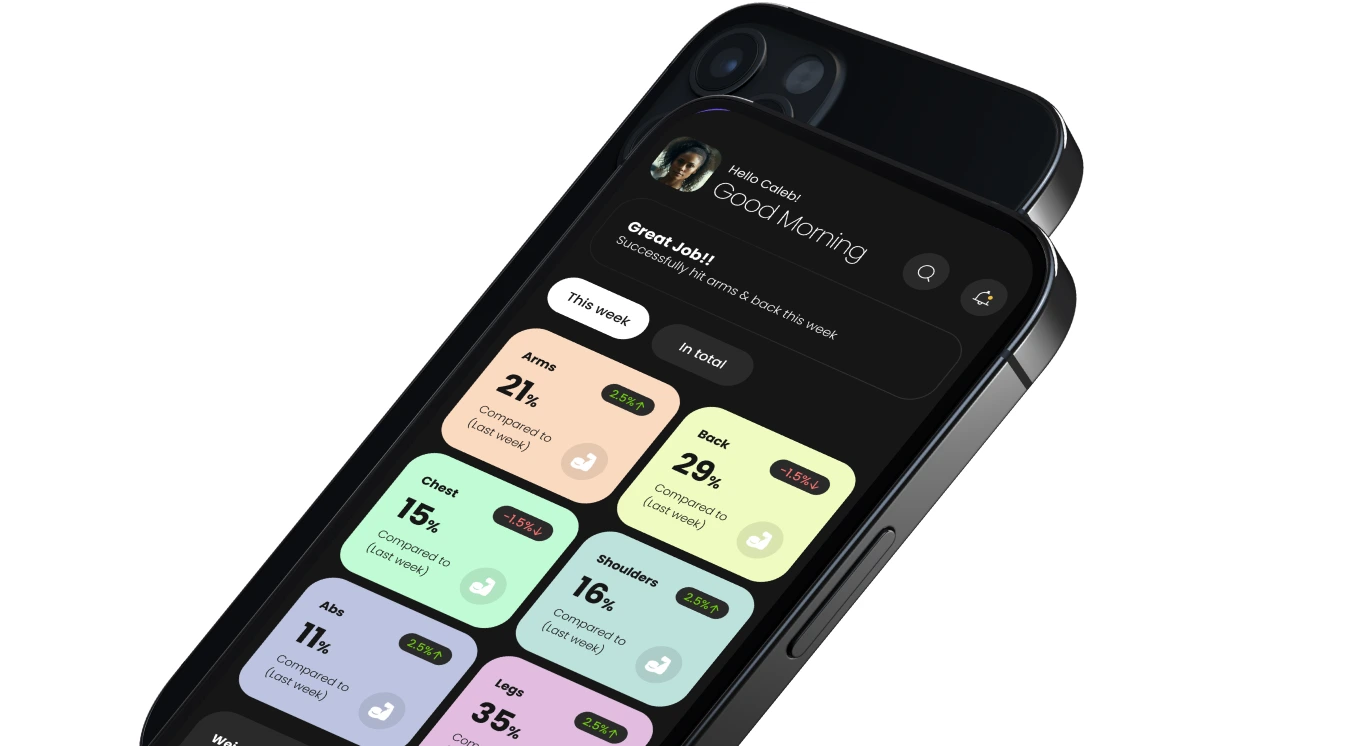
Analytics & History: weight and rep comparisons (average vs. maximum) charted across muscle groups, with weekly performance call-outs (e.g., "Successfully hit arms & back this week").
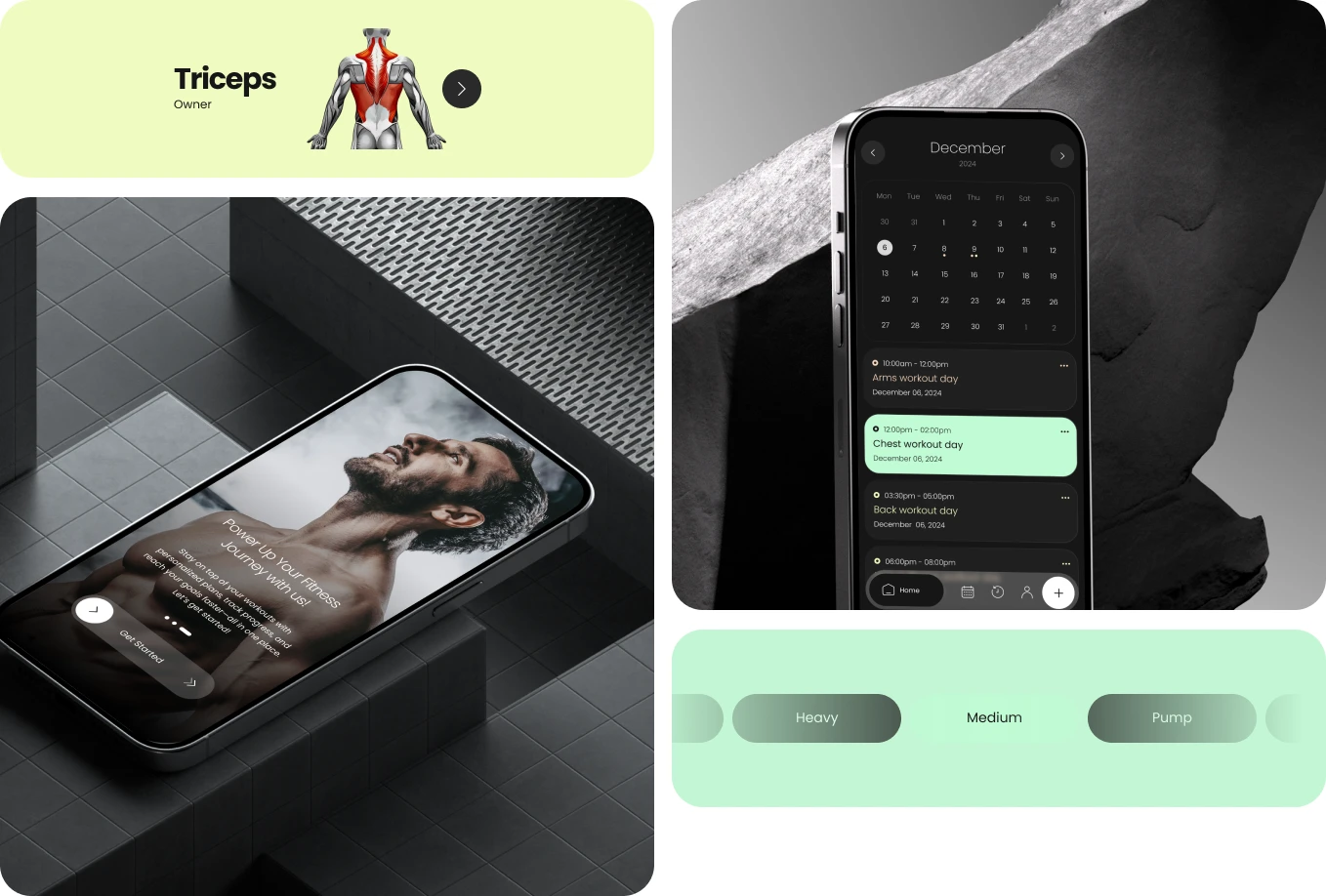
Calendar & Scheduling: a monthly view for planning and reviewing workout sessions by day and muscle group.
Community & Coaching: wellness challenges, social sharing, and scheduled coaching sessions with chat.
AI-assisted insights: surfacing health, energy, sleep, and recovery signals back to the user.
Profile & Account: membership management, personal info, feedback, and legal/settings screens.
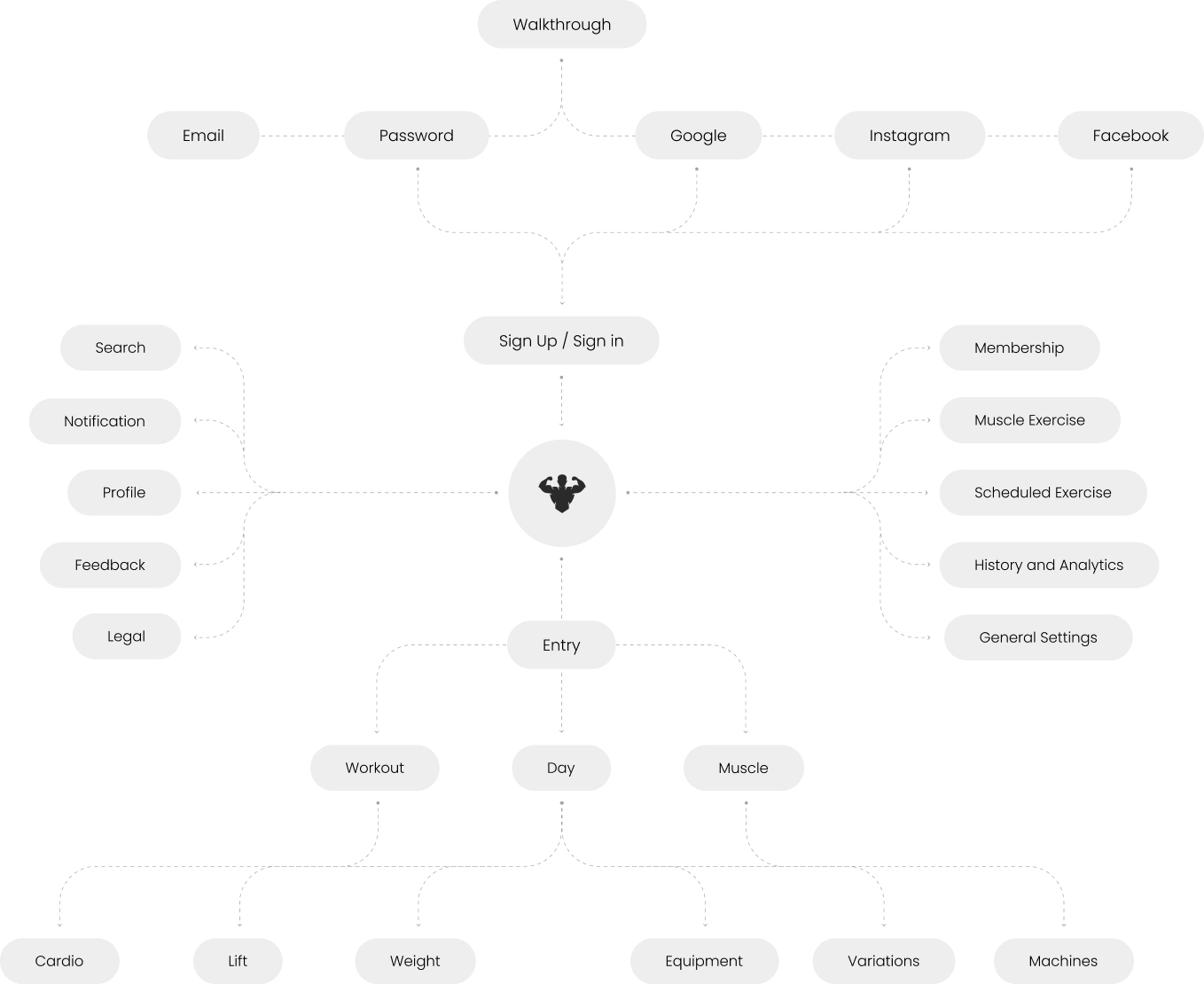
Multi-channel onboarding: sign-up/sign-in via email, Google, Instagram, and Facebook, preceded by a guided walkthrough.
Information architecture was mapped around a central hub connecting onboarding, account/settings, and the core logging flow (Workout > Day > Muscle > Cardio/Lift/Weight/Equipment/Variations/Machines), keeping every screen no more than a couple of taps from the home dashboard.

Tech stack
Front end
React Native - Shared codebase for iOS and Android, built from a modular component system.
Back end
Node.js - Core services, including authentication and activity tracking.
Database
Firebase - Scalable schema design and real-time data sync.
Design
Figma - UI, prototyping, and the design system.
APIs
RESTful - Kept front-end and back-end data fully synchronized.
Process
I followed a structured seven-stage MVP methodology to keep design and engineering aligned from kickoff to launch:
Strategy Development (objectives, competitor research, platform selection, monetization, persona analysis).
Analysis & Planning (functional/non-functional requirements, product roadmap, tech stack).
UX/UI Design (UX writing, wireframes, design system, branding, mockups, prototypes, app icon).
App Development (parallel front-end and back-end builds).
Mobile App Testing (functionality, accessibility, performance, security, usability, compatibility).
Deployment (app ID, certificates, App Store Connect, build/archive, submission).
Support & Performance Monitoring (load speed, screen rendering, throughput, error rates, crash reporting).
Timeline
A 14-week build, October to December 2024.
October: Front-End Foundation (Weeks 1-5)
Week 1: Discovery, requirements review, environment setup
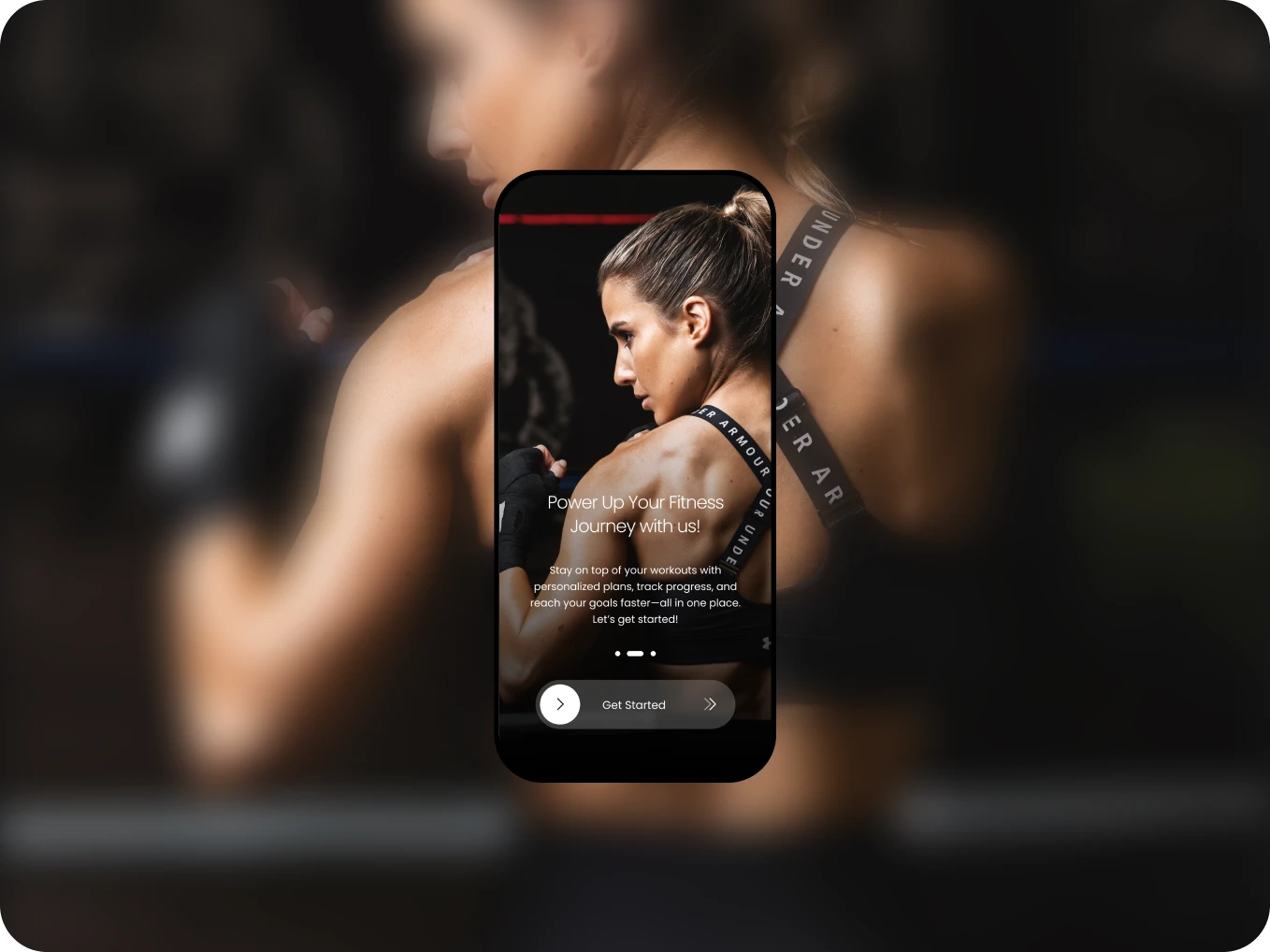
Weeks 2-3: Initial front-end design: reusable components, splash/login/onboarding screens
Week 4: Advanced UI: activity charts, trackers, settings, cross-platform feature parity
Week 5: UI testing, optimization, and first APK/IPA builds for client feedback
November: Back-End Build (Weeks 6-10)
Week 6: Backend kickoff: Firebase schema design, Node.js authentication and activity-tracking services
Weeks 7-8: RESTful API creation and front-end/back-end integration, with early security and performance testing
Week 9: Advanced backend features: analytics, activity history, secure real-time data handling
Week 10: Internal backend testing: API response times, error handling, debugging
December: Integration, QA & Launch (Weeks 11-14)
Week 11: Full system integration testing across UI, backend, and API workflows
Week 12: End-to-end QA and final usability fixes
Week 13: Final documentation: API docs and a clean, scalable source code handover
Week 14: Project handover and deployment: finalized APK/IPA delivery, app store submission support, backend hosting on the client's preferred cloud platform
Outcome
By project close, I had delivered:
A fully designed and developed cross-platform fitness app (iOS + Android) from a single React Native codebase
A scalable Node.js + Firebase backend supporting authentication, real-time activity sync, and analytics
A complete UI/UX overhaul that resolved the structural and strategic issues identified at project start
Documented APIs and an organized source code repository, handed over for long-term scalability
A production-ready build, submitted and deployed to the client's preferred environment
What began as a request to patch a front-end design became a full product partnership, taking the app from "needs better UI" to a launch-ready, end-to-end mobile experience.
Client Testimonial
We came to Muhammad needing a design fix and ended up with a complete product. He didn't just clean up the UI; he caught problems we didn't know we had, then took ownership of the entire build, backend included. Communication was consistent throughout, and the final app is something we're genuinely proud to put in front of users.
Like this project
Posted Jun 15, 2026
End-to-end fitness app: Figma UI/UX redesign, React Native development, Node.js + Firebase backend, and App Store deployment — iOS & Android, 14 weeks.
Likes
0
Views
14
Timeline
Oct 5, 2024 - Jan 20, 2025