Innovative Mobile App for Luxury GCC Pet Care Solutions

Muhammad Ashraf Khan


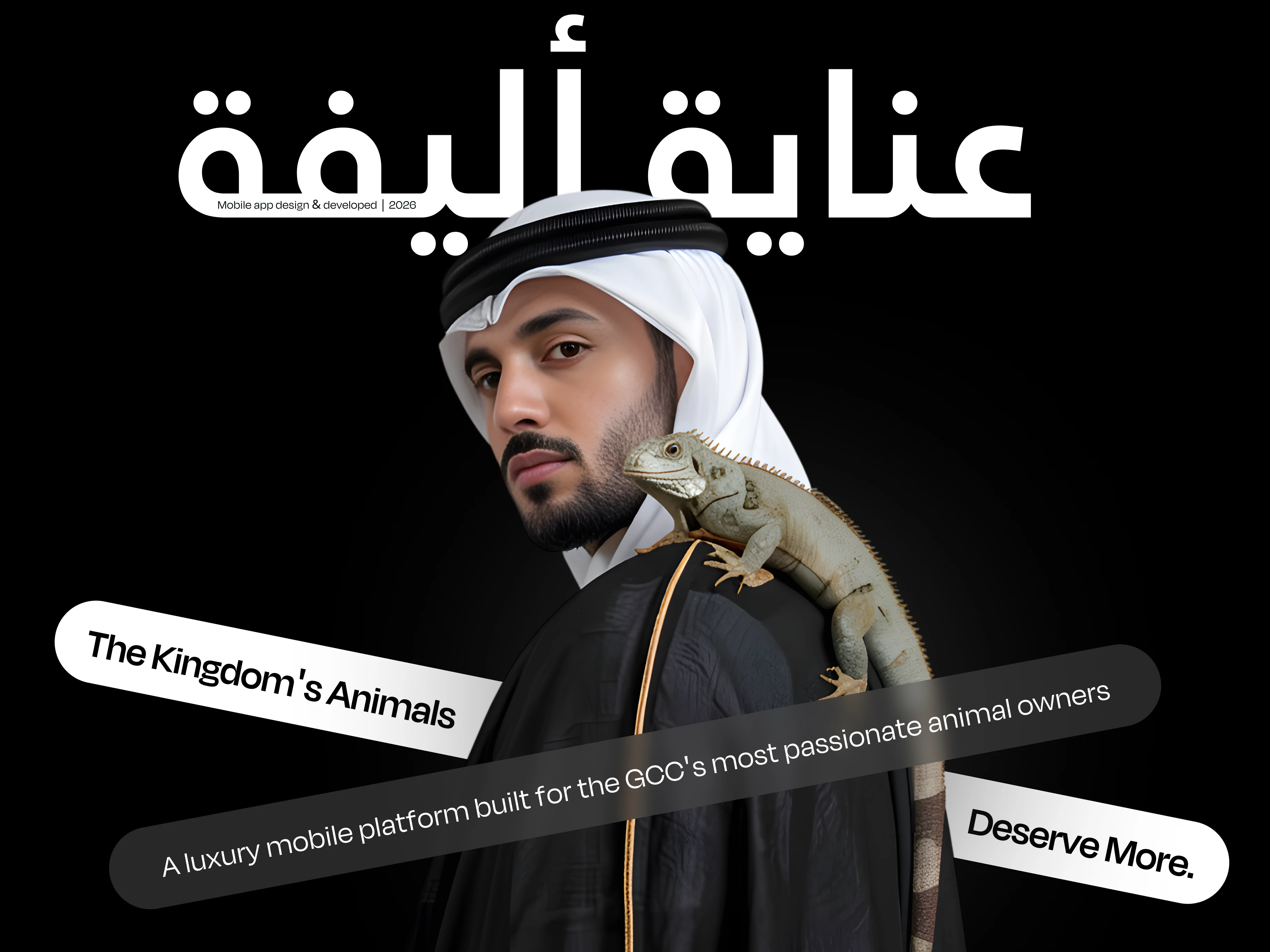
A Luxury Pet Care App for the GCC's Most Exotic Companions
The brief was unusual from the start. A client in the Gulf wanted a pet care app, but not for cats and dogs. For falcons, Arabian horses, exotic reptiles, and eight other species kept by some of the region's wealthiest collectors and breeders. There was no existing playbook. No competitor to benchmark against. Generic pet apps weren't built for this audience, and luxury apps weren't built for pets.
They needed something that didn't exist yet.
The Challenge
Designing for an Audience of One, Nine Times Over
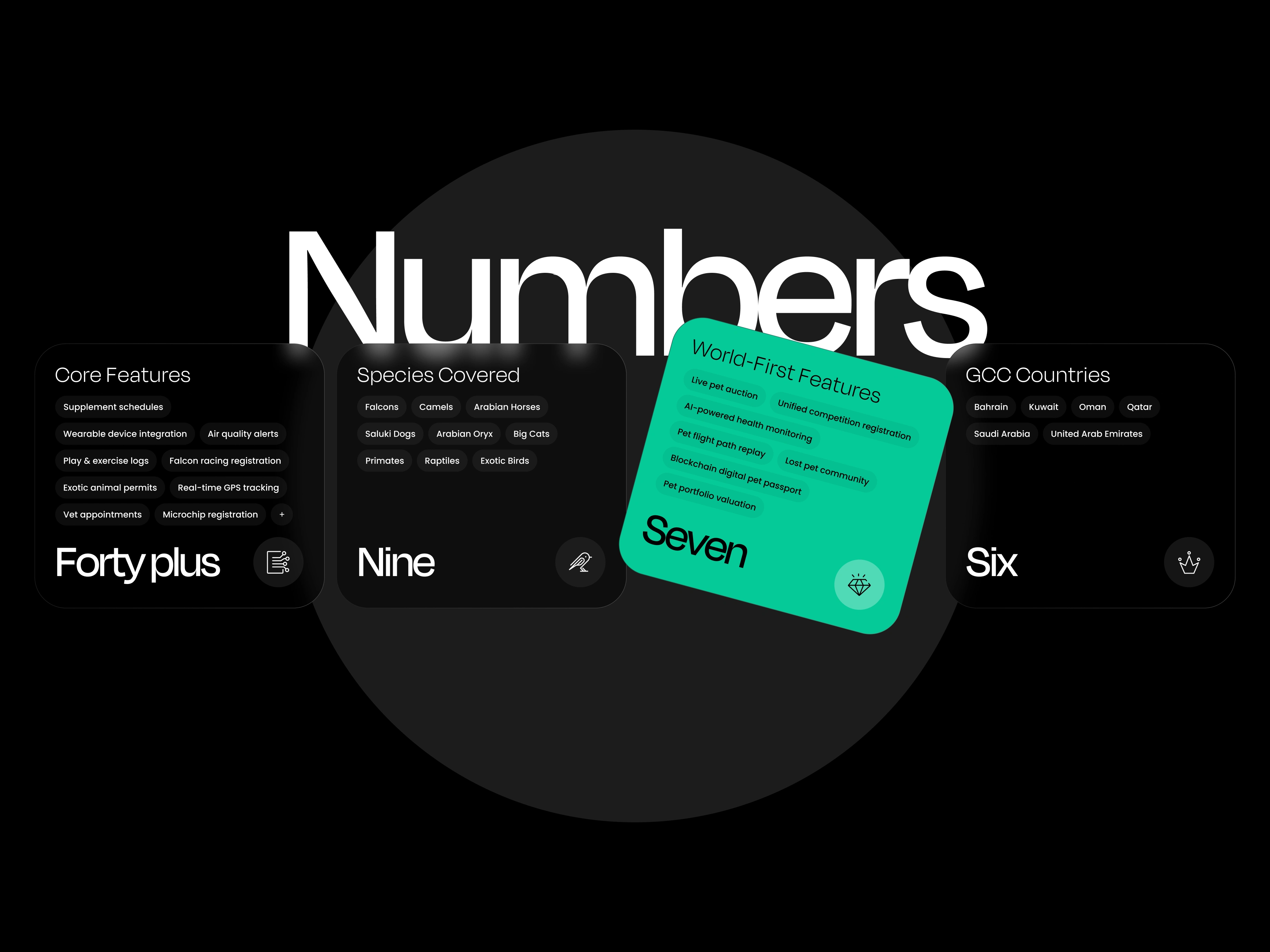
Most pet apps assume a single use case: walks, vet reminders, the occasional photo. Inayah Aleefah had to serve nine fundamentally different species, each with its own health markers, care rituals, and ownership culture, while still feeling like one coherent, premium product. A falcon owner and a thoroughbred breeder needed to open the same app and both feel like it was built specifically for them.
On top of that, this audience doesn't just want care tools. They want provenance, trust, and status: proof of lineage, verified health history, and a level of polish that matches everything else in their world.
The Approach
Strategy First, Pixels Second
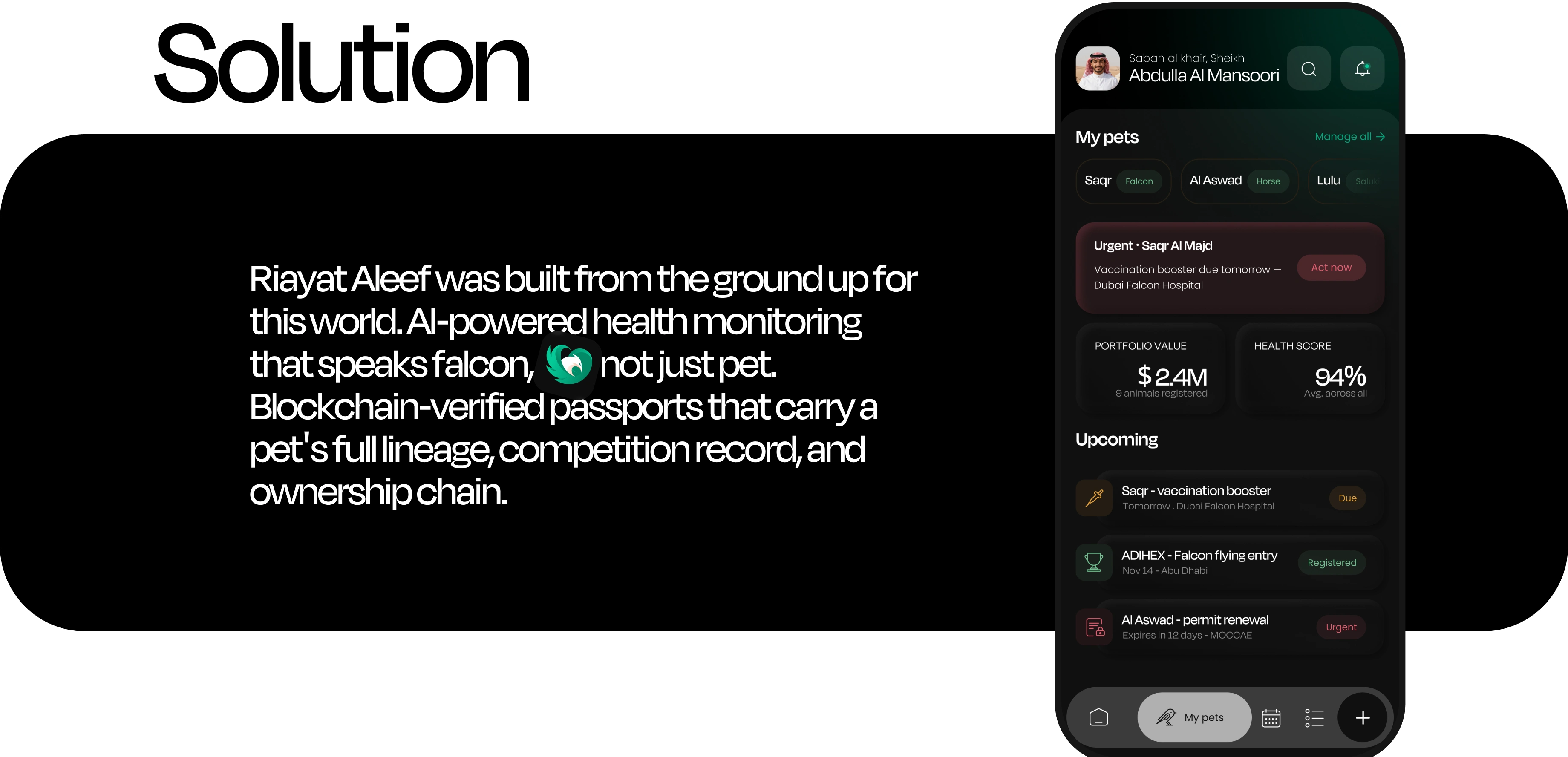
Before any screen was designed, the system had to be mapped: what does "luxury" mean across nine species with wildly different needs? The answer was structure: a flexible information architecture where each species got tailored health metrics and care modules, all sitting inside one consistent visual language. Same elegance, same interaction patterns, different content underneath.
From there, the work moved through Figma, establishing a calm, premium visual identity (think the restraint of a fine watch brand, not the busyness of a typical pet app), before moving into full React Native development for iOS.
The Build
Four Systems, One Seamless Experience
AI Health Monitoring: Continuous, species-specific health tracking that learns what's normal for each animal and flags what isn't, turning raw data into something an owner can actually act on.
Blockchain Pet Passports: A verifiable, tamper-proof record of lineage, ownership, and health history. For collectors and breeders, this wasn't a nice-to-add feature, it was the trust layer the entire category was missing.
GPS Tracking: Built for animals that don't behave like a dog on a leash. Location tracking tuned for the realities of falconry and large-animal ownership, not lifted from a generic pet-tracker template.
Luxury Brand & UI: Every screen, from onboarding to the health dashboard, was designed to feel less like a utility app and more like a private concierge: quiet confidence over flashy gimmicks.
The four weren't built as separate features bolted together. Each one fed the others: a health alert from the AI system could trigger a vet visit logged straight into the blockchain passport, viewable on a map of where the animal actually is.
The Outcome
A Category-Defining Product, From Strategy to App Store
Inayah Aleefah launched as a true end-to-end build: concept, UX strategy, full Figma design system, React Native development, and App Store release, all under one roof. It's a rare case where a single point of ownership across design and engineering meant nothing got lost in translation between "what we designed" and "what shipped."
This wasn't an app for everyone. It was an app for nine very specific kinds of someone, built with the same care they give their own animals.
Comprehensive Pet Profiling
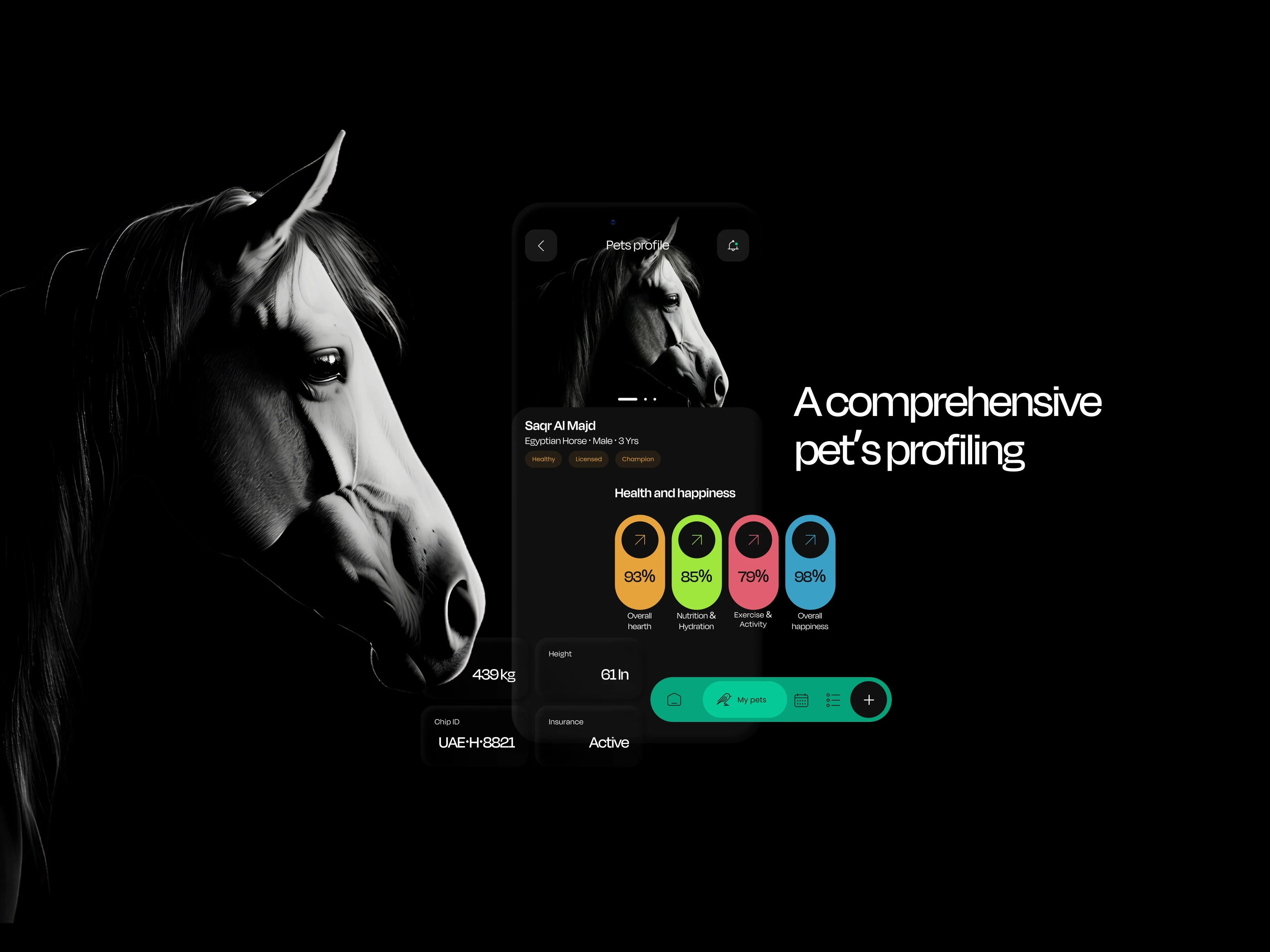
Every animal gets a living profile, not just a contact card. Saqr Al Majd, a 3-year-old Egyptian Horse, shows up with breed, sex, age, and status tags like Healthy, Licensed, and Champion at a glance. Chip ID, insurance status, weight, and height are logged alongside real-time health and happiness scores: overall health, nutrition and hydration, exercise and activity, and overall happiness, each tracked as its own metric rather than buried in a single generic "health" number. It's less a profile page and more a full identity record, built to hold the kind of detail that matters for a champion-bred animal, not a household pet.
AI Integration in Health Monitoring
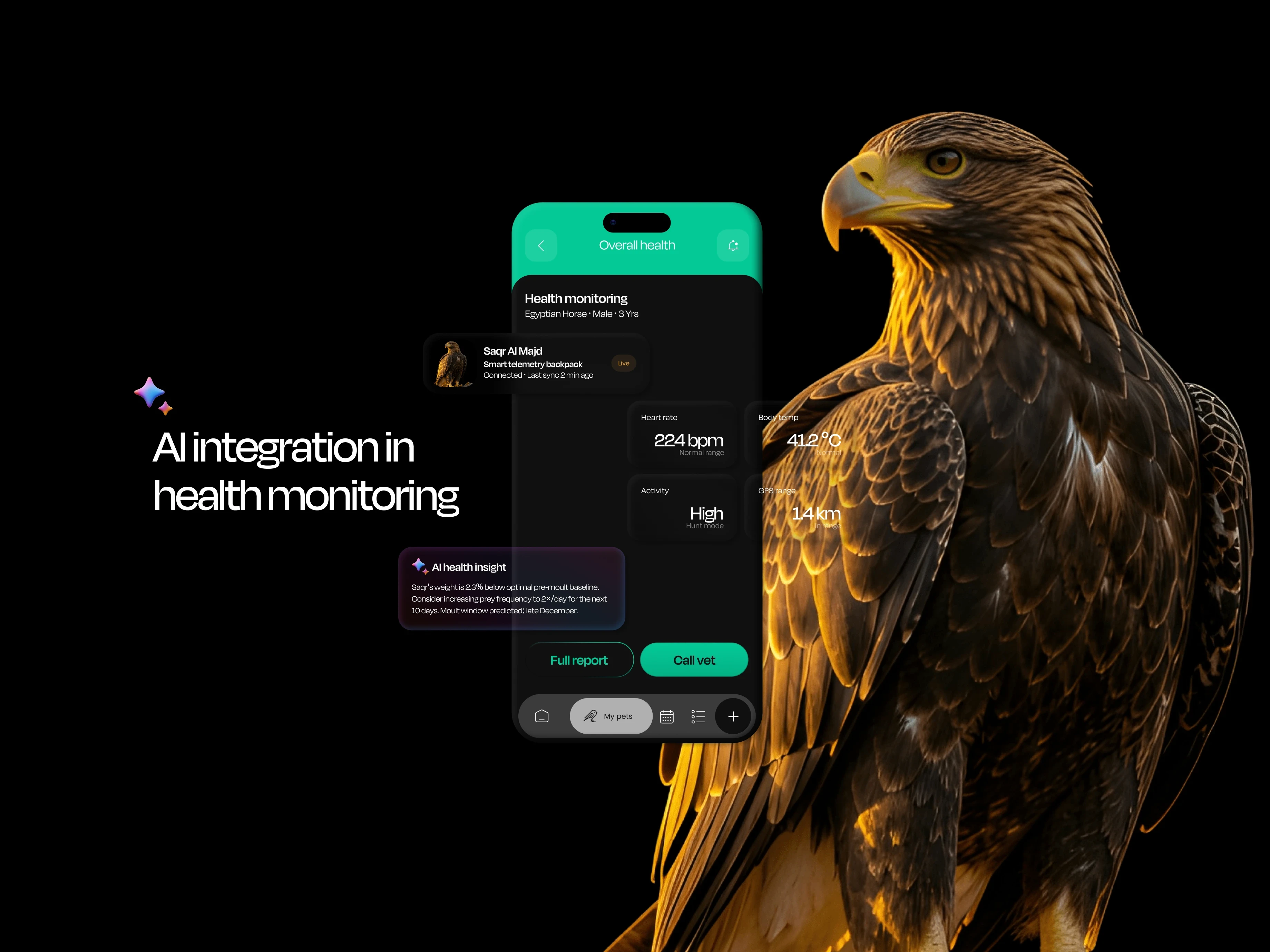
Real-time vitals replace guesswork. A falcon fitted with a smart telemetry backpack stays connected and live-synced, feeding back heart rate, body temperature, activity level, and GPS range in real time, 224 bpm, 41.2°C, high activity in hunt mode, 14 km in range. But the real value sits underneath the numbers: an AI health insight flags that the bird's weight is trending 2.3% below its optimal pre-moult baseline, recommends increasing feeding frequency, and predicts the moult window itself. It's not just monitoring, it's interpretation, turning raw telemetry into a recommendation an owner can act on immediately, with "Full report" and "Call vet" sitting one tap away.
The Process
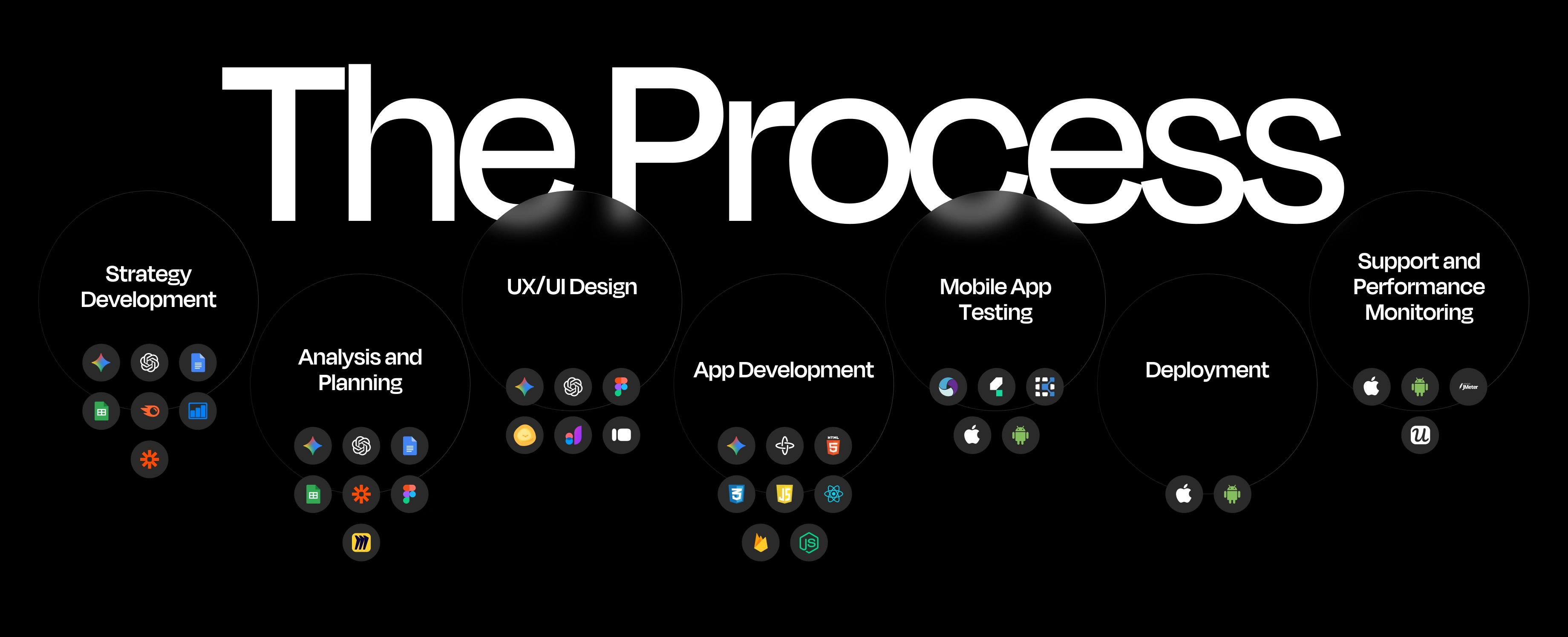
A Full Product Lifecycle, Step by Step
Strategy Development: identifying objectives, researching competitors, selecting the platform, choosing a monetization method, and mapping personas and audience research for a market with no direct comparable.
Analysis and Planning: functional and non-functional requirements, a full product roadmap, and the technology stack chosen to carry the app from concept to App Store.
UX/UI Design: UX writing, wireframes, a complete design system, branding, mockups, prototypes, and the app icon, built in Figma to establish a calm, premium feel across nine species.
App Development: frontend and backend built with React Native, HTML5, and CSS3, with Firebase and Node.js powering the data and infrastructure underneath.
Mobile App Testing: functionality checks, accessibility, performance, automated, usability, security, and compatibility testing across iOS and Android.
Deployment: creating the App ID, generating certificates, configuring App Store Connect, uploading assets, building and archiving, and submitting for review, with the equivalent process mirrored for Android.
Support and Performance Monitoring: tracking load speed, screen rendering, throughput, error rate, and app crashes to keep the experience polished after release.
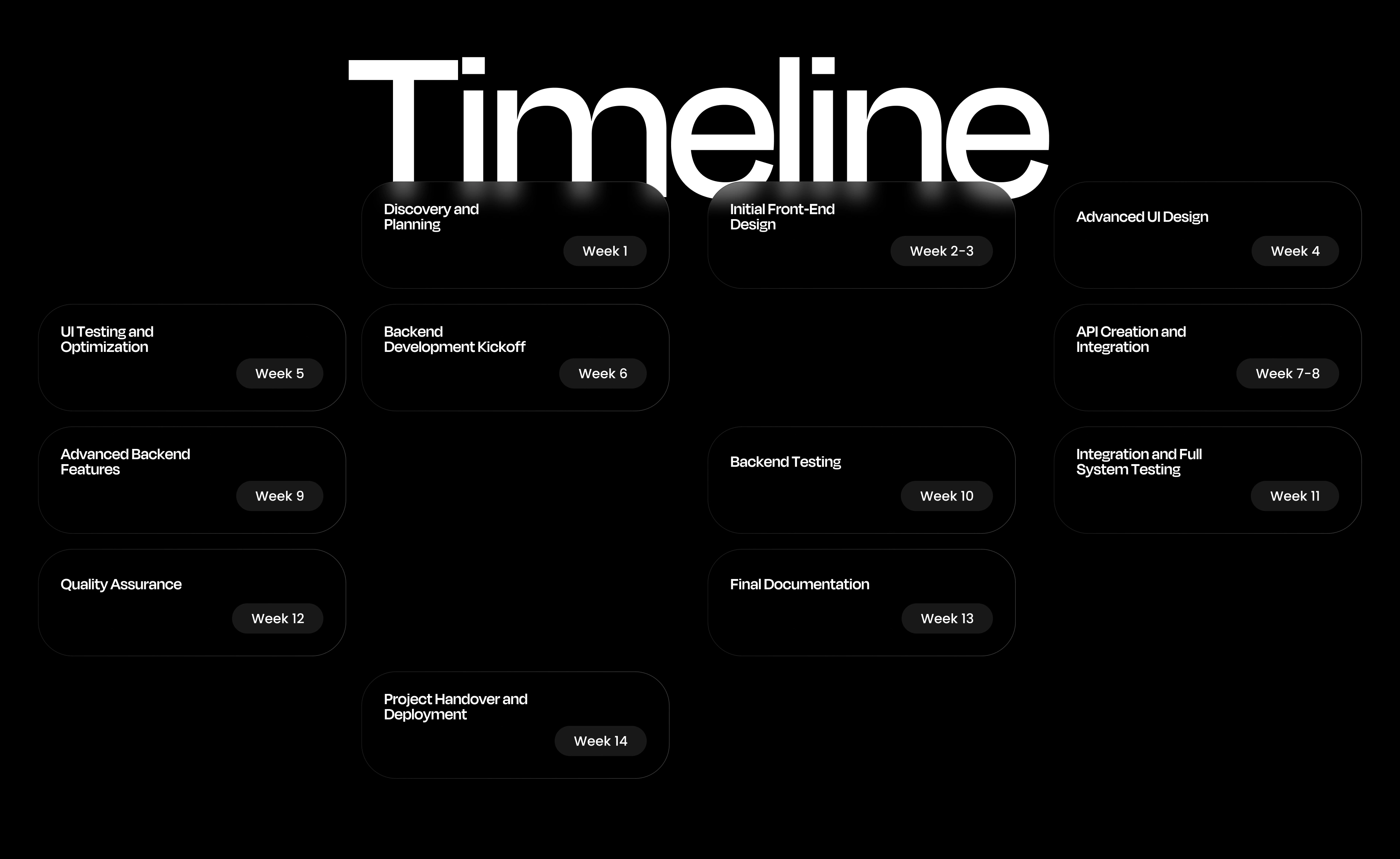
Timeline and Execution
A detailed 14-week journey from discovery to deployment
Week 1 — Discovery and Planning: reviewed client requirements, identified gaps in UI/UX, and outlined project milestones; set up front-end and back-end development environments using Visual Studio Code, Android Studio Emulator, and Xcode Simulator.
Week 2-3 — Initial Front-End Design: designed reusable front-end components like headers, buttons, and progress trackers; built foundational app screens such as Splash, Login, and Onboarding using React Native; created modular design systems for scalability.
Week 4 — Advanced UI Design: integrated complex UI features such as activity charts, trackers, and user settings; conducted initial cross-platform testing for feature parity and responsiveness.
Week 5 — UI Testing and Optimization: refined front-end designs for visual consistency and usability; delivered APK/IPA builds for preliminary client feedback.
Week 6-7 — Backend Development Kickoff: used Firebase for a scalable database schema; implemented core backend functionality with Node.js, including user authentication and activity tracking services.
Week 8 — API Creation and Integration: designed RESTful APIs for seamless front-end and back-end alignment; integrated APIs with front-end components for dynamic data synchronization; began testing backend services for security and performance.
Week 9 — Advanced Backend Features: built additional backend capabilities such as data analytics and activity history storage; ensured secure, scalable data handling using Firebase's real-time database.
Week 10 — Backend Testing: conducted internal testing of backend services, including API response times and error handling; debugged and optimized backend functionality to meet performance benchmarks.
Week 11 — Integration and Full System Testing: reviewed client requirements, identified UI/UX gaps, and outlined milestones; set up front-end and back-end environments across Visual Studio Code, Android Studio Emulator, and Xcode Simulator.
Week 12 — Quality Assurance: performed end-to-end testing across UI, backend, and API workflows; addressed outstanding issues to ensure a flawless user experience.
Week 13 — Final Documentation: completed API documentation for client handover; organized the source code repository for clarity and future scalability.
Week 14 — Project Handover and Deployment: delivered finalized APK and IPA builds to the client; assisted with app store deployment where required; hosted backend services on the client's preferred cloud platform.
Client Testimonial
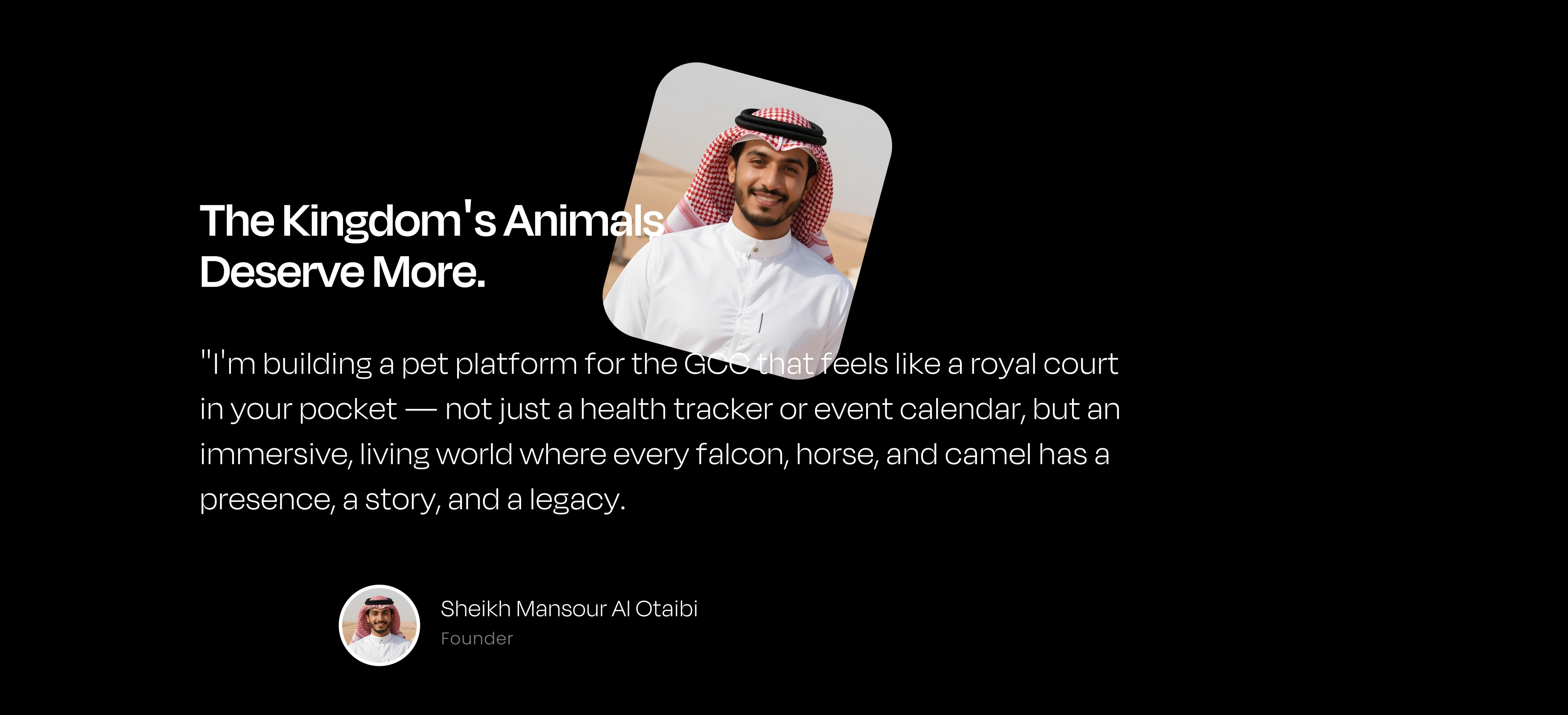
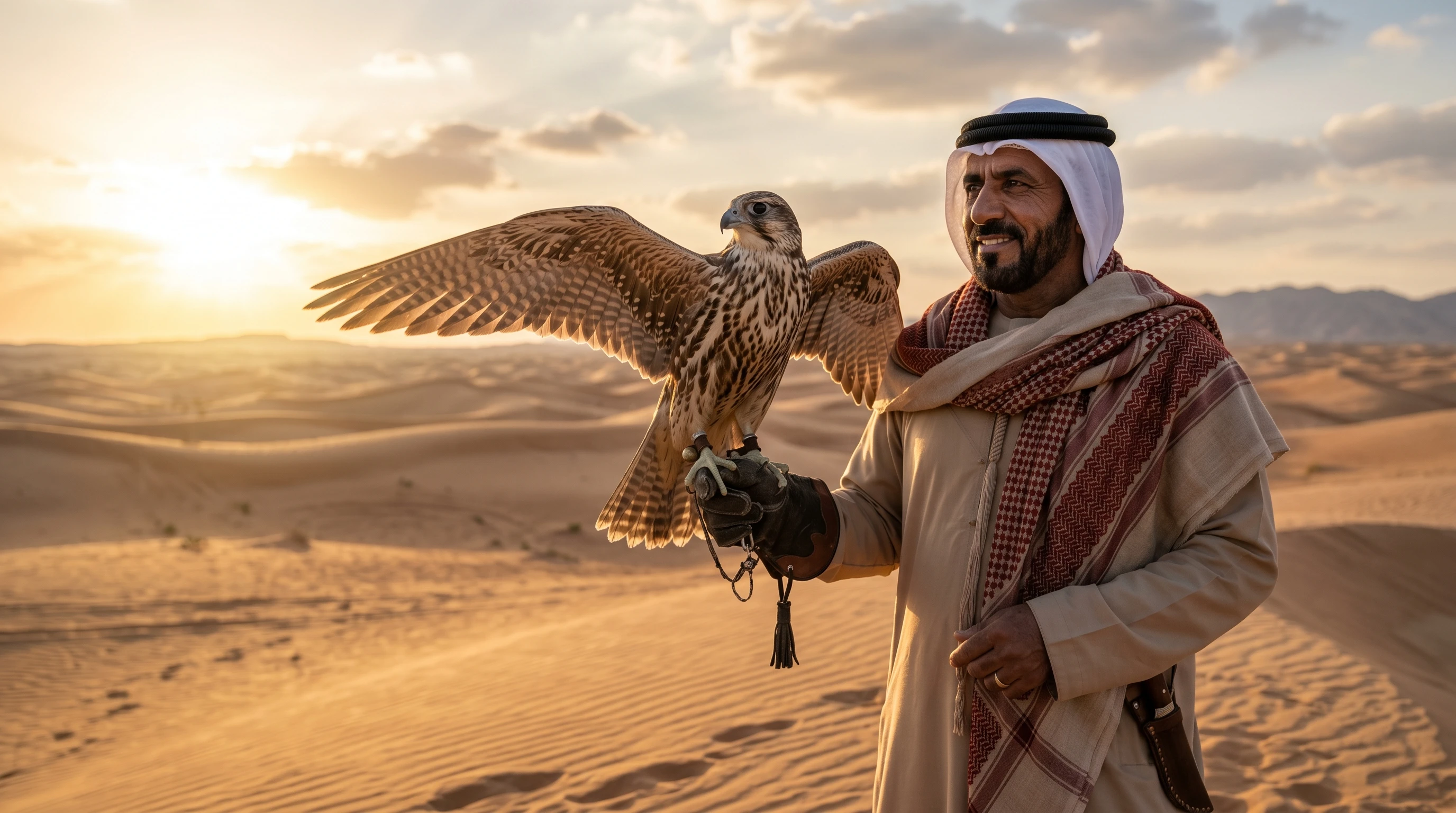
We brought them a vision that didn't exist anywhere in the world, AI health monitoring, blockchain animal passports, falcon flight tracking, moult prediction. They didn't just build it. They understood it. For the first time, technology has truly spoken the language of Gulf heritage.

Like this project
Posted Jun 15, 2026
Inayah Aleefah — luxury GCC pet app for 9 elite species. Led end-to-end: strategy, Figma, React Native, AI health, GPS, blockchain passports & App Store launch.