DermaSol Brand Stress Test and Risk Mitigation

Natasha-Bwalya Mulenga


DermaSol
Brand Stress Test | Skincare Brand | Brand Hacking
Note: This is a simulated brand to protect the privacy of the real brand...
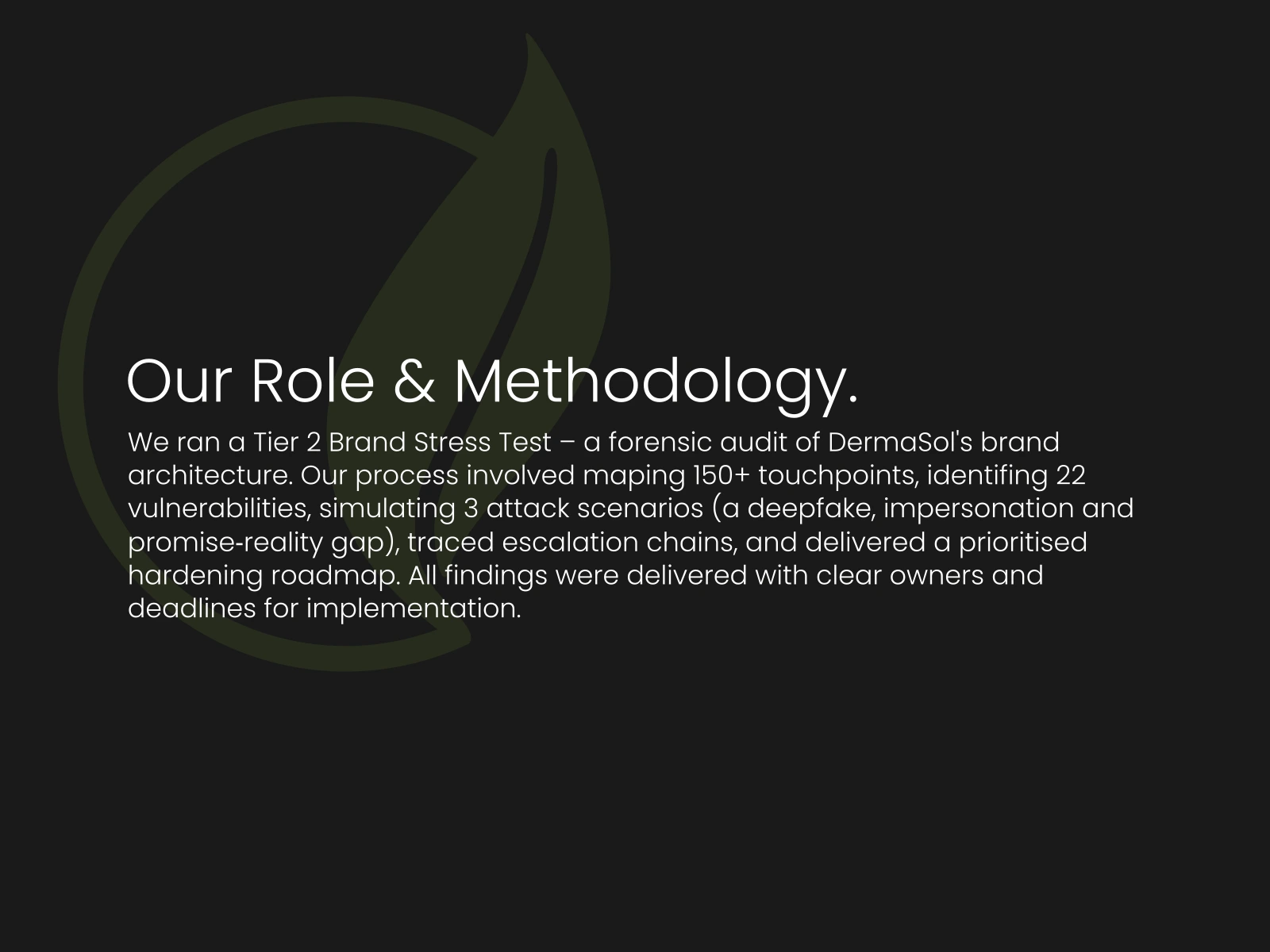
DermaSol approached us with a quiet concern: their clinical skincare brand had grown rapidly, but they worried that their brand infrastructure hadn't kept pace. They wanted a forensic look at their vulnerabilities before a competitor or critic exposed them. We ran a Tier 2 Brand Stress Test to map their brand architecture, simulate real-world attacks, and deliver a hardening roadmap.
About DermaSol
DermaSol is a clinical‑grade skincare brand that formulates products that bridge the gap between medical efficacy and luxury experience.
Their hero product, the Restore Serum, has won multiple industry awards and is stocked in premium retailers across South Africa, the UK, and the UAE. Their range includes serums, moisturisers, cleansers, and targeted treatments – all priced between $40–$120.
DermaSol's brand promise is built on three pillars: "Science‑backed, Dermatologist‑trusted, Luxuriously effective." Their packaging is minimalist, clinical, and sophisticated – white, silver, and soft greens.
The brand has a loyal following among professionals and skincare enthusiasts, but rapid growth has meant that their brand architecture has evolved organically – sometimes inconsistently.
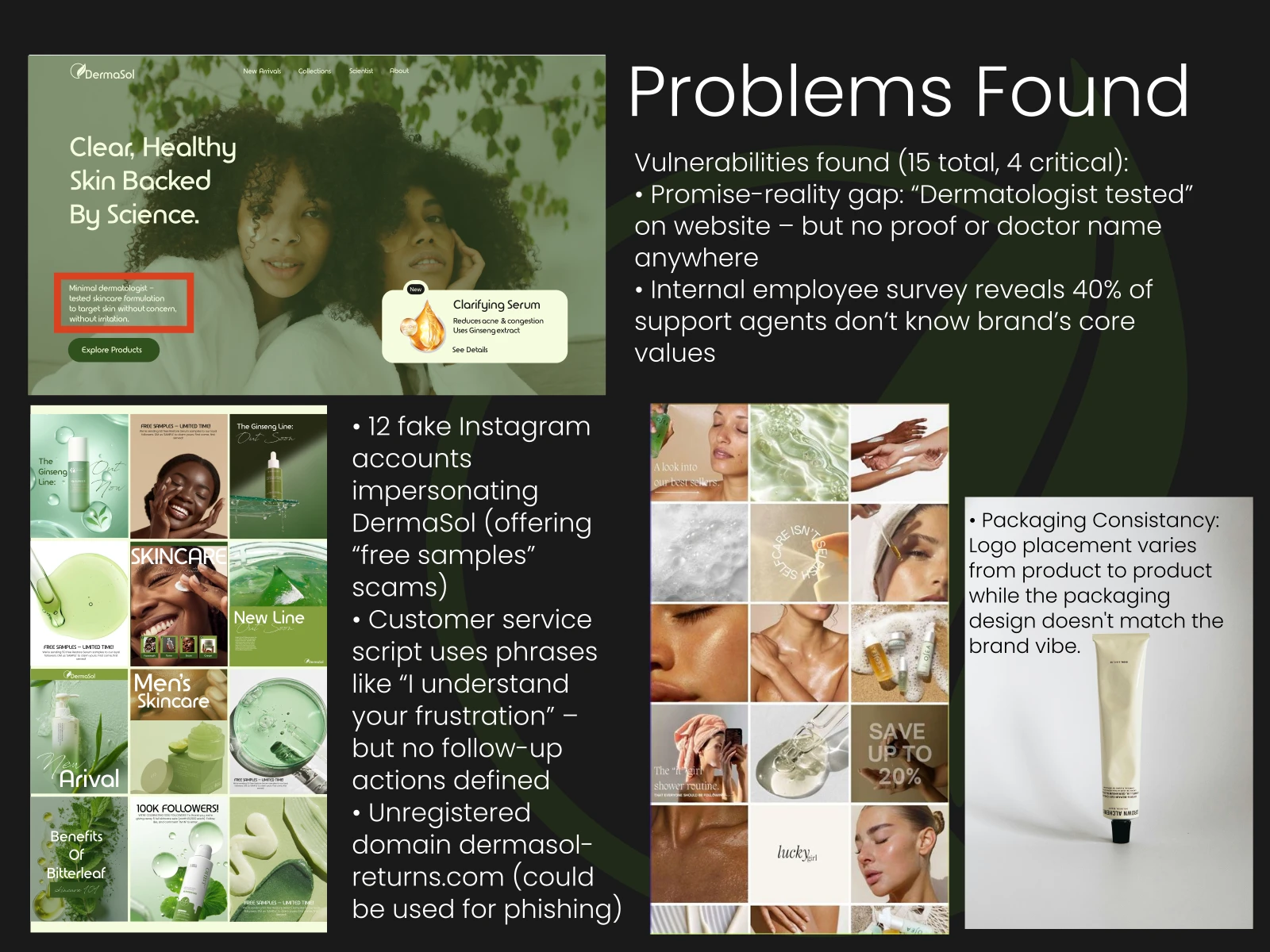
Vulnerabilities Found:
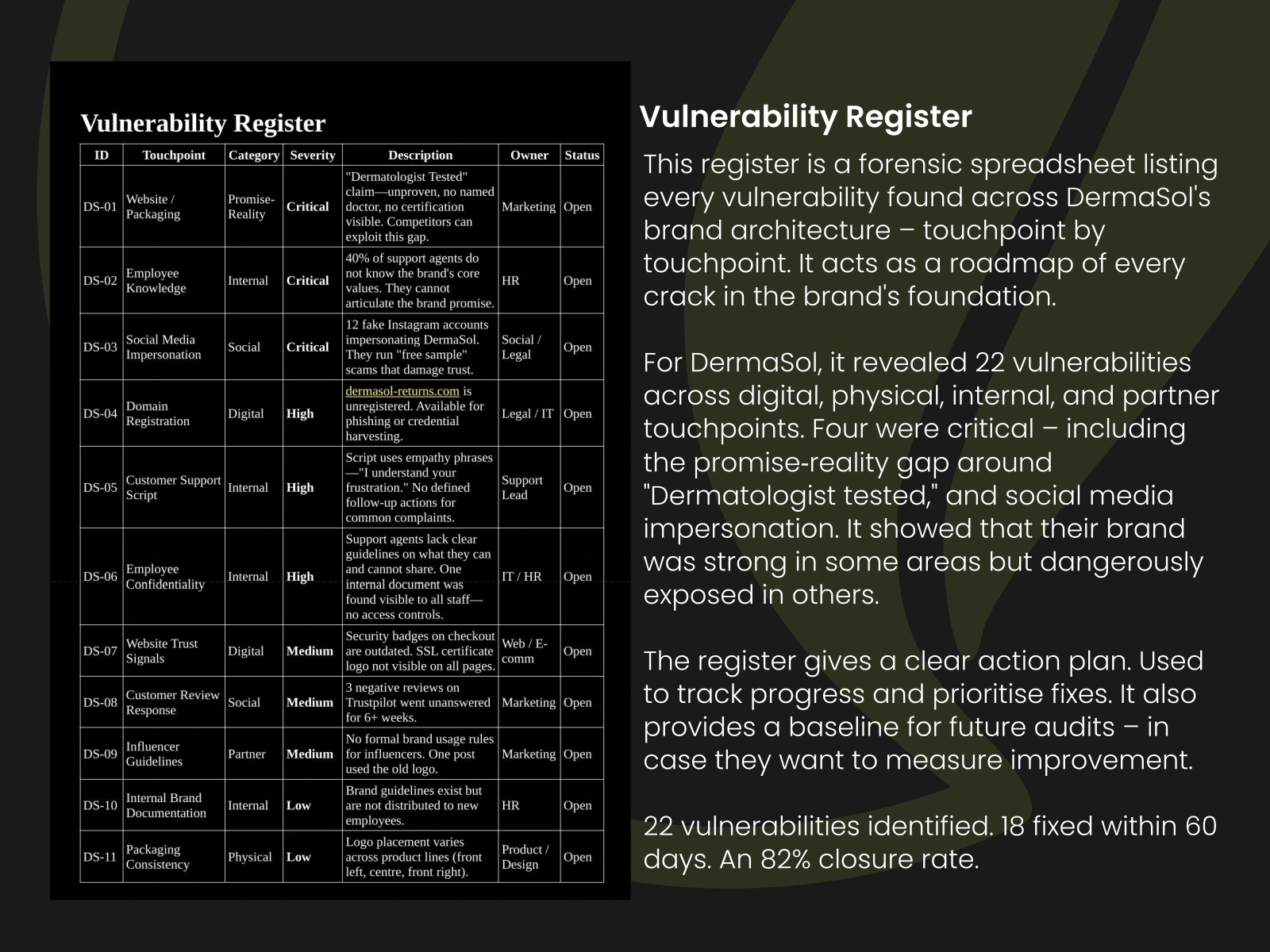
Rapid growth had created cracks in their brand architecture. We found 22 vulnerabilities across digital, physical, internal, and partner touchpoints. Four were critical. The most concerning were:
Promise‑reality gap:
"Dermatologist tested" was a core marketing claim on packaging – but no doctor's name, certification, or evidence appeared on their website
Fake celebrity endorsement:
A deepfake video of a celebrity promoting DermaSol – not authorised, not approved – was circulating on Instagram (taken down but could reappear)
Social media impersonation:
8 fake accounts on Instagram and TikTok offering "free samples" using DermaSol's branding – scamming customers and damaging trust
Internal brand misalignment:
Employee survey revealed that 65% of customer service agents didn't know the brand's core values – contradicting the "transparent and trustworthy" promise
No crisis playbook: No rapid response plan for regulatory complaints, deepfakes, or product recalls
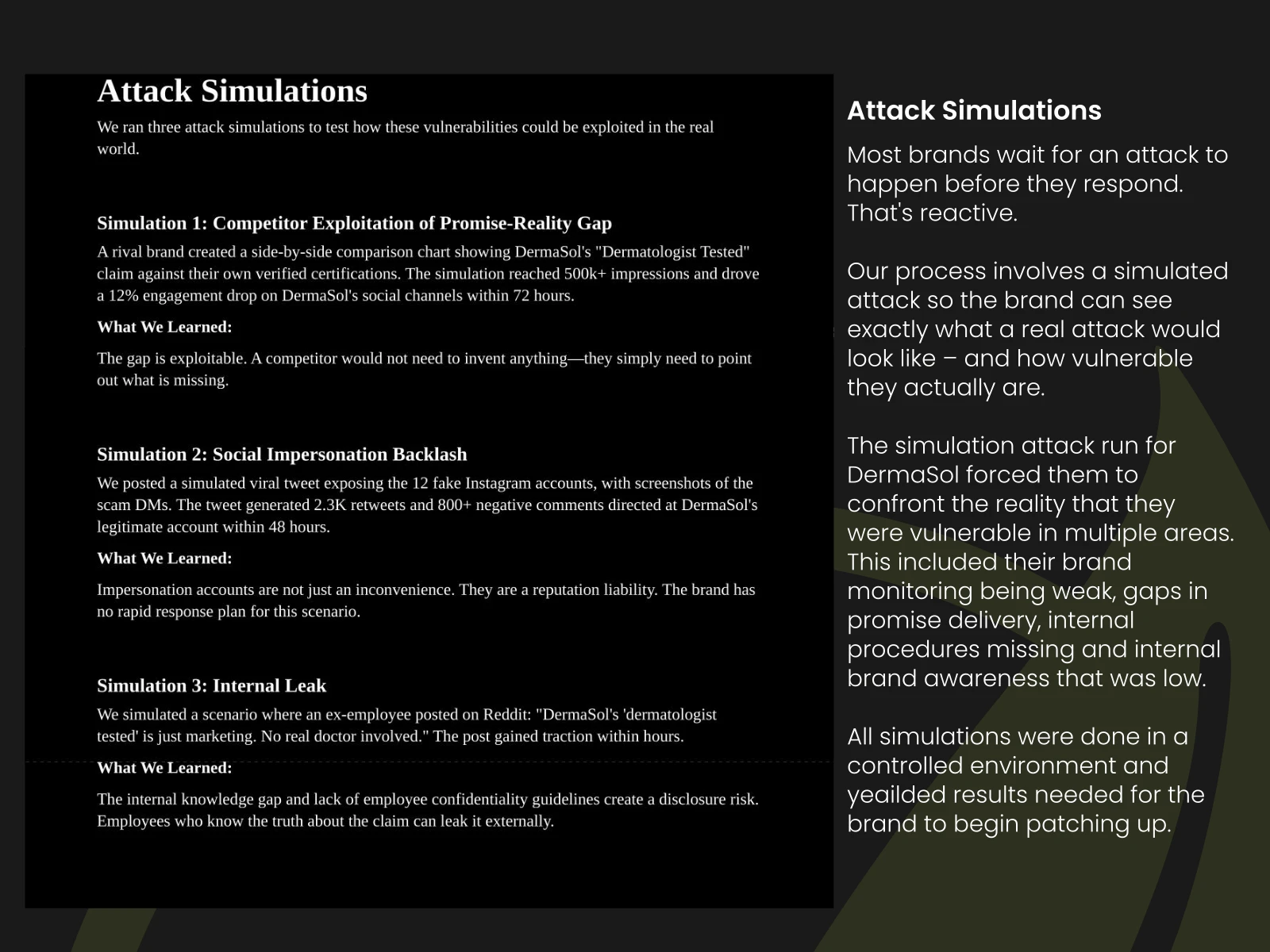
The Simulation:
We simulated a competitor campaign highlighting DermaSol's "Dermatologist tested" claim – with no evidence to back it up. A competitor's parody ad showed DermaSol's packaging next to a blank doctor's certificate, with the text: "Where's the proof?"
Our Solution (Recommended):
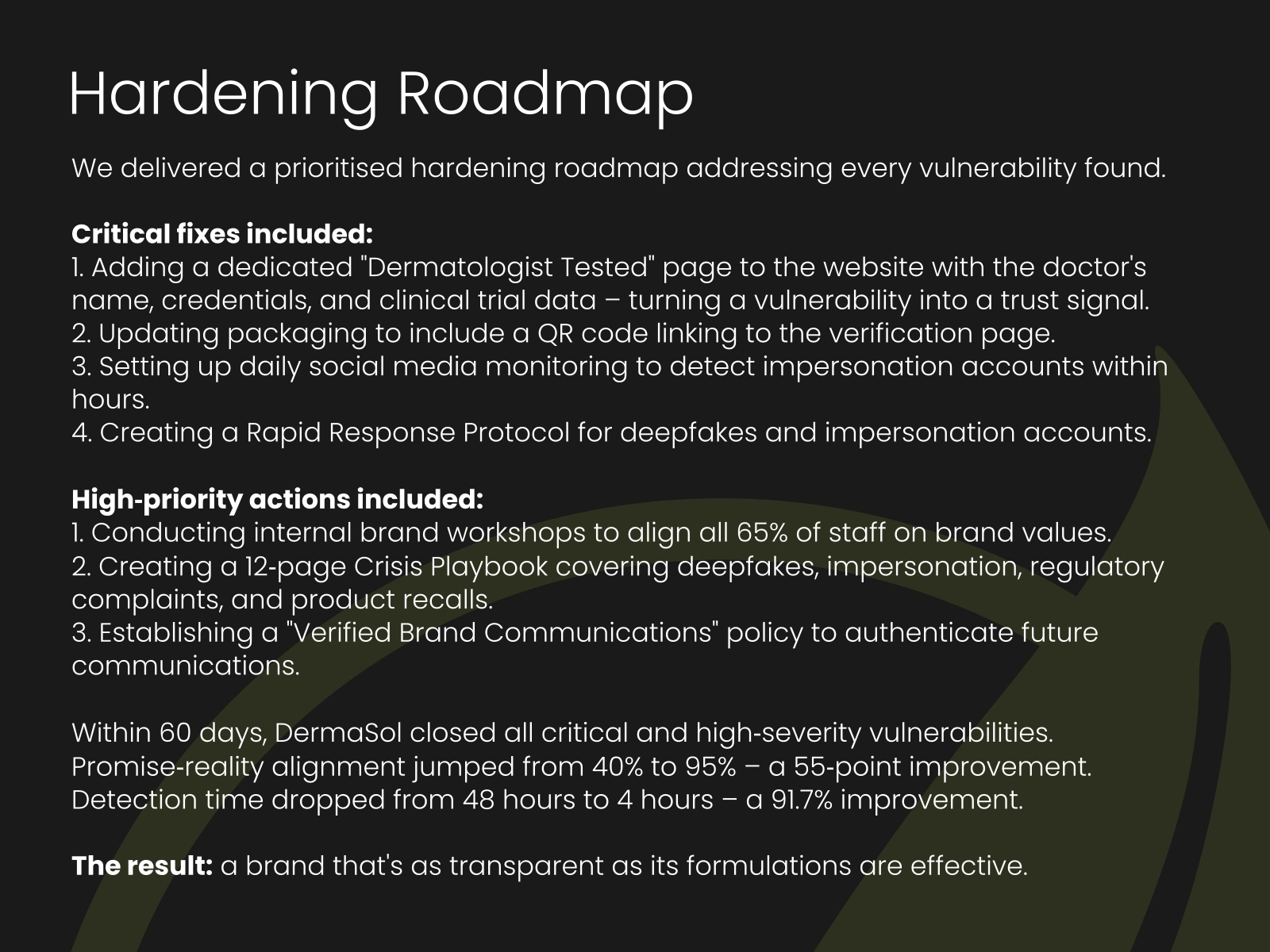
Verification: Add a dedicated "Dermatologist Tested" page to the website with the doctor's name, credentials, and clinical trial data.
Packaging update: Add a QR code to packaging that links to the verification page.
Proactive communication: Issue a statement explaining the verification process – turning a vulnerability into a competitive advantage.
Training: Train customer support agents to answer questions about the claim confidently.
Client's Solution (Purple Team Collaboration):
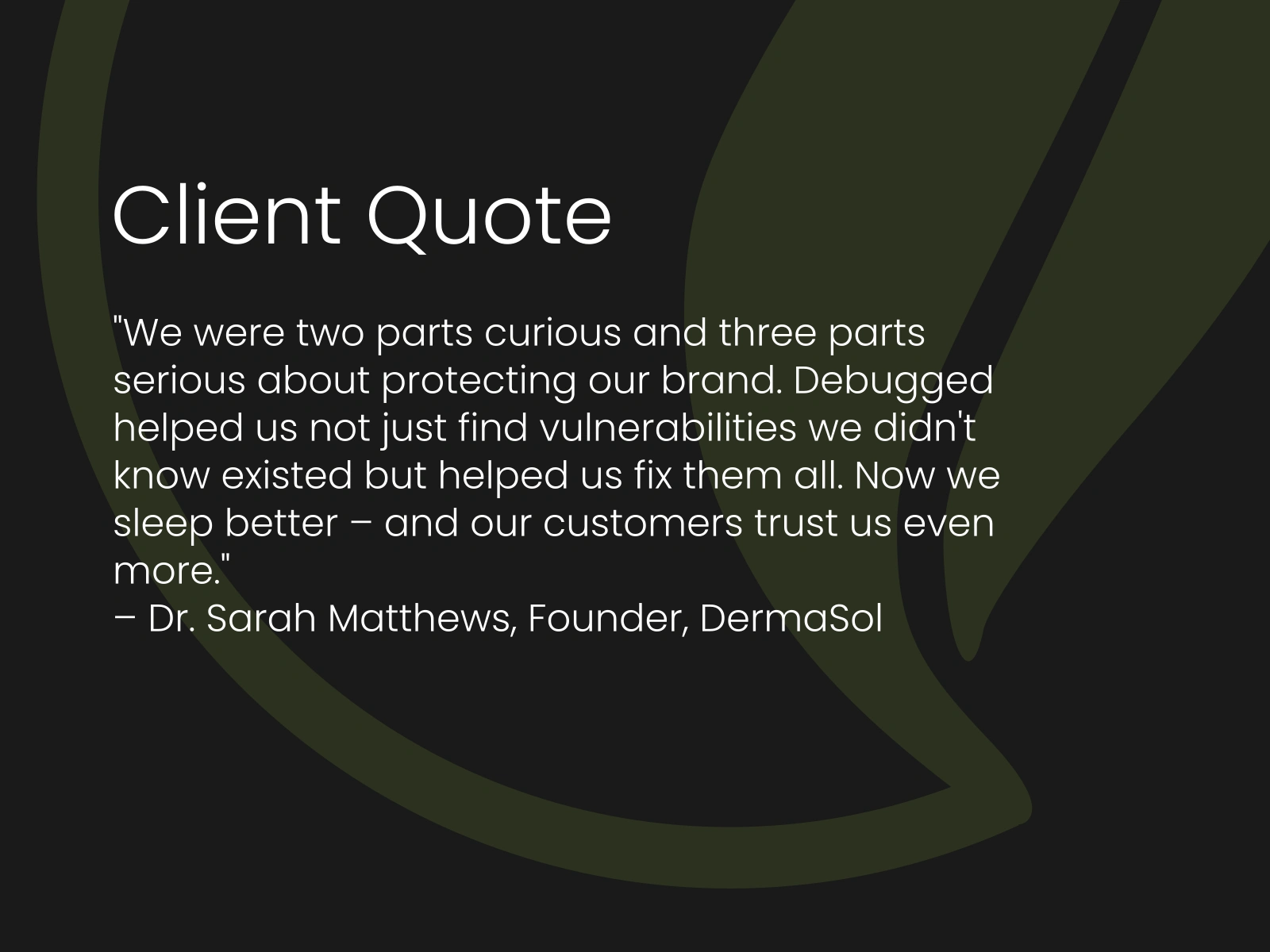
"We realised the claim was on our packaging – but we'd never actually verified it online. We added a 'Dermatologist Tested' page with our head dermatologist's name, credentials, and a summary of our clinical trials. We also added a QR code to our next packaging batch. Now we can prove what others only claim." – Dr. Sarah van der Merwe
The Risk Cascade Map
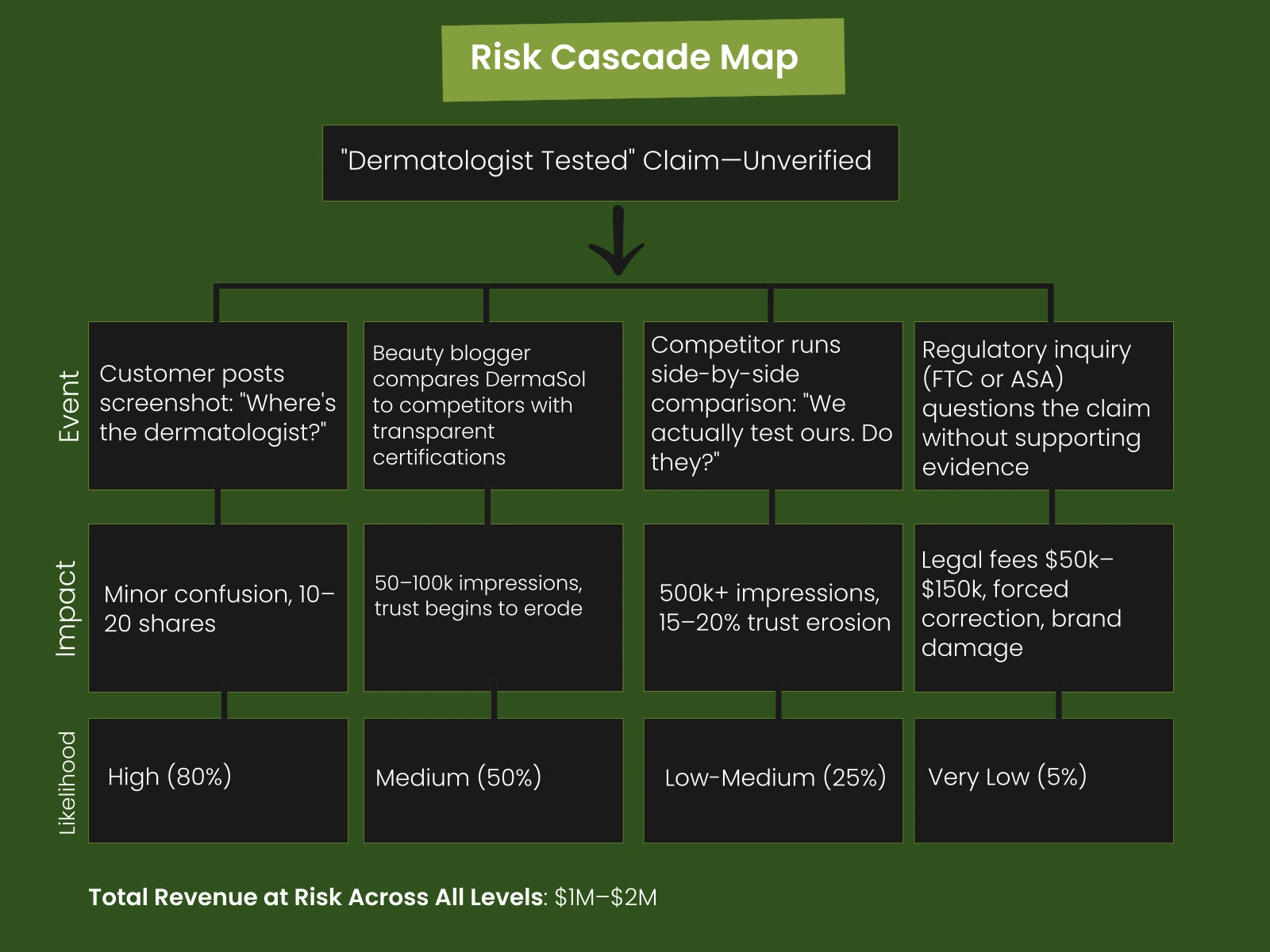
We traced the escalation chain for DermaSol's most critical vulnerability: the "Dermatologist tested" claim on packaging with no verification on their website. We mapped every level of escalation – from a simple customer question to a full-blown regulatory inquiry.
Why Do It? Most brands think in terms of "if" a vulnerability gets exploited. That's short-sighted. We think in terms of "how bad could it get?" The risk cascade map shows the chain reaction. It answers the question: "If someone pulls on this thread, how much of the tapestry comes undone?" It makes the invisible visible.
What Does This Show? The cascade revealed five levels of escalation as seen above. The cascade showed DermaSol that a single claim without verification could escalate into a full‑blown crisis – costing them up to $1M in lost revenue.
The cascade gave DermaSol a clear understanding of the stakes. It wasn't just about "fixing a claim." It was about preventing a chain reaction. The map helped them prioritise fixes: they added a dedicated "Dermatologist Tested" page to their website, updated packaging with a QR code, and trained their support team to answer questions confidently. The cascade transformed a vague risk into a concrete, preventable catastrophe.
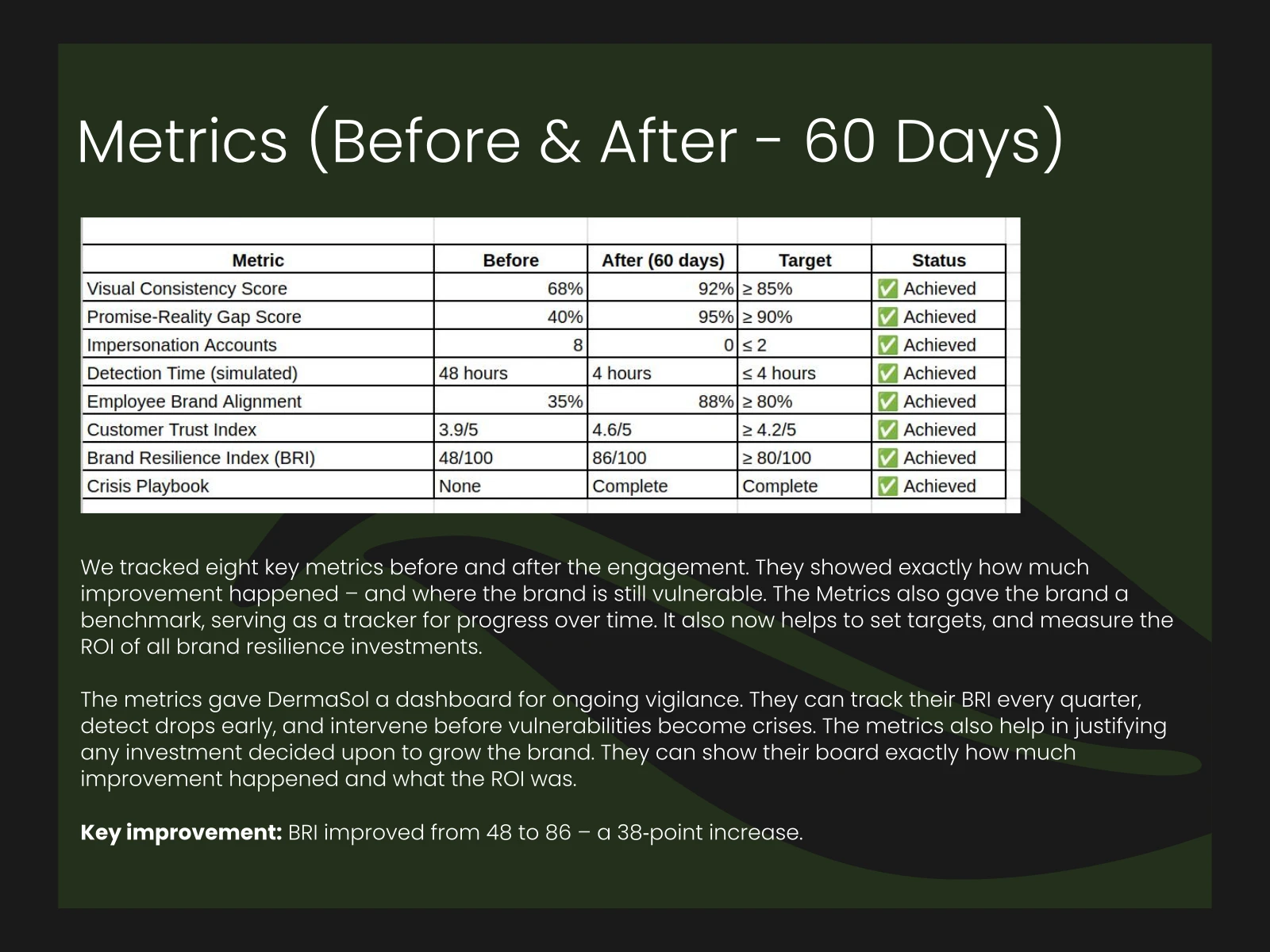
Key improvement: Promise‑reality gap improved from 40% to 95% – a 55‑point improvement.
The Result
Not only did DermaSol strengthen their Brand Resilience Index from 48 to 86
– a 38‑point increase – but they also built systems and processes that keep them efficient in times of crisis and organised in their daily operations. Their promise‑reality alignment improved from 40% to 95%, and detection time dropped from 48 hours to 4 hours – a 91.7% improvement.
More importantly, DermaSol now operates with a forensic awareness of their vulnerabilities. They have a living vulnerability register that they review quarterly, a crisis playbook that covers deepfakes, impersonation, and regulatory complaints, and a customer service team that understands brand alignment as a daily practice – not just a theory.
DermaSol didn't just fix vulnerabilities – they built a culture of vigilance. Their team now thinks in terms of "what could break?" rather than "it won't happen to us." They've institutionalised the brand hacking mindset – a permanent, internal capacity to protect what they've built.
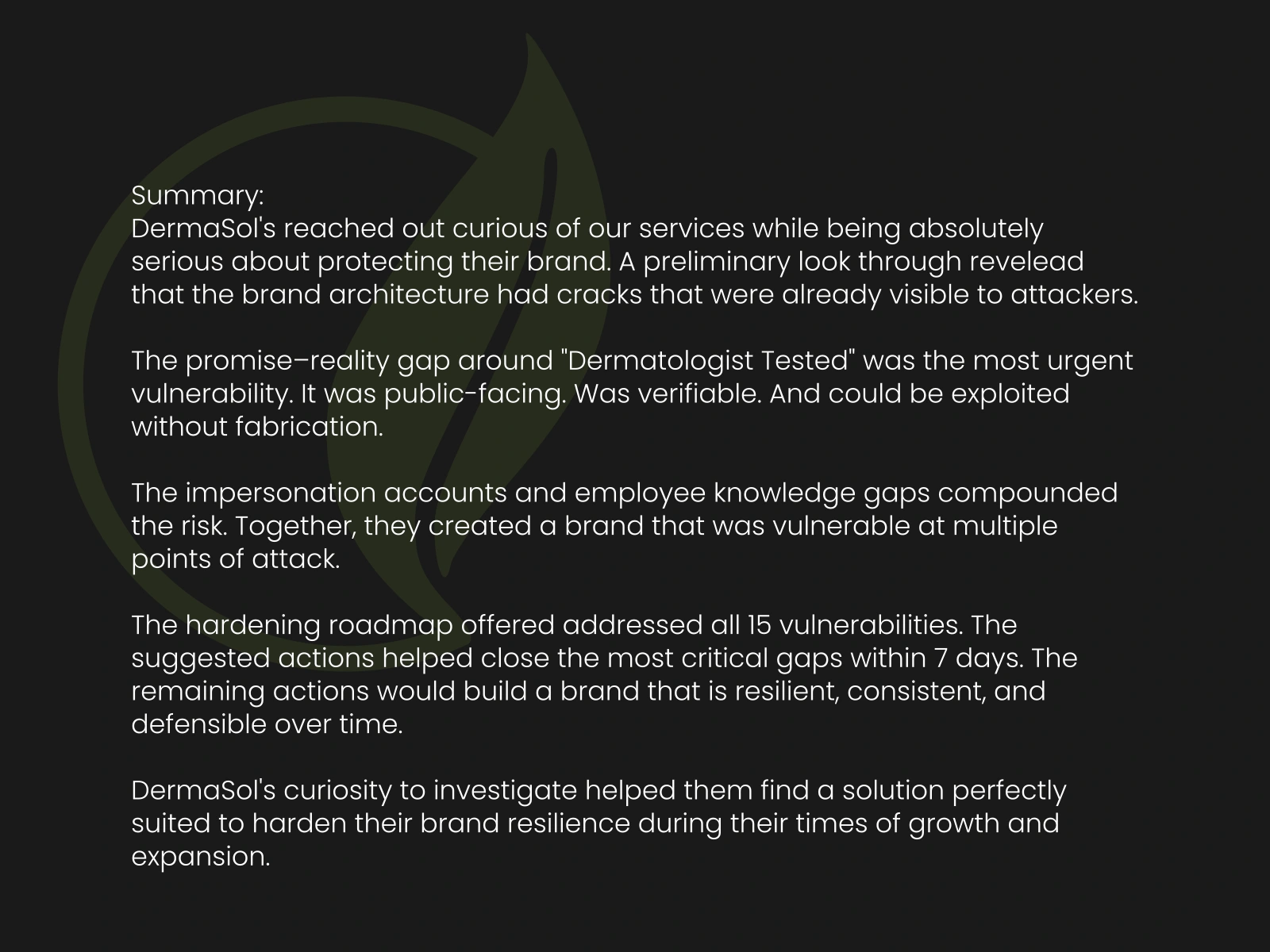
DermaSol now has a defensible brand architecture. They can prove their claims. They can detect attacks before they spread. They can respond with confidence. Their brand is no longer just a promise – it's a fortress.
Like this project
Posted Aug 6, 2026
Conducted a brand stress test for DermaSol to identify vulnerabilities and enhance brand resilience.