
SerpSpur vs Ahrefs: Which SEO Tool Offers Better Value for Your Budget?
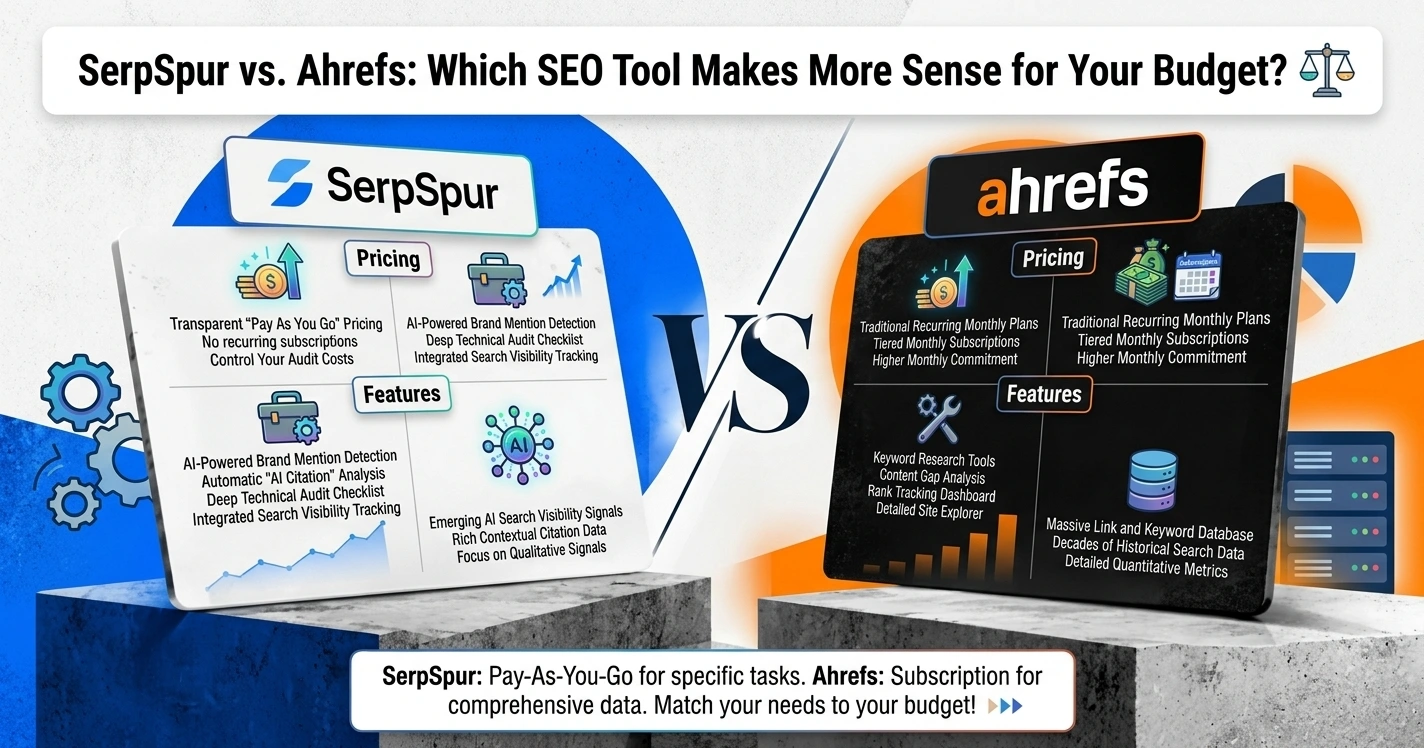
Choosing between SerpSpur and Ahrefs depends on what you need from an SEO platform. If your work requires extensive backlink intelligence, a large keyword database, and detailed competitor research, Ahrefs deserves serious consideration. If you want a more affordable platform for website audits, daily rank monitoring, and client reporting, SerpSpur may be a better fit.
The price difference is significant. According to the pricing information used in this comparison, SerpSpur Pro costs $49 per month, while Ahrefs Lite costs $129 per month. However, price alone does not determine which platform will deliver the most value for your business.
Your decision should account for three factors: the depth of data you require, your monthly software budget, and the complexity of your SEO operations.
SerpSpur targets freelancers, startups, and smaller agencies that want several SEO capabilities without committing to an expensive subscription. Ahrefs is designed for professionals who depend heavily on keyword intelligence, backlink analysis, and large-scale competitor research.
There is also an important pricing discrepancy worth understanding. SerpSpur's comparison material has referenced Ahrefs Lite at $99 per month, whereas the Ahrefs pricing information used for this review lists the plan at $129 per month. The figures below follow the stated official-price comparison rather than assuming both vendors' published claims are identical.
This guide examines the differences between the platforms, including their audit capabilities, keyword research, rank tracking, backlink data, AI search visibility, reporting, and total costs. It also explains the limitations of the available evidence so readers can make an informed decision.
Quick Verdict: SerpSpur or Ahrefs?
SerpSpur is worth evaluating if affordability, daily rank updates, and straightforward reporting are important to your workflow. Ahrefs is the stronger candidate when you need extensive backlink information, broader keyword coverage, and established research capabilities.
Neither platform is automatically the right choice for every SEO professional. The better option depends on how you intend to use it.
Comparison area | SerpSpur | Ahrefs | Practical advantage
Monthly pricing | Pro $49; Agency $165 | Lite $129; Standard $249 | SerpSpur on entry-level subscription cost
Rank tracking | Daily updates | Weekly updates listed | SerpSpur for update frequency
Listed backlink index | 197.3 billion live pages | 494 billion pages | Ahrefs on published index size
Keyword database | 12.5 billion keywords | 29 billion filtered keywords | Ahrefs on published database size
AI search research | AI visibility checks and mention analysis | Brand Radar and a larger published prompt index | Ahrefs on stated research scale
Agency reporting | Public dashboards and white-label PDF exports | Report Builder and higher-tier Looker Studio integration | SerpSpur for the stated reporting workflow
These comparisons reflect published product information, not a controlled experiment proving that one platform produces more accurate results. Database sizes are vendor-reported figures, and the underlying counting methods may differ.
1. Understanding SerpSpur and Ahrefs
Before comparing individual features, it helps to understand how each platform approaches SEO research and pricing.
SerpSpur: SEO Capabilities With a Flexible Credit Model
SerpSpur is an SEO intelligence platform aimed at freelancers, smaller businesses, and agencies that need practical tools for everyday optimization work.
Its offering includes website audits, rank monitoring, keyword research, backlink analysis, competitor insights, and tools related to website performance and AI search visibility.
Several characteristics distinguish its approach.
Credit-based usage: Subscription plans include a monthly credit allowance. Certain activities consume credits, and additional packs can be purchased when necessary. SerpSpur states that purchased credits do not expire, allowing users to retain unused credits rather than racing to spend them before a monthly deadline.
A free starting option: The pricing information used for this article lists a free plan with one project, 100 credits, and 10 daily tracked keywords. The platform also advertises more than 30 free SEO tools.
Proprietary metrics: SerpSpur provides metrics such as Trust Rate and Traffic Authenticity Index. These are platform-specific measurements and should not be treated as direct equivalents of metrics offered by other SEO providers.
AI-related features: Its capabilities include brand mention checks across selected AI platforms, AI Overview-related monitoring, and an llms.txt generator.
Questions about data collection: SerpSpur describes its index as proprietary, but the information reviewed for this article does not fully explain whether the index is collected through an independently operated crawler, third-party data, or a combination of sources. If you plan to use its data in important client deliverables, request clarification from the company.
SerpSpur's main attraction is the combination of several SEO workflows at a lower initial subscription cost. Users should nevertheless examine individual credit requirements before estimating the cost of intensive research.
Ahrefs: A Research Platform Built Around Extensive SEO Data
Ahrefs is an established SEO platform used by independent consultants, in-house marketing teams, agencies, and larger organizations.
Its core product suite includes Site Explorer, Keywords Explorer, Site Audit, Rank Tracker, and Competitive Analysis. Additional content research and reporting capabilities become available through particular plans.
Its main strengths include the following.
Large research databases: Ahrefs publishes extensive keyword and backlink index figures. These resources are particularly relevant to users conducting competitor research, link prospecting, and content planning across multiple markets.
Its own web crawler: Ahrefs states that it operates its own crawler. This provides additional transparency about one of the sources behind its search intelligence infrastructure.
Structured subscription tiers: Paid plans have defined allowances for tracked keywords, crawling, reporting, and other activities. Higher tiers provide more capacity.
Separate AI visibility offering: Brand Radar provides research into brand visibility across supported AI search environments. Its pricing and prompt allowances should be evaluated separately from the core SEO subscription.
Additional user charges: The plans described in this comparison include one user, with extra seats priced according to the selected tier.
Ahrefs may be especially valuable when extensive research data is central to a team's work. Its higher price, however, can be difficult to justify for businesses that primarily need routine audits and daily monitoring.
The Fundamental Difference
SerpSpur emphasizes a lower-cost, credit-based approach to multiple SEO tasks. Ahrefs places greater emphasis on its extensive research databases and structured subscription allowances.
One model may suit a freelancer who conducts regular audits and tracks a limited set of keywords. The other may better serve a specialist whose daily work involves extensive backlink analysis or large keyword datasets.
The right comparison is therefore not simply which product has more features. It is which combination of capabilities, limits, and costs best matches your actual workload.
2. How This Comparison Was Prepared
A trustworthy software comparison should explain what was examined and what remains unverified.
The underlying information for this article was compiled from public product pages, pricing information, credit schedules, published index figures, and supporting material available on October 13, 2026.
The review considers SerpSpur's Free, Pro, and Agency plans alongside Ahrefs Starter, Lite, Standard, and Advanced plans where relevant.
The comparison focuses on six practical questions:
What does each platform charge for its core subscription?
How much keyword and rank-tracking capacity does each plan provide?
What do the vendors publish about their backlink and keyword databases?
Which audit and competitor-research features are available?
How useful are the reporting and AI visibility options?
What happens to total cost when a workload grows?
What Was Not Tested
This article does not claim to establish the relative accuracy of both platforms through a controlled hands-on experiment. It does not present a statistically validated comparison of keyword difficulty, search-volume estimates, traffic forecasts, or ranking positions.
The published index figures are also not directly interchangeable. Each vendor may use different definitions, collection methods, and counting procedures.
Consequently, statements about a larger database, more frequent updates, or lower subscription pricing should be understood as comparisons of published specifications rather than proof that one tool produces better SEO outcomes.
How to Validate the Findings Yourself
For a more practical assessment, use websites you own or are authorized to manage.
Connect Google Search Console, choose a consistent reporting period, and compare each tool's findings against information available from your own properties. For crawl diagnostics, use a crawler such as Screaming Frog alongside the actual website. For organic clicks and traffic, use Search Console and Google Analytics 4 rather than treating third-party estimates as exact measurements.
A structured test gives you a clearer understanding of which platform is useful for your particular work.
3. Website Auditing: Finding and Prioritizing SEO Problems
Technical auditing helps website owners investigate issues that may interfere with crawling, indexing, usability, or organic search performance.
Both platforms offer audit-related functionality, but their published allowances and feature descriptions differ.
SerpSpur Website Audit Features
SerpSpur describes an auditing workflow that investigates common technical and on-page issues, including:
Missing, duplicated, or excessively long page titles.
Broken pages and server errors.
Internal linking problems and potentially orphaned pages.
Content quality and readability concerns.
Image optimization and oversized image files.
JavaScript rendering requirements.
Core Web Vitals and related performance measurements.
Its published material references measurements such as Largest Contentful Paint, Cumulative Layout Shift, Interaction to Next Paint, First Contentful Paint, and Time to First Byte.
These checks can help users identify areas that deserve further investigation. However, finding an issue does not automatically establish that it is responsible for poor rankings. Each finding should be reviewed in context.
SerpSpur's stated free-page allowances are 100 pages per month on Free, 20,000 on Pro, and 100,000 on Agency. Additional scanned pages are listed at one credit each in the pricing information used here.
Ahrefs Site Audit
Ahrefs offers Site Audit with plan-specific crawl allowances and project limits.
The published specifications used for this comparison list:
Lite: 100,000 crawl credits and a 25,000-page cap per project.
Standard: 500,000 crawl credits and a 50,000-page cap.
Advanced: 1.5 million crawl credits and a 250,000-page cap.
Ahrefs also lists ongoing auditing capabilities. A Project Boost Pro add-on has been described at $20 per month per project, with faster crawling.
These limits should not be confused with identical units of measurement. A crawl-credit allowance and a free-page-scan allowance are not necessarily equivalent because the vendors may count their activities differently.
Which Audit Tool Should You Choose?
SerpSpur may be a practical starting point for smaller websites, freelancers, and agencies looking for an affordable auditing workflow with daily rank tracking and reporting.
Ahrefs may be more appropriate when you need its broader research ecosystem alongside site auditing, particularly if your organization already depends on its other SEO tools.
For either platform, prioritize issues according to their likely impact on crawling, indexing, user experience, and business objectives. A long list of warnings is not a substitute for a sensible implementation plan.
4. Rank Tracking: Daily Updates Versus Weekly Updates
Rank tracking helps SEO professionals observe changes in search positions over time. The usefulness of a tracker depends on more than its update schedule, but update frequency is an important difference between these products.
SerpSpur Rank Tracking
The plan information used in this comparison lists daily keyword updates for SerpSpur.
Its published daily tracking allowances are:
Plan | Daily tracked keywords
Free | 10
Pro | 100
Agency | 300
The credit schedule also describes different tracking depths: top 10 for Free, top 50 for Pro, and top 100 for Agency.
SerpSpur includes additional SERP-related signals, such as search features, People Also Ask results, and AI Overview-related monitoring. Its materials describe Google and Bing tracking across more than 100 countries.
These features may help professionals observe changes during content updates, technical fixes, and ongoing campaigns.
Ahrefs Rank Tracker
The published Ahrefs limits in this comparison are 750 tracked keywords for Lite, 2,000 for Standard, and 5,000 for Advanced.
Ahrefs lists weekly Rank Tracker updates across these plans. This gives users a defined monitoring schedule, although it may not be ideal for every project.
For example, a consultant who wants to observe changes every day after a technical correction may prefer a daily tracker. A team monitoring thousands of terms across a broader campaign may value the capacity of a larger keyword allowance.
Is Daily Tracking More Accurate?
Not necessarily. More frequent updates provide more observations, but they do not automatically prove that the underlying position data is more accurate.
Location, device, search features, personalization, and the time of measurement can all affect observed rankings.
Before relying on either tool for client reporting, compare a sample of tracked terms using consistent locations and conditions. Also remember that Google Search Console reports average positions using its own methodology, so its figures will not always match a rank tracker's point-in-time position.
Practical verdict: SerpSpur has an advantage in published update frequency. Ahrefs offers larger tracked-keyword allowances on the plans compared here.
5. Keyword Research: Database Size, Competition, and Search Intent
Keyword research helps businesses discover what their audience searches for and decide which topics deserve attention.
The important considerations include database coverage, country selection, search intent, keyword difficulty, and the ability to investigate competing pages.
SerpSpur Keyword Research
SerpSpur publishes a keyword index figure of 12.5 billion keywords across Google and Bing in the comparison material.
The stated plan allowances include 5,000 keyword exports for Pro and 20,000 for Agency. Additional regional keyword research is priced through credits according to the platform's credit schedule.
Its keyword research workflow is intended to support:
Competitor keyword analysis.
Keyword difficulty assessment.
Long-tail keyword discovery.
Content-gap investigation.
Search-intent classification.
Country-specific keyword research.
A particularly useful element is its emphasis on examining the top 10 search results to understand what currently ranks for a query.
Rather than concentrating only on a large list of keyword suggestions, users can examine the pages competing for their target term and identify subjects that their own content may need to cover more effectively.
Ahrefs Keywords Explorer
Ahrefs publishes a larger keyword database figure in the comparison material: 29 billion filtered keywords, 110 billion keywords ever seen, and coverage across 217 locations.
Its Standard plan adds capabilities such as keyword clustering, search-intent information, and AI-assisted suggestions, according to the specifications used for this review.
The additional coverage may be useful for organizations that conduct extensive research across different countries, industries, and language markets.
Does a Bigger Keyword Database Mean Better Results?
A larger database can improve the range of ideas available, but database size alone does not determine keyword quality.
A smaller set of relevant keywords can be more valuable than thousands of suggestions that have little connection to a business's products or audience.
Keyword difficulty is also an estimate, not a promise of ranking success. Use it alongside search intent, competing pages, your site's existing authority, and the quality of the content you can produce.
For keywords where you already receive impressions, compare the tool's estimates with Search Console data. This will help you understand how its figures relate to your website's actual search performance.
Practical verdict: Ahrefs has the larger published keyword index. SerpSpur may be sufficient for professionals who want keyword discovery, competitor analysis, and content planning at a lower subscription cost.
6. Backlink Analysis and Link-Building Research
Backlinks remain an important subject in SEO analysis, but a useful backlink tool needs to provide more than a large headline number.
SEO professionals should consider referring-domain coverage, link freshness, historical information, relevance, and the quality of potential link opportunities.
Published Backlink Figures
The comparison material provides the following vendor-reported figures:
Metric | SerpSpur | Ahrefs
Pages in the stated index | 197.3 billion live pages | 494 billion pages
Backlink figure | 2 trillion live backlinks | 35 trillion external backlink history records
Domains | 708.6 million backlink domains | 286 million vetted domains
Reported freshness | Claims of second-by-second updates | Claims of refreshes every 15–30 minutes
Authority metrics | Trust Rate and Domain Rank | Domain Rating and URL Rating
These numbers should not be interpreted as a direct apples-to-apples comparison. For example, live backlinks and historical backlink records describe different kinds of data. Domain counts may also differ according to the vendor's definitions and filtering procedures.
Similarly, Domain Rating and Domain Rank are separate proprietary metrics. A score from one platform cannot be assumed to have the same meaning as a score from another.
Competitor Backlink Gap Analysis
SerpSpur includes a backlink gap analysis capability that can identify websites linking to competitors but not to your own domain.
This information can help link builders identify potential outreach opportunities. The published credit schedule used for this comparison lists 100 credits per competitor-gap query and 500 credits per 1,000 backlinks fetched.
Ahrefs provides Competitive Analysis and a broader backlink research ecosystem. Its larger published index may be useful when link prospecting depends on discovering a wide range of referring domains and examining historical data.
How to Compare Backlink Data Properly
Choose the same domain in both tools and examine a sample of referring websites. Check whether the links exist, whether the pages are accessible, and whether the referring sites are relevant to your industry.
Google Search Console's Links report can provide additional information for your own verified website, although it is not a complete independent record of every backlink.
Practical verdict: Ahrefs has the advantage in the published index figures used here. SerpSpur may appeal to smaller teams seeking backlink research and gap analysis within a lower-cost toolkit.
7. Competitor Analysis and Estimated Traffic
Competitor analysis helps businesses identify which websites compete for relevant searches, what topics those websites cover, and where new opportunities may exist.
Both platforms provide estimates and competitor research, but those estimates should not be confused with actual website analytics.
SerpSpur Competitor Research
SerpSpur's published features include information about organic and paid keyword activity, traffic value, and geographic traffic distribution.
The plan information used here lists one competitor per project on Free and three on Pro and Agency, with additional competitors available through credits.
These capabilities can help a consultant build a preliminary picture of a competitor's search presence and identify pages worth examining.
Ahrefs Competitor Research
Ahrefs publishes an organic traffic keyword database figure of 545 million keywords across 185 locations, alongside a paid keyword index of 12 million.
The plan information used in this article lists up to 20 competitors per project on Lite. This larger allowance can be useful for teams that need to compare multiple rivals in one research workflow.
How Reliable Are Traffic Estimates?
Third-party SEO platforms estimate organic traffic using their own data and models. Their figures may differ substantially from actual visits recorded by the website owner.
For your own website, compare the estimates with Google Search Console clicks and Google Analytics 4 traffic over the same period. The metrics are not identical, so focus on understanding the differences rather than expecting an exact match.
For competitor websites, actual analytics are usually unavailable unless the owner shares access. In that situation, use estimates as directional indicators rather than verified visitor counts.
Practical verdict: Ahrefs has the advantage in the published scale of its competitor research data. SerpSpur can be sufficient when you need a more focused comparison of a smaller number of competing websites.
8. AI Search Visibility and Generative Engine Optimization
Search visibility is expanding beyond traditional blue links. Businesses are increasingly interested in whether their brands and pages appear in AI-generated answers, citations, and search experiences.
This area is commonly discussed under terms such as AI search visibility and generative engine optimization, or GEO.
SerpSpur AI Visibility Features
SerpSpur describes features for examining brand mentions and citations across supported AI systems, including ChatGPT, Claude, Gemini, and Perplexity.
Its offerings also include AI Overview-related monitoring and tools for generating llms.txt files.
The comparison material cites a figure of 338.4 million prompts in its AI index. This should be treated as a vendor-published claim rather than an independently validated measure of coverage.
These features may provide a starting point for exploring how a brand appears in selected AI-driven discovery environments.
Ahrefs Brand Radar
Ahrefs offers Brand Radar as a separate AI visibility product. The comparison material describes a database of 476 million monthly prompts across six AI indexes.
The listed core-plan prompt allowances are five for Lite, 10 for Standard, and 20 for Advanced. Additional prompt packages have been described as starting at $50 per month.
These allowances and prices should be verified before purchasing because product packaging can change.
What About llms.txt?
An llms.txt generator may be useful for experimenting with how website information is organized for AI-related workflows. However, it should not be presented as a requirement for ranking in Google or appearing in AI Overviews.
Google's guidance states that websites do not need special AI text files or dedicated AI optimization requirements to appear in its AI search experiences. Site owners should continue to focus on helpful content, accessibility, technical health, and established search fundamentals.
AI visibility measurement also has limitations. Responses can vary by prompt, model, region, and time. Neither a large prompt database nor a brand mention report alone proves how frequently real customers discover a company through AI search.
Practical verdict: Ahrefs offers the larger published prompt database in this comparison. SerpSpur may be a lower-cost starting point for teams exploring AI mentions and citations.
9. Client Reporting and Agency Workflows
Agencies need to communicate findings clearly, explain what has changed, and help clients understand what should happen next.
The value of an SEO platform therefore depends partly on how efficiently it supports reporting.
SerpSpur Reporting
SerpSpur's published capabilities include public, view-only dashboards, white-label PDF exports, CSV exports, and integrations with Google Search Console and Google Analytics 4.
These features can help smaller agencies prepare client-facing reports without assembling every piece of information manually.
The credit schedule used for this comparison lists a cost of 1,000 credits for sharing a project beyond the free sharing allowance. Agencies should include any relevant usage charges when estimating their overall costs.
Ahrefs Reporting
Ahrefs provides Report Builder and scheduled reporting capabilities. The plan information reviewed here lists five reports for Lite and Standard, and 15 for Advanced.
Advanced also includes a Looker Studio integration and an agency directory listing.
The public pricing material used in this comparison did not establish whether Ahrefs provides the same white-label PDF workflow described by SerpSpur. Agencies that require custom branding should confirm the available options before committing.
Which Platform Works Better for Agencies?
SerpSpur may be attractive to agencies that value accessible dashboards, white-label exports, and a relatively low entry price.
Ahrefs may be more suitable for teams whose reporting process depends heavily on its keyword, backlink, and competitive research data.
The best choice depends on whether your reporting requirements center on presentation and operational efficiency or on the breadth of underlying research.
10. Usability, Customer Support, and Billing
A platform can offer extensive functionality and still be unsuitable for a particular team if its interface, support options, or billing structure do not match the team's needs.
SerpSpur is positioned as a simpler, more affordable toolkit. Ahrefs offers a wider research environment, which may require more time to learn but can provide additional capabilities to experienced SEO professionals.
Support and Payment Considerations
The Ahrefs materials reviewed for this comparison describe a help center and email support, along with payment options including major international card networks. Its stated billing terms allow customers to cancel without a long-term contract, while general refund restrictions apply.
SerpSpur provides help resources, a community, and a contact form. Its materials also state that local currencies may be available at checkout.
Do not assume that payment options, refund eligibility, or billing policies are identical across the two providers. Read the current terms for the relevant plan before paying.
Ease of Use Depends on Your Experience
A beginner may appreciate a workflow that concentrates on a smaller set of core tasks. An experienced researcher may prefer the greater range of controls and data available in a broader platform.
Third-party reviews can help you discover common user concerns, but some reviews are promotional or based on limited experience. Test both interfaces yourself if possible, particularly when the subscription will be used for client work.
11. SerpSpur vs Ahrefs Pricing: What Will You Actually Pay?
Pricing is one of the most visible differences between these platforms. SerpSpur uses a lower-priced subscription with credit-based usage, while Ahrefs offers tiered subscriptions with defined allowances.
The figures below reflect the pricing information supplied for this comparison, using the stated October 2026 reference date. Confirm the current checkout price and limits before making a purchasing decision.
SerpSpur Monthly Plans
Plan | Monthly price | Projects | Monthly credits | Daily tracked keywords | Included page scans
Free | $0 | 1 | 100 | 10 | 100
Pro | $49 | 3 | 10,000 | 100 | 20,000
Agency | $165 | 12 | 35,000 | 300 | 100,000
SerpSpur also lists separate credit packs:
$10 for 2,500 credits.
$40 for 15,000 credits.
$120 for 70,000 credits.
The platform states that purchased credits do not expire. However, credit-based usage can make costs harder to predict if your research requirements vary considerably from month to month.
The pricing information used here also shows struck-through prices of $125 for Pro and $255 for Agency. These displayed reference prices should not be interpreted as proof of a historical selling price without further evidence.
Ahrefs Monthly Plans
Plan | Monthly price | Tracked keywords | Rank update frequency | Crawl credits | Historical data
Starter | $29 | Verify current allowance | Verify current allowance | Verify current allowance | Verify current allowance
Lite | $129 | 750 | Weekly | 100,000 | 6 months
Standard | $249 | 2,000 | Weekly | 500,000 | 2 years
Advanced | $449 | 5,000 | Weekly | 1,500,000 | 5 years
Enterprise | From $1,499 | From 10,000 | Weekly, per published comparison | From 5 million | Unlimited, per published comparison
The Starter plan is a separate entry-level product and should not be treated as identical to Lite.
The comparison information also lists one included user per plan, with additional seats priced according to the tier: $40 on Lite, $60 on Standard, and $80 on Advanced. Verify current seat limits and pricing before calculating a team's total subscription cost.
Annual billing may reduce the effective monthly price. The tables above use the stated monthly billing figures rather than assuming an annual discount.
Three Example Cost Scenarios
The following examples illustrate how the stated subscription prices affect a budget. They are not complete quotations and do not include taxes, variable usage, or every possible add-on.
Scenario A: A solo freelancer managing three websites
SerpSpur Pro costs $49 per month, or $588 over 12 months at the same monthly price.
Ahrefs Lite costs $129 per month, or $1,548 over 12 months.
The difference is $960 annually before considering any other costs. This makes SerpSpur attractive when its feature set meets the freelancer's needs.
Scenario B: A small agency with several clients
SerpSpur Agency costs $165 per month, or $1,980 annually.
Ahrefs Standard costs $249 per month. If two additional seats are required at $60 each, the monthly total becomes $369, or $4,428 annually.
Under these assumptions, the annual difference is $2,448. The exact value depends on the agency's actual seat requirements, project setup, and plan eligibility.
Scenario C: A growing agency with more users and projects
SerpSpur Agency starts at $165 per month. Additional project slots and usage may require more credits, so the total depends on the workload and the current credit schedule.
Ahrefs Advanced costs $449 per month. Four additional seats at $80 each would raise the monthly total to $769, or $9,228 over 12 months.
The difference is substantial, but the plans do not provide identical allowances. Ahrefs offers a larger tracked-keyword limit, while SerpSpur's daily tracking and credit model may suit a different workflow.
Why Credit Usage Matters
A low base price does not necessarily guarantee the lowest cost for every task.
For example, the supplied SerpSpur credit schedule indicates that retrieving 20,000 backlinks would consume 10,000 credits. That equals the stated monthly credit allowance for Pro.
This example illustrates why agencies conducting frequent, large-scale backlink research should estimate usage before selecting a plan.
For lighter workflows, credits that do not expire may offer useful flexibility. For intensive research, calculate the expected number of searches, tracked terms, pages, exports, and backlink requests before comparing subscriptions.
12. Pricing and Feature Claims Worth Verifying
Vendor comparison pages can simplify complex plans, but differences between published claims should be checked carefully.
The pricing material used for this article identifies several discrepancies between SerpSpur's comparison material and the Ahrefs pricing information used in the review.
Claim appearing in comparison material | Ahrefs figure used in this review
Lite at $99 per month | Lite at $129 per month
Advanced at $399 per month | Advanced at $449 per month
Extra users at $50 per month | Tier-specific seat prices of $40, $60, and $80
A fixed limit of five projects | Project allowances depend on verification status and plan conditions
100,000 site audit pages | 100,000 crawl credits and a separate 25,000-page project cap for Lite
These differences do not automatically mean that either vendor is deliberately misleading customers. Pricing pages can change, comparison pages may lag behind, and some terms describe different limits.
The same care is needed when interpreting SerpSpur's descriptions of unlimited usage. Its plan tables list specific project and keyword allowances, while additional usage can be purchased through credits. Buyers should distinguish included capacity from capacity that can be purchased separately.
Before paying, verify the plan's included limits, extra-user costs, credit consumption, cancellation terms, and any features essential to your workflow.
13. Where SerpSpur Has the Advantage
SerpSpur's strongest selling points are affordability, daily rank monitoring, flexible credits, and its reporting workflow.
Lower Starting Cost
At the prices used in this comparison, SerpSpur Pro costs considerably less than Ahrefs Lite. For freelancers and small agencies, the difference can free up budget for content production, website development, or other business expenses.
Daily Rank Updates
Daily tracking may be useful for professionals who want to observe changes frequently while monitoring selected keywords.
Flexible Credits
The stated non-expiring credit policy can help users who conduct more research in some months than others. The main consideration is whether the credit cost of each task remains manageable.
Client-Facing Reports
Public dashboards and white-label PDF exports can support agencies that regularly communicate SEO findings to clients.
Free Tools and a Free Plan
A free entry point allows users to investigate the platform before committing to a paid subscription. It also provides a way to assess the interface and workflow against actual requirements.
These advantages make SerpSpur worth considering when your main priorities are cost control and practical SEO operations rather than the largest possible research database.
14. Where Ahrefs Has the Advantage
Ahrefs has a stronger case when a project depends on large research datasets, extensive backlink analysis, or broader keyword coverage.
Extensive Published Indexes
Ahrefs reports larger keyword and page-index figures than SerpSpur in the comparison material. This may matter to researchers who need to explore many competitors and markets.
Backlink Research
Its established crawler and backlink research capabilities are relevant to link-building specialists who regularly investigate referring domains and historical link activity.
Larger Keyword Allowances
The listed paid plans support substantial tracked-keyword volumes. The appropriate tier depends on the size of the campaign and the number of terms being monitored.
Historical Research
Longer historical data allowances may help researchers examine trends over time, subject to the metrics and data available for a particular site.
Brand Radar
Ahrefs offers a dedicated AI visibility research product with a larger published prompt index in this comparison. Organizations conducting structured brand research across AI search environments may find this valuable.
These advantages can justify the higher subscription cost when the research capabilities are essential to the business.
15. Which Platform Should You Choose?
There is no universal winner. A useful decision starts with your actual work rather than a general ranking of SEO products.
Choose SerpSpur If You:
Work independently or operate a small SEO agency.
Need website audits, daily rank tracking, and reporting in one workflow.
Want to keep your starting subscription cost relatively low.
Prefer a credit model with non-expiring purchased credits.
Want to test an SEO platform through a free plan before subscribing.
SerpSpur may be a suitable choice when you need practical tools for regular optimization work and do not require the full depth of a large research database.
Choose Ahrefs If You:
Conduct extensive backlink and competitor research.
Need broad keyword coverage across many markets.
Depend on its backlink and historical research capabilities.
Want a larger tracked-keyword allowance on the relevant plan.
Need its proprietary metrics or established research environment for your work.
Ahrefs may be the stronger option when advanced data research is a central part of your daily responsibilities.
Can You Use Both?
Yes. Some professionals may find value in combining the platforms rather than treating the decision as an either-or choice.
For example, an agency could use Ahrefs for intensive backlink and competitor research while using SerpSpur for daily rank monitoring, audits, or client-facing reports.
However, using two paid platforms only makes sense when the additional capabilities justify the combined expense. You should also avoid paying for duplicate features that your team rarely uses.
Google Search Console remains a useful free companion for examining your own website's search performance, while Google Analytics 4 provides additional information about website traffic and engagement.
16. How VISER X Approaches SEO Tool Selection
At VISER X, the principle described in this comparison is to treat SEO software as a source of evidence and investigation, rather than as the final authority on a website's performance.
A tool can identify a possible technical issue, estimate traffic, or highlight a backlink opportunity. The next step is to examine the relevant page, verify the finding where possible, and determine whether it deserves attention.
For client projects, this means reviewing Search Console information, inspecting the live website, checking important link opportunities, and interpreting rank changes over time.
Reports should focus on findings that connect to the client's objectives. A smaller number of well-explained insights is often more useful than a large dashboard filled with metrics that do not inform a decision.
The same principle applies when selecting an SEO platform. Choose the capabilities your team can use consistently, and evaluate their value against the actual cost of your workflow.
Final Verdict: SerpSpur vs Ahrefs
The choice between SerpSpur and Ahrefs ultimately comes down to your requirements, budget, and preferred research workflow.
SerpSpur offers a lower-cost entry point, daily rank tracking, website auditing, flexible credits, and client reporting features. These characteristics may make it a practical option for freelancers, startups, and smaller agencies.
Ahrefs offers extensive published keyword and backlink databases, established research tools, and broader capacity for certain data-heavy tasks. For SEO professionals who depend on that depth, the higher subscription price may be justified.
Before choosing, test the available features on websites you own or manage. Compare a sample of tracked keywords, review audit findings, inspect backlink opportunities, and calculate the likely cost of your actual workload.
The best SEO tool is not necessarily the one with the biggest database or the lowest monthly price. It is the one that provides useful information for your work at a cost your business can sustain.
Explore SerpSpur: https://serpspur.com
Explore Ahrefs: https://ahrefs.com
Frequently Asked Questions
Is SerpSpur a good alternative to Ahrefs?
SerpSpur may be a suitable alternative for freelancers and smaller agencies that prioritize affordability, daily rank tracking, website audits, and client reporting. Ahrefs may be more suitable for teams that depend on extensive backlink and keyword research. Evaluate the features and limits you actually need before deciding.
How much does SerpSpur cost compared with Ahrefs?
The pricing figures used in this article list SerpSpur Free at $0, Pro at $49 per month, and Agency at $165 per month. Ahrefs is listed at $29 for Starter, $129 for Lite, $249 for Standard, and $449 for Advanced. These prices should be checked against current official pricing pages before purchasing.
Is SerpSpur's keyword data accurate?
This comparison does not establish keyword-data accuracy through a controlled test. To assess its usefulness, compare a sample of keyword estimates against Search Console impressions and other relevant data from websites you manage. Remember that search-volume estimates and difficulty scores are not guarantees of traffic or rankings.
Does SerpSpur have its own backlink crawler?
The material reviewed for this article describes SerpSpur's index as proprietary but does not conclusively establish whether it operates its own crawler or relies partly on external sources. If the data's origin matters to your work, request written clarification from the company.
Which platform is better for small SEO agencies?
SerpSpur may appeal to small agencies that prioritize lower subscription costs, daily rank monitoring, and straightforward client reporting. Ahrefs may be preferable when the agency's services depend heavily on broad backlink and keyword research. The right choice depends on client volume, feature requirements, and usage costs.
Does Ahrefs offer a free plan?
Ahrefs offers free SEO tools with limited functionality for eligible websites and use cases, as well as a separate Starter subscription. Its exact current free-tool access and plan terms should be checked on the official website. SerpSpur also advertises a free plan and a collection of free SEO tools.
Can I use SerpSpur and Ahrefs together?
Yes. You could use one platform for extensive backlink or competitor research and the other for audits, rank tracking, or reporting. Compare the combined cost with the time saved and the additional value generated before maintaining both subscriptions.
Which tool is better for keyword research?
Ahrefs has the larger published keyword database in the comparison presented here. SerpSpur offers keyword research, competitor analysis, difficulty estimates, and content-gap discovery at a lower entry price. Database size alone does not establish accuracy or guarantee better keyword recommendations.
Is daily rank tracking better than weekly tracking?
Daily tracking provides more frequent observations and can be helpful when monitoring active changes. Weekly tracking may be sufficient for slower-moving campaigns. Neither frequency alone proves greater accuracy, so compare results under consistent conditions.
Should I choose the cheapest SEO tool?
Not necessarily. Consider the features you use, the quality and relevance of the data, the limits on your plan, the cost of additional usage, and how much time the tool saves. A lower subscription is valuable only when the platform supports your work effectively.
What is the best way to test SerpSpur and Ahrefs?
Use a website you own or are authorized to manage. Compare a sample of keyword rankings, inspect a set of audit findings, review backlink examples, and calculate the cost of completing the same tasks. Use Search Console, Analytics, and a crawler where appropriate to validate the results.
0 likes · 0 views · Oct 29, 2026
SerpSpur vs Ahrefs: Which SEO Tool Offers Better Value for Your Budget? Choosing between SerpSpur and Ahrefs depends on what you need from an SEO platform. ...


