
Mujahid Mughal
Mujahid Mughal SEO Specialist and Website Audit Expert
- 1
- Followers

Exploring SerpSpur: Technical SEO Auditing, TAI™, Backlinks, and AI Search Visibility
I recently reviewed the SerpSpur SEO Audit dashboard for RankMat using the $49 Pro plan.
I wanted to explore how one dashboard brings together technical crawl checks, estimated search visibility, backlink metrics, traffic-authenticity analysis, and AI search workflows.
Here are the displayed metrics and the technical questions I would investigate next.
1. Crawl coverage and broken links
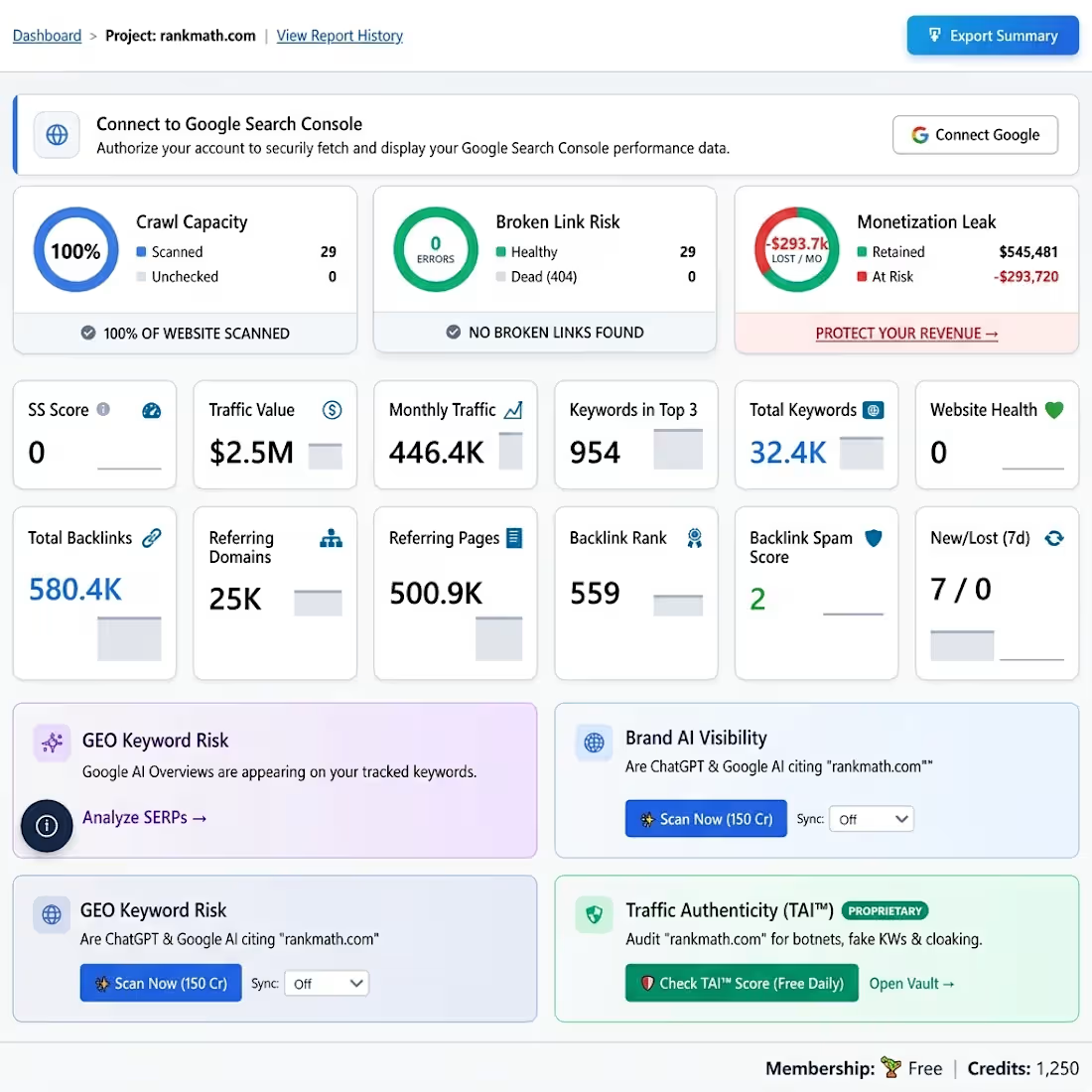
The dashboard displays:
Crawl capacity: 100%
URLs scanned: 29
URLs unchecked: 0
Broken-link errors: 0
URLs marked healthy: 29
For a developer, this is a useful initial checklist—not proof that an entire website is free from technical problems.
The next steps are to examine the crawl scope, verify important URLs, check response codes, and confirm whether canonicalization, redirects, and robots directives behave as intended.
2. Organic search estimates
The dashboard reports 446.4K estimated monthly traffic, $2.5M estimated traffic value, 32.4K total keywords, and 954 keywords in the Top 3.
These figures can provide a starting point for competitive research. For implementation decisions, compare estimates with first-party search performance data wherever possible.
3. Backlink analysis
The displayed backlink metrics include:
580.4K backlinks
25K referring domains
500.9K referring pages
Backlink Spam Score: 2
Bulk backlink exports can be useful for processing link data, identifying patterns, and preparing outreach lists.
The Google Disavow Shield Manager workflow can support the organization of backlink-risk investigations. However, a developer or SEO specialist should verify suspicious links and avoid treating a third-party spam score as an automatic disavow instruction.
4. Traffic Authenticity (TAI™)
SerpSpur's proprietary TAI™ feature offers an additional perspective on traffic authenticity.
Unlike conventional link-based authority metrics, it is positioned around traffic-quality investigation. To evaluate it rigorously, document its inputs, scoring methodology, validation process, and known limitations.
TAI™ should not be presented as a direct replacement for Moz DA/PA or as universally more accurate without supporting comparative evidence.
5. GEO and AI visibility
The dashboard also includes:
GEO Keyword Risk: Investigate tracked keywords appearing in Google AI Overviews.
Brand AI Visibility: Explore brand mentions and citations across supported AI search platforms.
AI Rank Checker: Investigate AI search visibility using the platforms and prompts supported by the tool.
For reproducibility, record the prompt, platform, language, date, and relevant page. AI responses can vary between checks, so avoid interpreting a single observation as a stable ranking.
6. Keyword tracking and bot traffic
Keyword tracking supports monitoring traditional search positions. Bot traffic detection helps investigate potentially automated or suspicious traffic patterns.
These functions solve different problems. Rank changes need consistent tracking settings, while traffic anomalies should be compared with analytics data, server logs, and known crawler behavior.
7. Can SerpSpur fit into a developer's SEO workflow?
Potentially—especially when the goal is to combine audit checks, backlink research, keyword monitoring, and AI visibility investigations without maintaining separate manual workflows for every task.
Before committing, compare the actual features, limits, exports, integrations, and data coverage against your existing stack.
My takeaway: An SEO dashboard is most useful when its findings are reproducible, its limitations are clear, and its recommendations lead to verifiable improvements.
1
10
SerpSpur Website SEO Audit Tool
1
40

Hi, Everyone my name is Mujahid Mguhal from Pakistan. I work SEO last 3 years. I am specialist Shopify Store Management, Keyowrd Research (keyword Planner), Products Hunting and Listing, Social Media Marketing (Linkedin, Quora, Reddit, Indiehacker, Facebook, Instagram), Data Entry Work , Complete SEO Audit Using Tools like Semrush, SerpSpur.
0
18
AdSense Banned Site Checker — Investigate a Domain Before You Monetize
If you're buying an expired domain, launching a new content website, or acquiring an existing site, this is one of the first questions you should ask.
A domain can look completely normal today while its previous history, accessibility, or search visibility raises important questions.
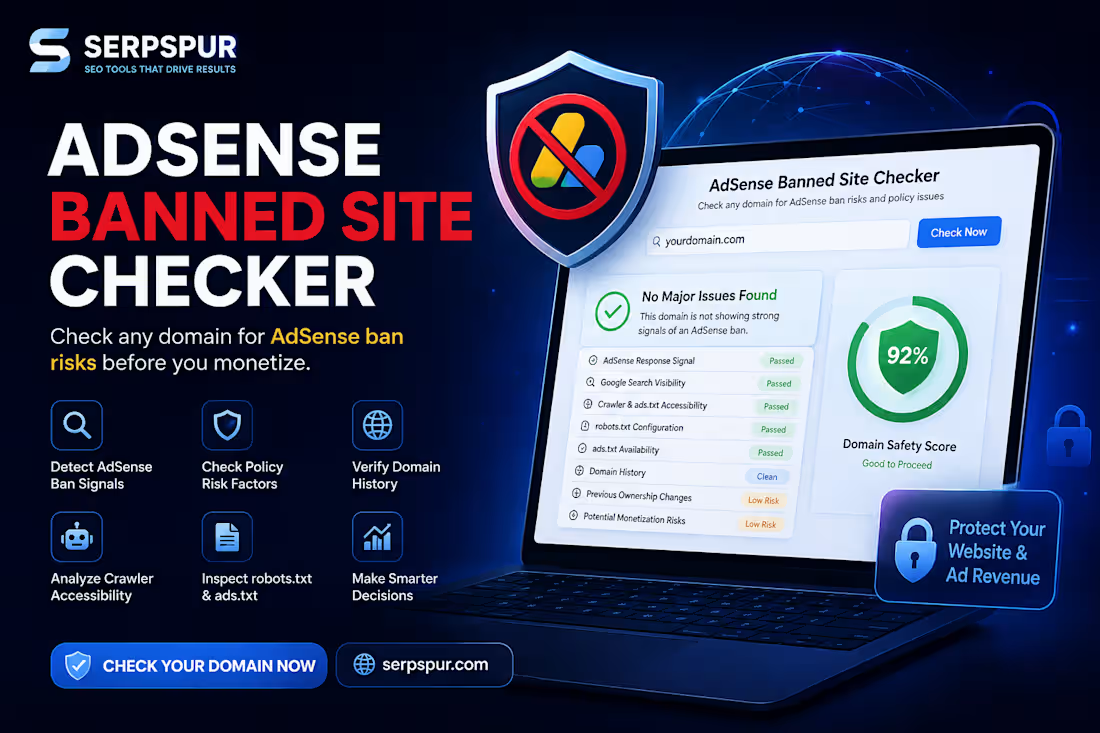
SerpSpur AdSense Banned Site Checker helps you investigate those signals before you invest your time, content, SEO budget, and monetization strategy into a domain.
How the SerpSpur AdSense Check Works
Google does not provide a public API that simply tells third-party tools whether a domain is “AdSense banned.” That's why SerpSpur approaches the problem through multiple independent signals rather than relying on a single yes/no test.
01. AdSense Response Signal
SerpSpur checks how the domain responds to an AdSense-related request and looks for unusual server responses, including access-denied responses such as 403 Forbidden.
A 403 by itself is not proof of an AdSense blacklist—server configuration, security systems, firewalls, or other restrictions can also produce a 403. SerpSpur therefore treats this as one signal within the overall analysis.
02. Google Search Visibility Check
SerpSpur examines the domain's presence in Google Search to identify potential visibility problems.
If a website has little or no indexed content, that is a reason to investigate further.
However, a site:domain.com (http://domain.com) search is not a definitive ban detector. Google explains that Search indexing and AdSense crawling are separate systems, so search visibility should be treated as supporting evidence rather than proof of an AdSense enforcement action.
03. Crawler & Ads.txt Accessibility
SerpSpur also checks important accessibility signals, including robots.txt and ads.txt.
This matters because Google says the AdSense crawler, Mediapartners-Google, respects robots.txt restrictions. If it is blocked from pages where ads are served, Google may not be able to crawl those pages for AdSense purposes.
The tool can also inspect ads.txt accessibility. Google recommends making ads.txt available to its crawler and ensuring that robots.txt does not unintentionally block the file.
04. Robots.txt Configuration
Your robots.txt file tells crawlers which parts of your website they can or cannot access.
An incorrectly configured file can unintentionally block important pages or advertising-related crawlers.
SerpSpur helps you identify potential robots.txt restrictions so you can determine whether the configuration needs attention.
Why it matters:
A simple configuration mistake can look like a much bigger SEO or monetization problem.
05. Ads.txt Availability
ads.txt is an important part of the digital advertising ecosystem.
It helps publishers publicly identify which companies are authorized to sell their advertising inventory.
SerpSpur checks whether the domain's ads.txt file is available and accessible.
This is particularly useful when taking over an existing website or preparing a domain for advertising because an incorrectly configured or missing ads.txt file can create monetization complications.
Before adding advertising, check the file—not after a problem appears.
06. Domain History
Today's website isn't necessarily the complete story.
An expired domain may previously have been used for:
A completely different business
Affiliate websites
Low-quality content
Spam
Multiple projects
Previous advertising activities
SerpSpur helps you investigate the domain's history so you can understand what you're potentially building on.
A good-looking domain today doesn't guarantee a clean history.
07. Previous Ownership Changes
A domain can change hands several times before reaching you.
For example:
Owner A → Owner B → Expired → Auction → New Owner
Multiple ownership changes don't automatically mean a domain is problematic.
However, they provide useful context—especially when you're purchasing an expired domain.
SerpSpur helps make this history part of your due-diligence process instead of leaving it unknown.
08. Potential Monetization Risks
Before monetizing a website, it's worth looking at the bigger picture.
Potential concerns can involve:
Unusual traffic patterns
Invalid-traffic indicators
Policy-related website issues
Poor domain history
Accessibility problems
Advertising configuration
Suspicious website activity
SerpSpur brings these signals together to help you determine what deserves further investigation.
It doesn't replace Google's own AdSense enforcement systems, but it can provide a useful early warning and due-diligence layer.
Why Use an AdSense Banned Site Checker?
The biggest benefit is due diligence.
Before purchasing an expired domain or building a monetized website, you want to know whether there are signals that deserve further investigation.
SerpSpur can help you identify potential concerns involving:
AdSense-related response signals
Search visibility
Crawler accessibility
robots.txt configuration
ads.txt availability
domain history
previous ownership changes
potential monetization risks
This doesn't replace Google's own AdSense Policy Center, which is the authoritative place to see issues affecting your AdSense sites and account.
Instead, SerpSpur gives you an early investigation layer before you commit to a domain.
Don't Wait Until After You Build the Website
Imagine buying an expired domain, publishing 100 articles, building backlinks, and spending months growing traffic—only to discover that the domain has unexpected issues that should have been investigated earlier.
A quick pre-purchase check can help you make a more informed decision.
It's especially useful for:
Domain Investors — investigate domains before purchasing them.
Bloggers & Publishers — evaluate a domain before building an AdSense website.
SEO Professionals — add domain-risk analysis to your due-diligence workflow.
Affiliate Marketers — investigate expired domains before investing in content.
Website Buyers — perform an additional check before acquiring an existing website.
More Than a Simple “Banned / Not Banned” Answer
A professional domain checker shouldn't pretend that Google's private enforcement systems are publicly accessible.
Instead, the smarter approach is to combine multiple signals and tell you:
What looks normal?
What deserves attention?
What should you investigate further?
That's the philosophy behind SerpSpur.
Google confirms that AdSense enforcement can occur at the page, site, or account level, including actions related to policy violations and invalid traffic.
SerpSpur helps you perform pre-monetization due diligence—while Google's own systems remain the final authority on AdSense enforcement.
Check First. Monetize With More Confidence.
Your domain is the foundation of your website.
Before you spend months building content and SEO authority, investigate it.
Enter the domain → Analyze the signals → Review the findings → Investigate potential risks → Make a smarter decision.
SerpSpur AdSense Banned Site Checker
Don't guess about a domain's history. Check it before you build.
Check Your Domain with SerpSpur (https://serpspur.com/tool/adsense-banned-site-checker/)
1
27