Degree Verification Platform | Multi-Portal Operations System

Waleed Ashraf Usmani


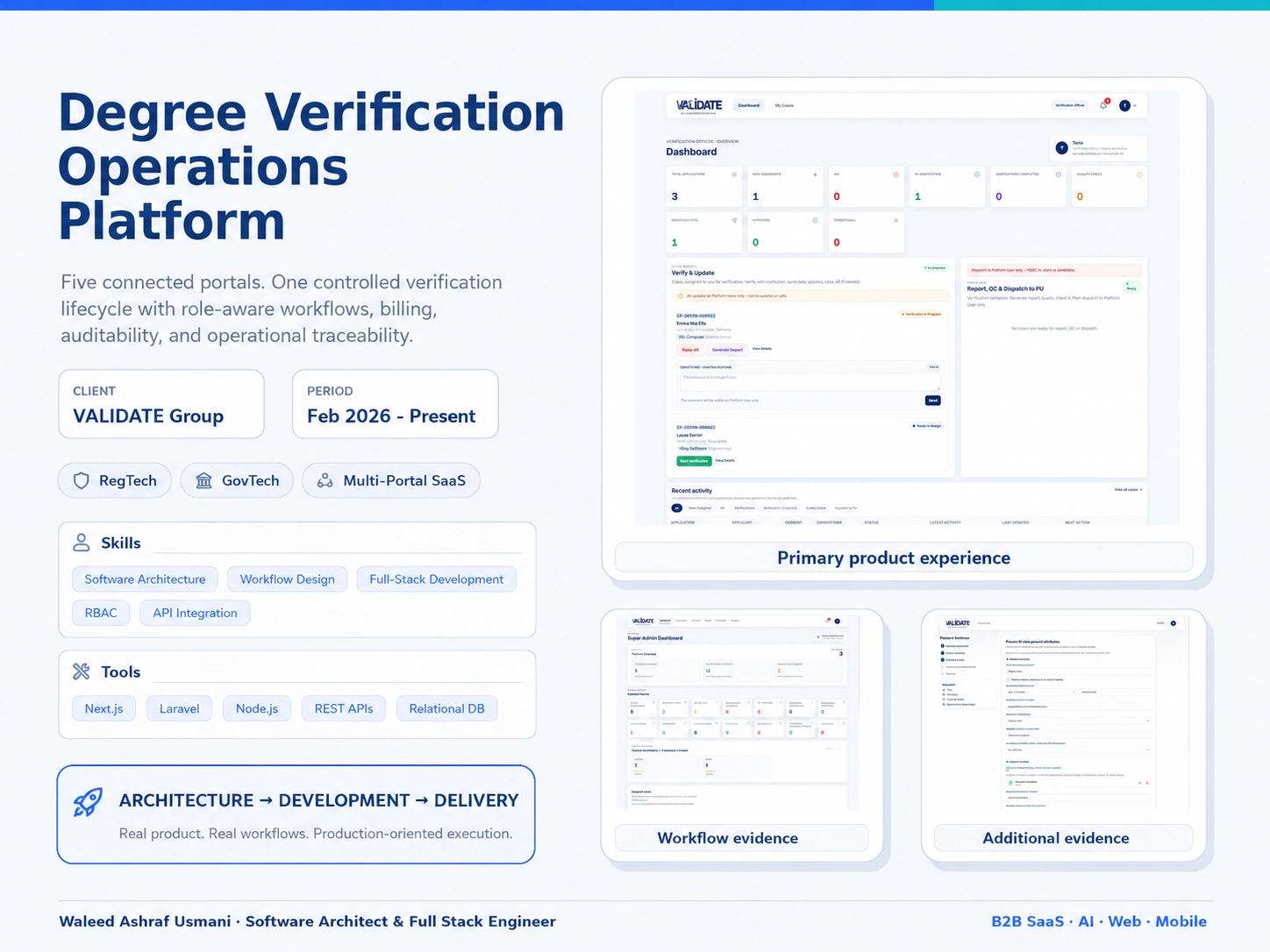
The Problem
Degree verification is not simply an online application form.
The platform needed to coordinate a complete operational lifecycle across external users and multiple internal teams without losing ownership, status history, documents, billing context, or accountability between handoffs.
Key challenges included:
Applicants needed a simple guided experience despite complex verification requirements.
Company administrators required a separate business-side application and tracking workflow.
Processing teams needed structured queues, assignments, priorities, and next actions.
Verification Officers needed controlled case handling, verification progress, AIR workflows, and report preparation.
Super Administrators required visibility across applications, users, billing, notifications, integrations, and operational controls.
Insufficiency and document resubmission needed to preserve the original case history.
Status movement needed governed workflow rules rather than freely editable labels.
Important operational actions needed to remain traceable throughout the lifecycle.
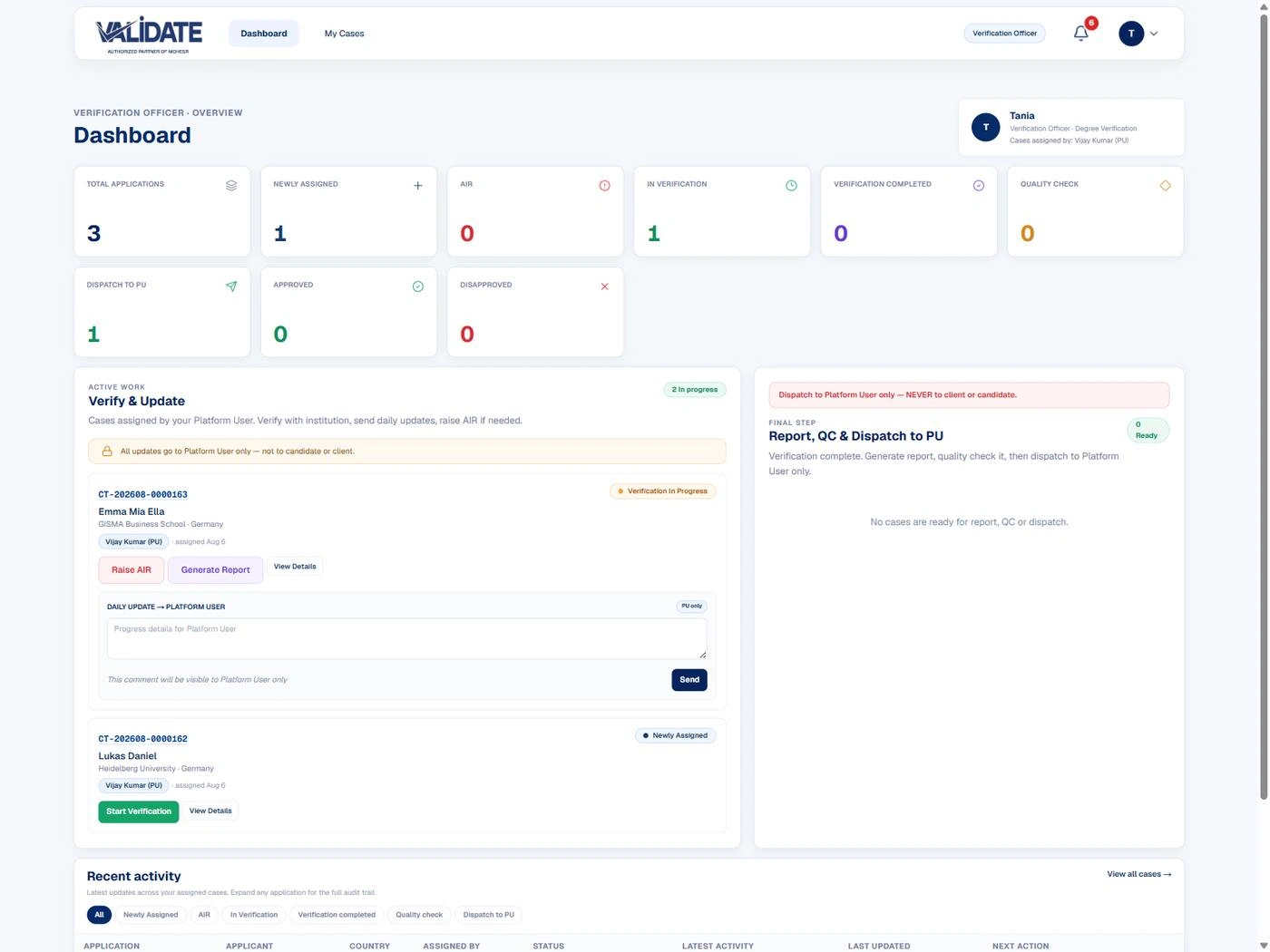
Verification Officer workspace — cases, workload, status and next-action visibility.
The Approach
I designed the product around one shared verification lifecycle with five role-specific experiences.
Operational Discovery
Mapped responsibilities, handoffs, exceptions, approvals, and dependencies across all five portals.
Defined how applications progress from submission through processing, verification, quality control, dispatch, and tracking.
Identified the information, permissions, and permitted actions required at each stage.
Workflow & State Architecture
Structured governed application states instead of unrestricted status changes.
Defined assignment, insufficiency, candidate/client resubmission, verification, QC, and dispatch workflows.
Designed operational queues around ownership, priority, status, and next action.
Five Connected Portals
Individual Applicant Portal
Company Admin Portal
Processing Unit Portal
Verification Officer Portal
Super Admin Portal
Each portal exposes only the information and actions required by that role while operating on the same underlying application lifecycle.
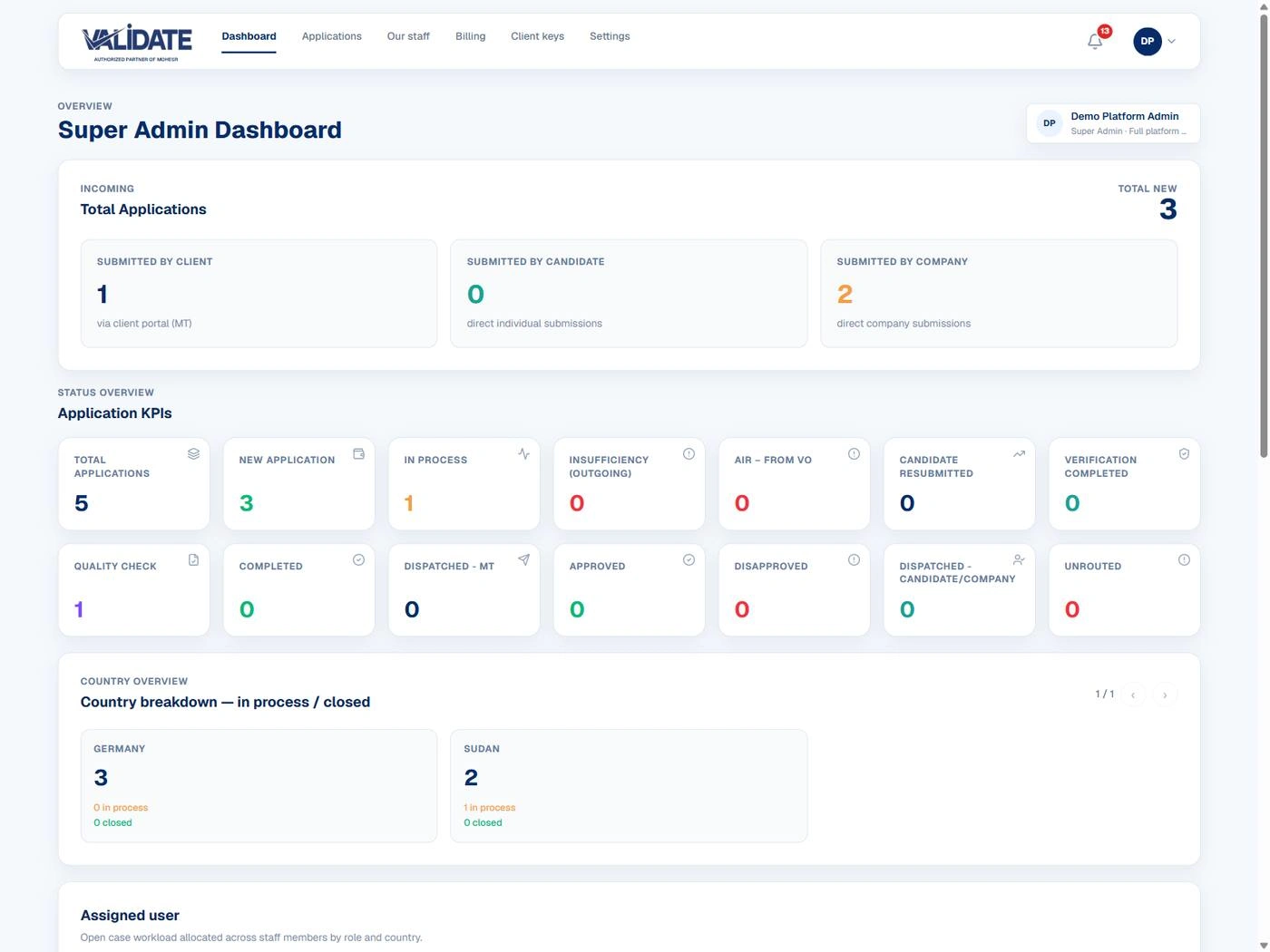
Super Admin oversight — global operational visibility and administrative control.
Applicant Experience
The external journey was designed to make a complex verification process easier to complete.
The application flow covers:
Personal information
Education details
Document upload
Review and authorization
Secure payment
Application tracking
Individual applicants use UAE PASS, while company-side access uses business email and OTP.
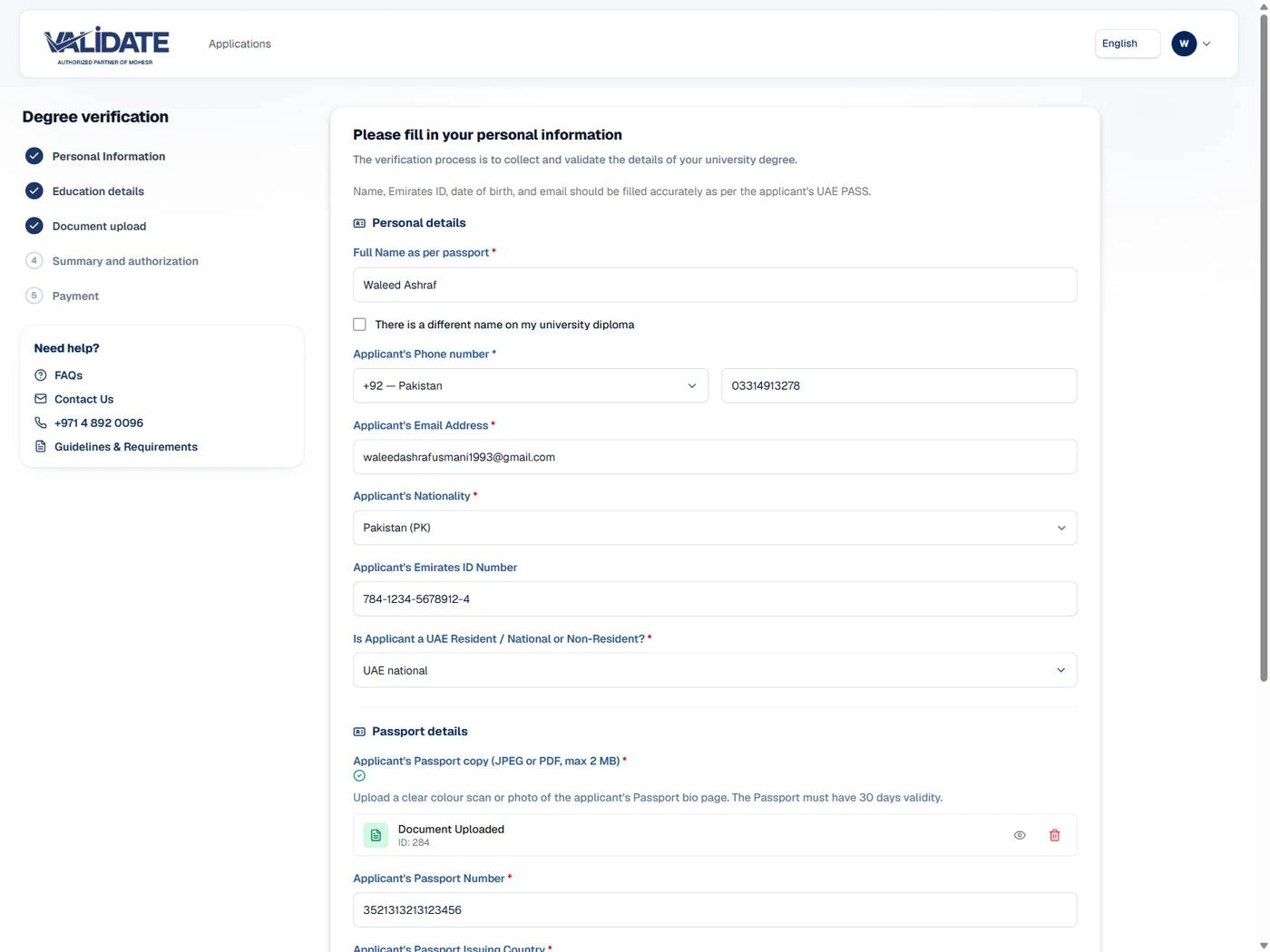
Applicant Step 1 — personal information and guided application intake.
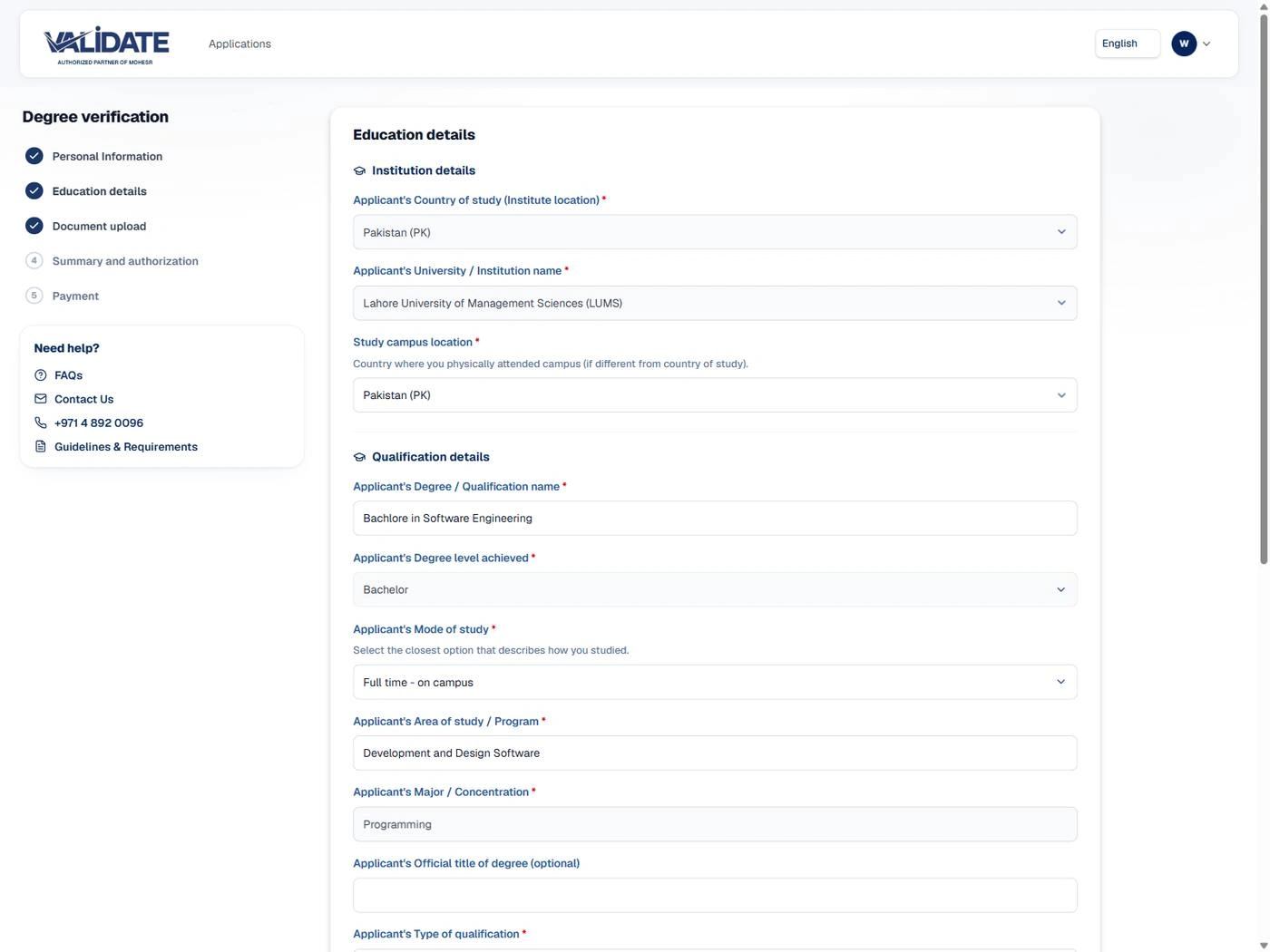
Applicant Step 2 — institution, qualification, and education details.
Architecture Decisions
Shared workflow engine vs separate portal workflows
One lifecycle prevents duplicated status logic and inconsistent behavior between portals.
Role-specific portals vs one universal dashboard
Each role sees only the cases, information, permissions, and actions relevant to its work.
Controlled state transitions vs editable status labels
Application states behave as governed workflow transitions, protecting case integrity.
Queue-based processing vs manual handoffs
Operational work is organized around ownership, priority, current status, and next action.
Secure documents outside core business records
Sensitive files remain separated from relational application data with controlled access.
Laravel + Node.js responsibilities
Laravel supports core application workflows and APIs while Node.js supports appropriate asynchronous, integration, or service-level processing.
Audit-aware architecture
Assignments, notifications, status changes, document activity, and administrative events remain traceable.
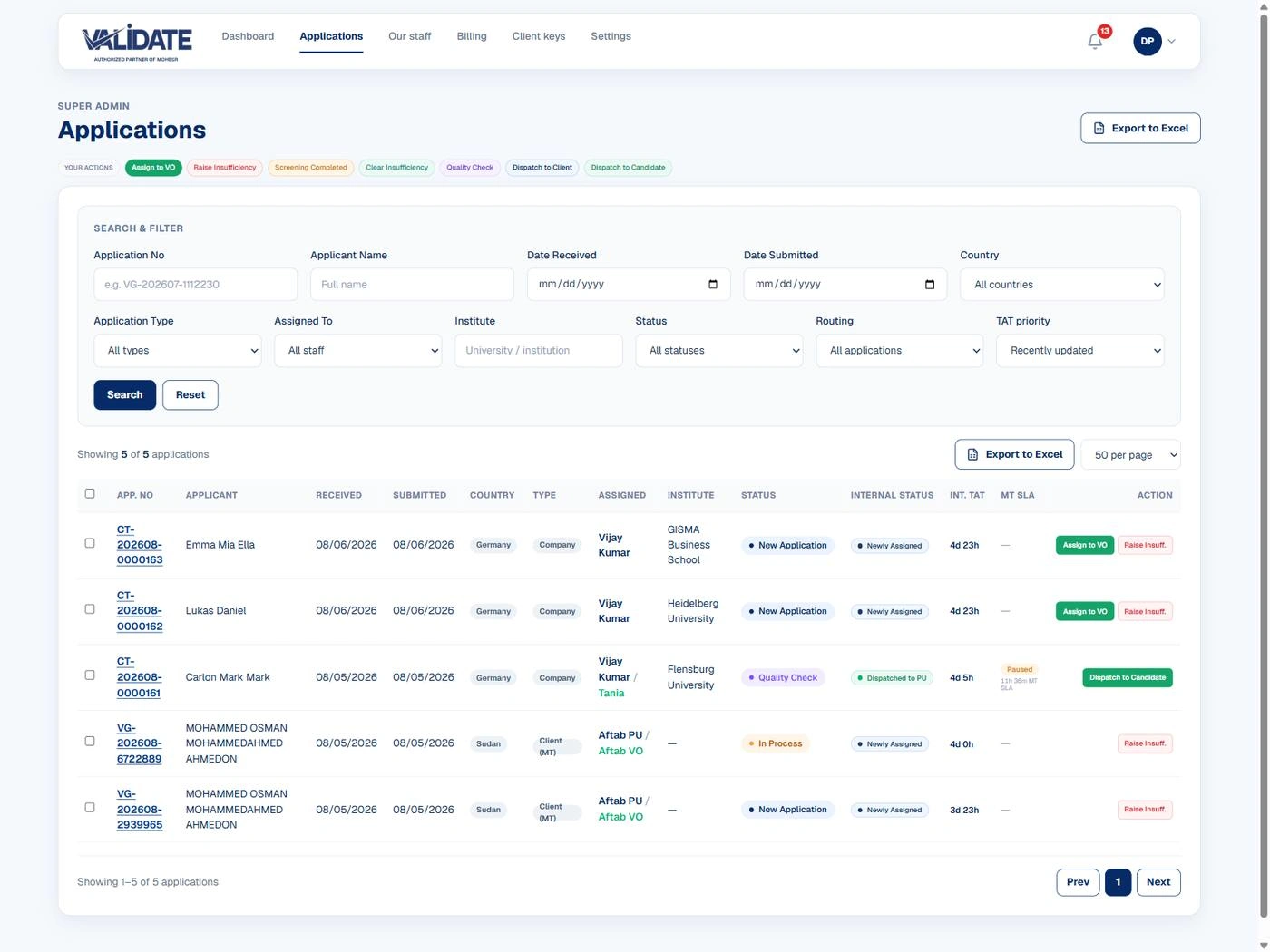
Application operations — search, filters, assignment and controlled workflow actions.
My Role
I owned the software architecture and hands-on development direction from workflow definition through production readiness.
My contribution included:
System architecture
Workflow and state modeling
Portal boundaries
RBAC and permission design
Full-stack implementation
API and integration planning
Technical reviews
Complex workflow debugging
UAT leadership
Production-readiness validation
Deployment coordination with the associate/team
Core Deliverables
Five connected role-specific portals
Unified application lifecycle
Multi-step applicant workflow
Secure document handling
Role-based dashboards
Operational queues
Assignment workflows
Insufficiency and resubmission workflows
Verification and quality-control stages
Billing and transaction visibility
Notifications and recent activity
Audit-trail support
TAT and priority visibility
Client-key controls
UAE PASS integration
Business email + OTP
MOHESR integration boundaries
UAT and production-readiness support
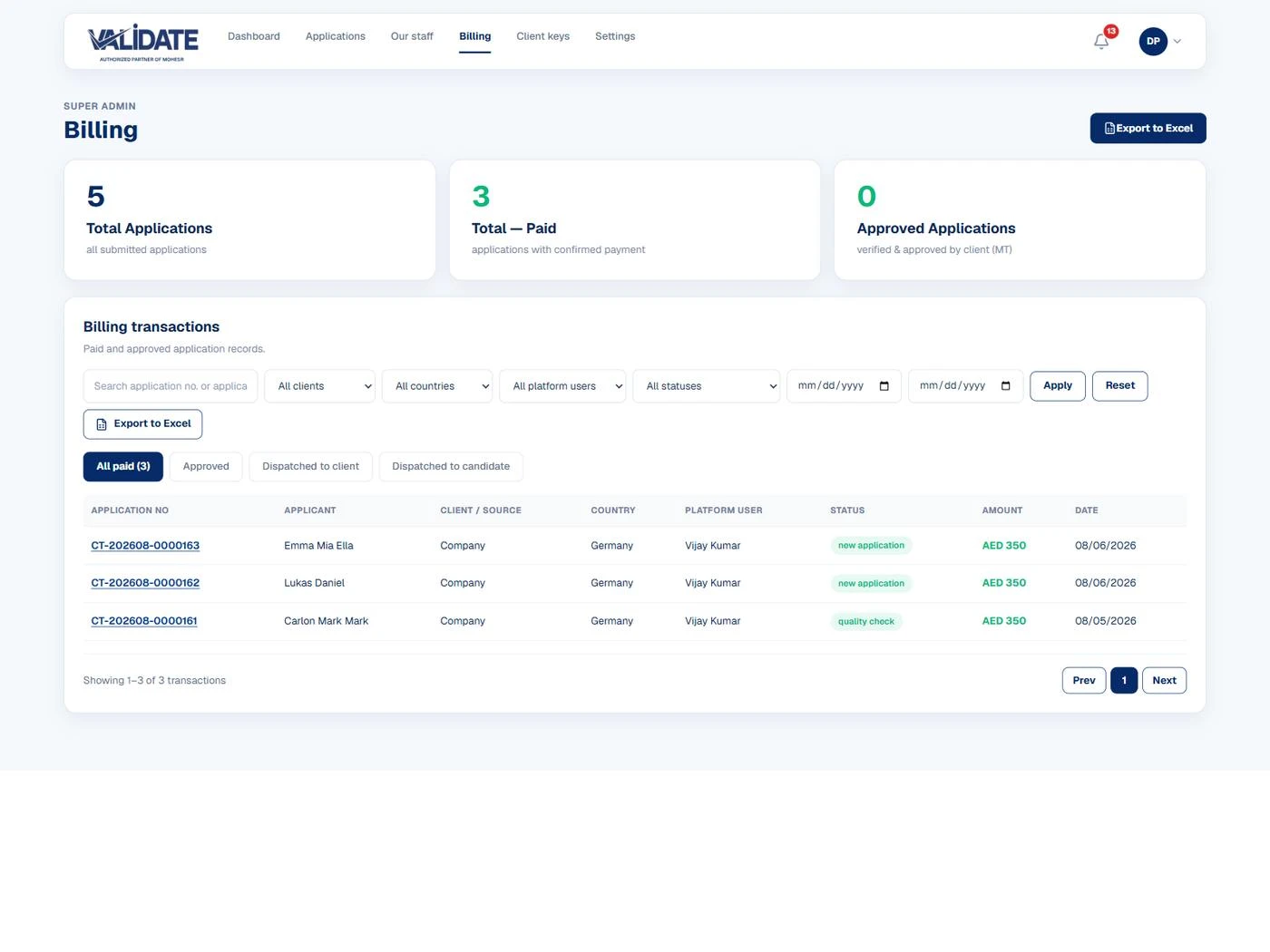
Billing and transaction oversight integrated into the operational lifecycle.
Results & Business Value
Converted fragmented verification activity into one controlled operating model.
Improved visibility into application ownership, status, priority, and next actions.
Reduced ambiguity across Processing Unit, Verification Officer, and administrative handoffs.
Created stronger traceability across status changes, notifications, assignments, and operational actions.
Established a scalable architecture for continued integrations and platform expansion.
Created a production-oriented operating platform instead of disconnected workflow screens.
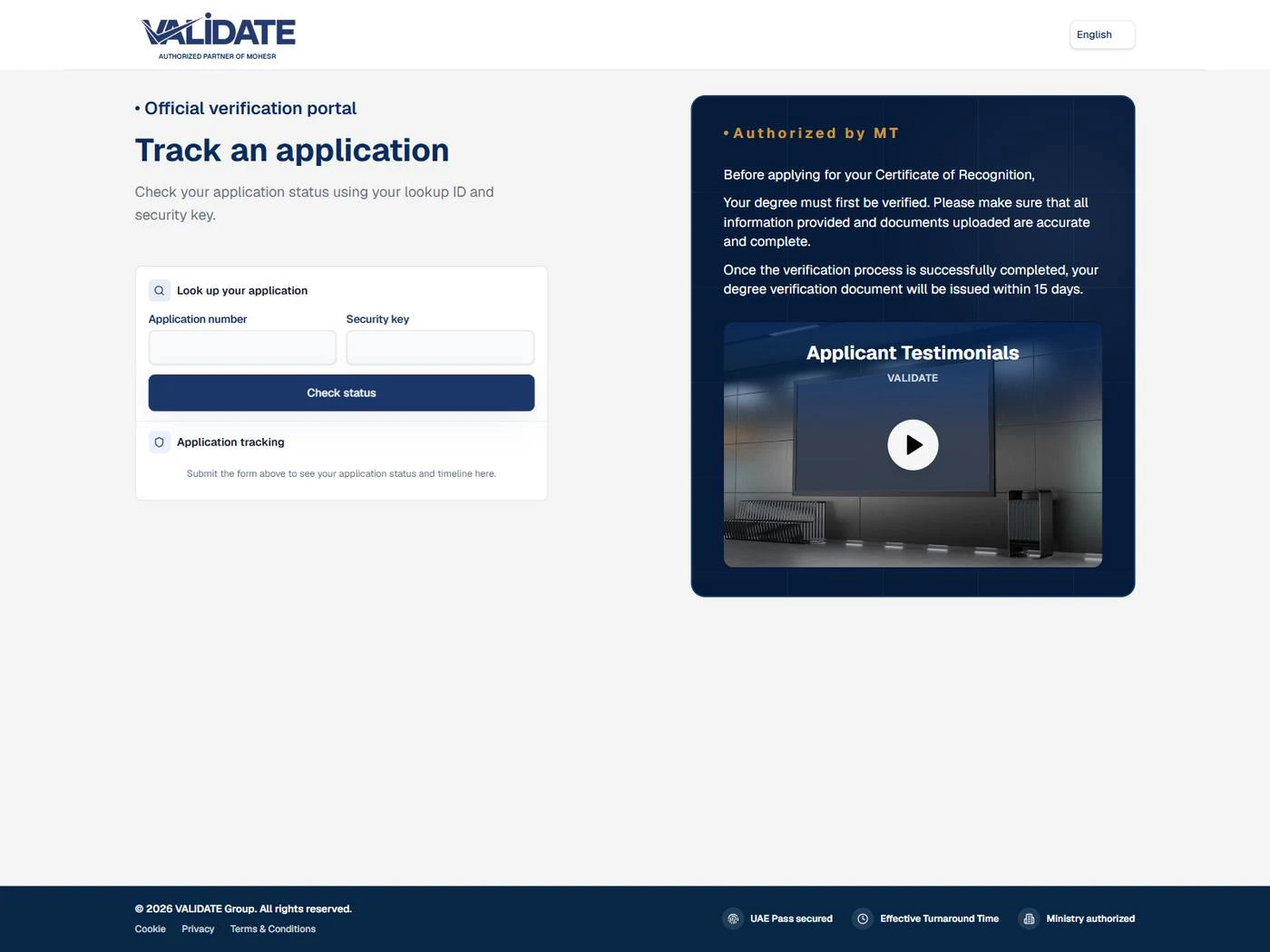
Applicant tracking — transparency after submission without exposing internal complexity.
Like this project
Posted Aug 12, 2026
Architected and built a five-portal degree verification platform connecting applicants, operations, verification, billing, and admin workflows.
Likes
1
Views
1
Timeline
Feb 2, 2026 - Ongoing