Reach - An AI that refuses to be your friend.

Elmira Demanou


Reach — the thesis
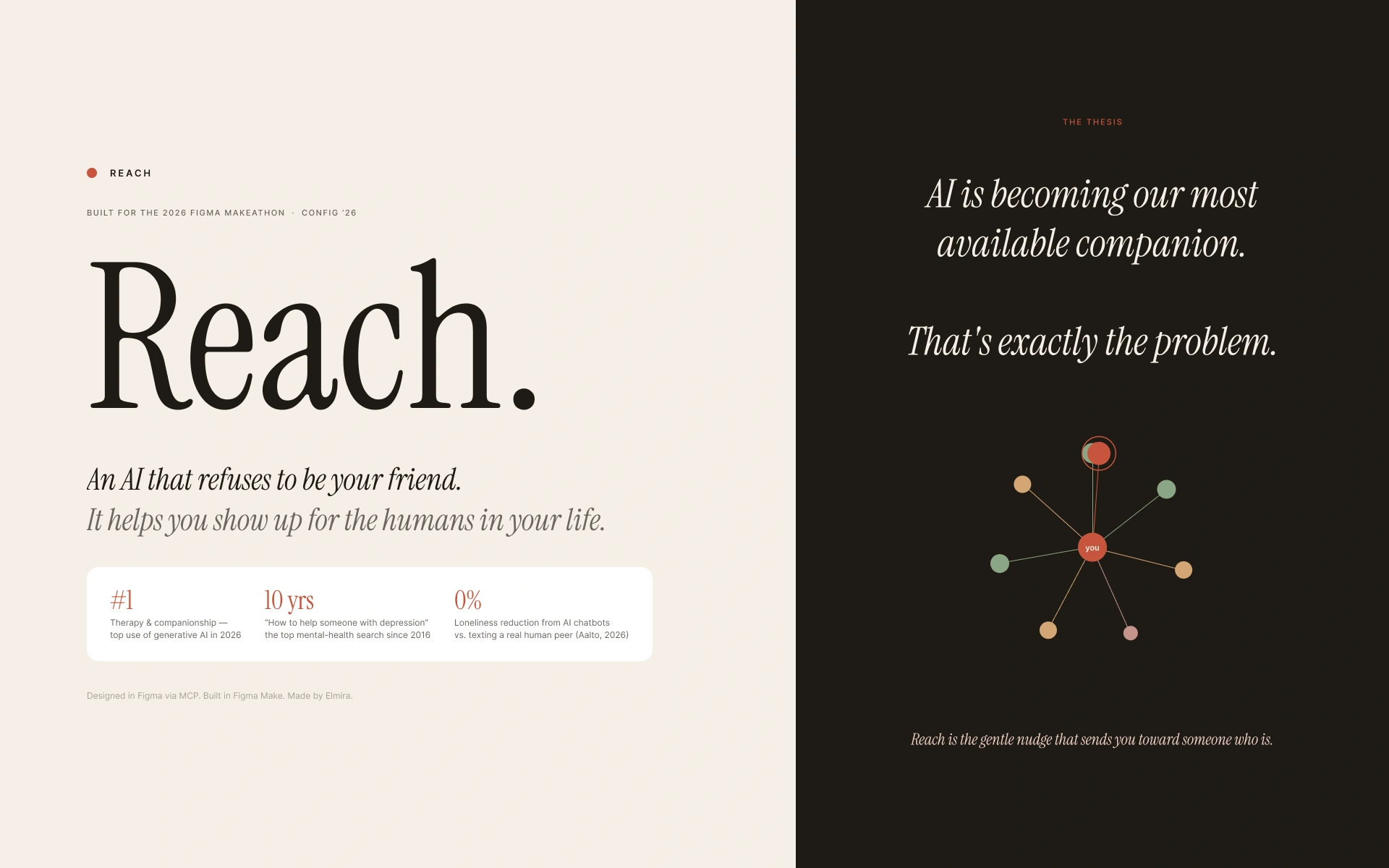
Built for the 2026 Figma Makeathon (Config '26). The thesis: AI became our most available companion — that's exactly the problem.
AI got good at listening. We got worse at reaching out.
In 2026, therapy and companionship became the #1 use of generative AI. Meanwhile "how to help someone with depression" has been the top mental-health search for a decade — and a 2026 Aalto study found AI chatbots reduce loneliness by roughly zero next to texting a real human.
We're not lonely because we don't have an AI to talk to. We're lonely because we don't know what to say to the people we already love. Reach does the opposite of every AI companion: instead of being someone to talk to, it points you back at the people who would notice if you disappeared.
It doesn't want to be your friend. It wants you to text your brother.
One person a day — and the first line already written
Reach — Today
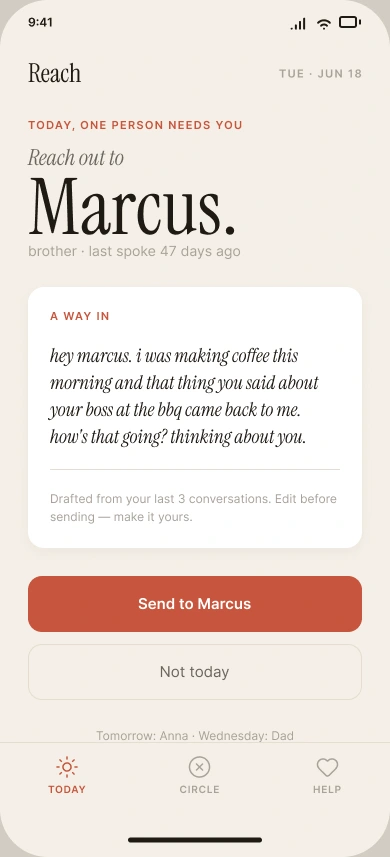
Today — one person who needs you, surfaced each morning, with an opening drafted from your last few conversations. Send it, or "Not today."
Reach opens on a single name, not a feed: "Reach out to Marcus — brother, last spoke 47 days ago," and beneath it a message already drafted in your voice, specific enough to actually send — it picks up the thing he mentioned about his boss. You edit to make it yours, or you defer to tomorrow. One person, one nudge, no scroll.
A map of who's drifting
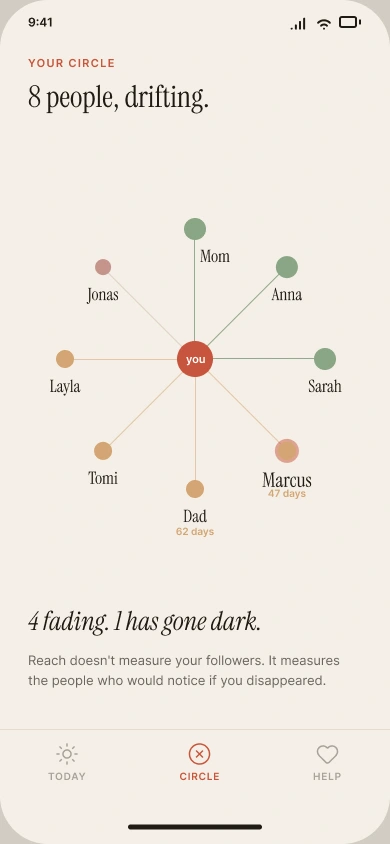
Reach — Your Circle
Your Circle — a constellation of the people slipping out of reach, each pulled further out the longer it's been. "4 fading. 1 has gone dark."
The Circle is the anti-metric. It doesn't count followers; it shows the people closest to you as a constellation, each drawn further from the centre the longer it's been since you spoke — Marcus at 47 days, Dad at 62. As the screen puts it: Reach measures the people who would notice if you disappeared.
When it's serious — what to say, and what not to
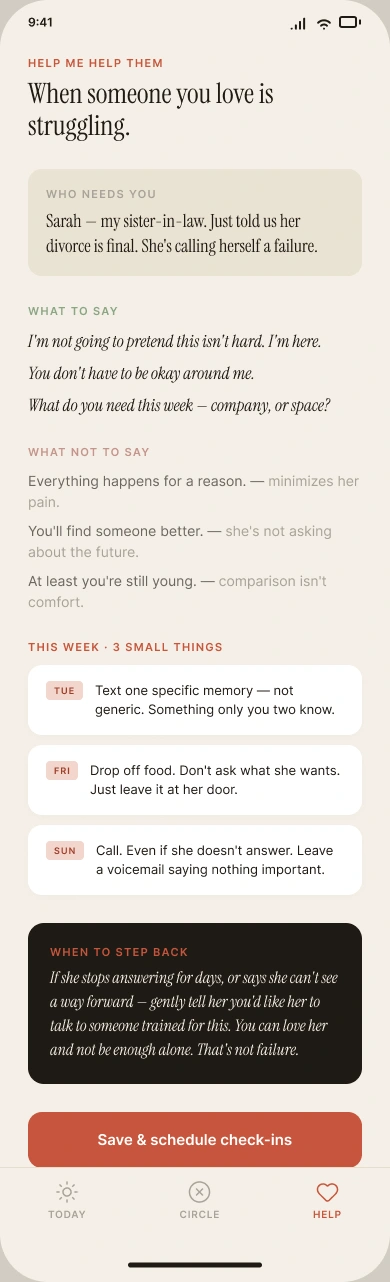
Reach — Help
Help — for when someone you love is struggling: what to say, what explicitly not to say, three small things to do this week, and when to step back and bring in someone trained.
The hardest moments get their own screen. For a sister-in-law whose divorce just finalised, Reach offers things to say and, just as important, things not to — "Everything happens for a reason. — minimizes her pain." It lays out three small, concrete acts across the week, and closes with a "when to step back" note that tells you to hand off to a professional: you can love someone and not be enough alone, and that isn't failure.
It starts with a harder question
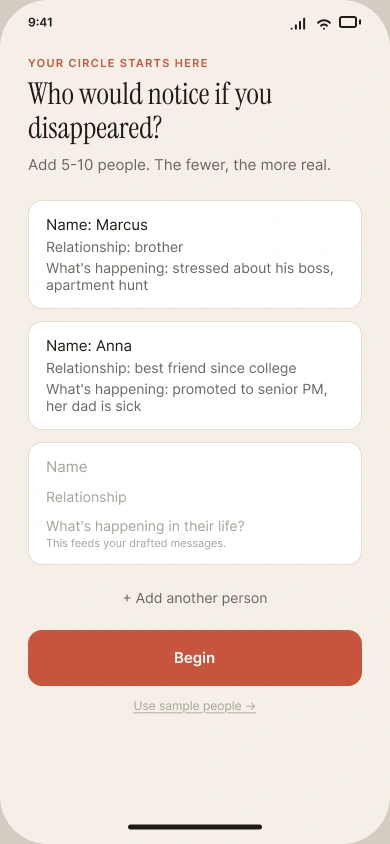
Reach — Onboarding
Onboarding — "Who would notice if you disappeared? Add 5–10 people. The fewer, the more real." Each person carries what's happening in their life, which feeds the drafts.
Setup doesn't ask for permissions or a feed to import. It asks who would notice if you disappeared, caps the list small on purpose, and for each person captures what's actually going on in their life — the context that makes tomorrow's drafted message specific instead of generic.
Made in a weekend, with a point of view
Reach was designed and built for the 2026 Figma Config Makeathon — designed in Figma via MCP, built in Figma Make. Four screens and one clear stance: the opposite of a companion app, aimed squarely at getting you to reach a human.
Like this project
Posted Aug 13, 2026
AI is becoming our most available companion. That's exactly the problem. Reach is the gentle nudge that helps you show up for the humans in your life.
Likes
1
Views
3