Second-Purchase Scorecard: planning and measurement worksheet

Nimrod Ogachi

Second-Purchase Scorecard
A self-directed, AI-assisted planning and measurement resource for ecommerce brands and email teams. This two-page worksheet was originally prepared on 20 September 2026. The attached readable edition refreshes the typography while preserving the scoring criteria and measurement definitions.
Purpose
Help a team locate missing evidence in one product category and one first-time-buyer cohort, then choose a bounded next experiment.
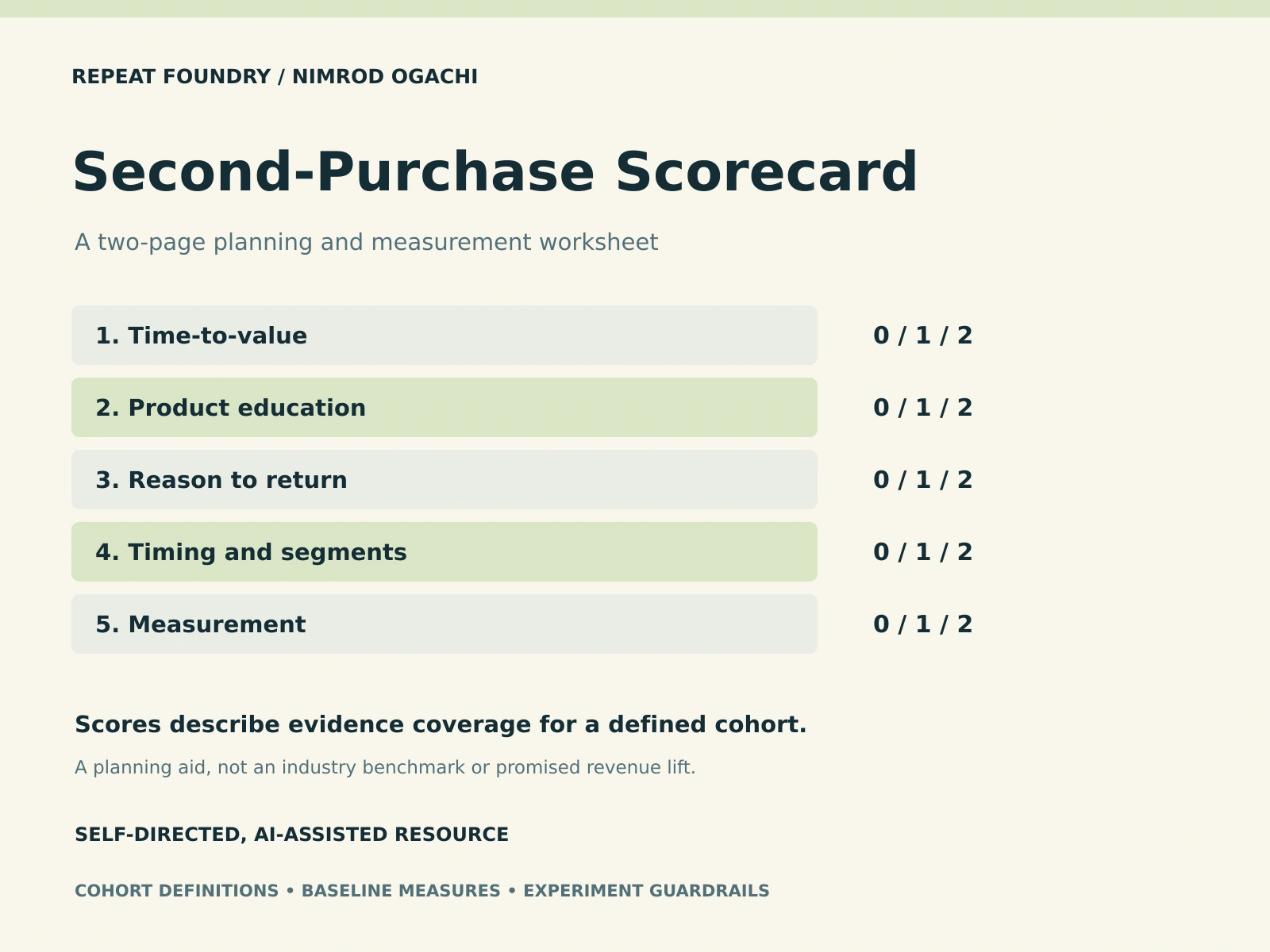
Page one: inspect five evidence areas
• Time-to-value after delivery
• Product education
• A relevant reason to return
• Timing and customer segments
• Measurement and cohort maturity
Each area is scored 0, 1 or 2: absent or unverified; incomplete evidence or coverage; documented and checked. The total describes evidence coverage. It is a planning aid, not an industry benchmark or a prediction of revenue.
Page two: turn the review into a testable brief
Define the eligible cohort and observation window, record a second-purchase baseline, write a hypothesis, name the change and owner, and agree review criteria. The worksheet retains guardrails for margin, opt-outs, complaints and fulfilment issues.
Measurement boundary
Only compare buyers with a complete observation window. Report median days to second order alongside the repeat-purchase rate because that median excludes non-repeat buyers. Platform-attributed revenue alone does not establish incremental lift.
No client data, scored brand assessment, completed experiment or performance result is claimed. Download the blank worksheet below.
Like this project
Posted Oct 5, 2026
Self-directed, AI-assisted two-page worksheet for evidence coverage, cohort definitions and a bounded retention experiment. No client results claimed.
Likes
1
Views
6