Reverse-Engineering a Publication's House Style

JP Vergara


Overview
Editorial job applications usually ask you to assert that you can hold a publication's voice. I wanted to demonstrate it instead.
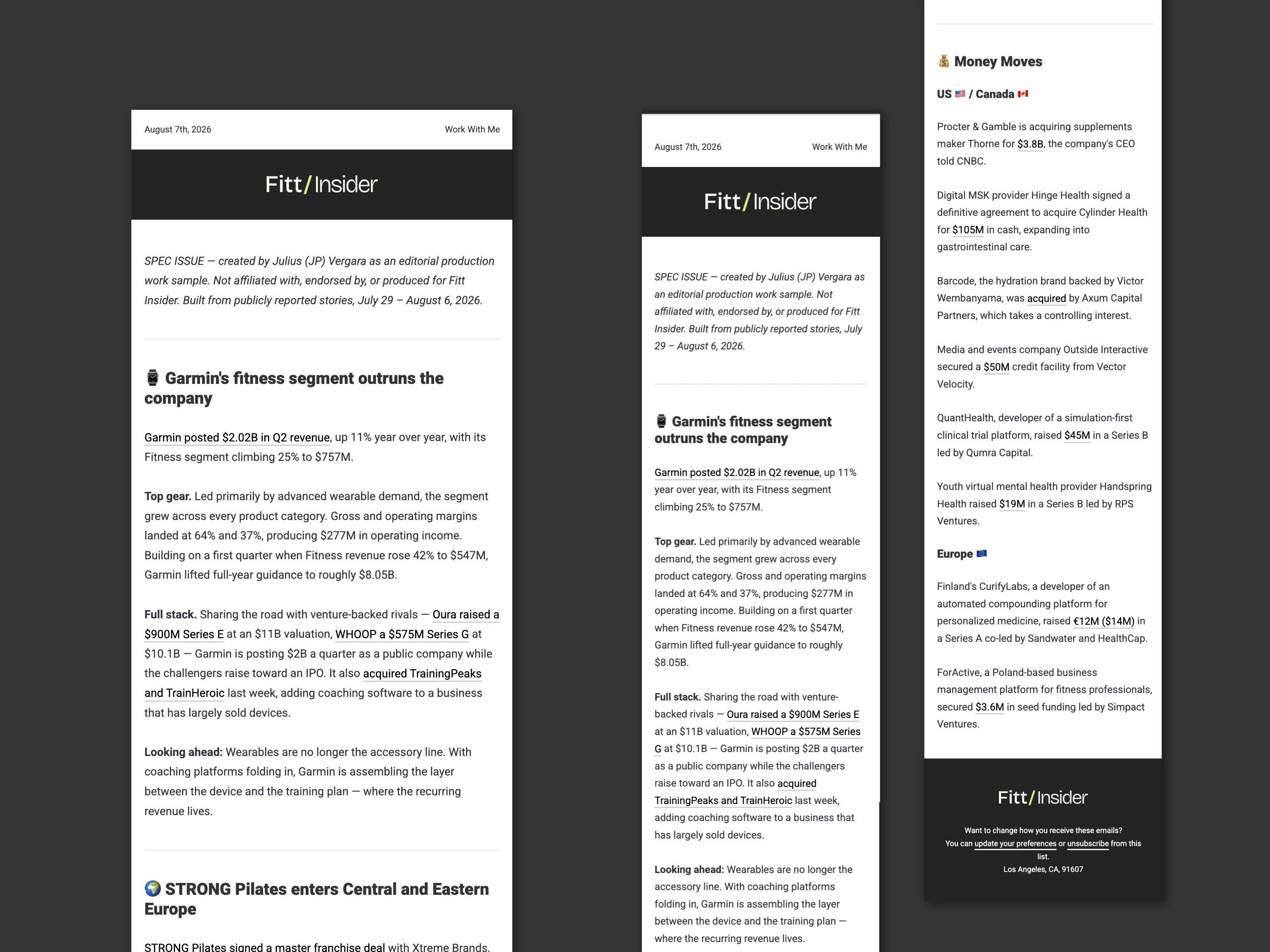
I picked a business-media publication covering the health and wellness industry, worked out its editorial conventions from published output, then wrote and produced a full spec issue to those conventions — built and rendered as a live campaign in Mailchimp.
Self-directed. No brief, no client.
Three surfaces, three rule sets
The most useful thing I found was that the publication runs different conventions on each of its three publishing surfaces — and that the differences are systematic, not sloppy.
Anyone reading only the website would produce a newsletter that looked wrong in five different ways. That gap is the whole reason to decode all three.
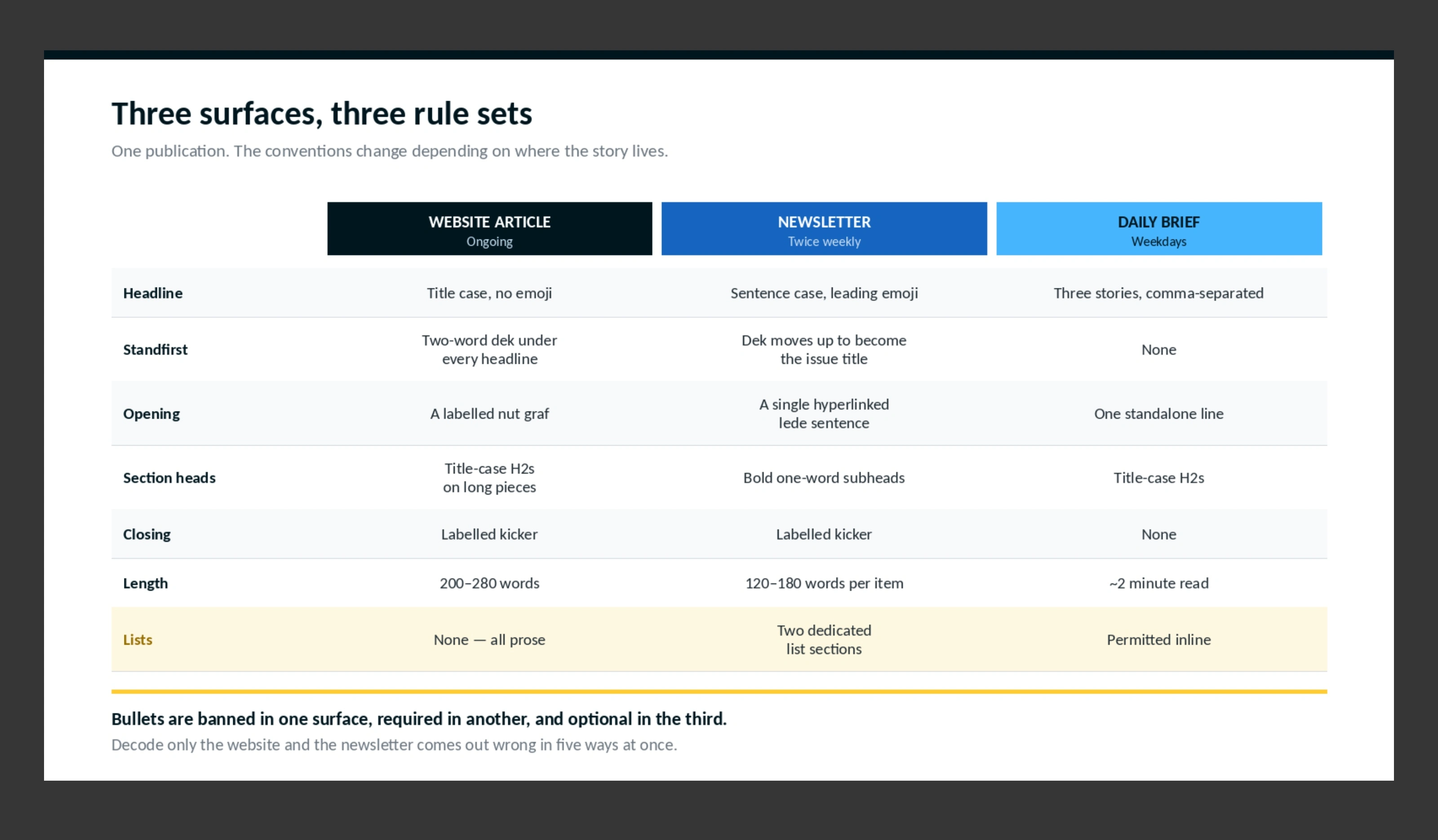
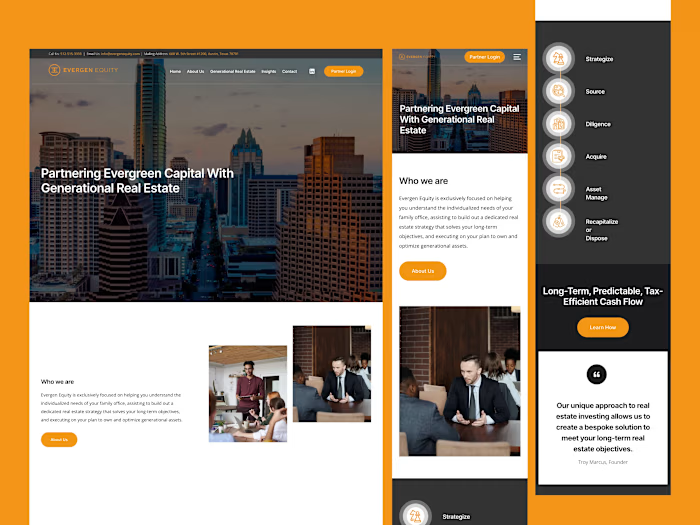
Three surfaces analyzed across one publication
What the conventions actually are
Shared across all three surfaces:
The two-word standfirst: always a repurposed idiom carrying a literal reading of the subject and a figurative reading of the argument
One semantic field per piece: the standfirst, the section headers, and every subhead inside come from the same lexicon. A story about diagnostics runs bathroom idioms top to bottom
Paragraph architecture: a fixed opener length, body paragraphs capped at three sentences, a labelled closing kicker that rotates between three options
Number and name formatting: magnitude suffixes, abbreviated years, companies rendered in their own styling
A sentence-level signature: roughly two-thirds of sentences open with a front-loaded participial phrase carrying the analytical judgment before the factual clause
Sourcing discipline: statistics hyperlinked to primary sources, companies and people linked to prior coverage
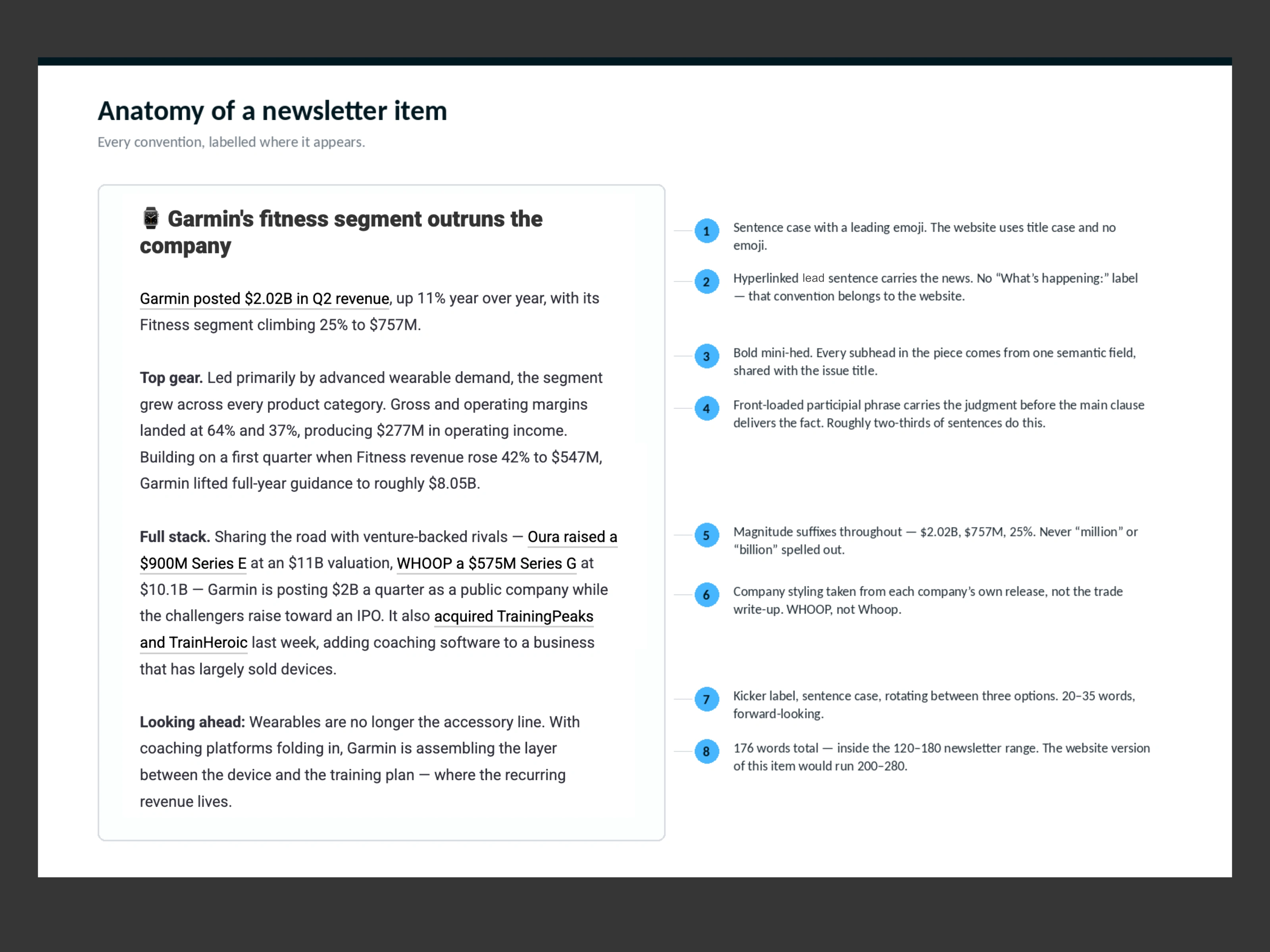
Callouts towards each convention
Writing and producing the issue
I wrote two news sections written to spec from that week's primary sources, plus the two recurring production sections the newsletter runs in every issue: a linked news roundup and a funding roundup grouped by region.
I traced every figure to a primary source instead of an aggregator, and logged a citation for each one. One number in the reporting was ambiguous about whether it described a business segment or the whole company. The arithmetic settled it, so I wrote the item to the verified reading.
A trade outlet styled one company in title case. The company styles itself in caps. I caught it because I checked the company's own release instead of the write-up about it.
Production
Built as a live campaign in Mailchimp:
Modular template with repeating section blocks, so issues assemble rather than rebuild
Subject line and preheader written to the house pattern
Every link tested from the test send rather than the editor
Mobile render checked before scheduling
Clearly labelled as a spec sample in the header, never presented as a real issue of a real publication
Companion artifacts (view 📑)
A three-surface editorial style sheet: the decoded conventions for website, newsletter, and daily brief side by side, as a working desk reference
A pre-publish QA checklist: primary-source verification, link testing, alt text, headline and standfirst checks, mobile render, second-reader sign-off
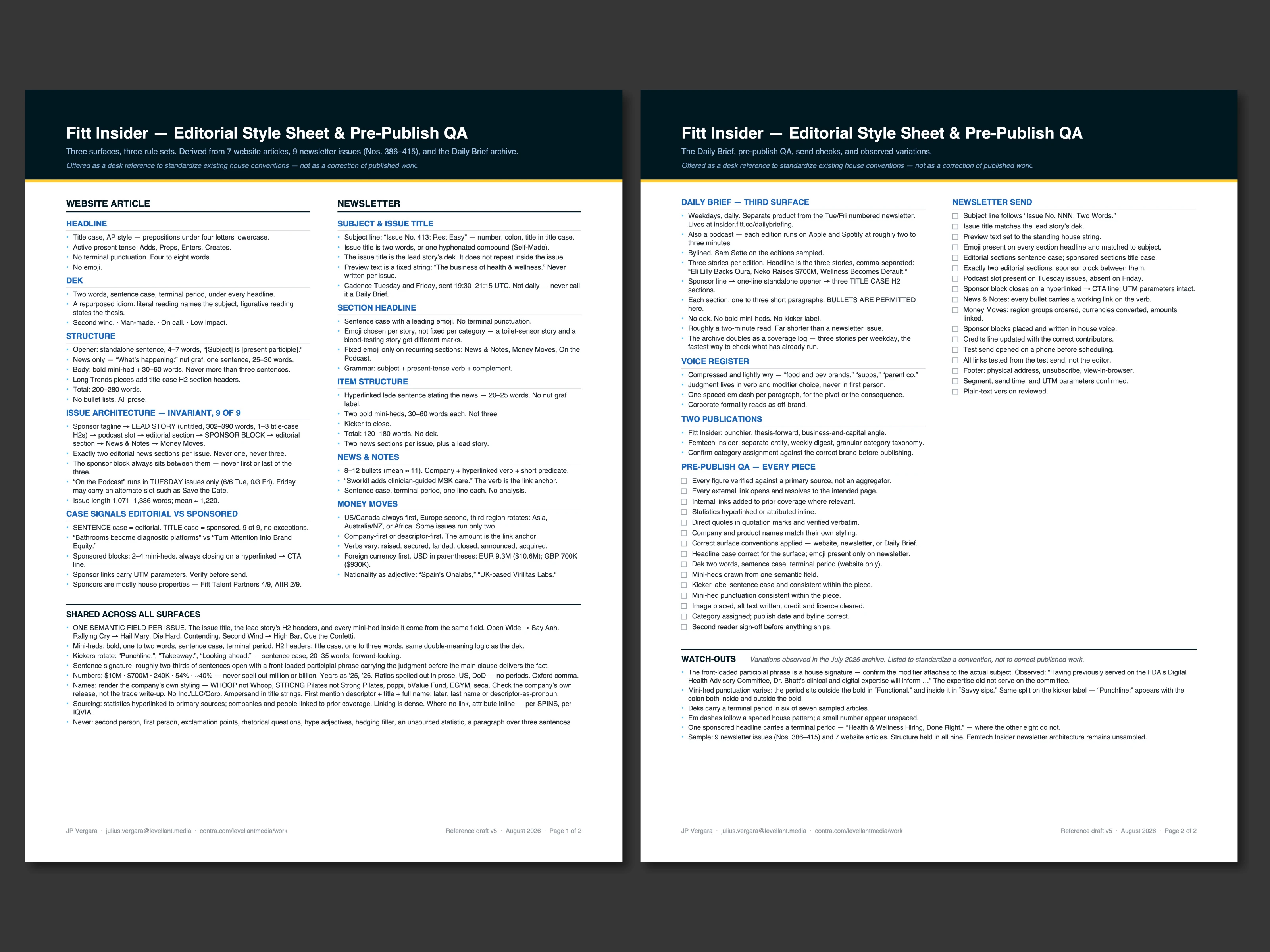
editorial style sheet / QA documentation
What transferred
House style is a system that can be learned from the outside, which means voice consistency is a production problem as much as a writing one. Once the conventions are documented, holding them is a checklist, and a checklist survives handoff, volume, and a bad week in a way that instinct doesn't.
The harder part was the standfirst. A two-word idiom that has to be true of the subject and figuratively true of the argument is a real constraint, and most attempts fail on the second half.
Like this project
Posted Aug 5, 2026
Decoded a business-media publication's various editorial conventions, then wrote and produced a full issue to spec in Mailchimp.