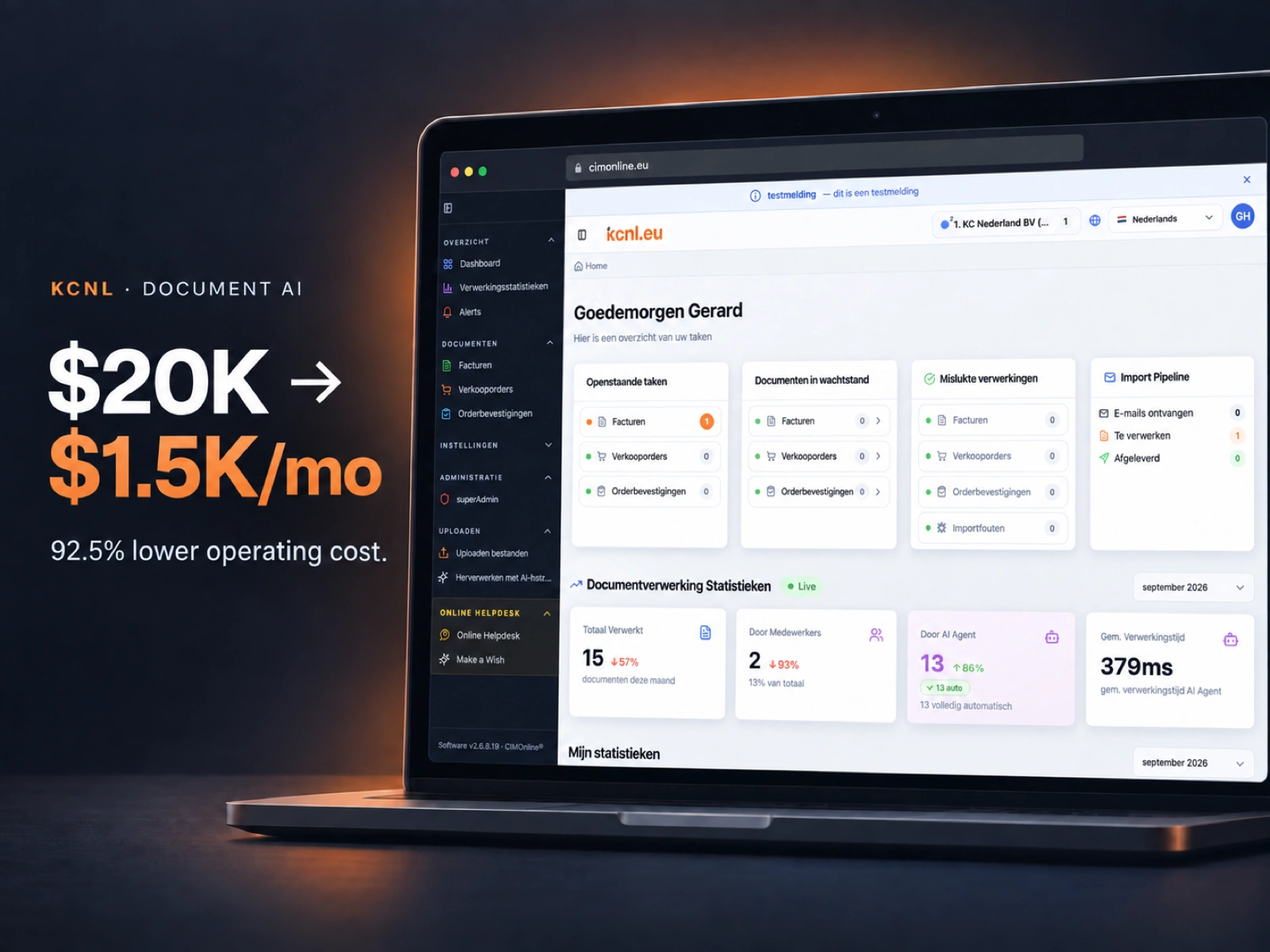
KCNL: cutting document-AI cost from $20K to $1.5K/month

Muhammad Haseeb


Client: KC Nederland BV / CimOnline
Role: AI developer and backend developer
Duration: Almost five years and ongoing
Industry: B2B document automation
Live product: https://cimonline.eu
KC Nederland builds CimOnline, a multi-tenant platform that processes business documents and connects the extracted data to ERP and CRM systems. The platform has about 10,000 users and has handled more than 100,000 invoices during a peak month.
I joined KCNL directly almost five years ago, before the current LLM wave. I am still working with the team as an AI and backend developer. Over that time, I built the document AI and the backend services that make it work inside real accounting and purchasing operations.
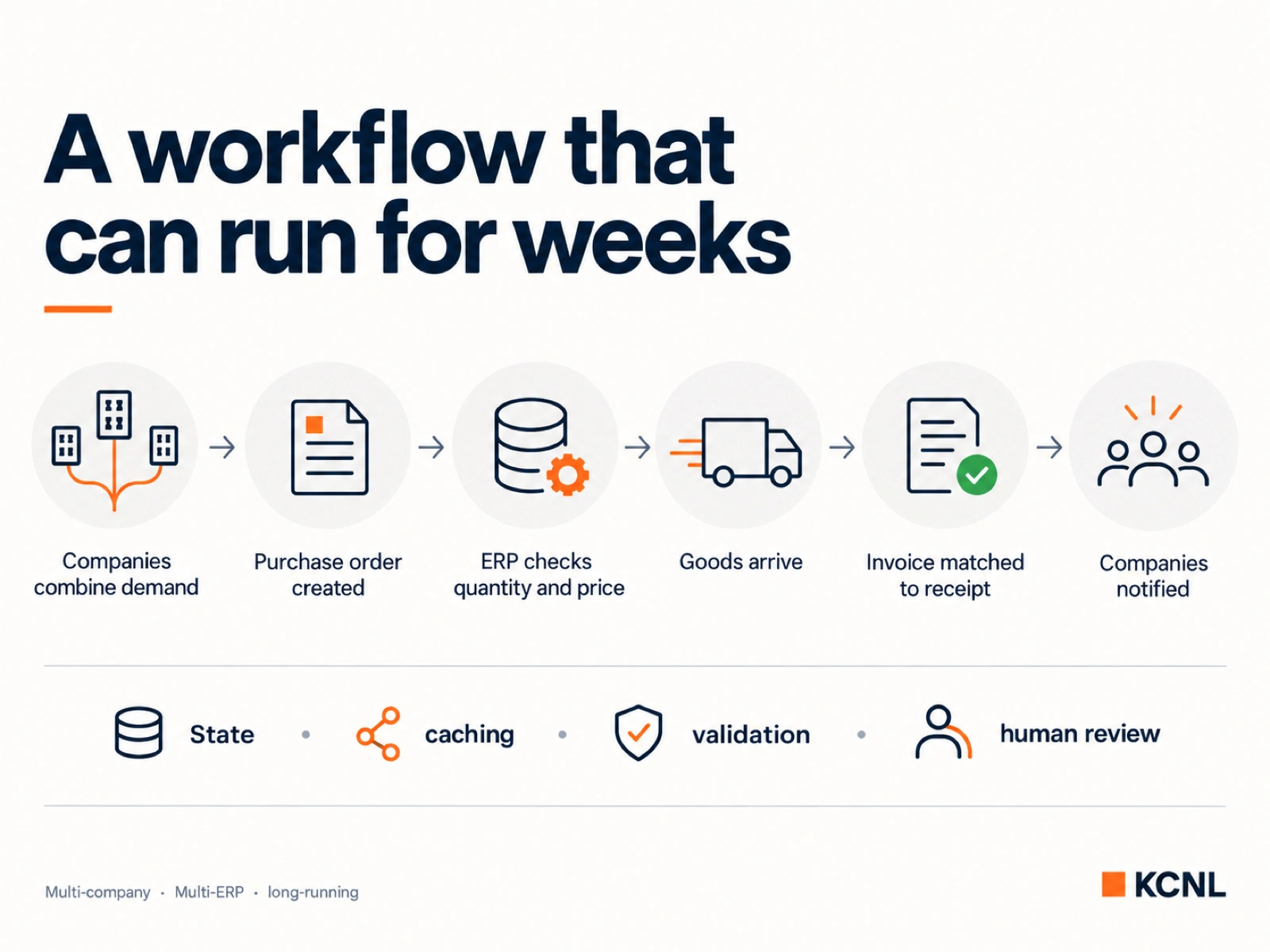
The group-purchasing workflow moves from combined demand to ERP validation, goods arrival, invoice matching and notifications.
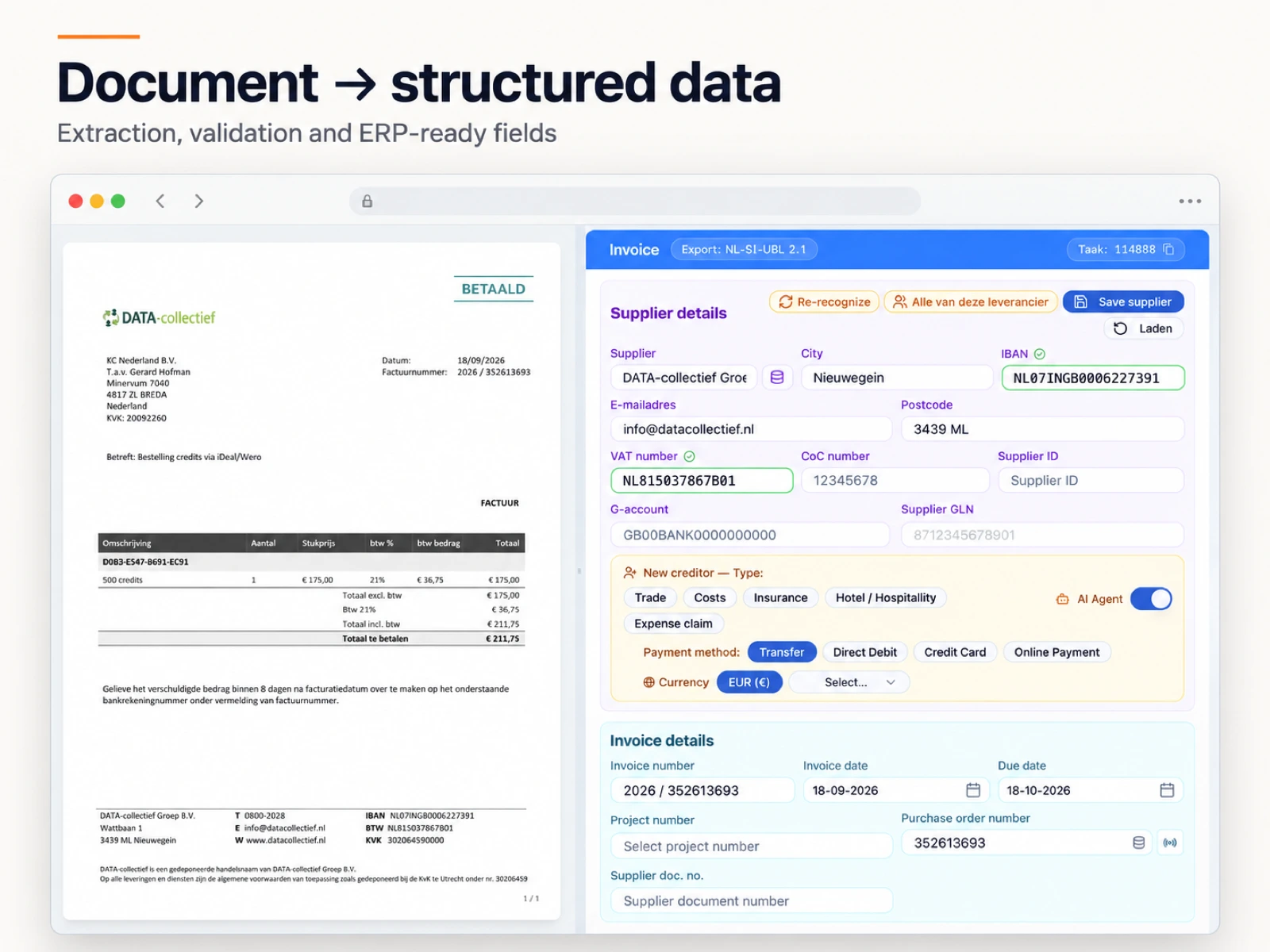
CimOnline turns source documents into structured fields that can be checked before reaching downstream systems.
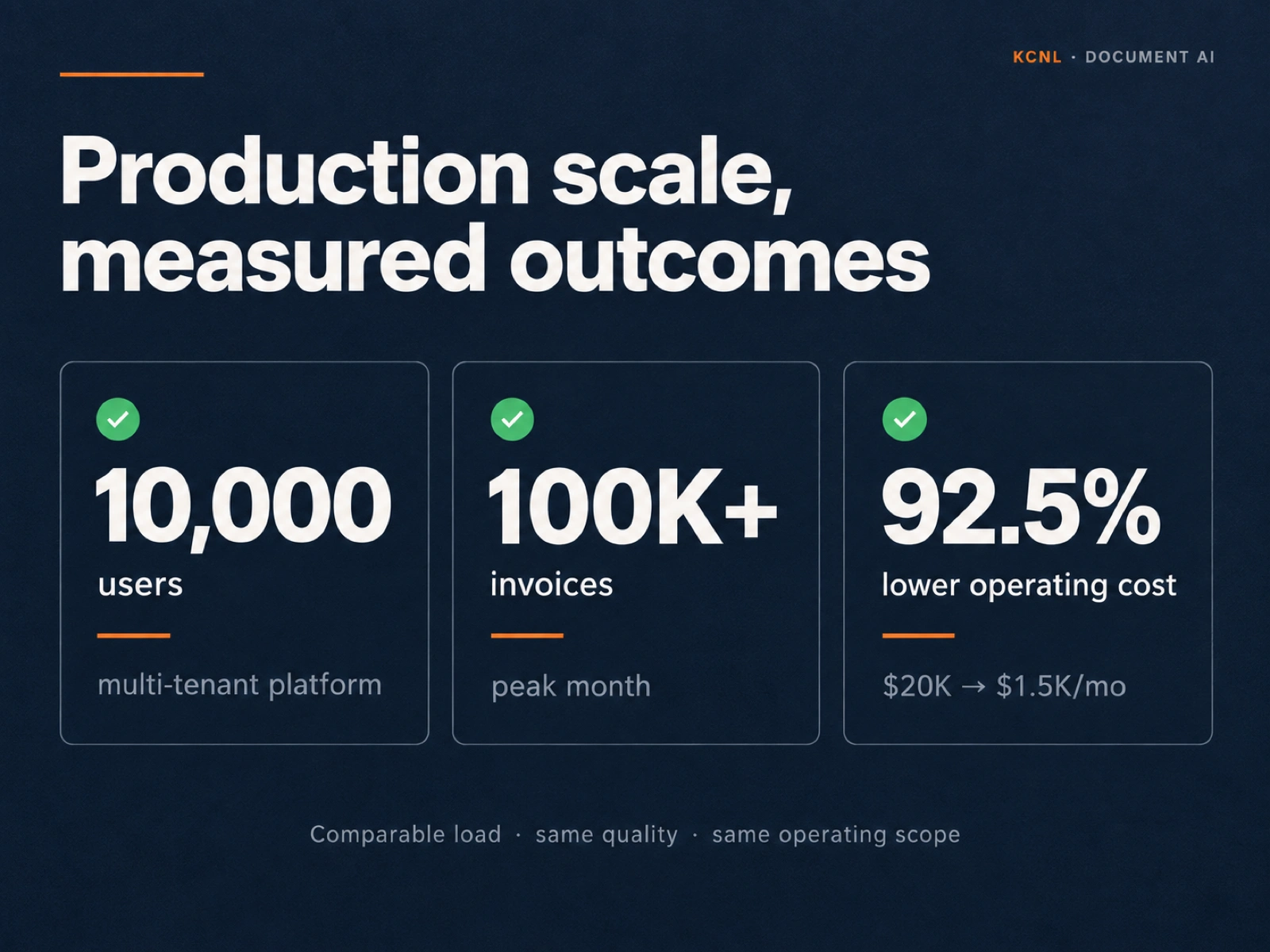
Production scale and measured outcomes: approximately 10,000 users, more than 100,000 invoices during a peak month and a 92.5% reduction in monthly operating cost at comparable load, quality and scope.
The documents are harder than they look
The input can be a text PDF, a scanned document or an image. The system needs to identify the buyer and seller, payment terms, invoice and delivery dates, IBANs, VAT numbers, taxes, prices, totals and line items. Tables may continue across several pages, and suppliers use different formats for the same information.
Reading the text is only part of the job. The output must be structured, checked and safe to pass into another business system. A wrong supplier, total or payment detail can create an accounting problem rather than a minor AI mistake.
Building the processing path
I built the AI and backend APIs behind this process.
The pipeline accepts native PDFs, scans and images. It combines OCR and computer vision with custom models, language models and deterministic validation. The system uses rules when a value has a strict structure or when fields must agree with each other. If it cannot resolve a document safely, the item can move to human review instead of quietly producing a bad result.
The backend also connects extracted information to ERP and CRM systems. The work does not stop at returning structured data. It has to fit into the customer's existing document, accounting and purchasing process.
CimOnline is multi-tenant. Each tenant has separate company data, configuration, integrations, users and processing history. User roles include owner, manager and accountant. The backend keeps those boundaries intact while supporting different document rules and downstream systems for each company.
A purchasing workflow that can run for weeks
One of the more demanding flows supports group purchasing.
Several companies can combine purchases into one large order to reduce freight cost. The system checks the order against each company's ERP data, including products, quantities and vendor prices. It keeps the relevant records while the order is in progress. When the goods arrive, it notifies the participating companies and checks the invoice against what was ordered and received, including quantity, quality and price information.
This is a long-running business process, not one model call. A workflow can remain active for weeks and move through several documents, companies, ERP checks and follow-up actions.
Repeatedly recomputing information made those workflows slower and more expensive. I moved the processing toward a hybrid open-source stack, added caching and reduced unnecessary AI execution. The system could reuse information it had already established instead of paying to calculate it again.
That work reduced monthly operating cost from approximately $20,000 to $1,500, a 92.5% reduction, while handling a comparable production load and maintaining the same quality and operational scope.
Quality and privacy controls
The AI output is not trusted automatically. Deterministic checks validate structured values and relationships between fields. Uncertain cases can move to human review, and a dedicated QA function tests the system against document variations and business scenarios.
The platform also includes access, security and retention controls for GDPR-sensitive business documents. These controls are part of the backend and operational design, alongside tenant isolation and human review.
Results
Approximately 10,000 users across the multi-tenant platform.
More than 100,000 invoices processed during a peak month, in addition to other document types.
Monthly operating cost reduced from about $20,000 to $1,500 at comparable load, quality and scope.
A 92.5% cost reduction, equal to roughly $18,500 in monthly operating savings.
One backend supporting separate company data, roles, configurations and integrations.
A long-running purchasing workflow that coordinates documents and ERP checks across participating companies.
Almost five years of continuous development, starting before the current LLM era and continuing today.
After almost five years on this product, my main takeaway is practical: document AI cannot be separated from backend engineering. Validation, integrations, review paths, tenant isolation and failure handling determine whether the model is useful in production.
Related service
I help teams build and improve document-AI systems that need to work with real business data, existing software and production constraints.
Like this project
Posted Sep 22, 2026
Built KCNL's multi-tenant document AI and backend, processing 100K+ invoices at peak while cutting monthly operating cost from $20K to $1.5K.