MedMatch: Deployed Healthcare Voice Agent

Muhammad Haseeb

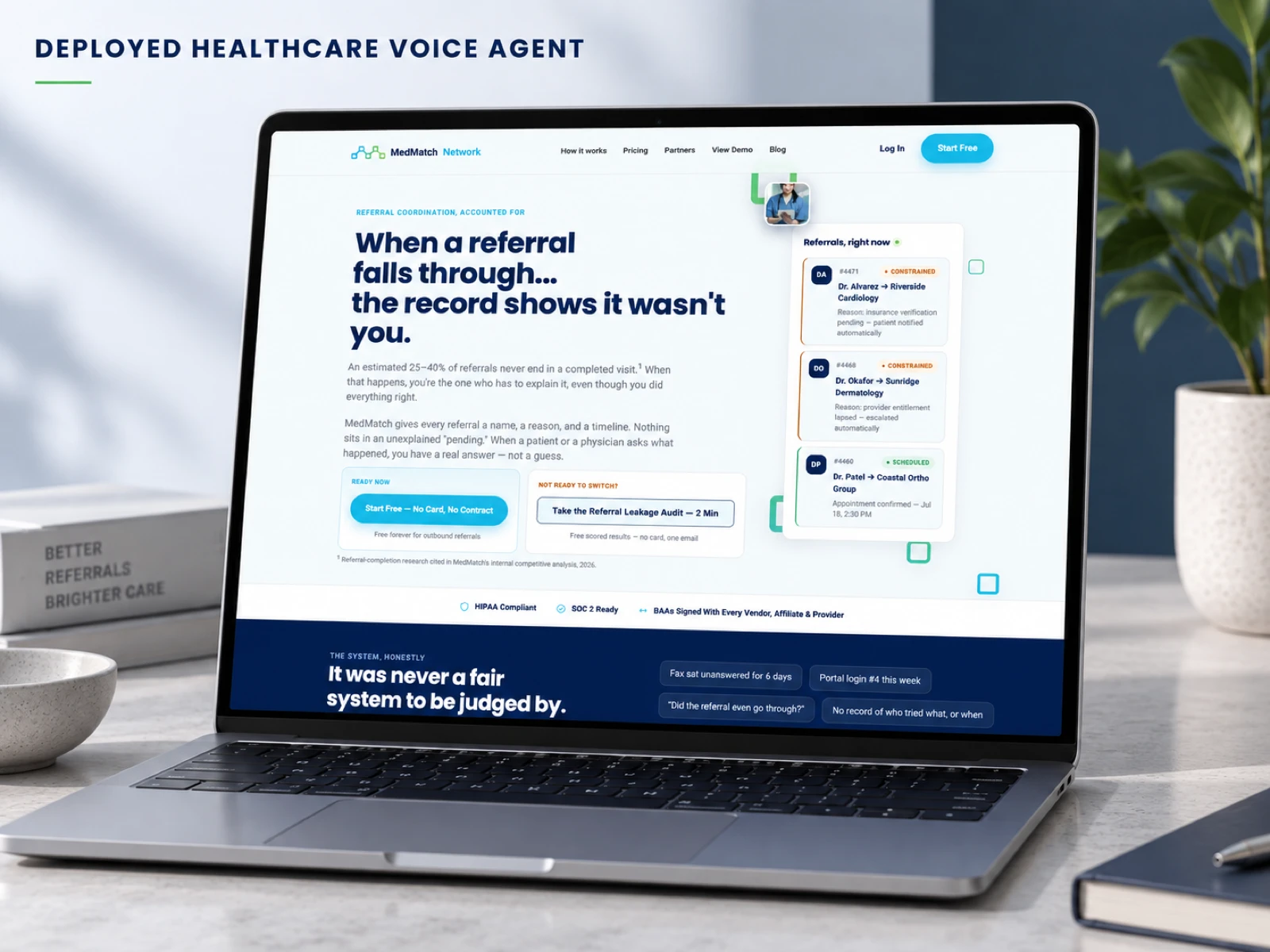
Building MedMatch's deployed voice agent for healthcare follow-ups
Healthcare follow-up rarely happens through one channel. A reminder may begin with a phone call, continue by SMS, and require an email or fax before the case can move forward. When a doctor has not responded or an expected action is missing, someone still needs to identify the gap and initiate the next step.
MedMatch wanted to automate more of this routine communication without losing the context, traceability, and human oversight that healthcare workflows require.
The CEO hired me directly. I have worked with the company for more than six months and remain involved today. My first responsibility was building the voice agent. My role has since expanded to reviewing work from other developers, finding production risks, and helping the engineering team improve quality before new features are released.
The difference between a voice demo and a production system
A voice demo can place a call and read a script. A production agent needs to handle everything that happens once a real person or phone system answers.
It has to know why it is calling, load the relevant context, respond when someone interrupts, and keep the conversation focused on the intended task. It also needs sensible behavior for voicemail, automated phone menus, missing information, failed attempts, and retries.
The result of the call cannot disappear when the conversation ends. The system needs to record what happened, write back a structured outcome, and make the next action available to the rest of the MedMatch workflow.
For MedMatch, the common use cases include reminders and status follow-ups. The agent can notify someone about the current state of a referral, follow up when a doctor has not responded, or identify an expected action that is still missing.
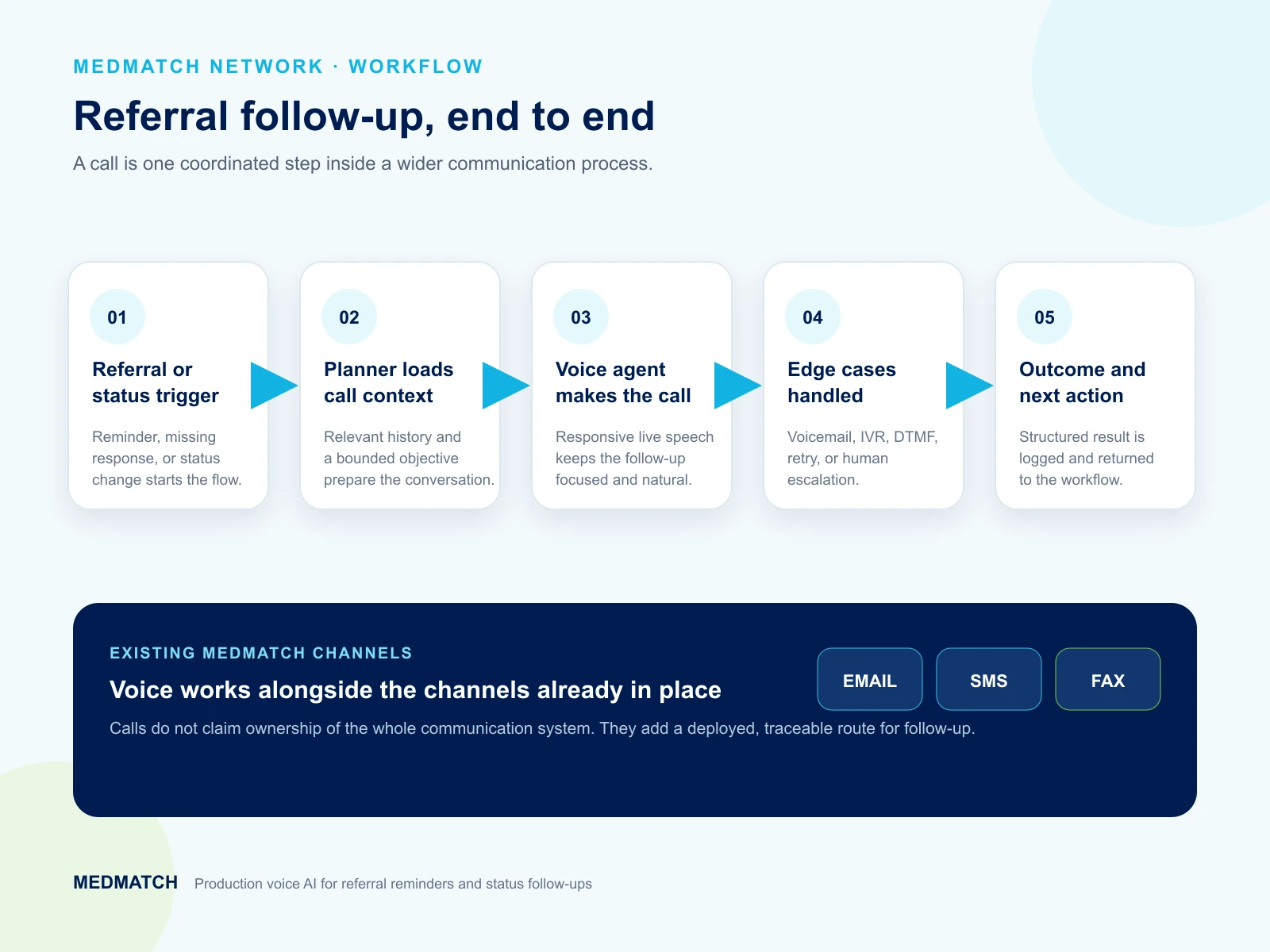
The follow-up path starts with a referral or status trigger, prepares call context, handles the conversation and telephony edge cases, then records the outcome and next action. Email, SMS, and fax continue as existing parallel channels.
What I built
I built and deployed the voice-agent system responsible for initiating and managing these outbound conversations.
The implementation covers SIP calling, real-time speech-to-text, text-to-speech, LLM orchestration, contextual call planning, and conversational memory. I also built the operational paths that turn a prototype into a usable production system: voicemail handling, IVR and DTMF interaction, eligibility and retry logic, database context, structured post-call actions, and audit logging.
Before each call, the planner assembles the relevant context and a clear objective. During the conversation, the agent uses that context to respond naturally while staying within the purpose of the call. Afterward, it converts the interaction into a structured outcome that the wider MedMatch workflow can use.
The current context-aware version is deployed and working in production.
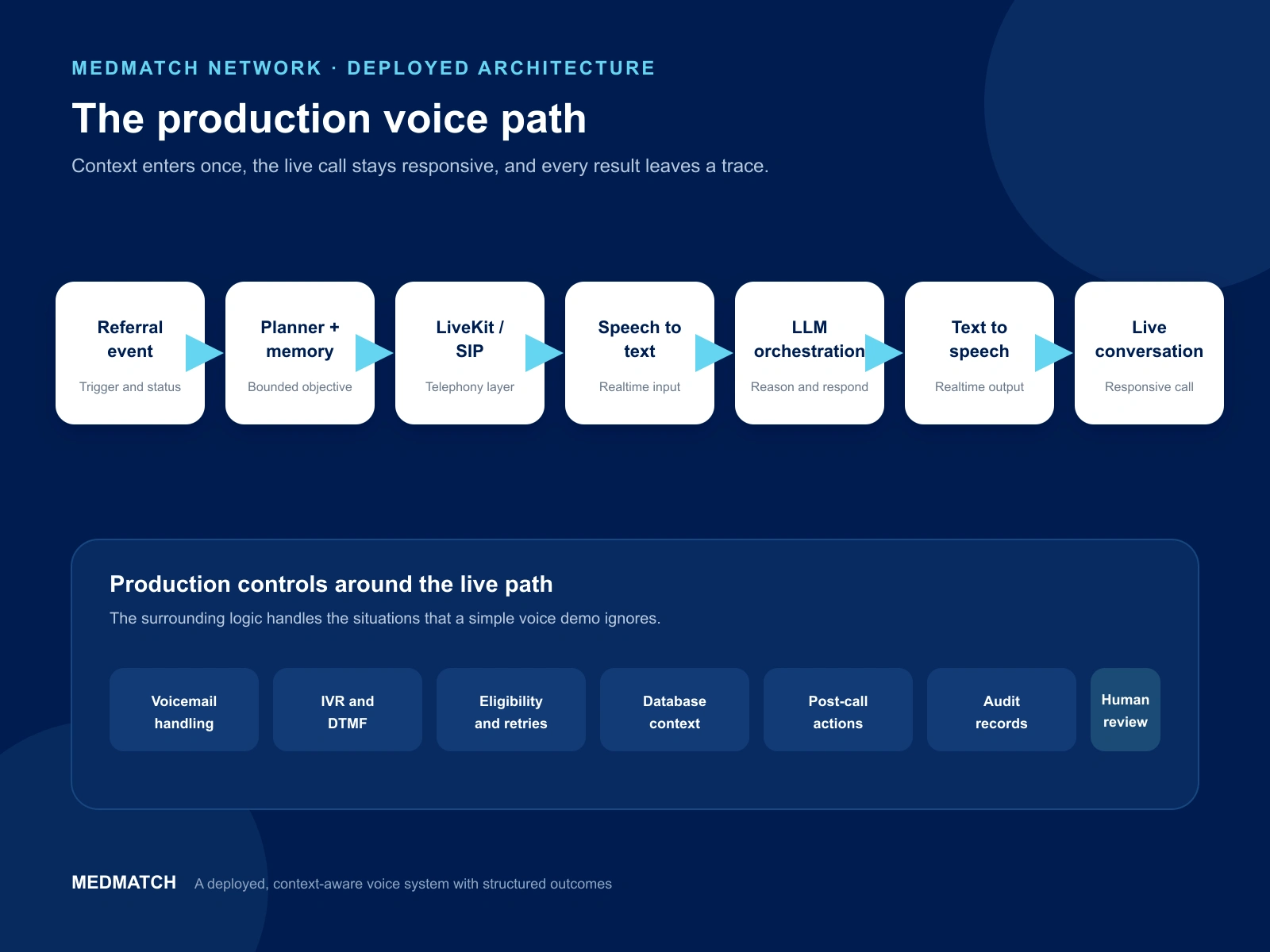
The deployed voice path combines call planning, memory, SIP telephony, live speech processing, LLM orchestration, post-call actions, audit records, and human escalation.
One channel inside a wider workflow
The voice agent does not replace MedMatch's other communication systems. It operates alongside existing email, SMS, and fax workflows.
That gives the platform more than one way to reach the relevant person. It also means a referral does not depend entirely on one successful phone conversation. Calls and other outreach can run in parallel, while outcomes remain available to the systems and people responsible for the next step.
When a situation requires judgment or cannot be resolved automatically, the workflow can surface it for human attention. The goal is to automate routine follow-up while keeping people involved where their judgment matters.
Working inside MedMatch's healthcare controls
MedMatch operates the product within its HIPAA-compliant environment, with BAAs and health-information processing controls already in place. My voice-agent work had to fit inside those controls.
That influenced how call context, conversation state, structured outcomes, and audit records were handled. The system needed to be useful during a live conversation and traceable after it ended, without treating sensitive healthcare information like ordinary application data.
From voice-agent development to production oversight
My work with MedMatch now extends beyond the voice agent.
I review code written by other developers, reproduce bugs, identify architecture and reliability problems, and give the team direction on what needs to change before a feature is production-ready. I do not claim ownership of the whole MedMatch platform. My responsibility is the voice system I built and the engineering review I now provide across the wider product.
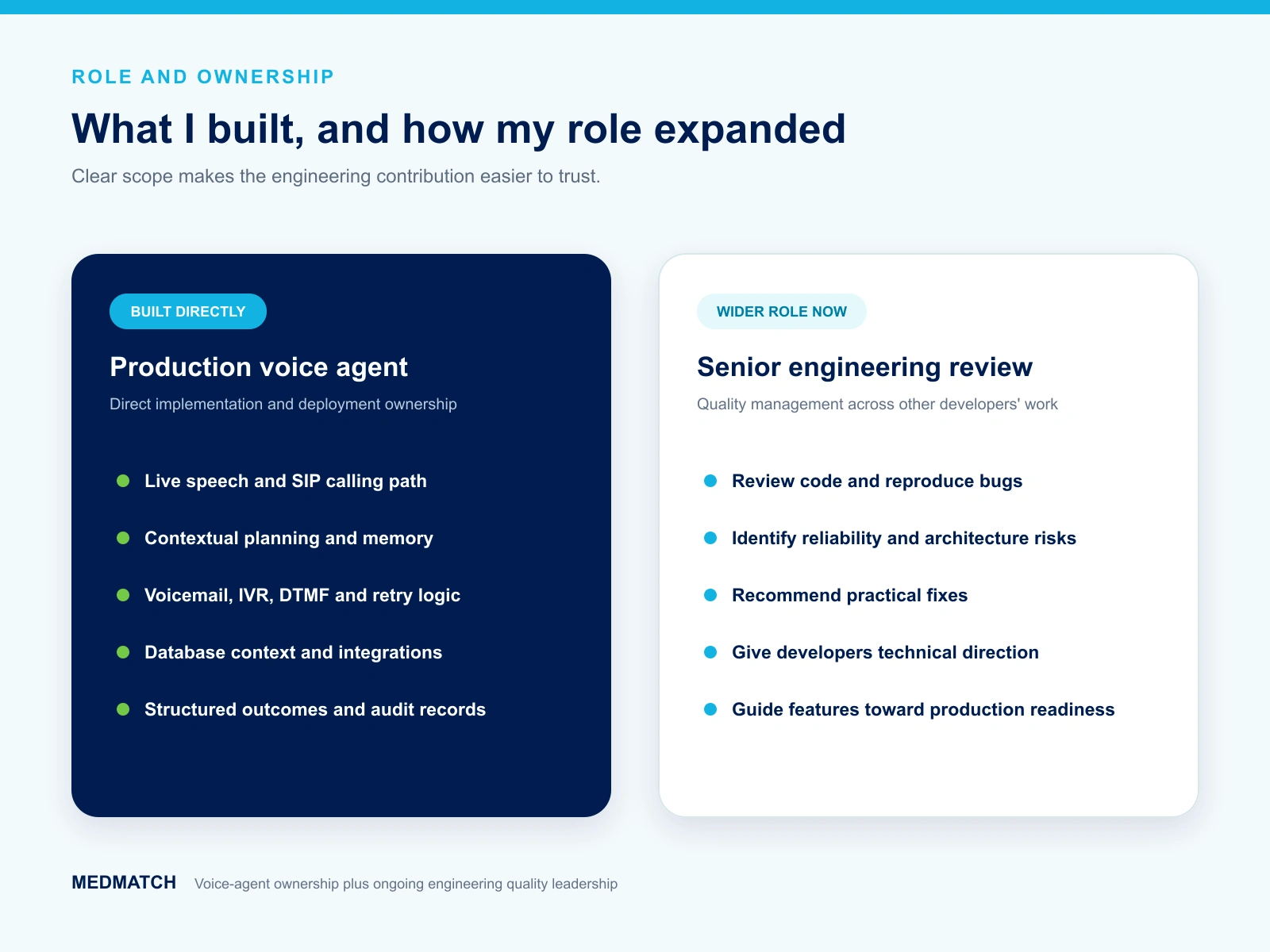
My direct ownership is the deployed voice system. My wider role is senior review: finding bugs and production risks, recommending fixes, and guiding other developers toward production readiness.
The result is a deployed voice channel that can manage contextual reminders and status follow-ups, work alongside MedMatch's existing communication channels, handle real telephony edge cases, and leave a structured record for the next person or system in the workflow.
If you are building a voice agent that must work reliably inside a real operational process, I can help design, implement, and harden it for production.
Like this project
Posted Sep 23, 2026
Built and deployed a context-aware voice agent for healthcare follow-ups, with SIP calling, structured outcomes, and human escalation.