Keji | AI Wellbeing Companion for Young Women

Grace Ajayi

Keji
For the Girl who Needs a Growth Companion
An AI wellbeing companion designed to support young women as they navigate adulthood, discover themselves, and grow into the women they want to become.
The Story Behind Keji
Growing up comes with questions that don't always have easy answers.
Who am I becoming? Am I making the right decisions? How do I know when I'm ready for love? How do I stand up for myself, manage my responsibilities, and build a life that feels like mine?
For many young women, the transition into adulthood brings new freedoms alongside new uncertainties. Relationships become more complicated. Decisions carry greater weight. Expectations grow, and the pressure to have everything figured out can become overwhelming.
Sometimes, you need someone to talk to. Someone who can help you organise your thoughts, look at a situation differently, or find the courage to take the next step.
This is where the idea for Keji begins.

The Meaning Behind the Name
In Yoruba culture, names often carry stories of family, hope, gratitude, and the circumstances surrounding a child's arrival.
Keji draws inspiration from Morenikeji, a Yoruba name associated with the feeling of having found a companion. It can express the joy of welcoming a precious child, particularly after a long period of waiting.
This meaning became the heart of the concept.
I wanted Keji to represent the feeling of having someone to turn to while navigating life's uncertainties. For young women finding their way through adulthood, that companionship could mean having space to ask questions, explore difficult feelings, build confidence, and make sense of who they are becoming.
The name connects a cultural expression of cherished companionship with a modern idea: an everyday AI companion designed to support personal growth.
The Design Challenge
How might we design an AI wellbeing companion that helps young women navigate everyday challenges with greater confidence, clarity, and self-awareness?
The challenge was to shape an experience that feels approachable enough for personal conversations while remaining practical and easy to use.
Keji needed to give users several ways to engage with the product, whether they wanted to talk through a difficult situation, express themselves aloud, find a little encouragement, or reflect on their personal goals.
The experience also needed a clear visual identity that could communicate warmth, confidence, and femininity without losing readability or usability.
Design Goals
1. Encourage self-expression: Make it easy for users to begin a conversation, even when they don't know how to explain what they are feeling.
2. Support personal growth: Create opportunities for reflection, self-care, confidence-building, and practical next steps.
3. Make interaction feel natural: Offer both text and voice as ways to communicate with Keji.
4. Build a recognisable identity: Develop a visual language that feels personal, expressive, and consistent across the app.
5. Keep the experience simple: Use familiar navigation, clear actions, and readable layouts to reduce friction.
Understanding the Intended Audience
Keji is designed for young women who are finding their footing in adulthood.
They may be navigating their first serious relationship, learning to set boundaries, making career decisions, managing money, building independence, or figuring out what they want their lives to look like.
Their circumstances differ, but they may share a desire to understand themselves better and feel more confident in their choices.
What they may need
A space to think clearly
A place to explore a problem, organise thoughts, and consider possible next steps.
An approachable experience where they can express uncertainty and ask questions they may find difficult to raise elsewhere.
Useful prompts and manageable actions that help turn reflection into everyday progress.
Room to grow independently
Support that encourages users to develop their own judgement, recognise their values, and make decisions that reflect their needs.
These are the needs I designed the concept around. They represent my initial product assumptions and would need to be explored further through user interviews and usability testing.

Defining the Product Experience
I shaped Keji around three connected ideas: conversation, self-discovery, and personal growth.
Conversation
Users can interact with Keji through text or voice. The experience is designed to feel approachable, allowing users to start with a simple question and explore a topic at their own pace.
Self-discovery
Conversation prompts help users explore topics such as confidence, relationships, boundaries, self-care, and decision-making. These prompts also give users an easy starting point when they are unsure what to say.
Personal growth
The concept includes opportunities to save reflections, establish personal goals, create routines, and revisit plans. These features are intended to help users carry useful insights into their everyday lives.
Together, these ideas shape Keji as a companion for the everyday moments in which a little clarity can help someone move forward.
The Five-Screen Experience
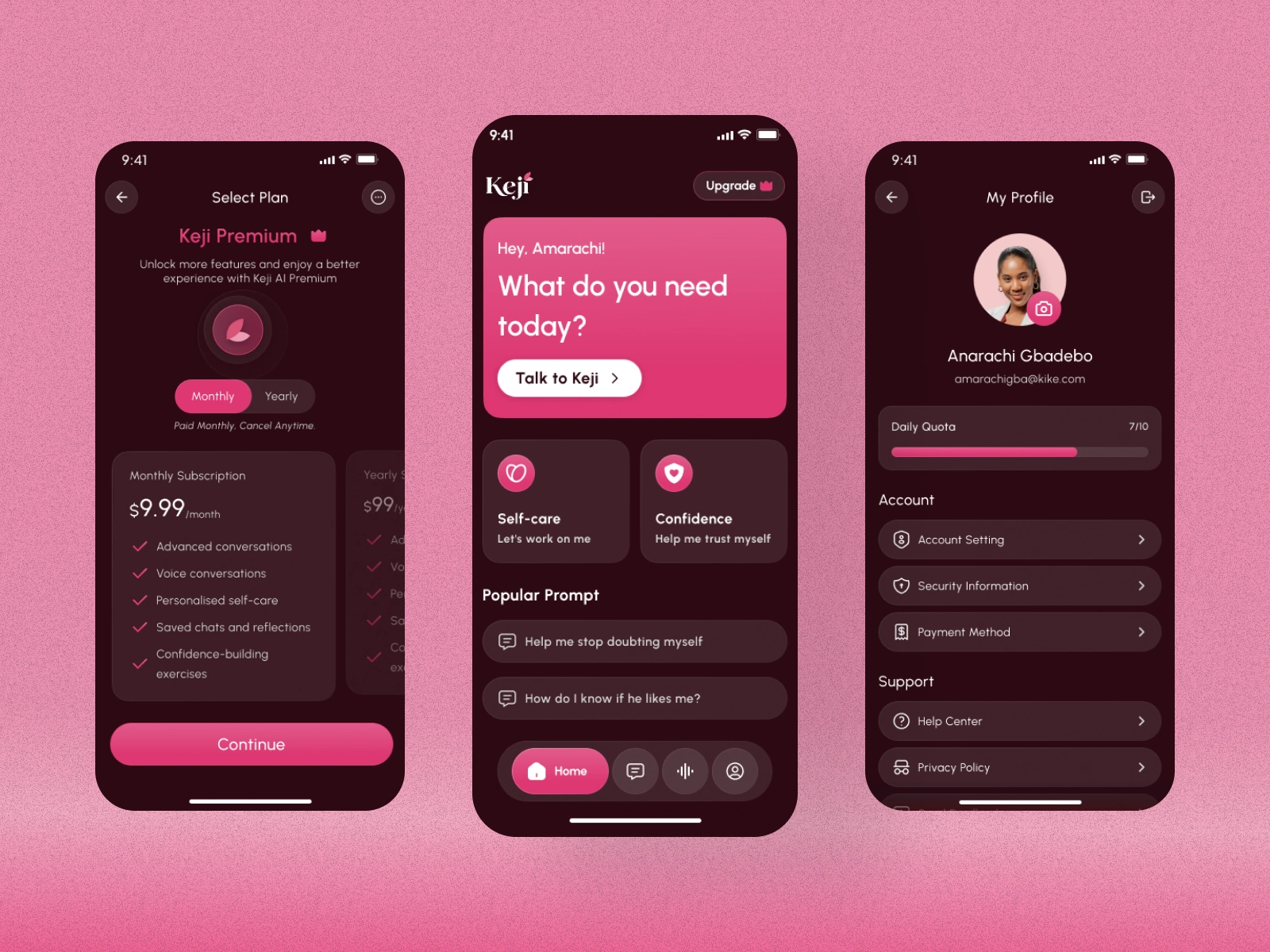
I adapted an existing five-screen mobile app template and reworked its content, visual direction, and product concept to develop Keji. The original structure provided a starting point for exploring how the experience could work.
Each screen has a specific role within the proposed user journey.
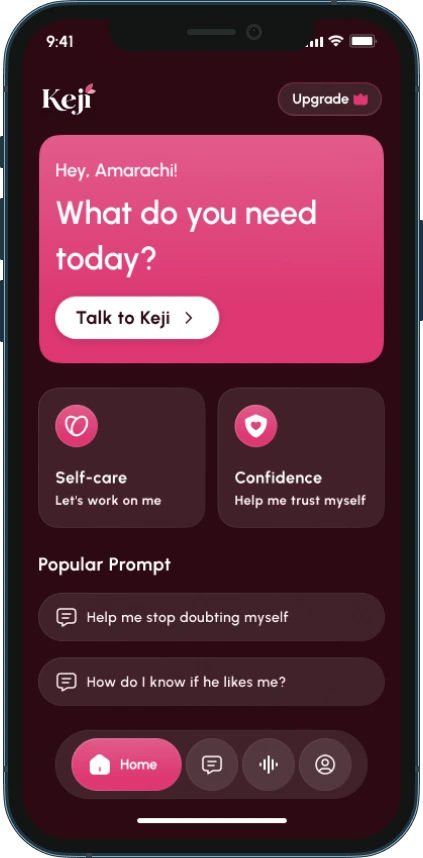
Home - A place to begin
The home screen is designed to welcome users and help them decide what they need in the moment.
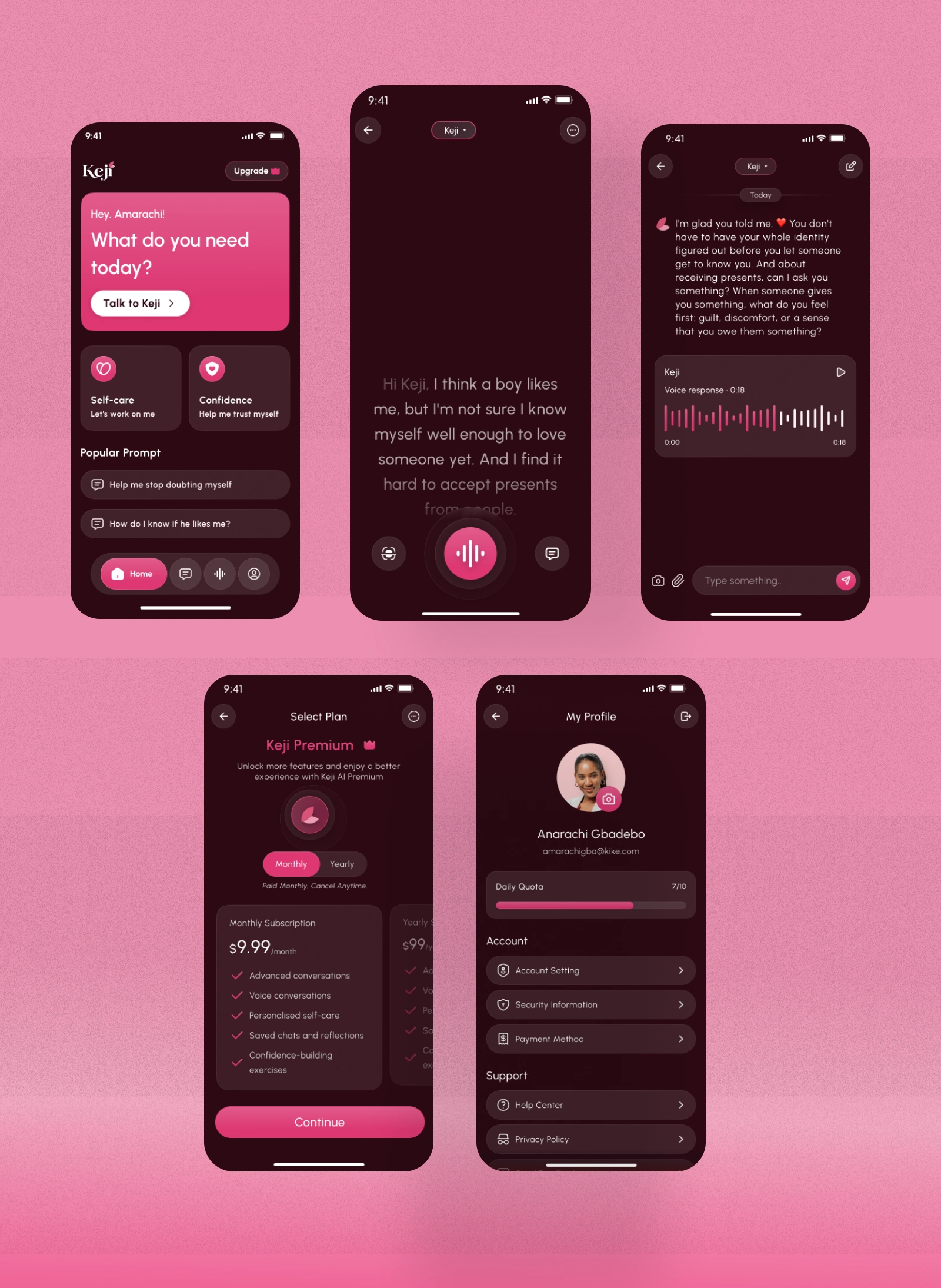
The greeting, “Hey, Amarachi! What do you need today?”, makes the experience feel personal. A prominent “Talk to Keji” button provides a clear starting point, while the self-care and confidence cards introduce common areas of support.
Popular prompts such as “Help me stop doubting myself” and “How do I know if he likes me?” give users concrete ways to begin a conversation.
Design intention: Reduce the effort required to get started and help users find a relevant entry point into the experience.
Voice AI - Space to speak freely
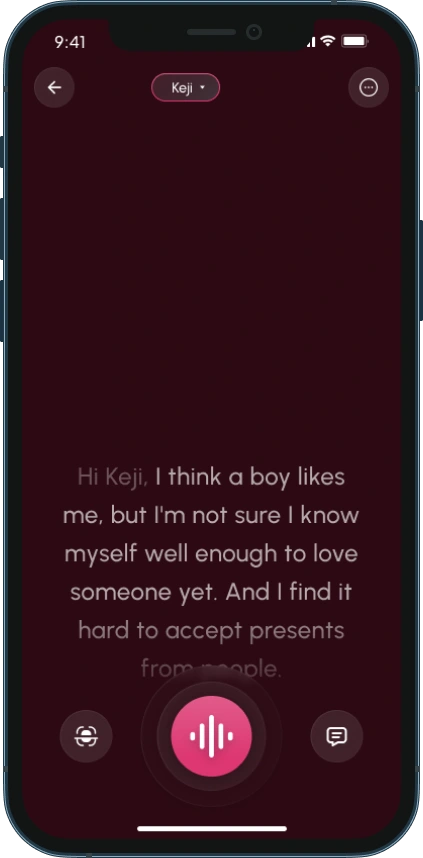
Sometimes, typing out a difficult feeling takes more effort than saying it aloud.
The Voice AI screen explores a more conversational way to interact with Keji. A central microphone control gives the interaction a clear focus, while the spoken prompt and audio feedback help communicate the state of the experience.
For example, a user might say:
“Hi Keji, I think a boy likes me, but I don't think I know who I am enough to love someone yet. And I have a hard time receiving presents.”
This kind of conversation introduces the personal, everyday situations Keji is intended to support.
Design intention: Make voice interaction feel approachable and give users another way to express themselves.
Chat Bot - Working through the question
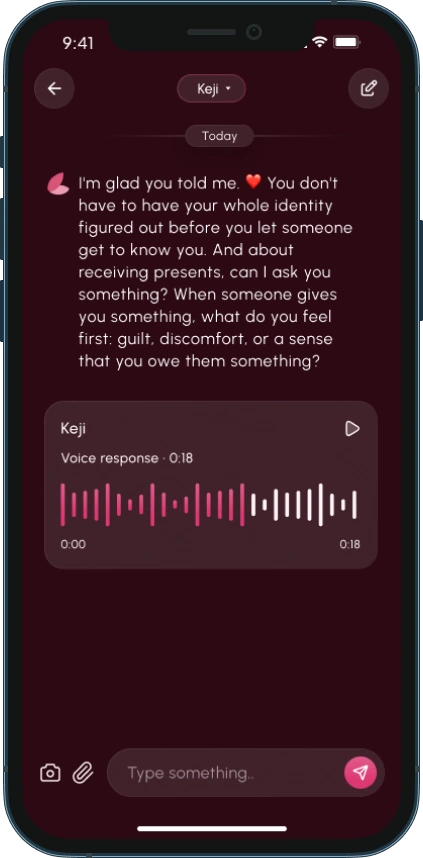
The chat screen is where a user can explore a concern in more detail.
Rather than presenting a list of generic answers, the concept explores a conversational exchange in which Keji acknowledges what the user shares, asks thoughtful follow-up questions, and helps her consider what might be happening.
For example, a conversation about finding it difficult to receive gifts could explore whether the user feels guilty, uncomfortable, or worried about owing something in return.
The intention is to help her understand her own feelings and consider her options at her own pace.
Design intention: Use conversational interaction to support reflection, while keeping the user in control of her decisions.
Pricing Plans - Making the options clear
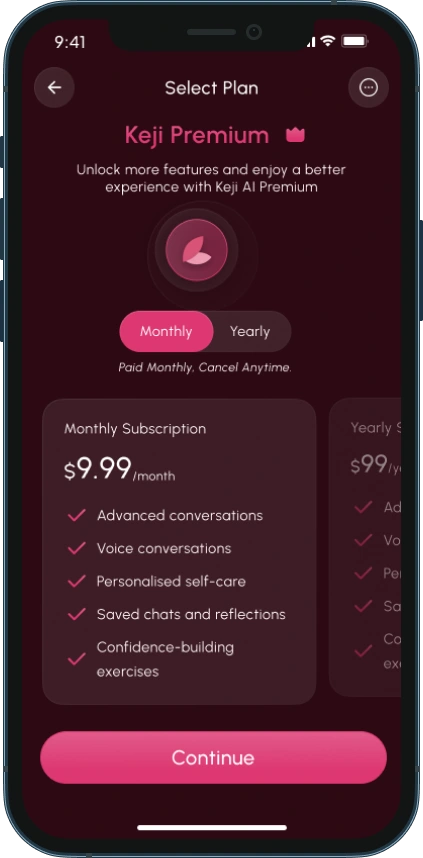
The pricing screen explores how a free experience and a premium subscription might coexist.
The monthly and yearly billing options follow a familiar subscription pattern. Keji Free offers a starting point for everyday conversations and basic self-care prompts, while Keji Plus proposes additional features such as higher conversation limits, voice interactions, saved reflections, personalised routines, and personal growth plans.
The comparison is designed to help users understand what each plan offers before making a decision.
Design intention: Present the proposed subscription options clearly, with benefits that relate directly to Keji's purpose.
The pricing and subscription features are illustrative and would require further product and business decisions.
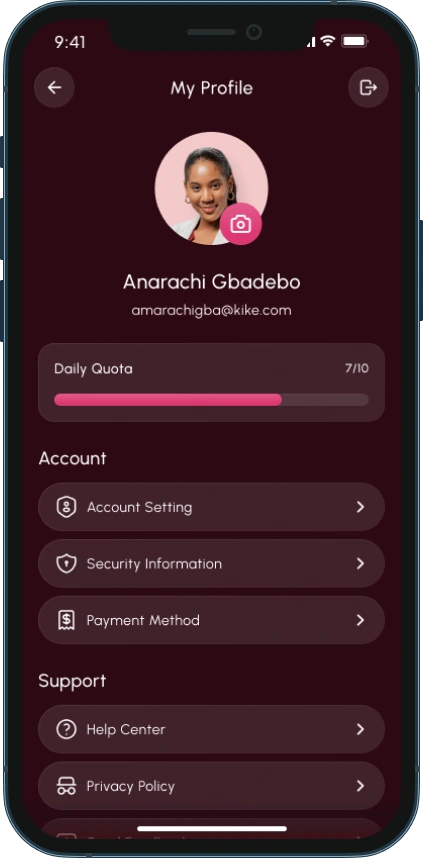
Profile - Making the experience personal
The profile screen brings personal preferences and account settings together in one place.
The proposed sections include personal details, growth goals, saved reflections, reminders, privacy and security, and subscription management.
These features support the idea that a user's experience with Keji can develop around her own priorities and routines.
Design intention: Make important settings easy to find and give users control over their personal experience.
Visual Identity and Art Direction
I wanted Keji's visual identity to feel feminine, confident, warm, and expressive.
The visual direction uses rich burgundy backgrounds, vibrant pink accents, rounded cards, and elegant typography. The darker surfaces create depth, while the brighter pink elements draw attention to important actions and interactive controls.
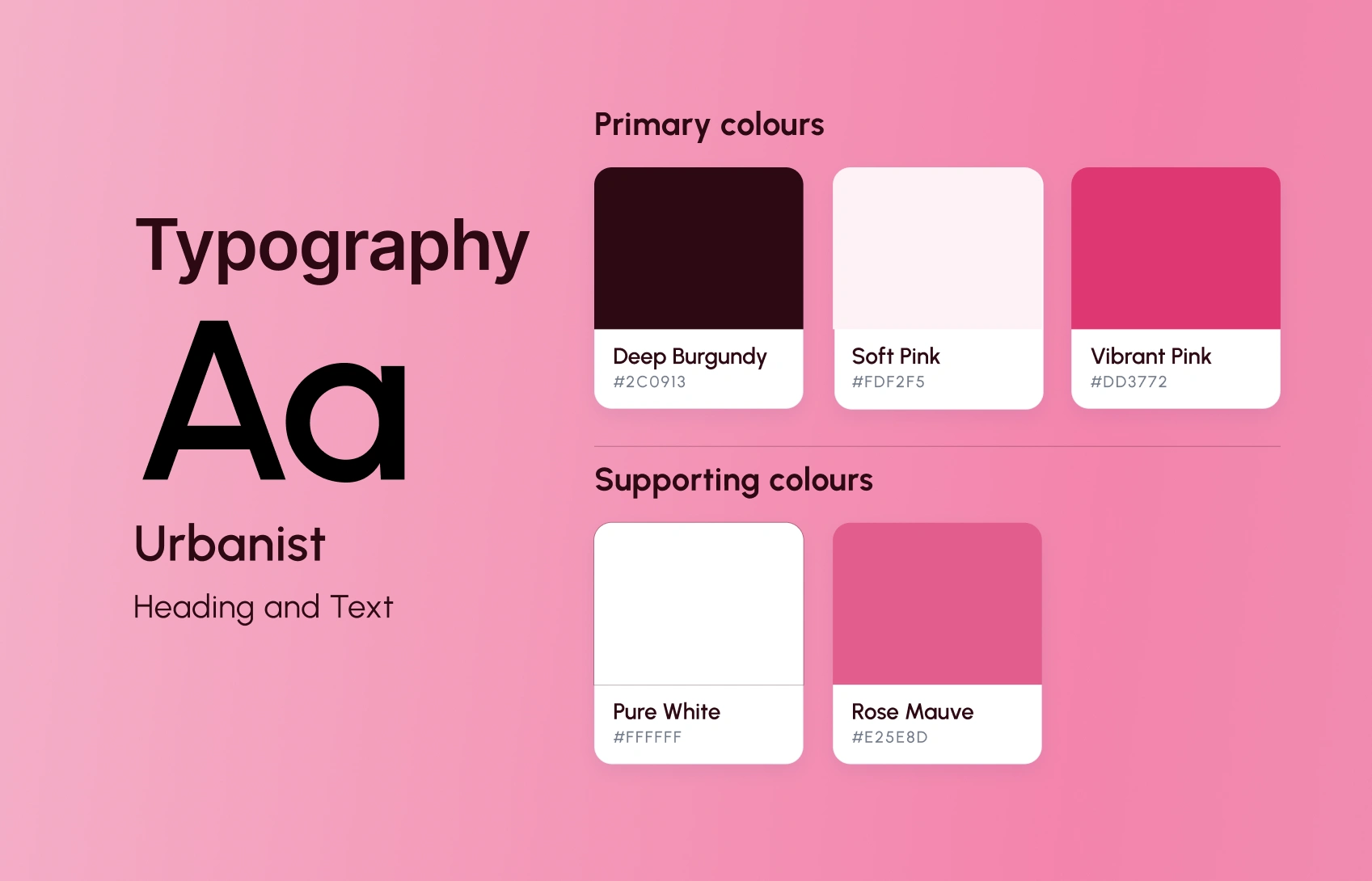
Colour palette
Deep burgundy: Provides depth and gives the interface a strong visual foundation.
Vibrant pink: Highlights primary actions, voice controls, and selected interface elements.
Soft blush: Adds warmth and supports the more personal side of the experience.
White: Creates contrast and helps important text remain readable against the darker backgrounds.
The colours work together to create a consistent visual identity across the five screens.
Typography
The Urbanist typeface combines an elegant serif style for the Keji wordmark with clean, rounded sans-serif text for the interface.
This creates a balance between brand personality and everyday usability. The logo brings character to the identity, while the interface typography supports clear reading across headings, messages, buttons, and navigation.
Components and layout
Rounded cards, pill-shaped controls, simple icons, and consistent spacing help establish a recognisable interface pattern.
The home screen uses a prominent feature card to establish the main action. The conversation screens prioritise message content and interaction controls. The pricing screen uses separate plan cards, while the profile screen groups related settings into clear rows.
These decisions help the screens feel connected while allowing each one to serve a different purpose.
Interaction and Content Design
Keji's personality is an important part of the proposed experience.
I explored a voice that feels confident, direct, and empowering. The language should acknowledge what the user shares, ask useful questions, and help her identify a manageable next step.
For example, when a user expresses uncertainty about a relationship, Keji might respond:
“You don't have to have everything figured out to get to know someone. Let's talk about what makes receiving gifts difficult for you.”
This approach keeps the conversation focused on the user's experience. It gives her room to explore her feelings instead of rushing her toward a decision.
The interface content follows the same principle. Prompts are written in everyday language, actions use clear labels, and the home screen offers specific starting points rather than leaving users with an empty chat field.
For a real product, these conversational behaviours would need further design and evaluation to ensure the AI responds appropriately, respects boundaries, and handles sensitive topics responsibly.
Designing for Trust and User Control
Because Keji is intended to support personal conversations, trust would be an essential part of the product experience.
The proposed design should make it easy for users to understand their settings, manage saved conversations, and control reminders. Privacy information should be accessible, and users should be able to choose whether to use text or voice.
The AI would also need clear boundaries. Keji could support reflection and everyday wellbeing, but it should not present itself as a replacement for professional mental health care or trusted human relationships. When a conversation involves serious distress or safety concerns, the product would need appropriate safeguards and guidance.
These considerations form part of the direction for future development rather than validated capabilities of the current concept.
Scope of the Project
This was a self-initiated UI/UX concept developed in Figma.
I began with an existing five-screen mobile interface template and adapted it to explore a different product idea. My work focused on developing the Keji concept, refining its content and visual direction, and reworking the screens to support the proposed user experience.
The project covers five screens:
- Home
- Voice AI
- Chat Bot
- Pricing Plans
- Profile
The current work explores the visual interface and proposed product experience. It does not represent a fully implemented AI application.
Further work would include validating the concept with young women, testing the main conversation flows, refining accessibility, exploring additional user journeys, and evaluating whether the proposed features address the audience's needs.
Reflection and Next Steps
Keji gave me an opportunity to explore how a product's purpose can shape its interface, language, and visual identity.
The project reinforced the importance of thinking beyond individual screens. The home screen needs to help users begin, the conversation needs to feel considered, the subscription page needs to communicate value, and the profile needs to support user control. Each part contributes to the overall experience.
It also highlighted an important next step: validating the idea with the people it is intended to serve. Conversations with young women could help me understand how they currently seek support, what they would feel comfortable sharing with an AI companion, and which features would be genuinely useful in their daily lives.
I would use those insights to refine the product concept, test the main user journeys, and explore how Keji could encourage healthy, sustainable personal growth.
Keji. Your everyday companion.
For the girl who needs a growth companion.
Like this project
Posted Oct 19, 2026
A UI/UX concept exploring how an AI companion can help young women navigate adulthood, build confidence, and grow into themselves.
Likes
0
Views
2