
What happens when a story's visual language becomes something you can wear?
Translating a Visual Narrative into Wearable Art
Project Type: Merchandise Concept Development, Creative Direction, Apparel Design
Focus: Visual Storytelling, Design Adaptation, Production Feasibility
Overview
The Smallest Thing is an independent literary and visual publication exploring the disproportionate shapes love takes, particularly the ways ordinary gestures, objects, and moments acquire extraordinary significance.
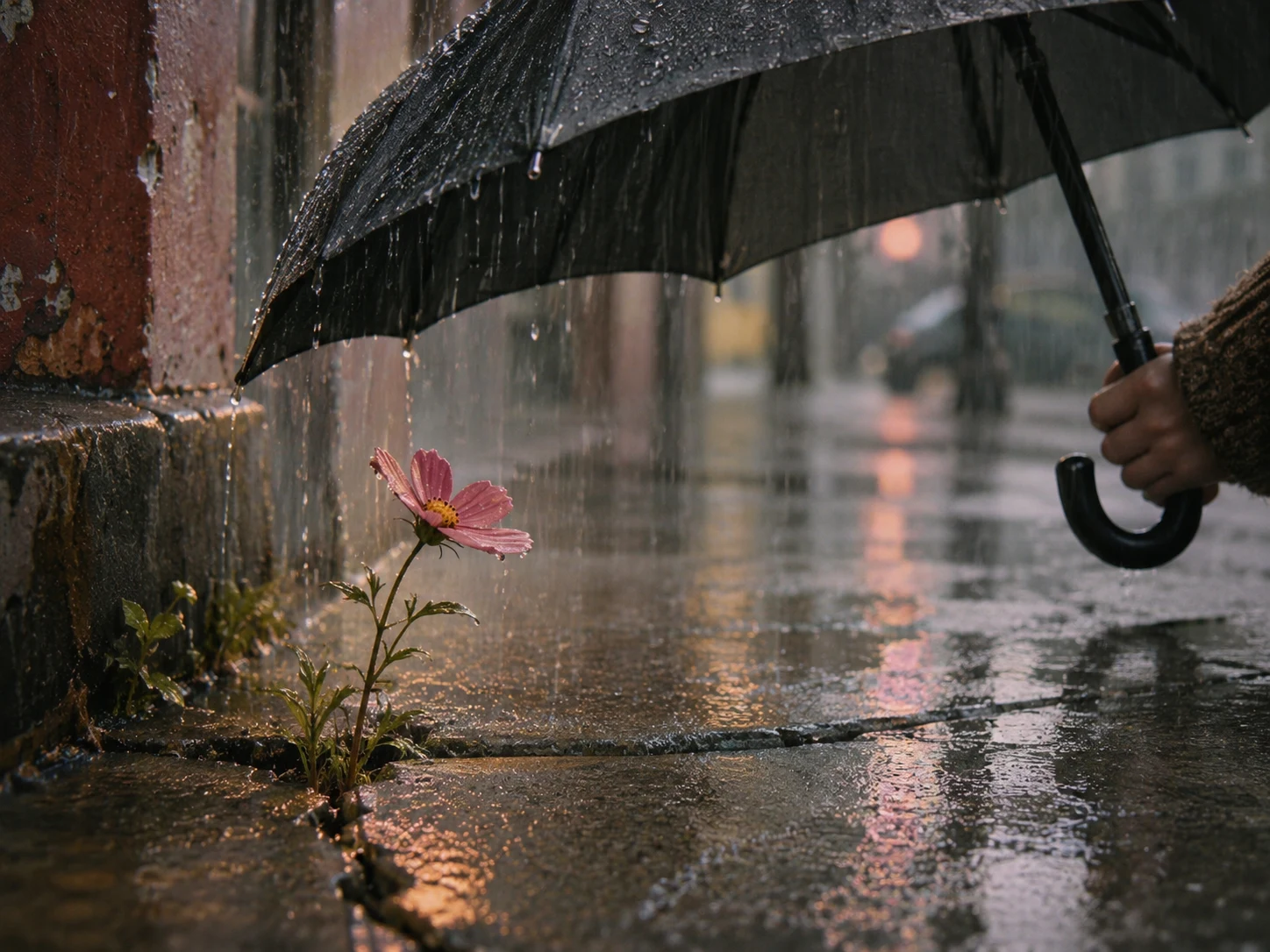
One of its central visual narratives begins with a flower emerging through a crack in the pavement. A passerby notices it and holds an umbrella over it. The flower blooms, others follow, and eventually the entire street is transformed.
The merchandise concept began with a question: How could that story become something wearable without becoming ordinary branded merchandise?
Rather than reproducing a frame from the film on a hoodie, the goal was to translate the story's underlying visual behavior into the garment itself.
The flowers wouldn't simply decorate the clothing. They would appear to grow across it.
The Creative Challenge
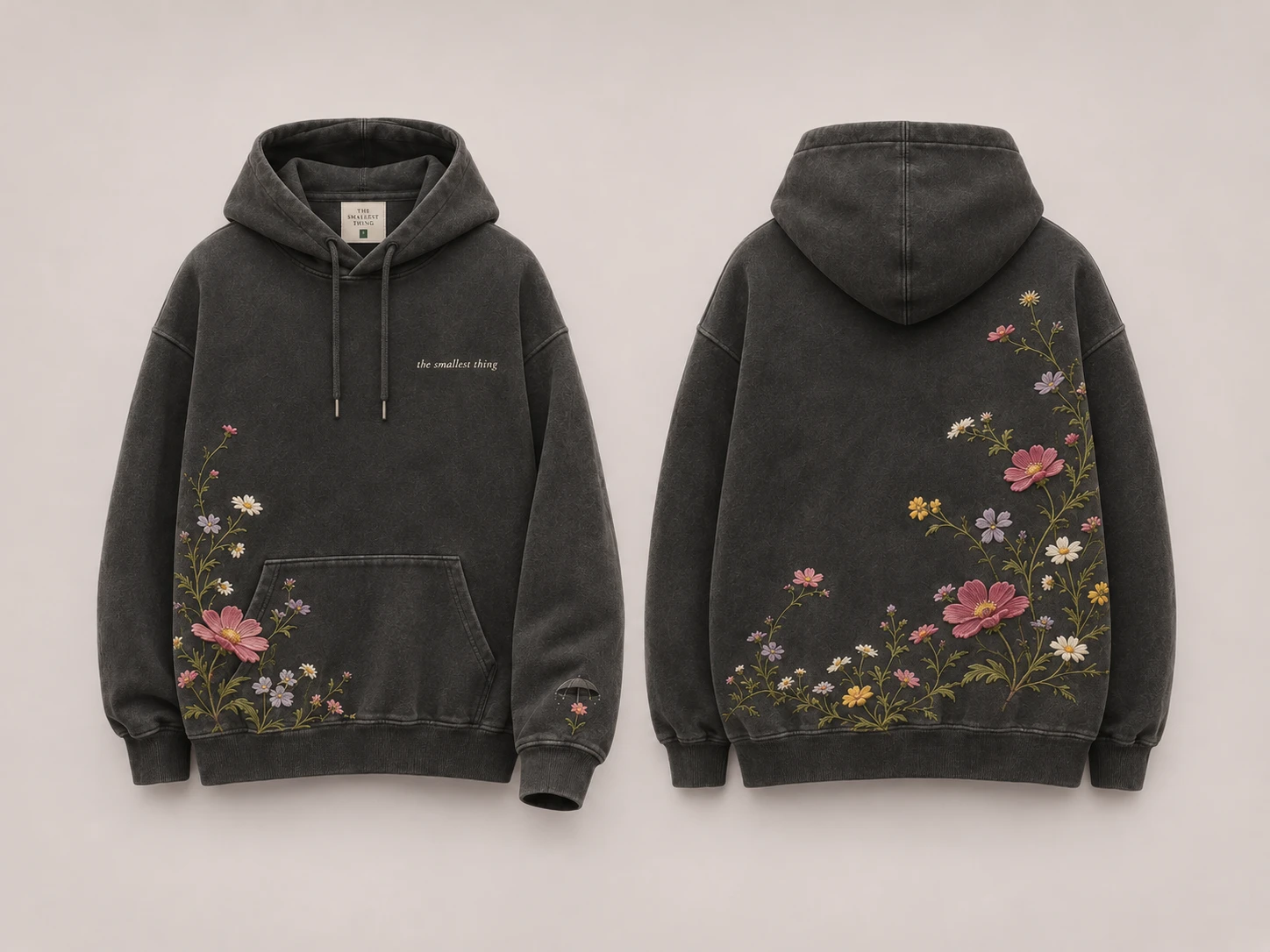
The initial concept featured a washed-charcoal oversized hoodie with delicate wildflowers emerging from the lower hem, climbing across the body, and spreading onto the sleeves. A small umbrella served as a subtle reference to the original narrative.
The composition was intentionally asymmetrical. The flowers appeared to disregard the garment's boundaries, echoing the way the original flower disrupted the rigid geometry of the sidewalk.
But the very elements that made the concept visually compelling also presented manufacturing challenges.
Conventional embroidery is constrained by placement areas, hoop dimensions, seam construction, stitch density, and thread colors. Reproducing the original composition would require multiple embroidery placements, potentially increasing production complexity and cost.
The challenge became one of preserving the artistic idea while reducing the physical demands of producing it.
The Design Approach
Instead of treating manufacturing restrictions as a reason to abandon the concept, I explored how the composition could be reduced without losing its narrative identity.
The guiding principle was simple:
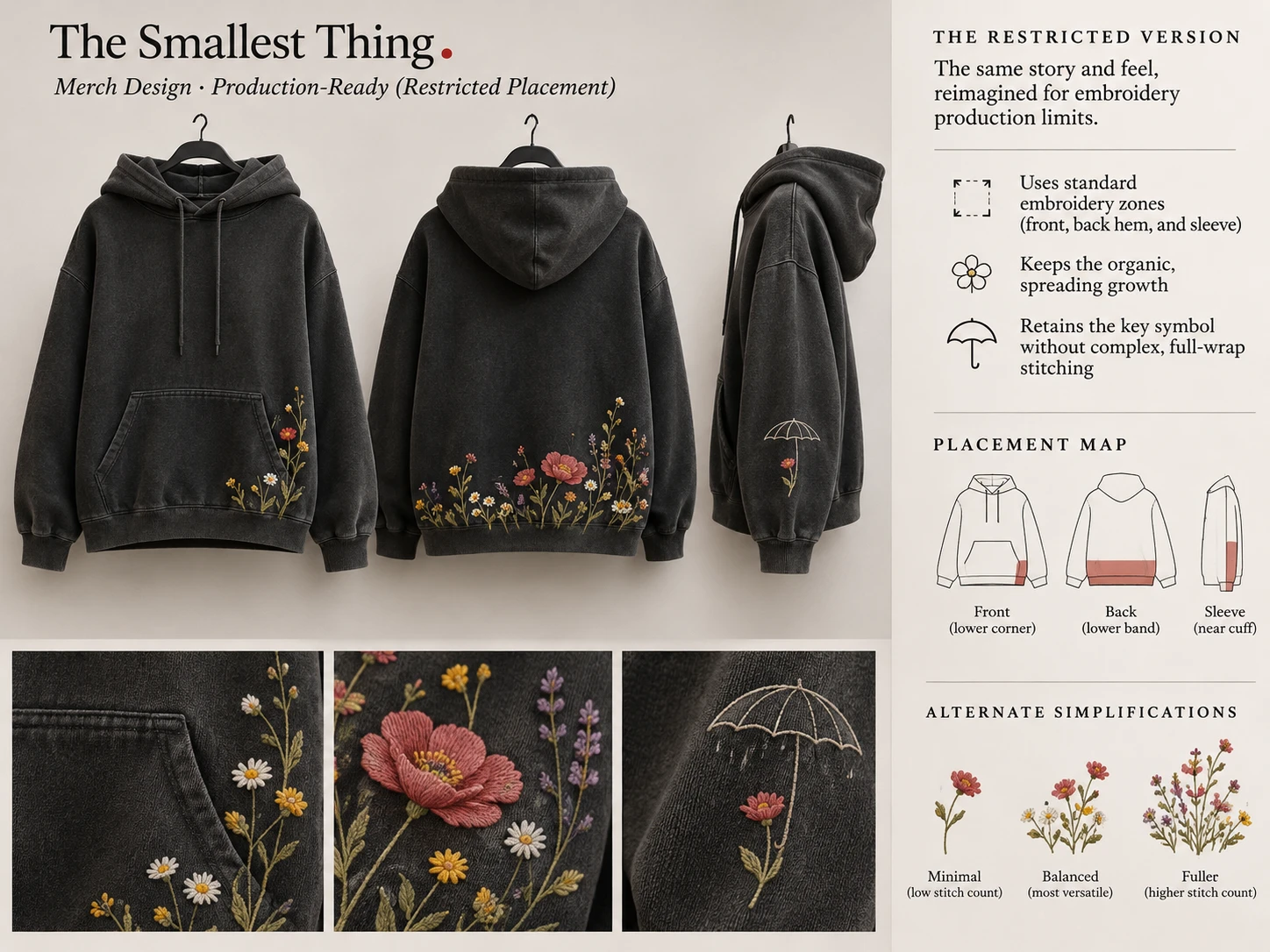
Restrict the embroidery area, not the concept.
Three alternative directions emerged, each prioritizing a different relationship between artistic expression and practical production.
Direction 01: The Botanical Corner
Case Study Illustrative Mockup
Preserving the original movement
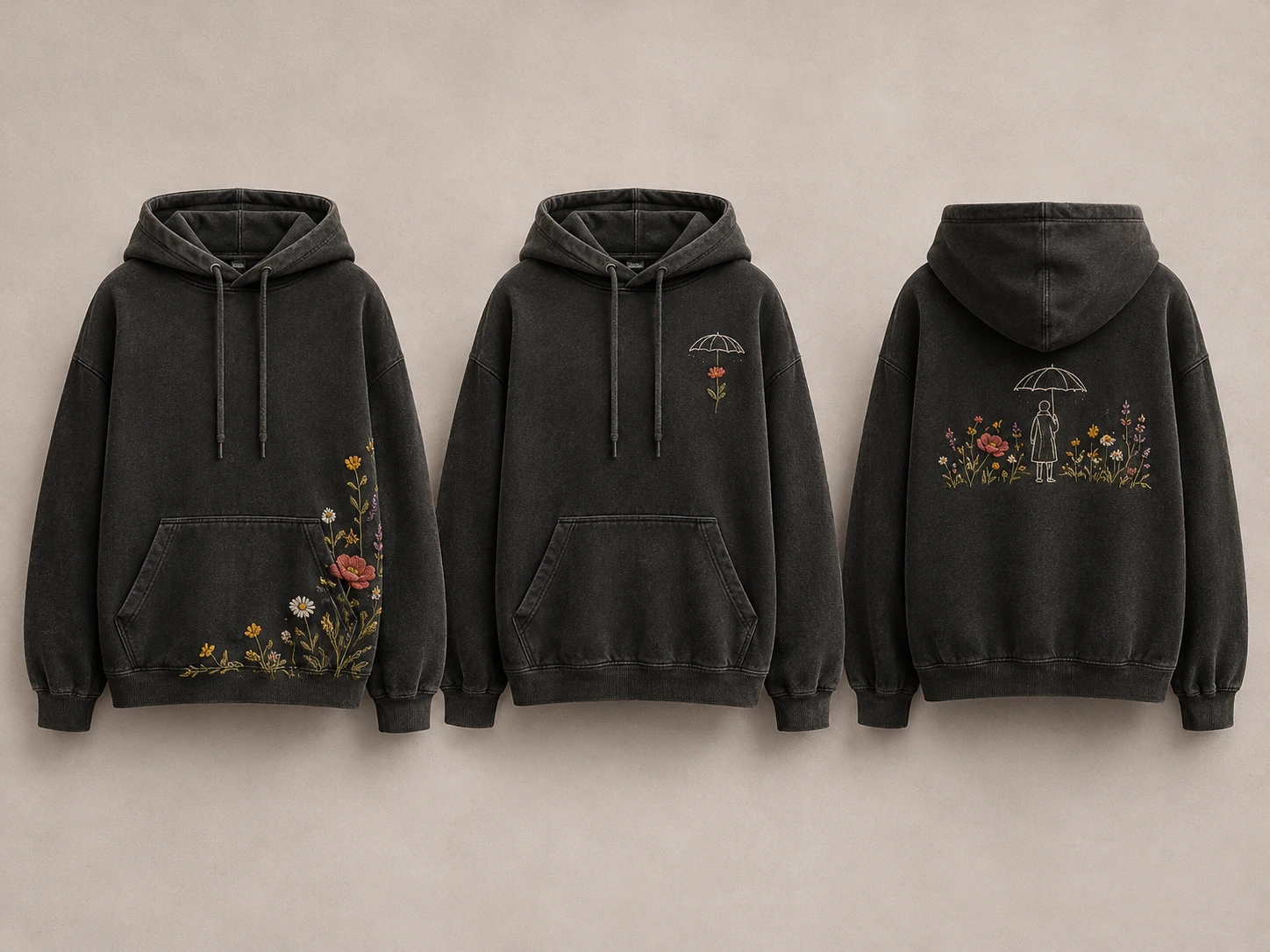
The wildflowers are concentrated into one asymmetrical cluster near the lower front of the hoodie, positioned above the hem rather than crossing it.
A few stems reach upward into the otherwise empty garment. A small umbrella appears separately on the chest or sleeve.
This approach preserves the impression of flowers spreading beyond their intended boundaries while reducing the number of complex embroidery placements.
Design consideration: Maintaining the sense of organic growth within a controlled embroidery field.
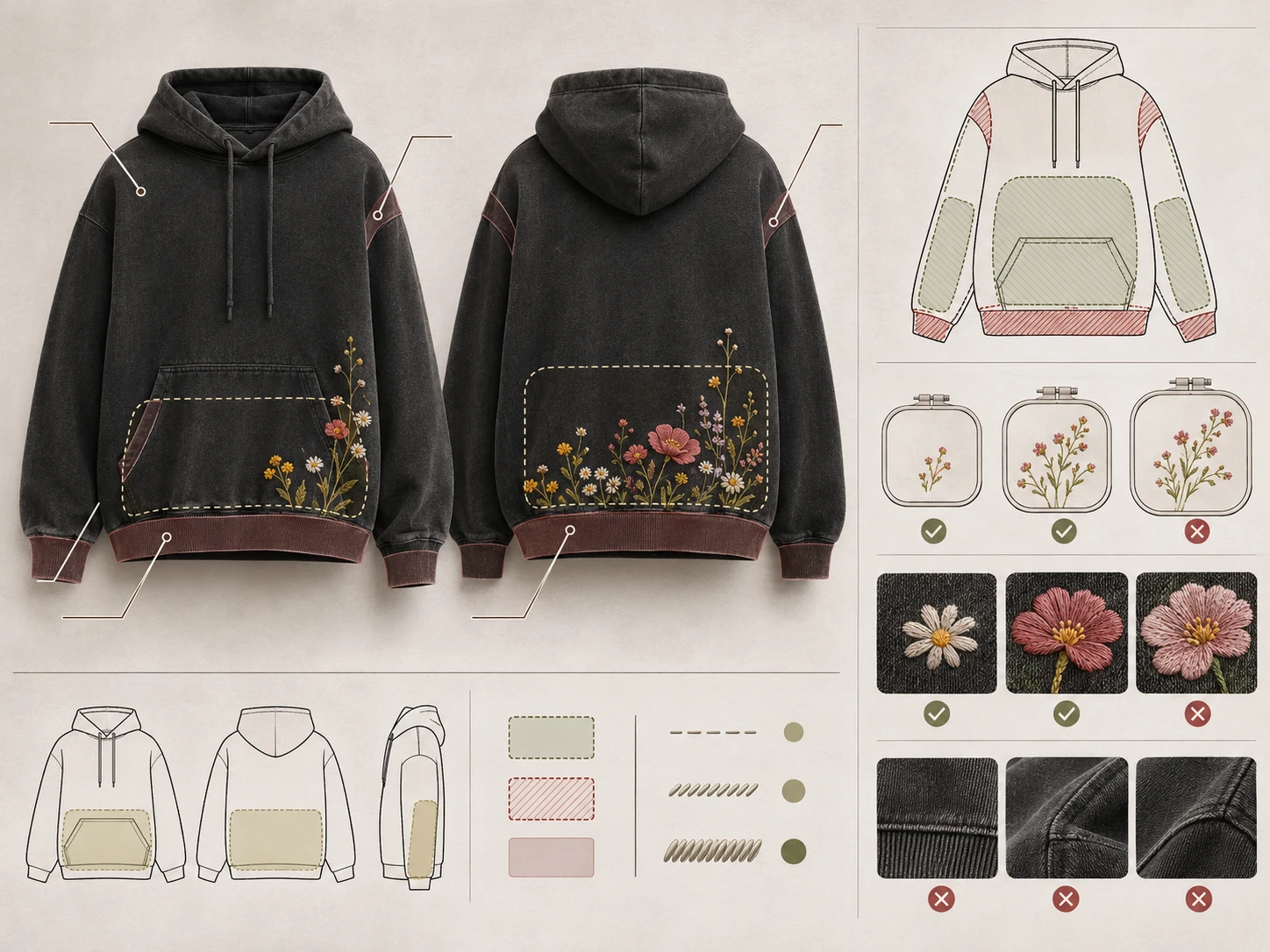
Case Study Mockup
Direction 02: The Pocket Garden
Reducing the story to its smallest recognizable form
The entire narrative becomes a miniature scene positioned on the left chest: a flower emerging through a crack, sheltered by a tiny umbrella.
From a distance, it resembles a conventional embroidered emblem. At closer range, the illustration reveals a complete visual story.
This direction explores how much information can be removed before the narrative becomes unrecognizable.
Design consideration: Using scale, detail, and proximity to create an intimate discovery.
Direction 03: The Garden on the Back
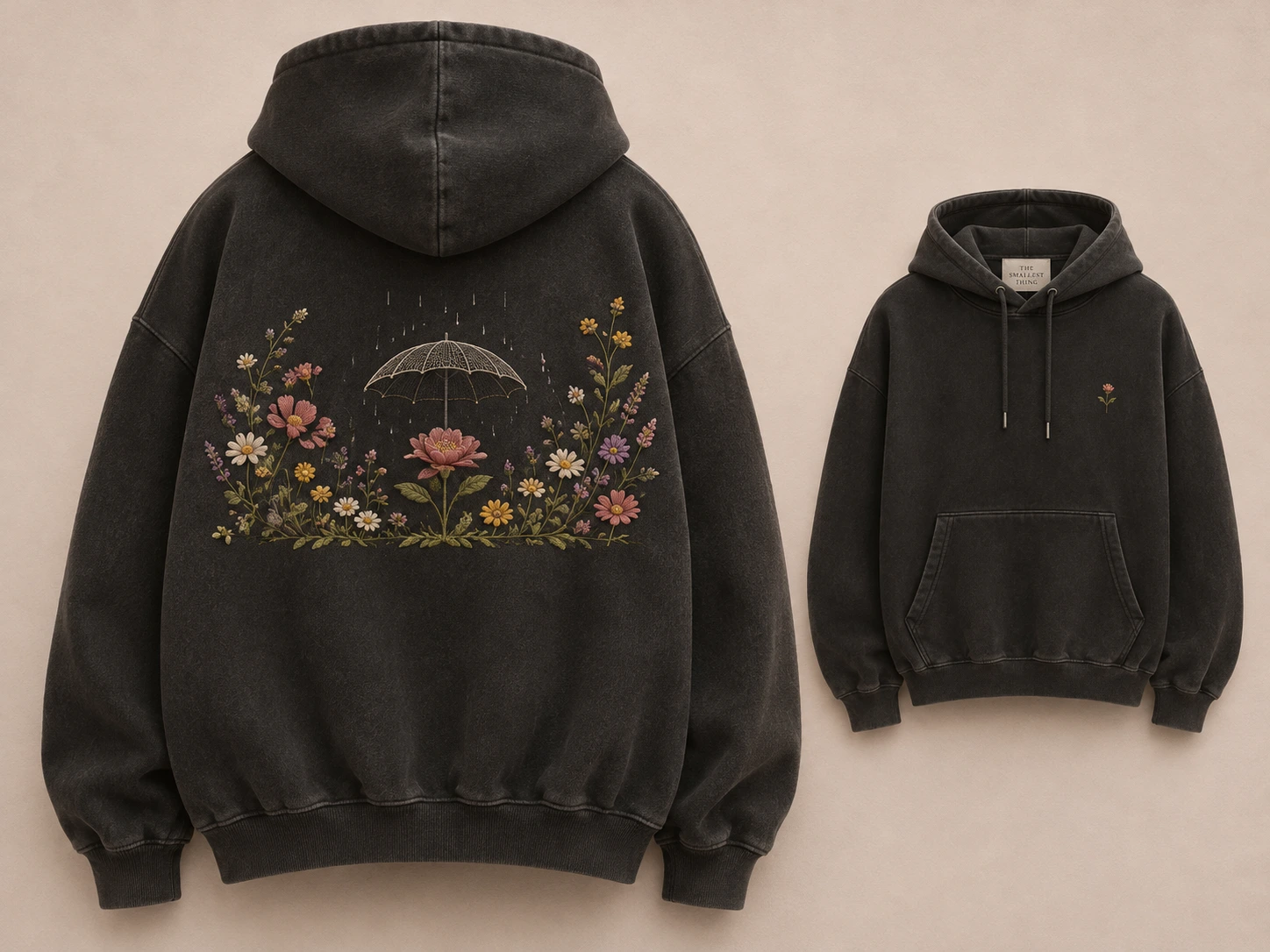
Treating the garment as a canvas
A larger botanical composition occupies a conventional upper-back embroidery area, depicting the umbrella and expanding flowers as a unified scene.
The front remains largely unadorned, apart from a small identifying detail.
This approach retains a stronger illustrative presence while consolidating the artwork into one primary placement.
Design consideration: Balancing visual richness against stitch complexity, production cost, and wearability.
Design Decisions
Across the three directions, several elements remained consistent.
Asymmetry as storytelling. The flowers appear to occupy space organically rather than conforming to a traditional centered apparel graphic.
Negative space as composition. Large areas of uninterrupted charcoal fabric reinforce the scale and movement of the botanical details.
Restrained branding. The publication's identity is communicated through the visual concept rather than prominent logos or slogans.
Narrative continuity. The umbrella and flowers remain connected to the originating film, allowing the garment to function as an extension of the publication rather than an unrelated product.
Production awareness. Placement boundaries, stitch density, thread limitations, and manufacturing costs inform each variation without determining its artistic meaning.
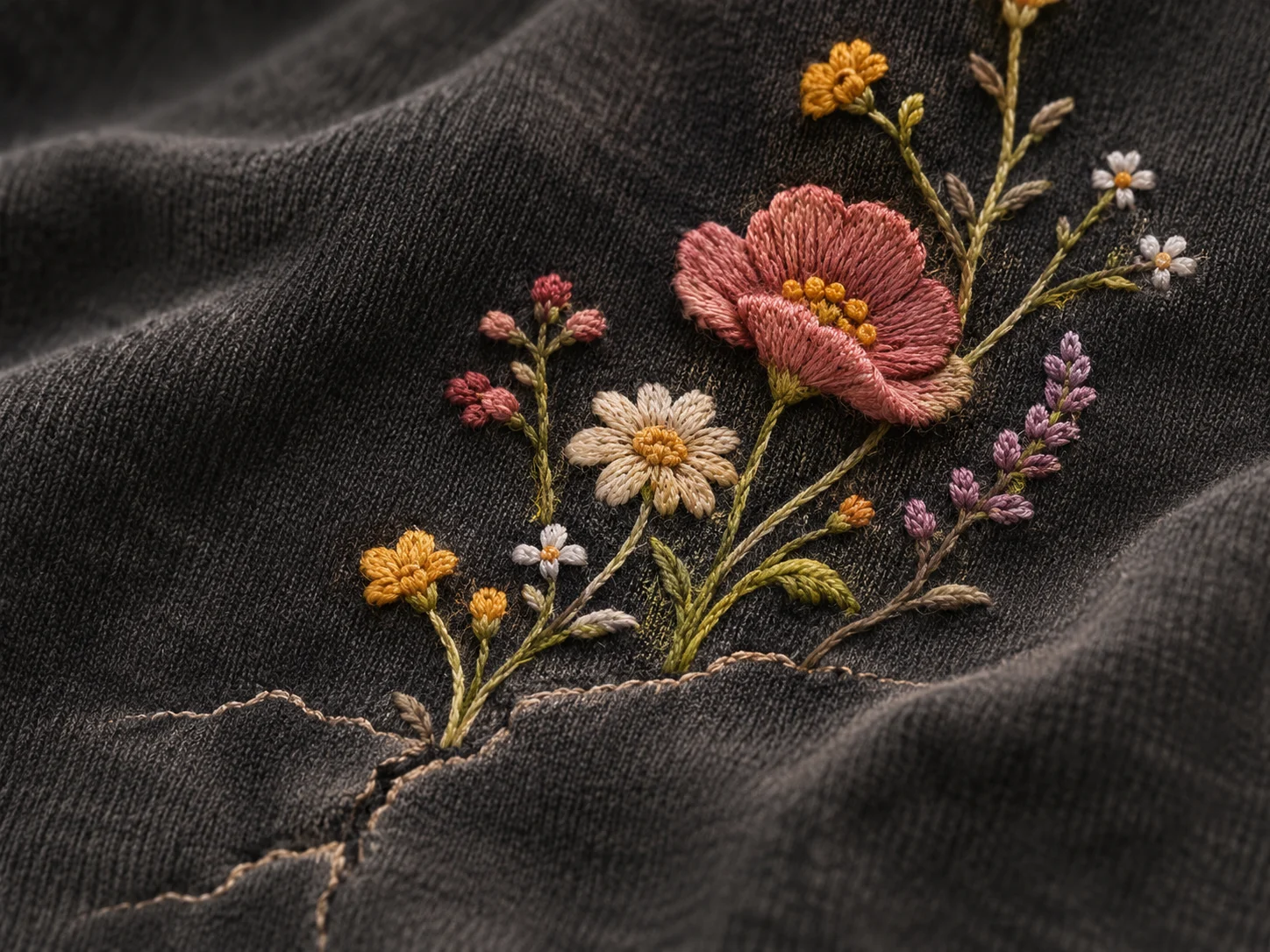
Outcome
The exploration produced an initial wearable-art concept and three simplified design directions, each offering a different balance between narrative expression and production practicality.
The Botanical Corner emerged as the strongest direction for further development. It preserves the original design's asymmetrical movement while concentrating the embroidery into a more manageable composition.
The project remains at the concept and feasibility stage. Final embroidery files, physical samples, manufacturer quotations, and production testing have not yet been completed.
The next stage would involve refining the selected artwork for digitization, confirming embroidery placement with a manufacturer, and evaluating a physical prototype for stitch quality, durability, and visual fidelity.
Reflection
This project began with a flower growing through concrete and became an exercise in preserving meaning across mediums.
Film allows a story to unfold through time. Apparel must communicate through form, placement, material, and the viewer's movement around an object.
The objective wasn't to reproduce the original animation on fabric. It was to identify what made the imagery meaningful and find a new way for that meaning to operate.
A small thing doesn't have to occupy much space to change the way we see everything around it.
Part of The Smallest Thing, an ongoing exploration of how literary and visual storytelling can extend beyond the page and into physical objects.
0 likes · 1 view · Nov 20, 2026
**The Smallest Thing | Wearable Art & Merchandise Design** An exploration of how visual storytelling can extend beyond the screen and into physical objects.

