Meta Ads Performance Audit and Optimization

Oluwaseun Aderemi


Facebook Ads cost
Facebook Ads cost can rise even when your campaigns are still generating conversations and conversions. If your Meta Ads Manager has ever shown you a “Below Average” Quality Ranking next to a healthy Conversion Rate Ranking, you may wonder what is actually driving your advertising costs.
Your ads can still generate conversations and conversions while showing signs that the creative is becoming less competitive in Meta’s auction.
That was the situation we identified during an ongoing Meta Ads audit for a client running two active ad sets on a combined budget of ₦10,000 per day.
This isn’t a final campaign report. It’s an audit snapshot of what we found, what the data was telling us, the changes we implemented, and what we’re continuing to monitor.
The Baseline: What the Account Looked Like
At the time of the audit, the client was running two ad sets simultaneously, both optimized for Conversations.
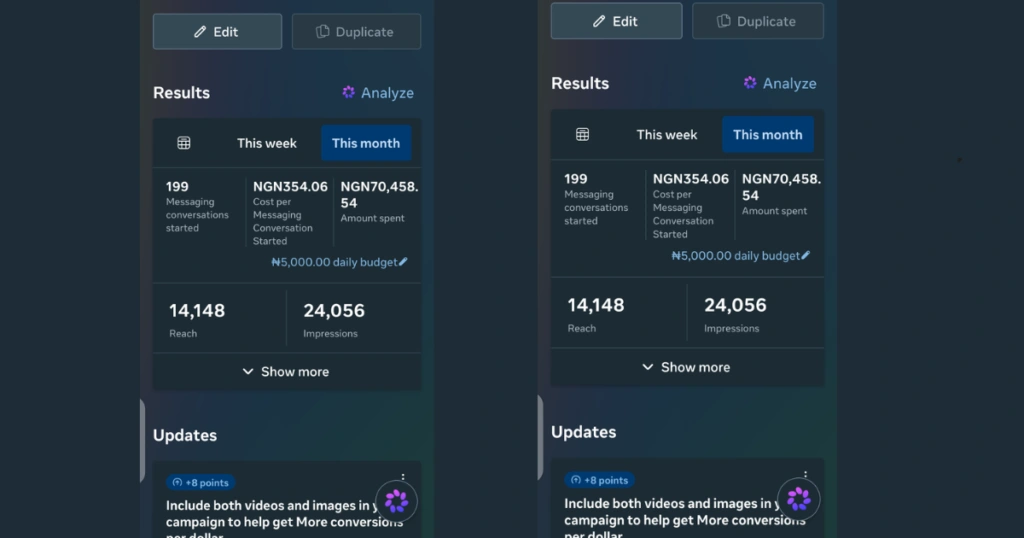
Ad Set 1 — “AUG”
199 Messaging Conversations Started
₦354.06 cost per conversation
₦70,458.54 total spend
14,148 reach
24,056 impressions
Ad Set 2 — “AUG ADS”
113 Messaging Conversations Started
₦482.49 cost per conversation
₦54,521.53 total spend
11,503 reach
22,084 impressions
Across the reporting period shown in the audit, the two ad sets had generated approximately 312 conversations from ₦124,980.07 in spend.
On the surface, the account was generating conversations.
But there was an important difference between the two ad sets.
The first was generating conversations at approximately 27% lower cost than the second.
That gap was our first reason to look beyond the headline conversion numbers.
The Diagnosis: A Below-Average Quality Ranking
Facebook advertising costs
Both ad sets showed a Below Average Quality Ranking, while their Conversion Rate Ranking was Average or Above.
This is where many advertisers can misread what Ads Manager is telling them.
A good conversion rate does not automatically mean the creative is performing strongly at every stage of Meta’s auction.
Conversion Rate Ranking gives us information about how well the ad is driving the desired action compared with other ads competing for similar delivery.
Quality Ranking, meanwhile, is one of Meta’s diagnostics for how the perceived quality of an ad compares with competing ads.
So an ad can still generate conversations efficiently among the people who respond to it while showing a Below Average Quality Ranking.
That doesn’t mean Meta has applied a literal “quality penalty.”
It means there is a diagnostic signal that the ad may be less competitive from a perceived-quality standpoint, and that signal deserves investigation.
The Bigger Clue: CTR Was Falling
The Quality Ranking wasn’t the only thing we looked at.
We also examined the creative’s engagement trend.
One ad set had experienced a 5.75% decline in CTR over 28 days, while a related ad in the same account had experienced a much sharper 17.45% decline.
That was significant.
The ads were still generating conversations, but fewer people were clicking relative to the number of people being reached.
This created a much more interesting picture:
The funnel wasn’t necessarily broken. The creative was showing signs that it was becoming less effective at earning attention.
That distinction matters.
If people are still converting after clicking but fewer people are engaging with the ad in the first place, immediately changing the offer, audience, or entire campaign structure may be premature.
The creative deserves investigation first.
Why This Matters for Your Facebook Ads Cost
This is where advertisers often make the wrong move.
They see rising costs and immediately:
Increase the budget
Change the audience
Duplicate the campaign
Turn off the existing ad
Create an entirely new campaign
But if the underlying issue is creative performance, those changes may not address the actual problem.
Meta’s auction considers multiple factors when determining ad delivery, including the advertiser’s bid, estimated action rate, and ad quality.
That means creative quality and engagement can influence how competitive an ad is in the auction.
So when CTR is declining and Quality Ranking is Below Average, we treat that combination as a signal to investigate the creative before making major structural changes.
The Account’s Performance Snapshot
Meta Ads audit
At the time of our review, the weaker ad set received a 3.5/5 overall performance assessment.
The breakdown was:
Volume: 4/5 — solid conversation volume
Efficiency: 3/5 — consistent, but with room to improve cost per result
Engagement: 2/5 — the clearest area requiring attention
The 2/5 engagement score was particularly important.
The account wasn’t suffering from a complete lack of results.
Instead, the evidence suggested that getting people to stop, engage, and click was becoming the bigger challenge.
That gave us a much clearer direction for the next stage of the audit.
Rather than immediately shutting down the campaigns and rebuilding everything, we implemented targeted changes while keeping the existing campaign structure active.
The goal was simple:
Improve the creative’s ability to compete without unnecessarily throwing away existing campaign data and momentum.
1. We Refreshed the Video’s Opening Hook
The existing creative was a video, so instead of immediately replacing the entire asset, we focused on the opening.
The first few seconds of a video are critical because users are deciding whether to continue watching or scroll past.
A creative can remain technically good while its opening becomes less effective over time.
So we introduced a new opening hook designed to give the viewer a stronger reason to stop and pay attention.
We’re continuing to monitor whether that change improves engagement and CTR.
2. We Added a Static Creative Variation
The campaign was relying heavily on video creative.
Rather than assume every audience segment would respond best to video, we introduced a static image variation.
This gives Meta another creative format to test and gives different users another way to engage with the offer.
The objective isn’t simply to “add another ad.”
It’s to create creative diversity and give the delivery system more options to find responsive users.
3. We Expanded Delivery With Advantage+ Audience
The original targeting setup was relatively narrow.
We also tested Advantage+ Audience to give Meta greater flexibility in finding people who were likely to respond.
This wasn’t done because broader targeting is automatically better.
It was done because the account had enough conversion activity for us to test whether Meta’s delivery system could identify additional efficient opportunities beyond the manually defined audience.
The important distinction is that this is an ongoing test, not a final result.
We’re monitoring cost per conversation, CTR, engagement, and conversation volume before deciding whether the change should remain part of the long-term setup.
Because this campaign is still active, we’re not going to pretend the audit has already produced a final winner.
The next stage is measurement.
We’re watching:
CTR
Is the decline stabilizing?
More importantly, does the refreshed creative begin to recover the engagement we’re losing?
Cost Per Conversation
Does the cost gap between the two ad sets narrow?
Quality Ranking
Does the creative improvement coincide with a stronger Quality Ranking?
Conversion Rate
Are people who engage with the new creative still converting into conversations?
Creative-Level Performance
Which hook and format are actually producing the strongest combination of engagement and cost efficiency?
This is the part of advertising that gets ignored in many case studies.
The first change isn’t necessarily the final answer.
Good account management means making a controlled change, collecting enough data, and then deciding what to do next.
Before increasing your budget or rebuilding a campaign, open Ads Manager and look beyond your cost per result. If you’re also relying on Google to help potential customers discover and trust your business, your review profile deserves attention too. See our guide on how to get more Google reviews.
Check:
Quality Ranking
Conversion Rate Ranking
CTR trend
Cost per result
Creative-level performance
Frequency and audience delivery
If your Quality Ranking is Below Average while your Conversion Rate Ranking remains Average or Above, don’t automatically assume your campaign is broken.
Instead, investigate where the performance deterioration is actually happening.
If CTR has also been falling, creative fatigue or declining creative relevance becomes a much more important possibility to investigate.
The right response isn’t always a new campaign.
Sometimes the better move is simply to refresh the creative, introduce another format, broaden delivery where appropriate, and monitor the data.
This is an important point.
The campaign is still running.
We’re not publishing a case study claiming that one creative change magically reduced costs overnight.
What we’ve established so far is more useful:
We found a significant cost difference between the two ad sets.
We identified Below Average Quality Ranking.
We found declining CTR.
We identified engagement as the weakest area of the account.
And we implemented targeted changes designed to address the likely creative and delivery issues.
Now we’re watching the data.
That’s what a real Meta Ads audit should look like.
Don’t guess. Diagnose. Test. Measure. Then scale what actually works.
Want a second look at your Meta Ads? If you’re seeing rising costs, declining CTR, or a Below Average Quality Ranking, Tangible Growth Agency can help you identify what’s happening and determine what to test next. Message us on WhatsApp to discuss your account.
Like this project
Posted Aug 25, 2026
Meta Ads audit identifying rising costs, declining CTR, Below Average Quality Ranking, and creative issues, followed by targeted campaign optimizations.


![[Project] ₦25.6M Revenue Scaling: The](https://media.contra.com/image/upload/c_fill,w_700/gckb1bfaq4lp2uwmdd6s.avif)