Food Delivery Platform for Underserved Cities

Adnan Aslam


FUDGO — Building a Food Delivery Platform for Underserved Pakistani Cities
FUDGO is a food delivery platform created for communities outside Pakistan's largest, best-served metropolitan markets.
The product connects customers with local restaurants through a mobile-first ordering experience, supported by a web application and a realtime backend. Customers can discover restaurants and food categories, view menu items, build their cart, place orders, and manage their activity through one accessible mobile experience.
I worked across the product architecture and implementation, including the React Native application, Next.js web application, authentication, database-backed workflows, realtime synchronization, and server-side Supabase Edge Functions.
FUDGO is publicly available on Google Play and has surpassed 10K downloads. Its store listing describes the product as a food delivery application for underserved areas and small cities of Pakistan.
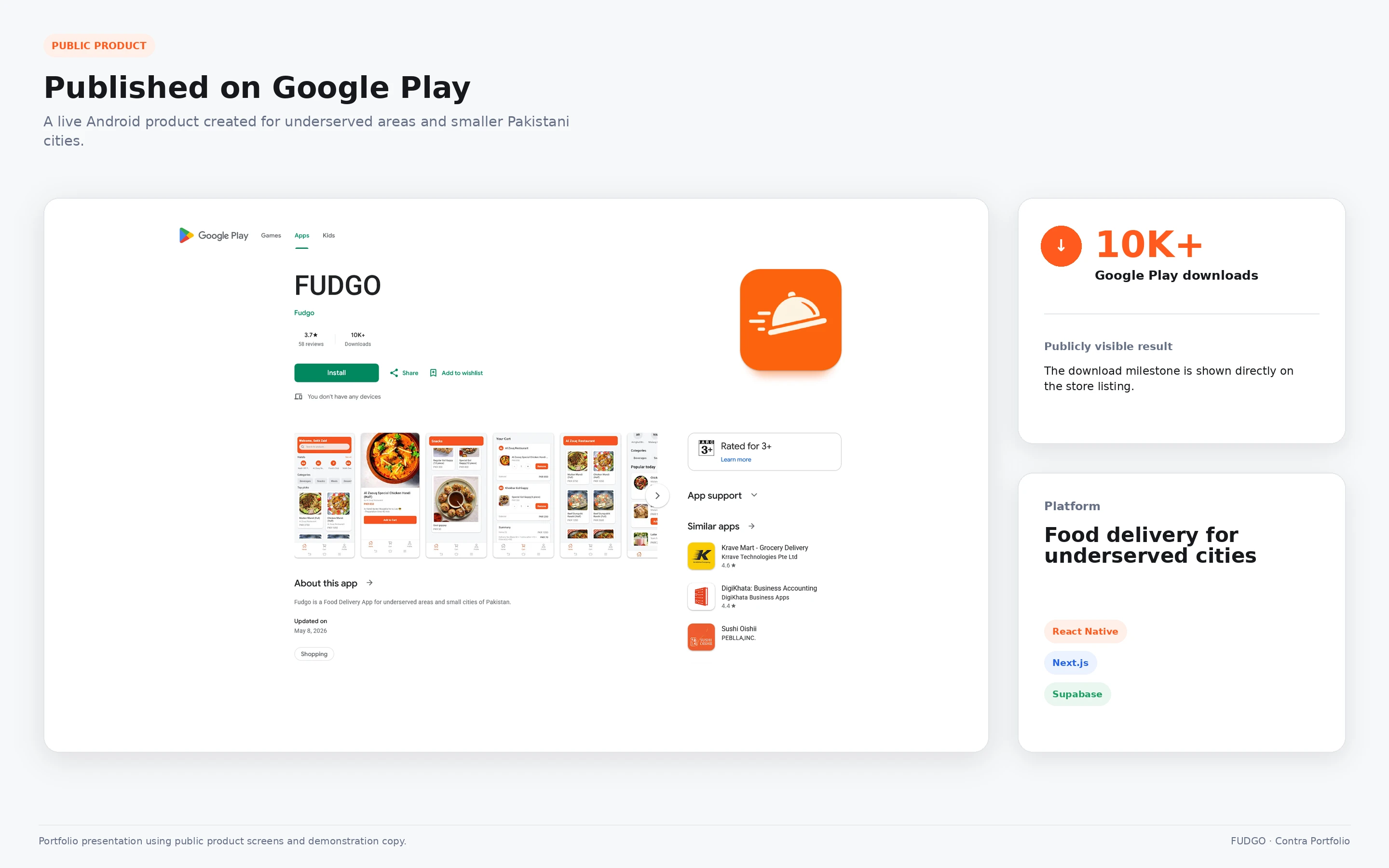
FUDGO is publicly available on Google Play and has surpassed 10K downloads.
FUDGO is publicly available on Google Play and has surpassed 10K downloads.
The challenge
Most food delivery products are designed around dense urban markets with large restaurant networks, mature logistics, standardized addressing, and customers already familiar with app-based ordering.
FUDGO was designed for a different environment.
The platform needed to support smaller cities and underserved communities where:
Local restaurants may have limited digital infrastructure
Menu information can change frequently
Users require a straightforward ordering flow
Operational teams need immediate visibility into changing order states
Mobile connectivity and device performance cannot be taken for granted
The system must remain manageable without enterprise-scale operational resources
The challenge was therefore larger than creating an attractive restaurant-listing application.
The product needed a connected technical foundation capable of supporting customers, restaurants, operational users, menu data, carts, orders, authentication, and realtime state changes across mobile and web experiences.
What I built
Customer mobile application
I built the customer-facing experience with React Native.
The application provides a structured ordering journey:
Restaurant and food discovery
Search
Category browsing
Menu and item details
Cart management
Order placement
Order-related activity
Customer account and profile access
The interface was designed around a familiar mobile-commerce pattern so users could understand the application without extensive onboarding.
The goal was not to introduce unusual interactions. It was to make local food ordering feel direct, predictable, and accessible.
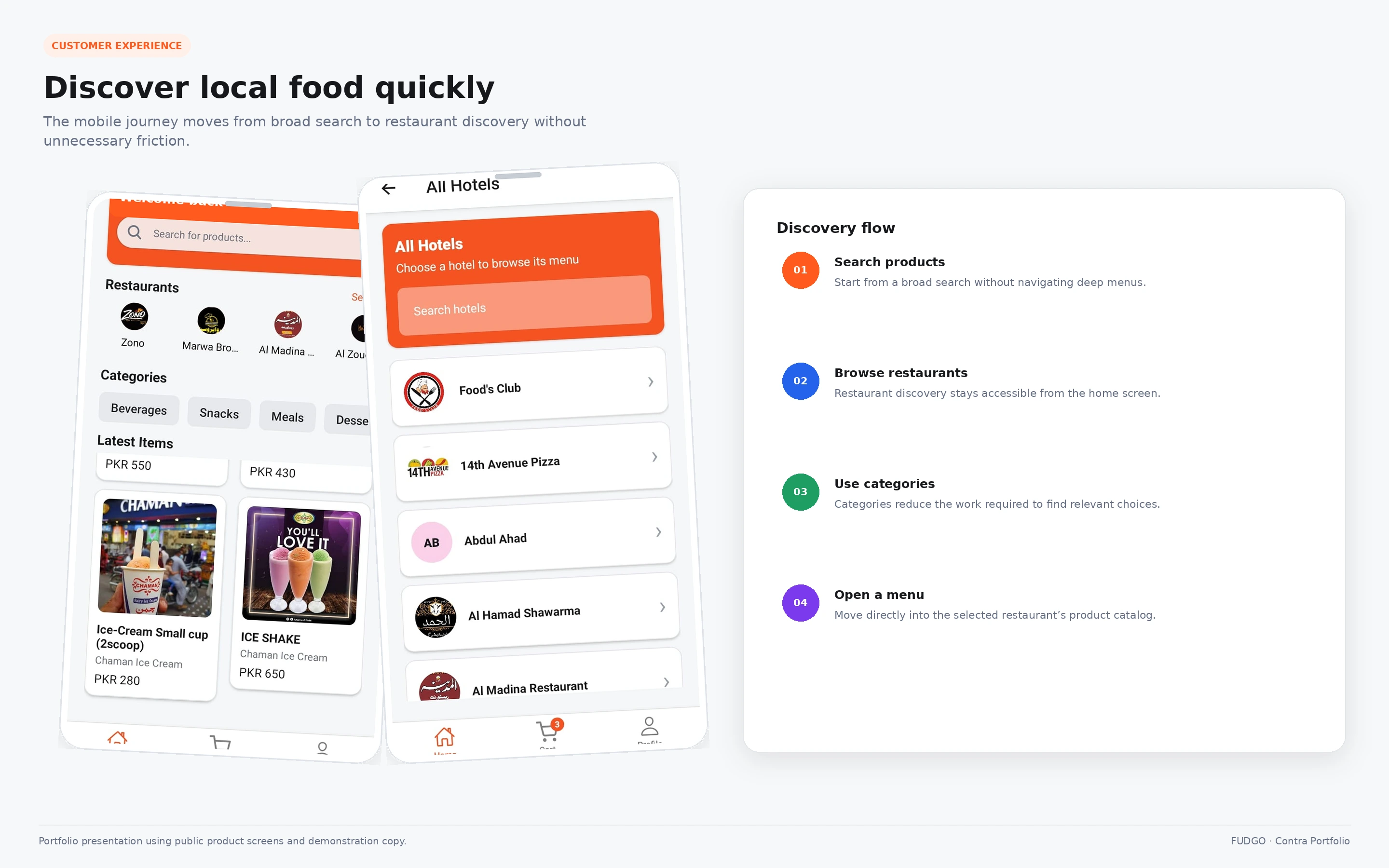
Mobile-first restaurant and food discovery designed for fast browsing across local menus and categories.
Mobile-first restaurant and food discovery designed for fast browsing across local menus and categories.
Restaurant and menu discovery
Customers can explore available food options through restaurant listings, categories, featured items, and individual product pages.
Menu data needed to support more than a static name and price. The platform had to represent:
Restaurant ownership
Categories
Food items
Images
Descriptions
Pricing
Availability
Cart quantities
Order relationships
This required a relational data model rather than treating each menu as an isolated content page.
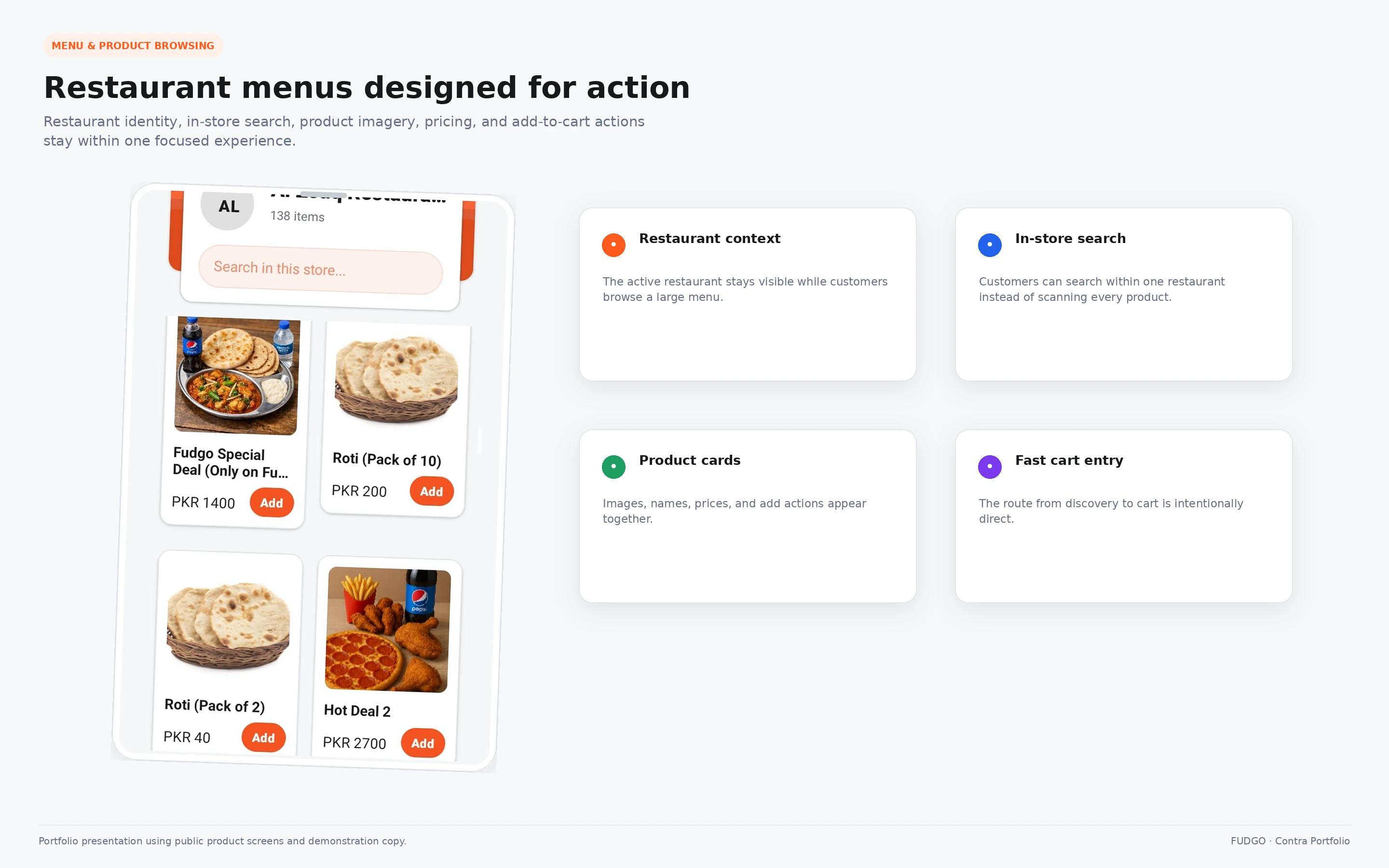
Structured menu presentation connecting restaurant information, product details, pricing, and cart actions.
Structured menu presentation connecting restaurant information, product details, pricing, and cart actions.
Cart and ordering workflow
The cart connects customer selections to the underlying restaurant and menu records.
The workflow needed to preserve:
Selected products
Product quantities
Prices
Restaurant associations
Customer ownership
Order totals
The transition from cart state to order state
I kept the ordering logic structured so that the mobile application did not become the sole authority for important transactional behavior.
Business-sensitive operations could instead be handled through the backend and server-side functions.
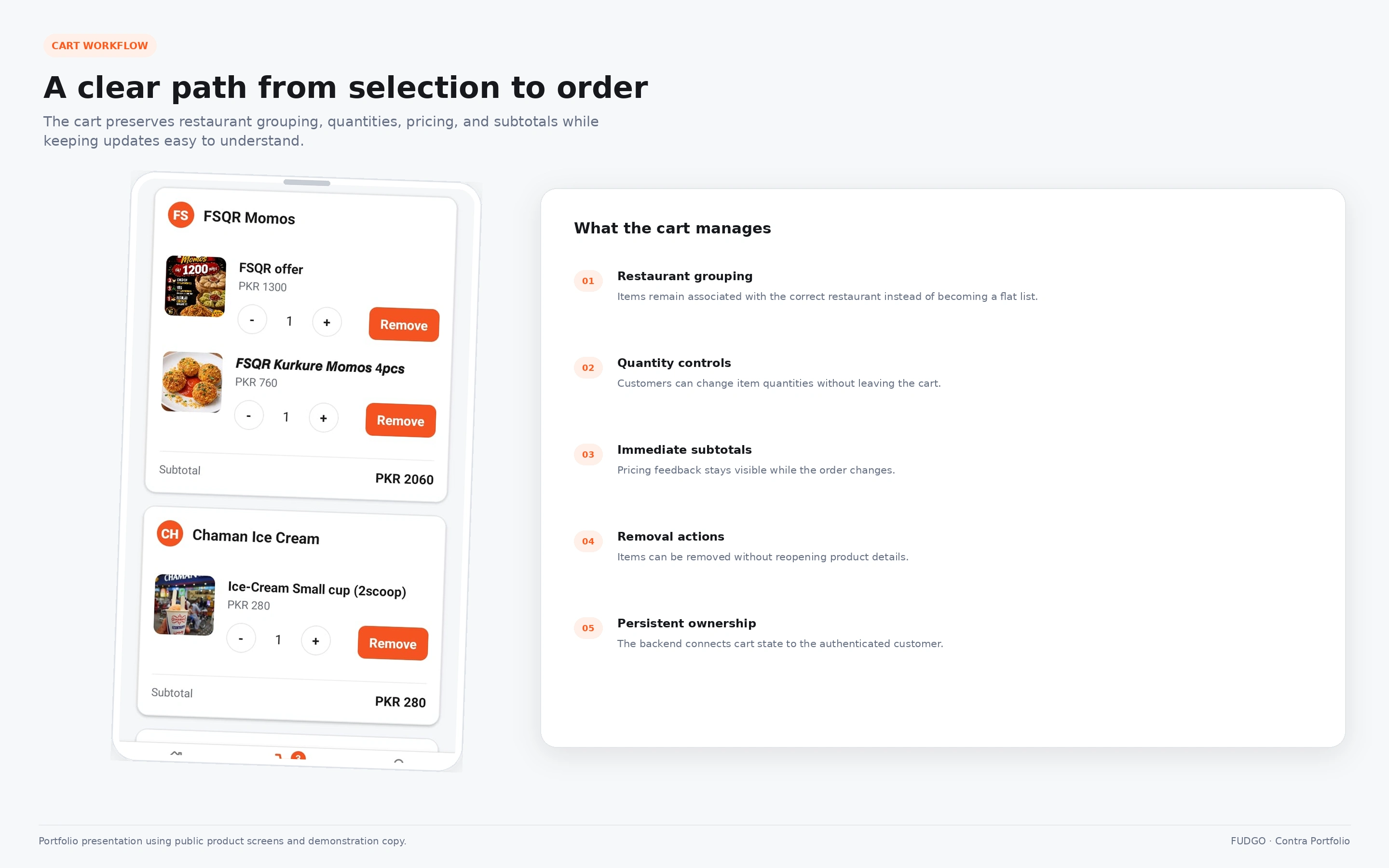
Cart workflow maintaining product quantities, restaurant associations, pricing, and order preparation in one clear mobile flow.
Cart workflow maintaining product quantities, restaurant associations, pricing, and order preparation in one clear mobile flow.
Supporting web application
I built a Next.js web application to support the wider platform outside the customer mobile experience.
This provided a web-based foundation for the operational and administrative parts of the product, while sharing the same backend data model as the mobile application.
Using separate mobile and web interfaces allowed each surface to be designed around its actual user:
Mobile for customer discovery and ordering
Web for data-heavy operational workflows
Supabase as the shared source of truth
This avoided duplicating backend logic across disconnected systems.
Realtime platform behavior
Food delivery is a state-driven workflow.
An order can move through multiple stages, and those changes may need to appear across different user interfaces without requiring constant manual refreshes.
I used Supabase Realtime as part of the architecture so relevant state changes could be synchronized across the platform. The broader FUDGO implementation combines Supabase Realtime with authentication, database services, and Edge Functions.
This architecture was suitable for workflows where the customer-facing application and operational web application needed to remain aligned around current backend data.
Authentication and controlled access
Supabase Auth provides the identity layer for the platform.
Authentication was integrated into the product architecture rather than added as an isolated login screen. User identity is relevant to:
Customer profiles
Cart ownership
Order ownership
Role-specific application behavior
Protected data access
Server-side operations
The important architecture decision was to avoid trusting user-supplied identifiers for ownership-sensitive actions.
Authenticated identity and backend validation provide a more reliable foundation for controlling which records a user can access or modify.
Server-side workflows with Edge Functions
Some actions should not be performed entirely inside a mobile application.
I used Supabase Edge Functions for server-side workflows that required controlled execution, privileged backend access, or integration logic that should not be exposed to the client.
This helped separate:
User-interface state
Database persistence
Privileged business operations
External integrations
Backend validation
The result was a cleaner boundary between what the customer application displays and what the backend authoritatively processes.
My process
1. Start with the complete product journey
I mapped the customer journey before treating individual screens as separate features:
Discover → Browse menu → Select items → Manage cart → Place order → Follow activity
This established the core entities and relationships needed by the platform.
It also prevented an early mistake common in marketplace products: building polished screens before defining how the underlying customer, restaurant, menu, cart, and order states connect.
2. Design the shared data model
The mobile application and web application needed to operate against the same platform state.
I structured the backend around core product domains such as:
Users
Customer profiles
Restaurants
Menu categories
Products
Carts
Cart items
Orders
Order items
Status changes
The objective was to make each record's ownership and relationships explicit.
This made the system easier to reason about and reduced the risk of contradictory data appearing across mobile and web surfaces.
3. Separate client and server responsibilities
I avoided placing all business behavior inside React Native components.
The mobile client handles user interaction and presentation, while the backend remains responsible for persistent data and protected operations.
The architecture distinguishes between:
Local interface state
Authenticated user state
Persistent platform records
Realtime subscriptions
Server-side functions
This separation made the application more secure and easier to evolve.
4. Build mobile and backend workflows together
I did not build the mobile application against static mock data and postpone backend integration until the end.
Each major customer flow was connected incrementally:
Define the data needed by the screen.
Connect it to authenticated backend records.
Implement loading, empty, and failure states.
Validate navigation between related steps.
Confirm that mutations persisted correctly.
Verify that realtime changes did not create conflicting local state.
This exposed product and data-model problems earlier than a frontend-first process would have.
5. Optimize for real mobile conditions
FUDGO was created for markets where users may not always have flagship phones or ideal connectivity.
That influenced practical decisions around:
Avoiding unnecessary screen complexity
Keeping navigation familiar
Reducing excessive client-side processing
Making loading and empty states understandable
Avoiding unnecessary network requests
Keeping important actions clear
Using backend-driven state instead of fragile local assumptions
The application needed to feel dependable before it needed to feel technically impressive.
6. Launch, observe, and improve
Publishing the application was not treated as the final engineering milestone.
A live consumer product introduces issues that development environments cannot fully reproduce:
Different Android devices
Variable connection quality
Unexpected user navigation
Incomplete customer information
Rapid menu and availability changes
Production authentication states
Store-release and deployment constraints
I continued improving the platform based on how the system behaved as a live product rather than assuming the initial implementation would remain sufficient.
Architecture decisions
React Native for the customer application
React Native provided a practical balance between native mobile delivery and maintainable product development.
It allowed the customer experience to be built around mobile interaction patterns while retaining a shared JavaScript and React development model.
This was valuable for:
Faster iteration
Android delivery
Reusable application patterns
Consistent state handling
Easier coordination with the React/Next.js web stack
Next.js for the web platform
Next.js was used for the supporting web application.
This provided a structured foundation for interfaces that benefit from:
Larger-screen layouts
Operational data presentation
Server-aware application behavior
Protected routes
Backend integration
Maintainable React components
The mobile and web applications serve different usage contexts, but both connect to the same backend platform.
Supabase as the shared backend
Supabase provided the backend foundation through:
Authentication
Database
Realtime synchronization
Edge Functions
Shared access from mobile and web clients
This kept the early platform operationally lean while still supporting a production application with multiple interfaces. The confirmed FUDGO stack includes React Native, Next.js, Supabase Realtime, Auth, database services, and Edge Functions.
The decision reduced the need to maintain separate infrastructure for authentication, realtime transport, backend functions, and relational data during the initial product lifecycle.
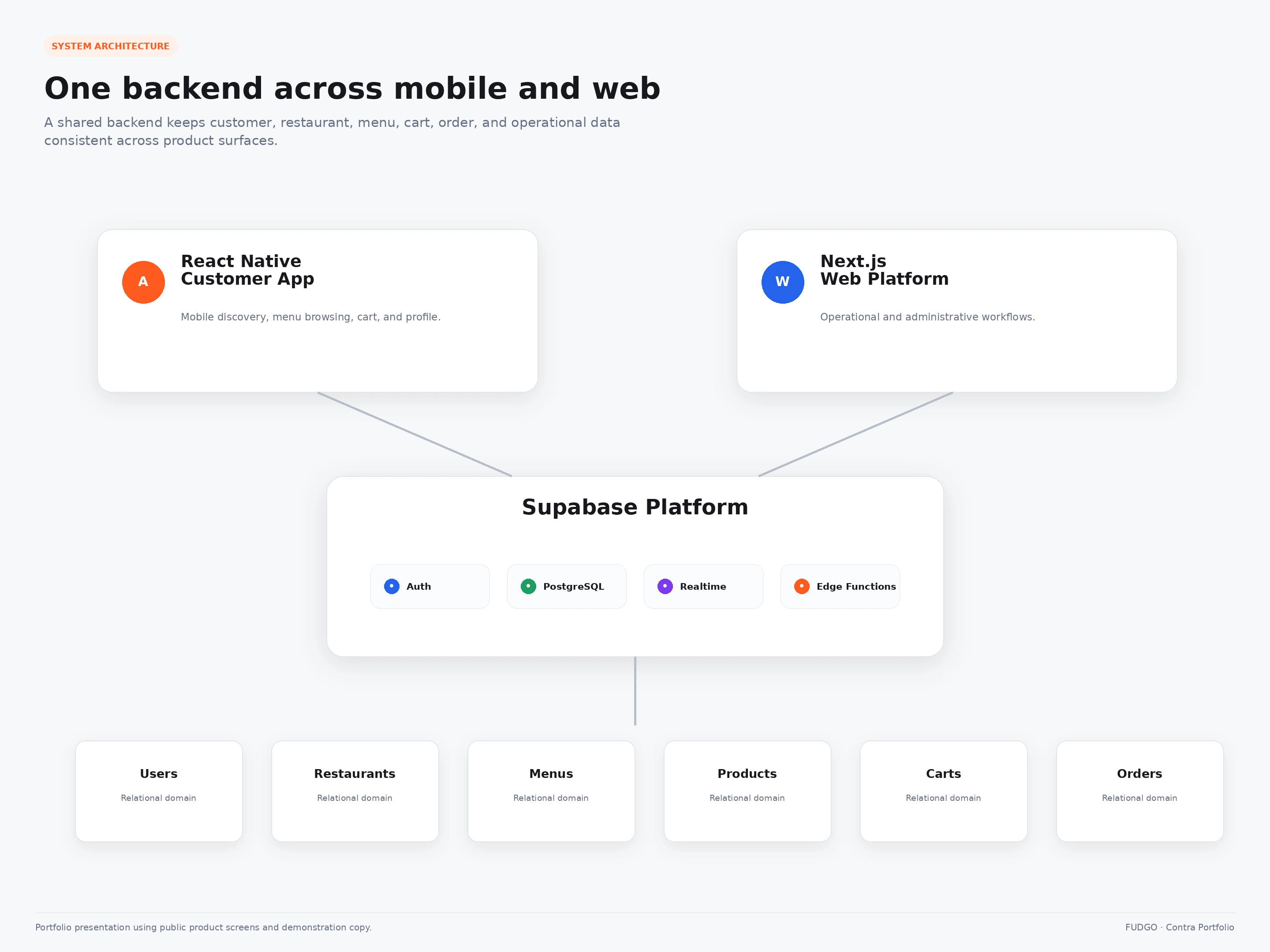
Shared backend architecture connecting the React Native customer application, Next.js web platform, authentication, realtime updates, database records, and server-side functions.
Shared backend architecture connecting the React Native customer application, Next.js web platform, authentication, realtime updates, database records, and server-side functions.
Relational modelling for marketplace data
Food delivery is fundamentally relational.
A customer selects products that belong to menus, menus belong to restaurants, carts contain selected items, and orders preserve transactional versions of those selections.
A relational backend was therefore more appropriate than storing the platform as loosely connected documents.
It provided clearer ownership, filtering, consistency, and reporting behavior.
Realtime only where it created product value
Realtime technology was not used simply because it was available.
It was applied where changing backend state could materially affect the user or operational experience.
This avoids a common architecture problem: subscribing every screen to everything, creating unnecessary network activity and difficult-to-debug state behavior.
Edge Functions for privileged operations
Sensitive operations and integration logic were kept outside the distributed mobile client.
This improves:
Secret management
Input validation
Authorization
Consistency
Maintainability
The ability to change backend behavior without forcing every rule into the mobile application
One backend across multiple product surfaces
The mobile and web applications were not implemented as independent products with duplicated data.
They share the same backend foundation.
This was an important scaling decision because restaurant, product, customer, and order information should remain consistent regardless of which interface creates or reads it.
Results
The clearest externally verifiable product result is that FUDGO reached 10K+ Google Play downloads.
The platform was successfully delivered as a working product comprising:
A published React Native mobile application
A supporting Next.js web application
Authentication
A persistent relational backend
Realtime platform behavior
Server-side Edge Functions
A complete customer ordering journey
FUDGO demonstrates my ability to move beyond an isolated feature or prototype and build a connected consumer platform across mobile, web, backend, and production release.
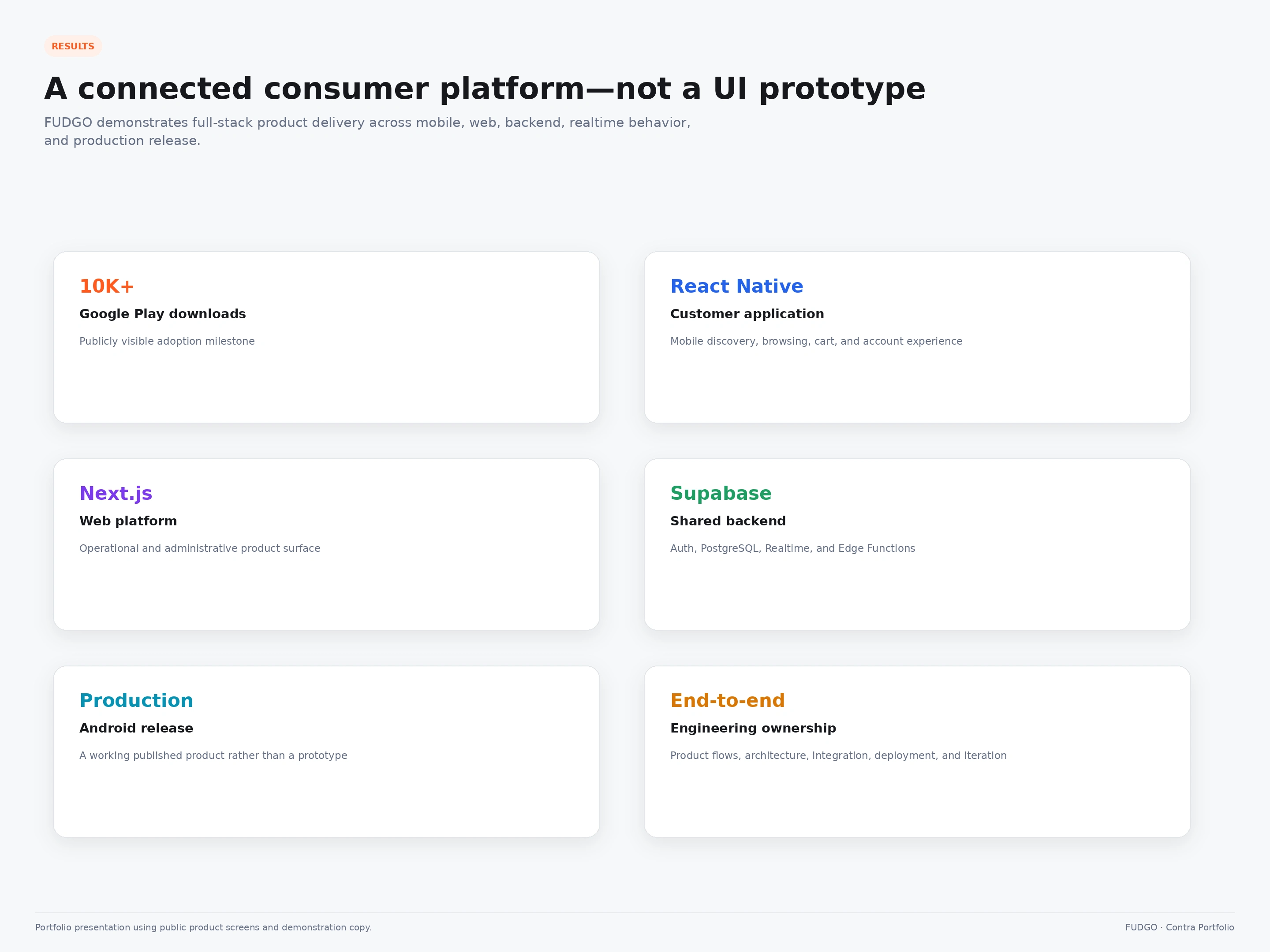
Results summary
My role
I led the full-stack product engineering across the React Native customer application, Next.js web application, Supabase backend, authentication, realtime data flows, database architecture, and Edge Functions. My work covered the complete path from product workflows and interface implementation to backend integration, production deployment, and continued improvement of the live application.
Technology
React Native
React
Next.js
TypeScript / JavaScript
Supabase
Supabase Auth
Supabase Realtime
Supabase Edge Functions
PostgreSQL-backed relational data
Google Play deployment
Like this project
Posted Jul 13, 2026
I built and launched a multi-role food delivery platform for underserved Pakistani cities, reaching 10K+ Google Play downloads.
Likes
1
Views
10