Bonaca: Revenue Decisions for Charter Fleets

Bozena Bulat


Bonaca — Revenue Decisions for Charter Fleets
An AI tool that helps yacht charter companies decide when to lower a price — and when to wait.
Role: product designer, end to end. Research, product strategy, interaction design, visual identity, design system. 2026. Design complete; now in development.
Context
Problem: charter companies guess when to cut prices, and a wrong guess costs money either way.
Solution: a calm assistant that recommends what to do for each boat — and explains why.
What it shows: how to design AI people can trust when they're under pressure.
Status: design done after a summer of research and testing — now in development.
Challenge
Charter companies rent boats by the week. Croatia charters thousands of boats across 1,244 islands. Each boat is booked about sixteen weeks out of fifty-two — so an empty week isn't a gap. It's the margin.
When a week isn't booking, someone has to make a call. Lower the price now, or wait? Lower too early and you give money away on a week that would have filled anyway. Wait too long and the boat stays empty. So most people drop the price and hope.
Croatia has it hardest. It hits peak occupancy by mid-June; Greece not until August. Croatian operators make their hardest pricing calls earliest, with the least information.
Today's tools show numbers, not answers. Fleets use booking systems. The largest, used by over a thousand fleets, compares competitor prices — and leaves the call to you. In short-term rentals this is a mature category: 83% of property managers adjust prices at least weekly. Nobody gave charter fleets a recommendation with the reasoning behind it.
The question I designed for: how do you help someone make an expensive decision when they're already worried?
Approach
Three screens for three moments. The operator's year has three very different moments, so Bonaca has three screens:
Brief — every Monday: what to do with each boat this week.
Panic — when bookings stop: one boat, two choices, and what each one costs.
Season — at the end of the year: what worked, and where Bonaca was wrong.
What research showed. Summer 2026, 13 participants: interviews, a first-click test, a pilot and A/B tests.
Pricing is usually done by the owner or base manager — alongside other jobs. So the Brief had to take about ten minutes.
Percentages looked more reliable, and were trusted blindly. The water shapes were understood without a legend.
A calm Panic lowered stress. Showing mistakes raised trust — but only with the amount, the reason and the lesson.
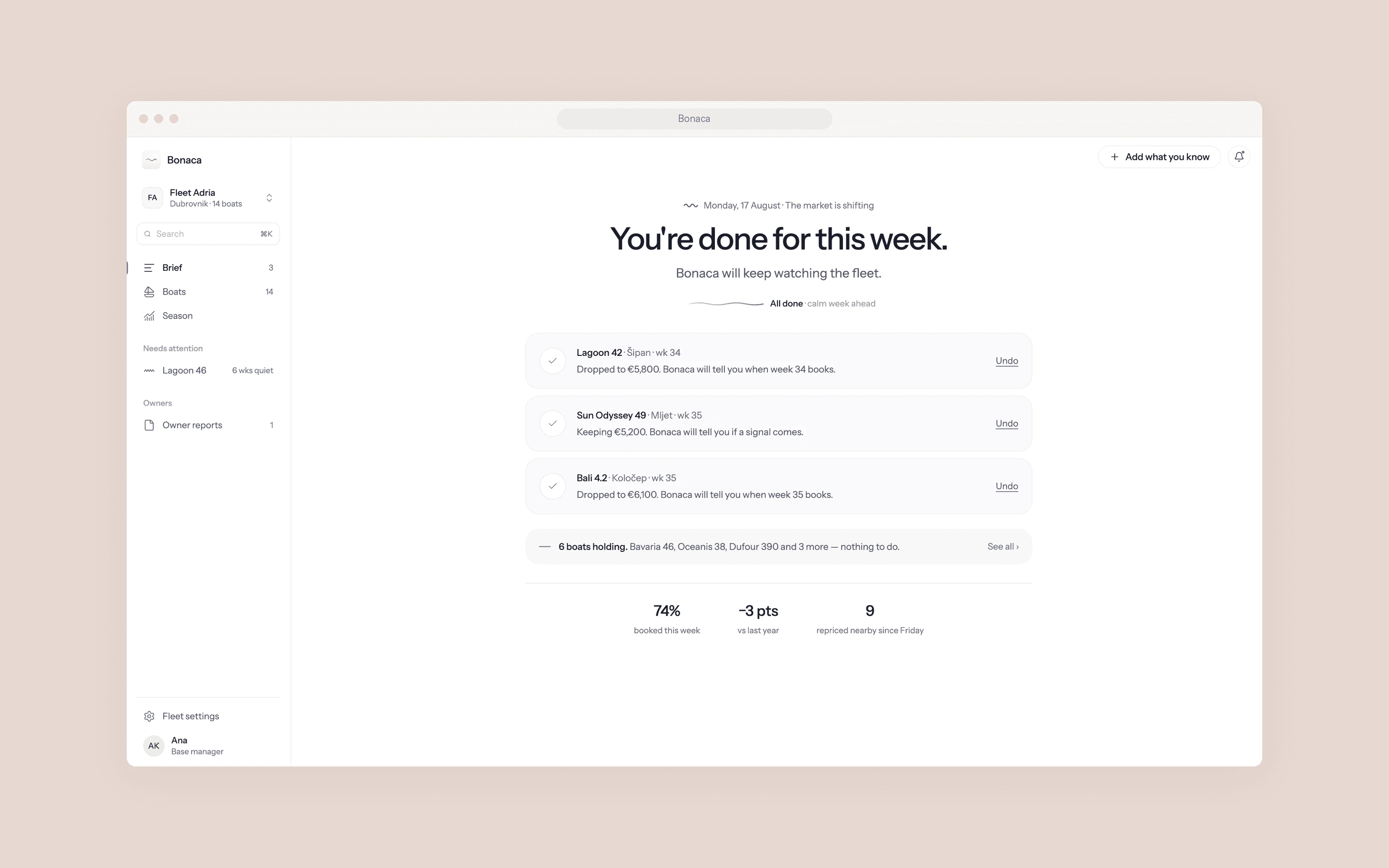
The Monday Brief, finished: three decisions in about ten minutes — then a calm week
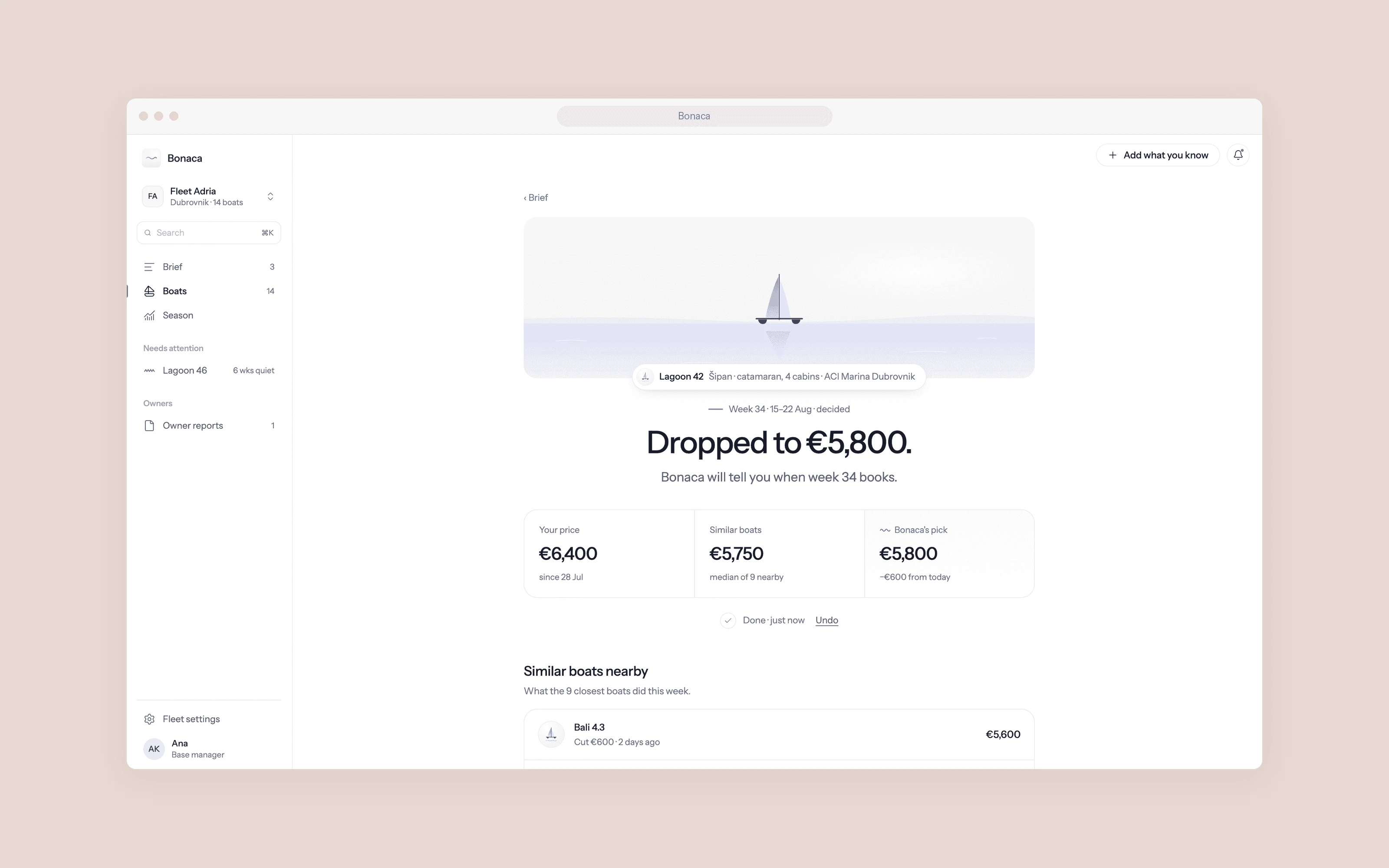
Boat detail: the recommendation first, with the price, the market and the season one scroll away
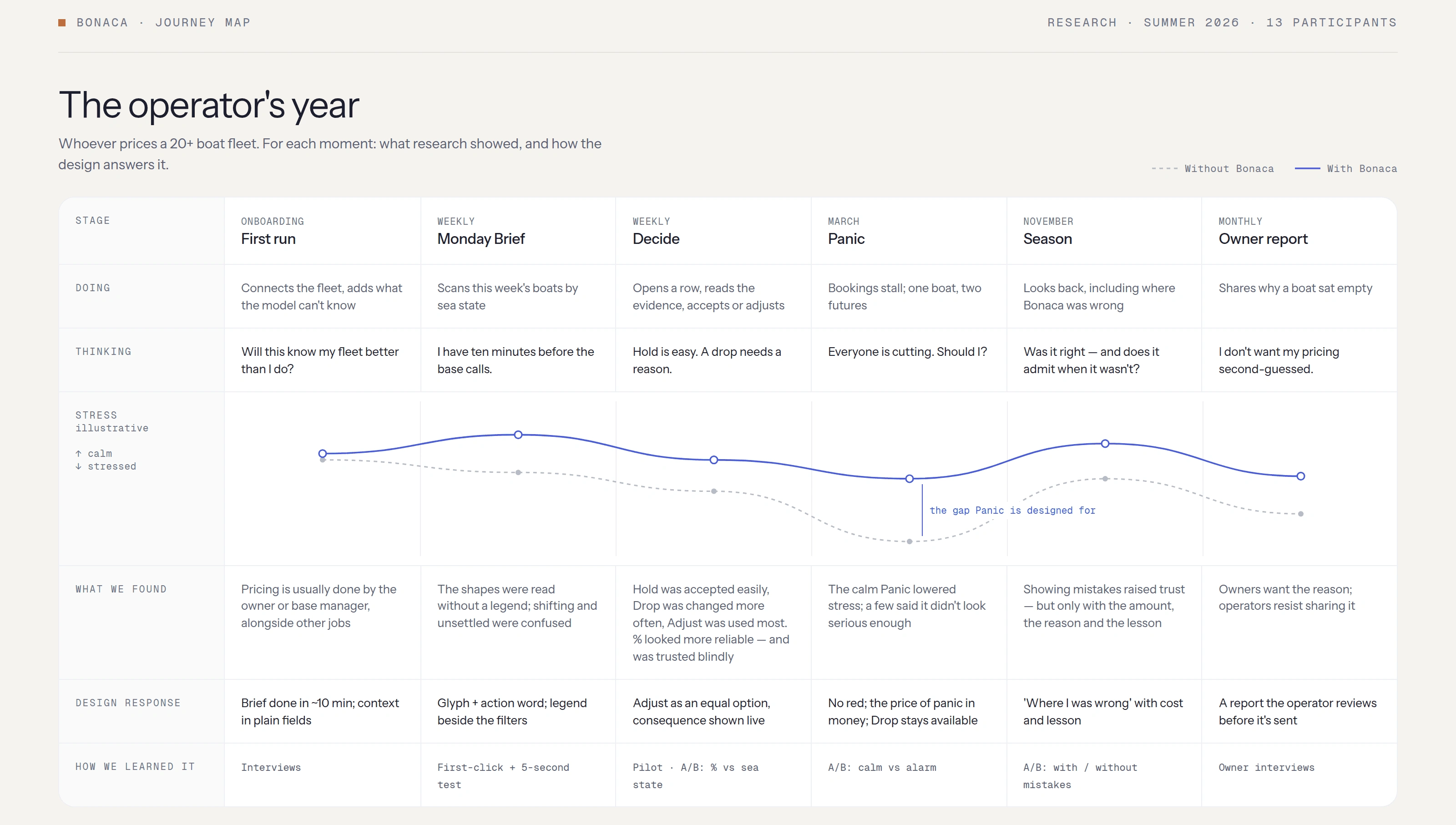
The operator's year: what research showed at each moment, and how the design answers it
Key decisions
1. No percentages
"78% likely to fill" sounds precise, but under stress people either ignore it or trust it blindly. Bonaca shows confidence as calm, rippled or choppy water. Shape carries the meaning, so it works even in black and white.
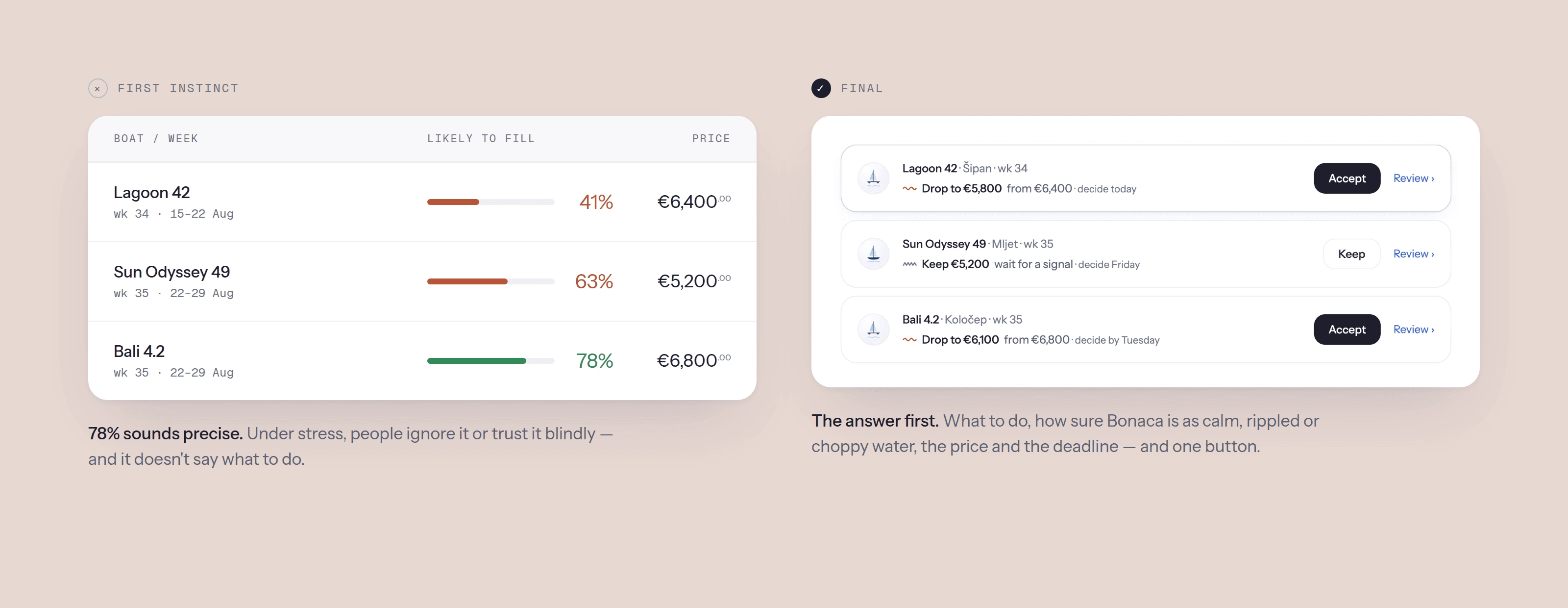
Confidence as calm, rippled or choppy water
2. The crisis screen is the calmest one
When bookings stop, the first instinct is red alerts. But a worried person plus alarms makes a worse decision. Panic has no red, and it isn't even a menu item — it only appears under "Needs attention" when a boat stalls. It gives one answer ("Hold your price"), two equal choices with what each one earns, and one button. Dropping stays just as easy to choose, with no judgement. After the decision, Bonaca says what it will watch and when it will check in.
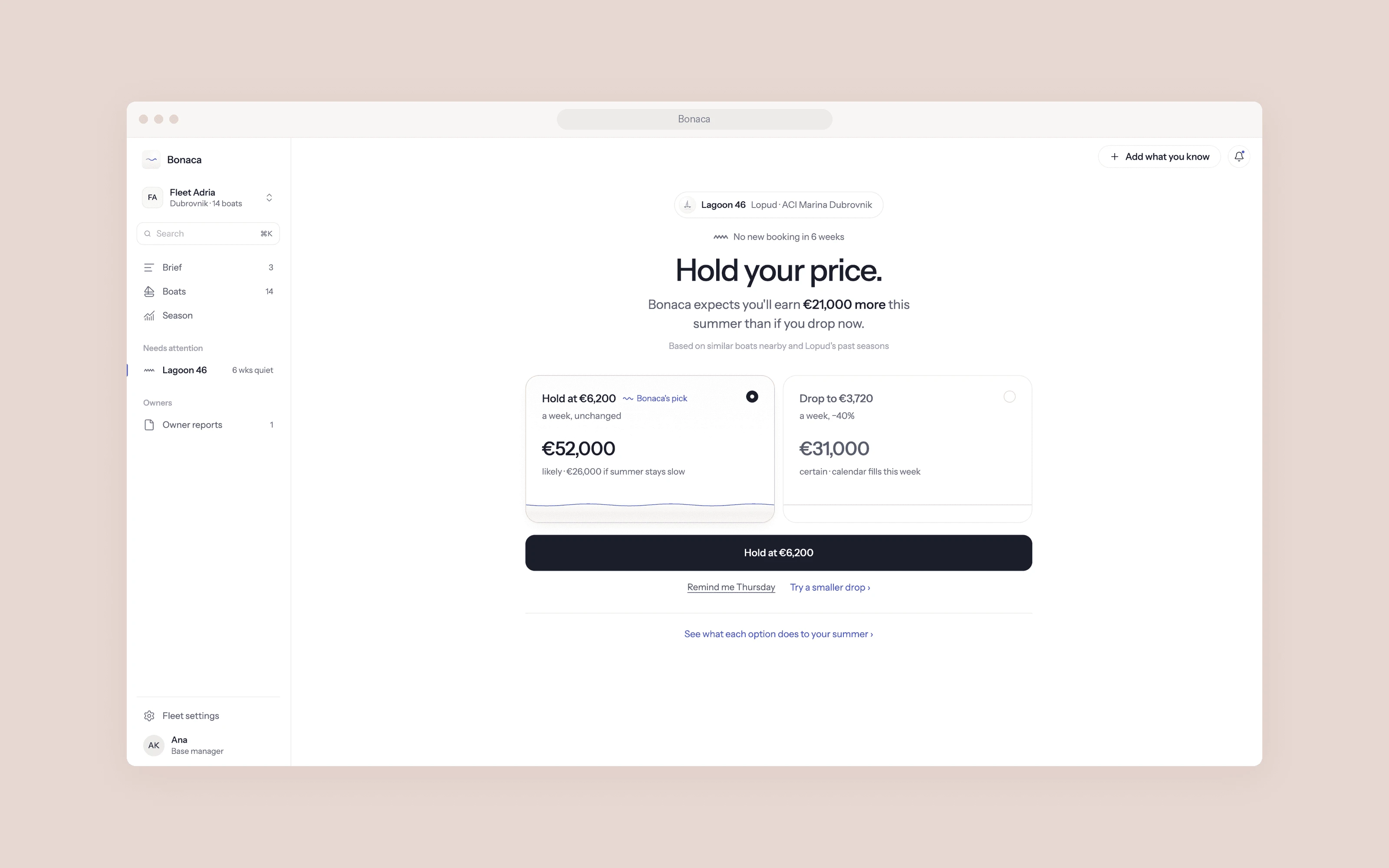
One answer, two equal choices, one button — the calm line means certain, the ripple means likely
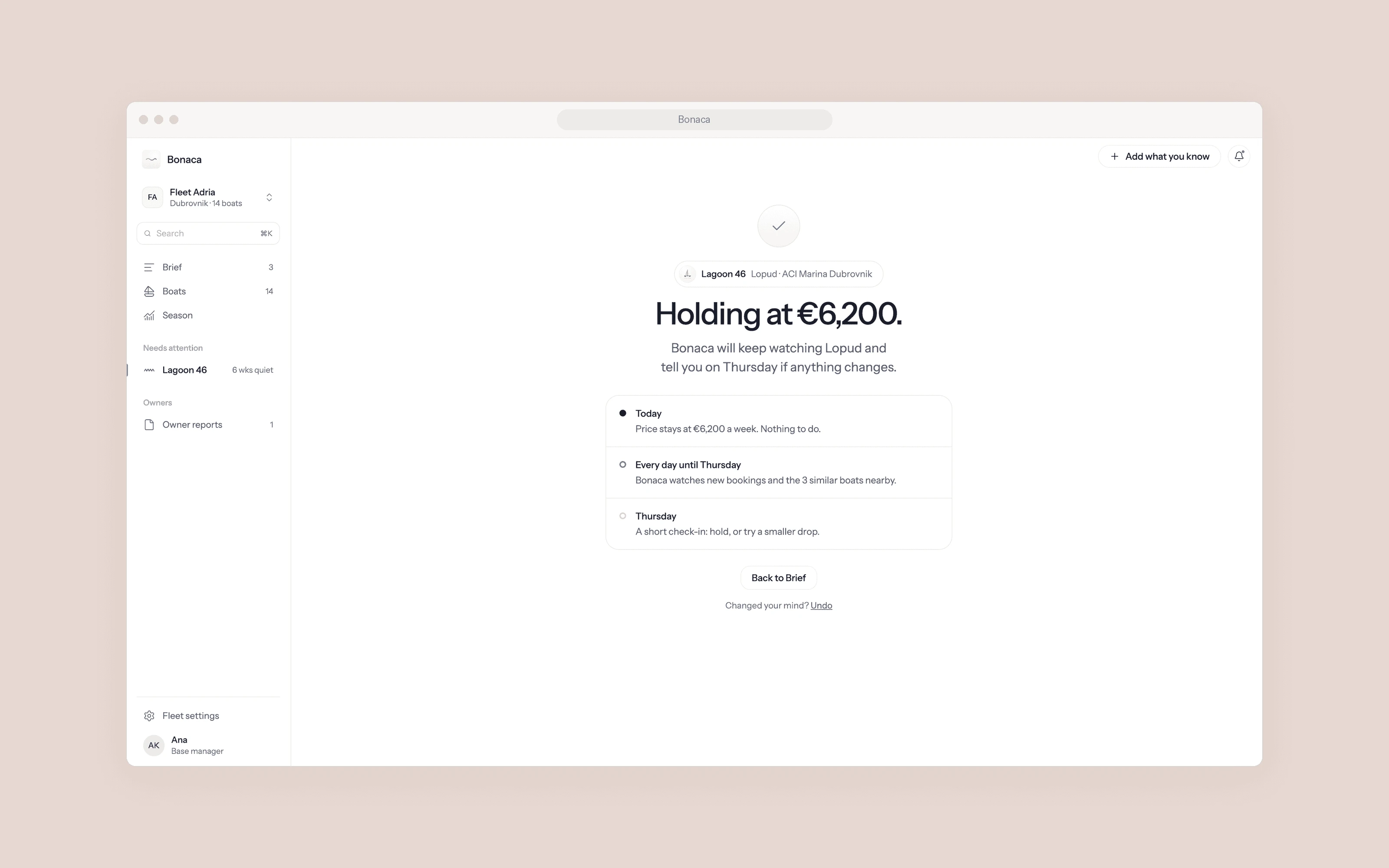
After the decision: what Bonaca watches next, and when it checks in. Undo is always there
3. Bonaca admits its mistakes
At the end of the season, Bonaca lists the calls it got wrong and what they cost. A tool that never admits mistakes never gets trusted twice.
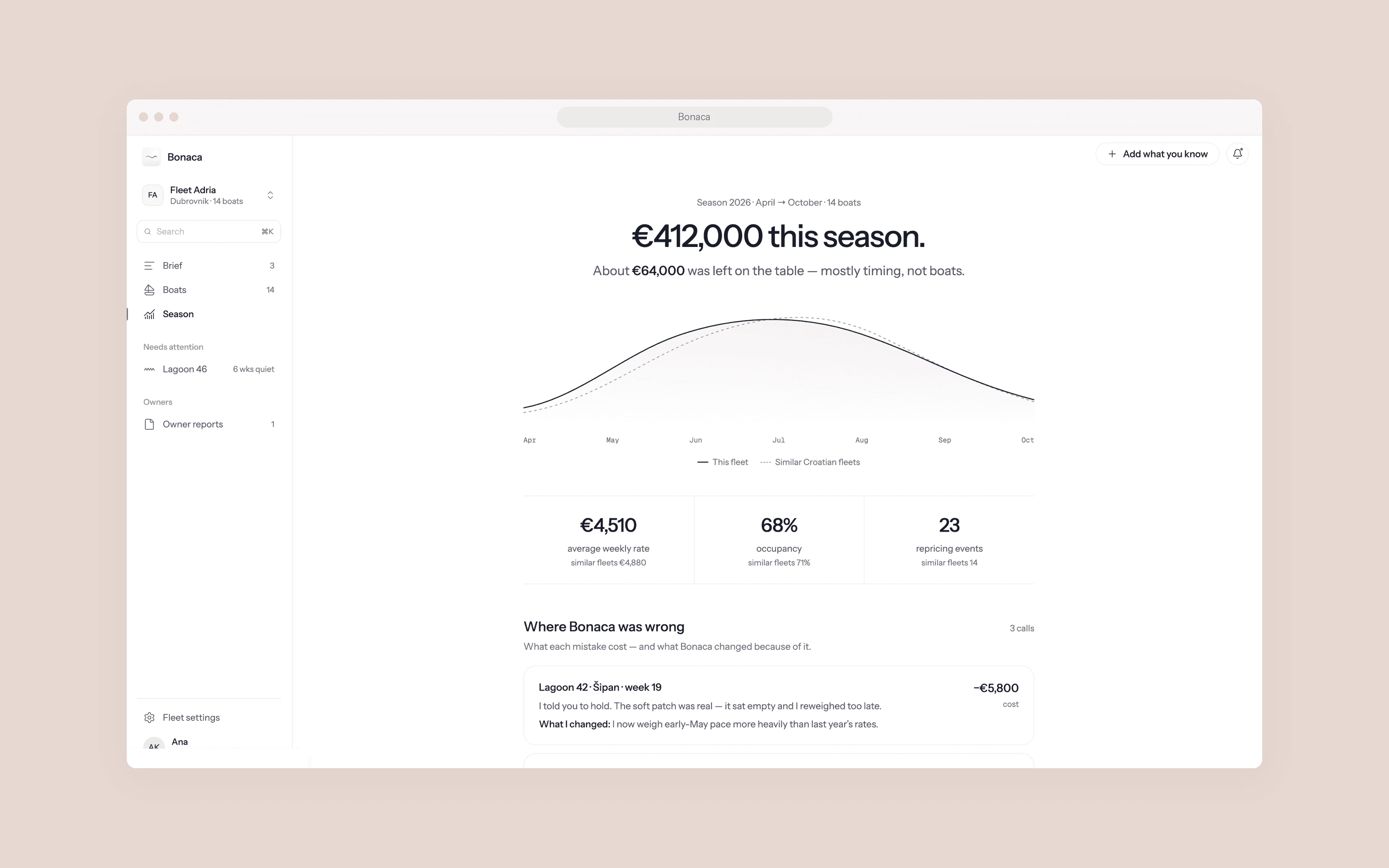
Season: the year in reverse — including where Bonaca was wrong, and what it changed
4. The operator knows things the AI doesn't
"The festival moved to week 36." The operator can add it, and Bonaca shows how much it changed the recommendation.
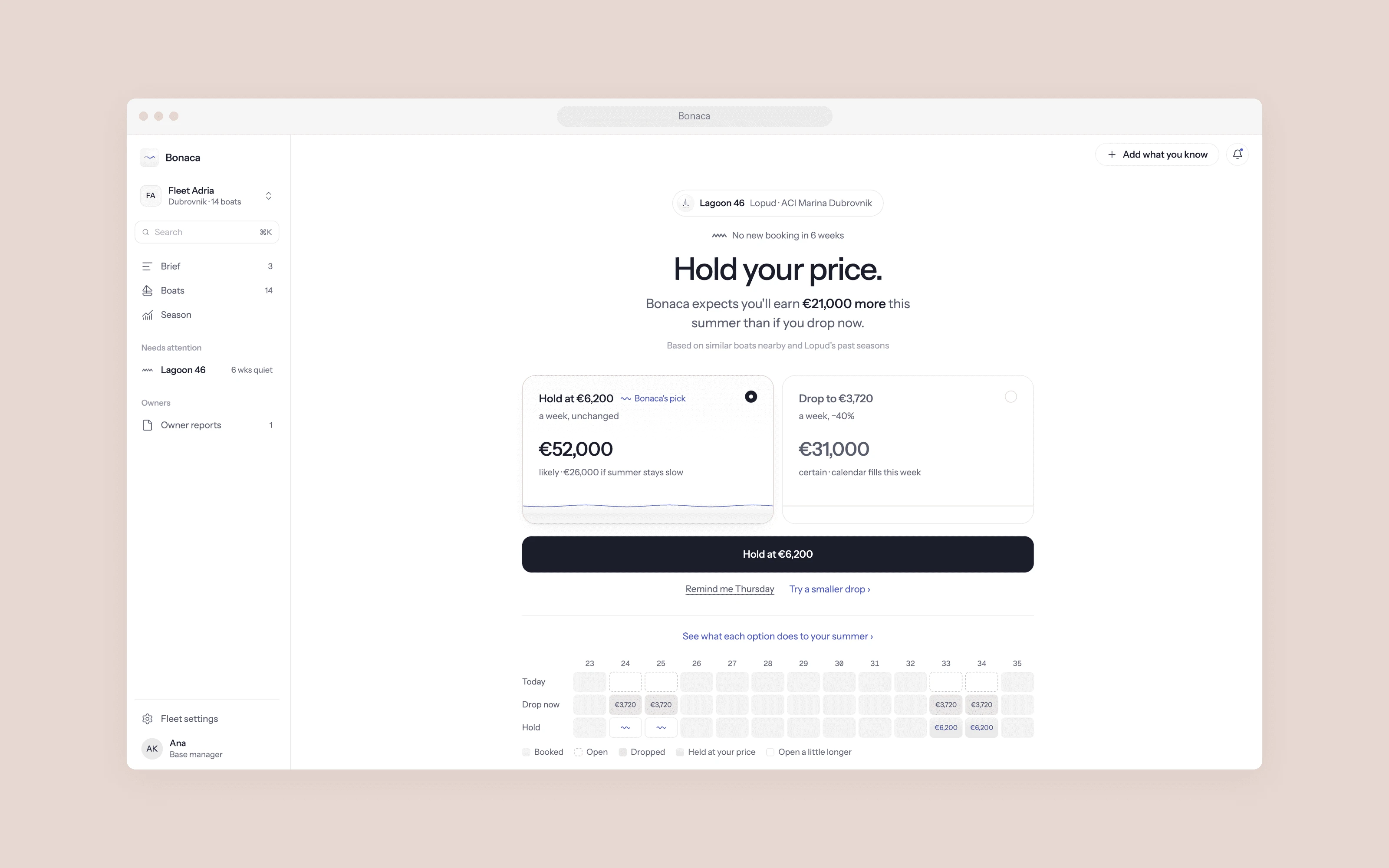
What each option does to the summer, week by week — and room to add what the model can't know
The design system
One white page, one accent colour, thin lines instead of shadows. Colour is used only where it means something.
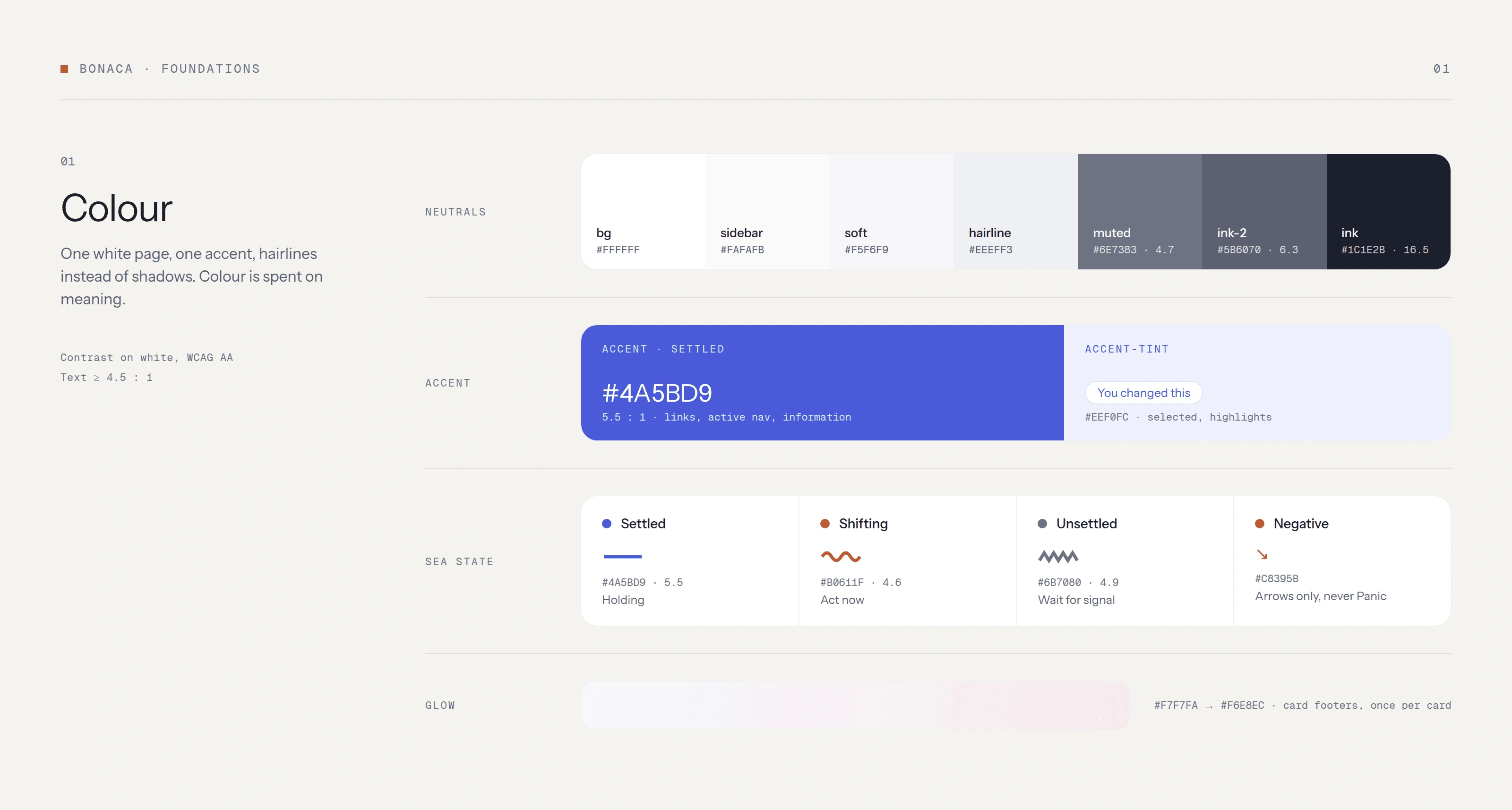
Colour: one white page, one accent, hairlines instead of shadows — colour is spent on meaning
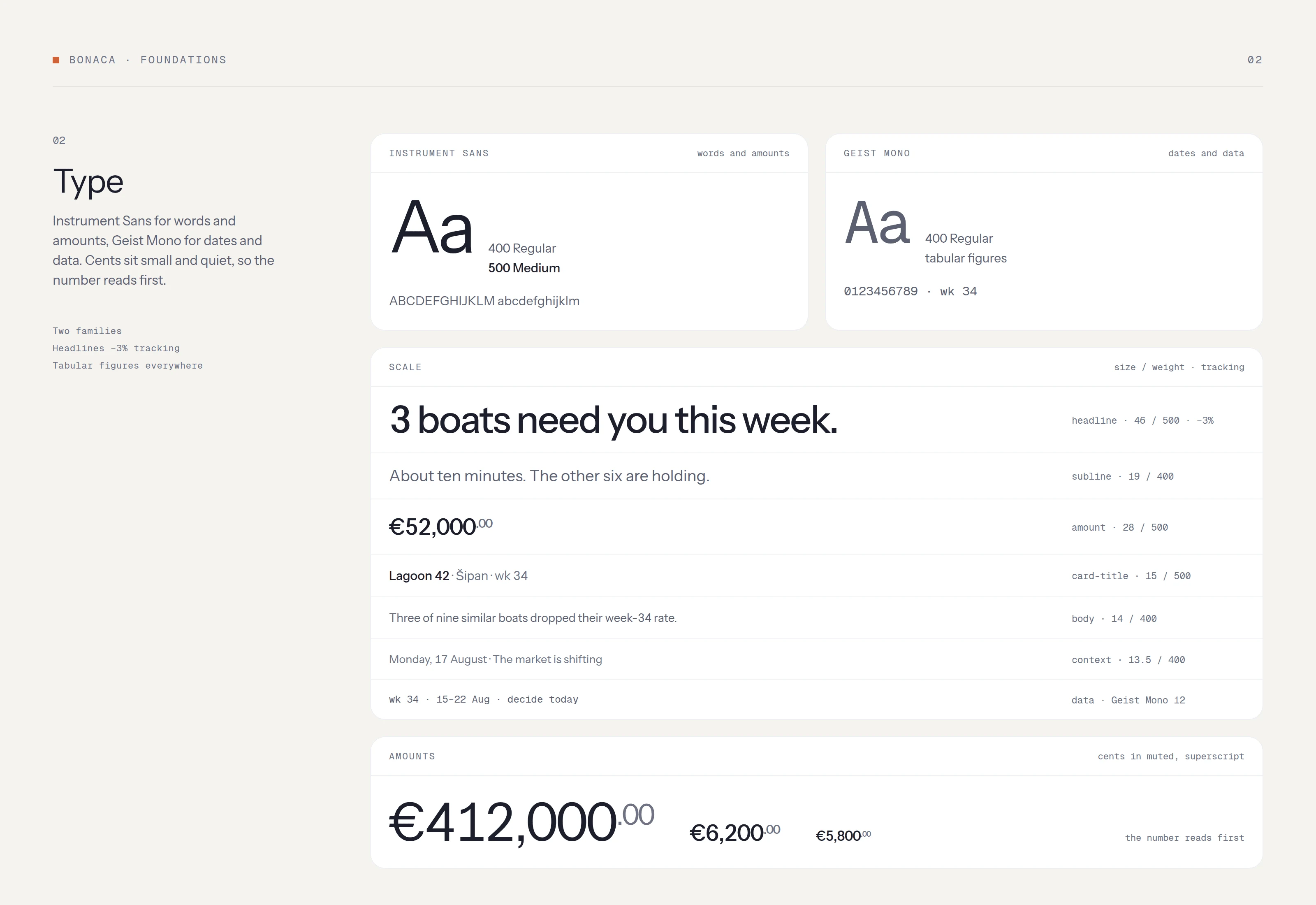
Type: Instrument Sans for words and amounts, Geist Mono for dates — the cents sit quiet so the number reads first
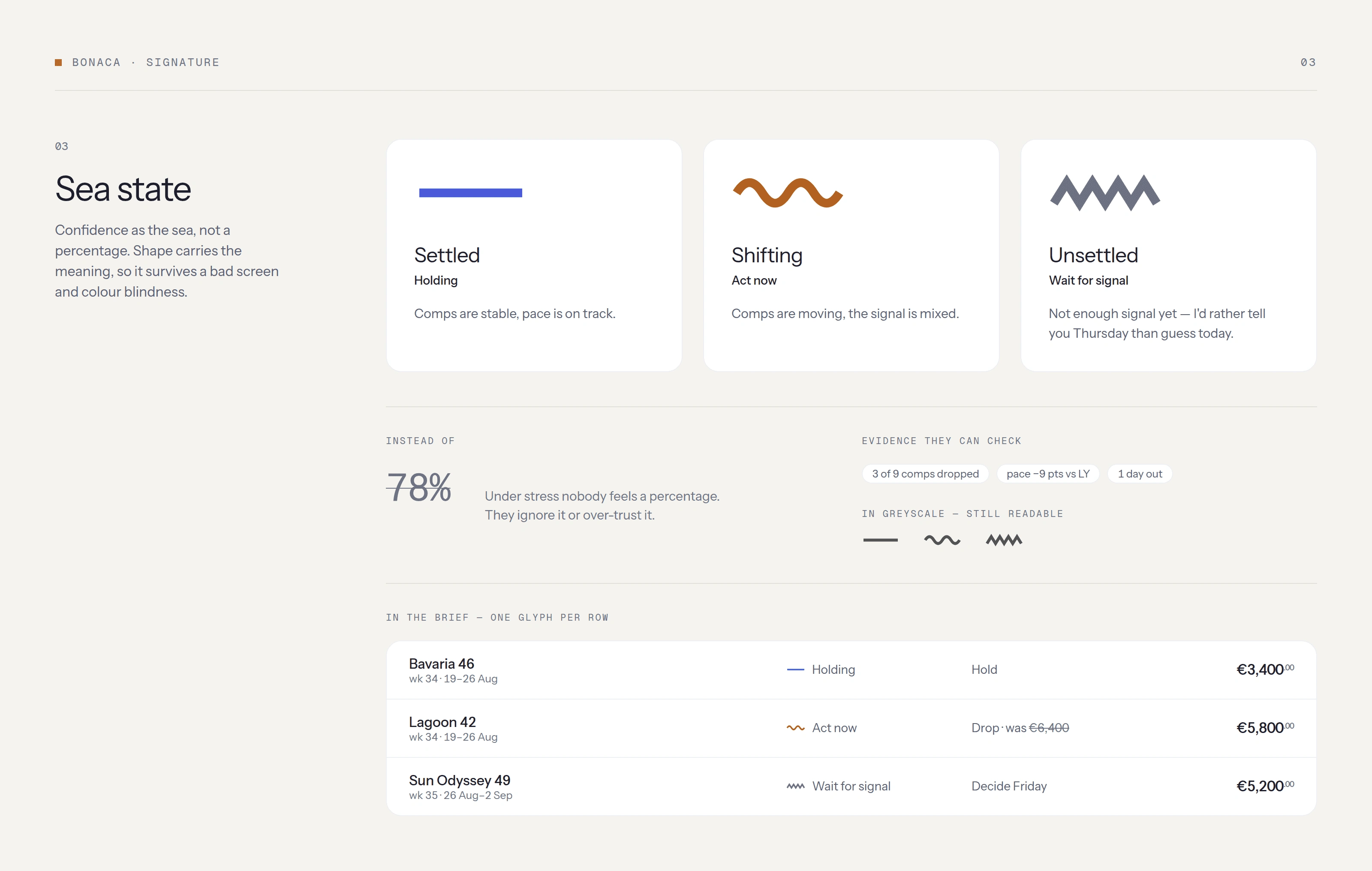
Confidence as a sea state: calm, ripple, chop — shape carries the meaning, even in greyscale
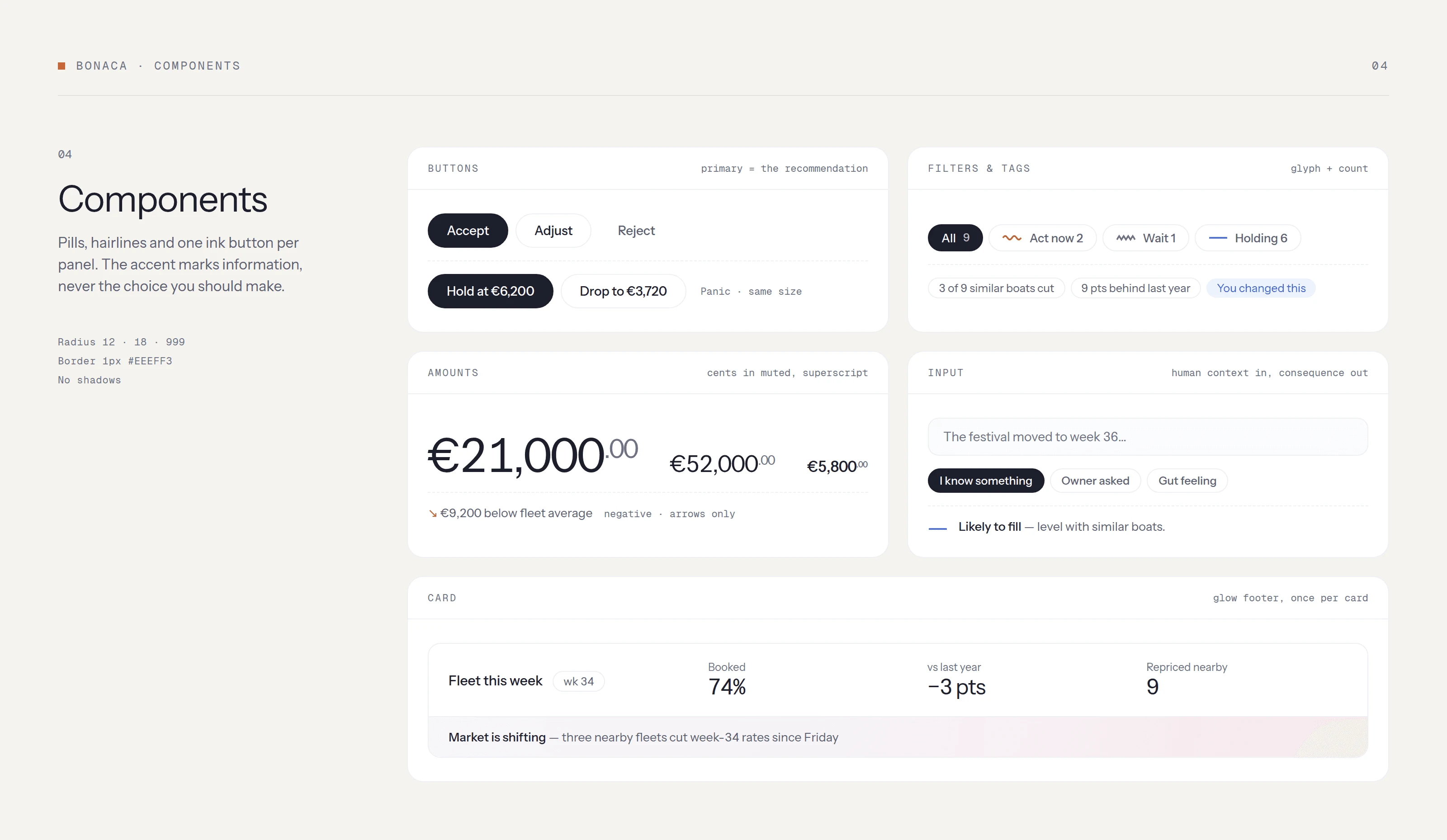
Components: pills, hairlines and one ink button per panel — the primary button is always Bonaca's recommendation
Outcome
How we'll measure success
at least half of the recommendations are accepted or adjusted
fewer price cuts made in panic
the weekly decisions take about ten minutes
revenue per boat-week against last season
What ships first
First: the Monday Brief for one fleet — the weekly habit that builds trust.
Then: Panic, once there's enough data behind it.
Last: Season and a report for boat owners — they need a full year of history.
Where it stands
The design is done, and Bonaca is now in development. The hardest problems weren't about data — they were about trust.
Like this project
Posted Oct 20, 2026
Product design for Bonaca, a revenue tool for yacht charter fleets: pricing and occupancy decisions in one workflow. Design complete, product in development.
Likes
1
Views
3
Timeline
Jan 1, 2026 - Ongoing