GoldLink

Keelan Miskell

GoldLink
A DeFi protocol surface balancing leverage, onboarding clarity, and trust inside a category where product mistakes feel expensive.
A lending protocol built after the category had lost trust.
GoldLink launched in the wake of FTX. The entire crypto lending category had collapsed because lenders couldn't see what borrowers were doing with their money — and when the music stopped, billions were exposed. Our thesis was the opposite of how most of the existing protocols worked: radical transparency. Lenders consent to specific strategies; borrowers can only deploy capital into pre-defined contracts; nothing happens off-chain that lenders can't audit.
The technical work was led by Sam, an ex-dYdX protocol engineer. The product work was mine. The design problem turned out to be harder than the smart-contract problem.
Two completely different users. One product. A primitive most people couldn't explain.
GoldLink was an automated prime brokerage for undercollateralized lending. The strategies — delta-neutral funding rate farming, scrutinized leveraged yield farming, perpetual–spot price arbitrage — were sophisticated even by DeFi standards. The product had two sides:
Lenders — passive capital providers who needed to understand what their money was doing without becoming traders themselves
Borrowers — active operators who needed to configure leverage, collateral, and risk parameters with confidence
Most products solve this by splitting the audience into two apps. We wanted one app that worked for both, because the trust loop only closed if a lender could see exactly what a borrower was doing with their capital.
The product had to teach users what it was while they were signing up to use it.
Neither user type could evaluate GoldLink without understanding the underlying mechanic. Trust came from comprehension. Comprehension came from showing, not telling.
The design solution was progressive disclosure: surface enough context at each step to build confidence without front-loading all the complexity. The product had to teach the protocol in the same motion as the user committed capital or deployed a strategy. Every screen needed to earn its weight by reducing the learning curve or surfacing trust.
Each side of the market needed a different density of explanation.
The deposit flow was designed to answer the questions a lender hadn't asked yet. What am I earning yield on? What protects me? Who is on the other side? Each strategy card surfaced the underlying mechanic, projected APY, current utilization, and the volatility profile — before the user committed any capital.
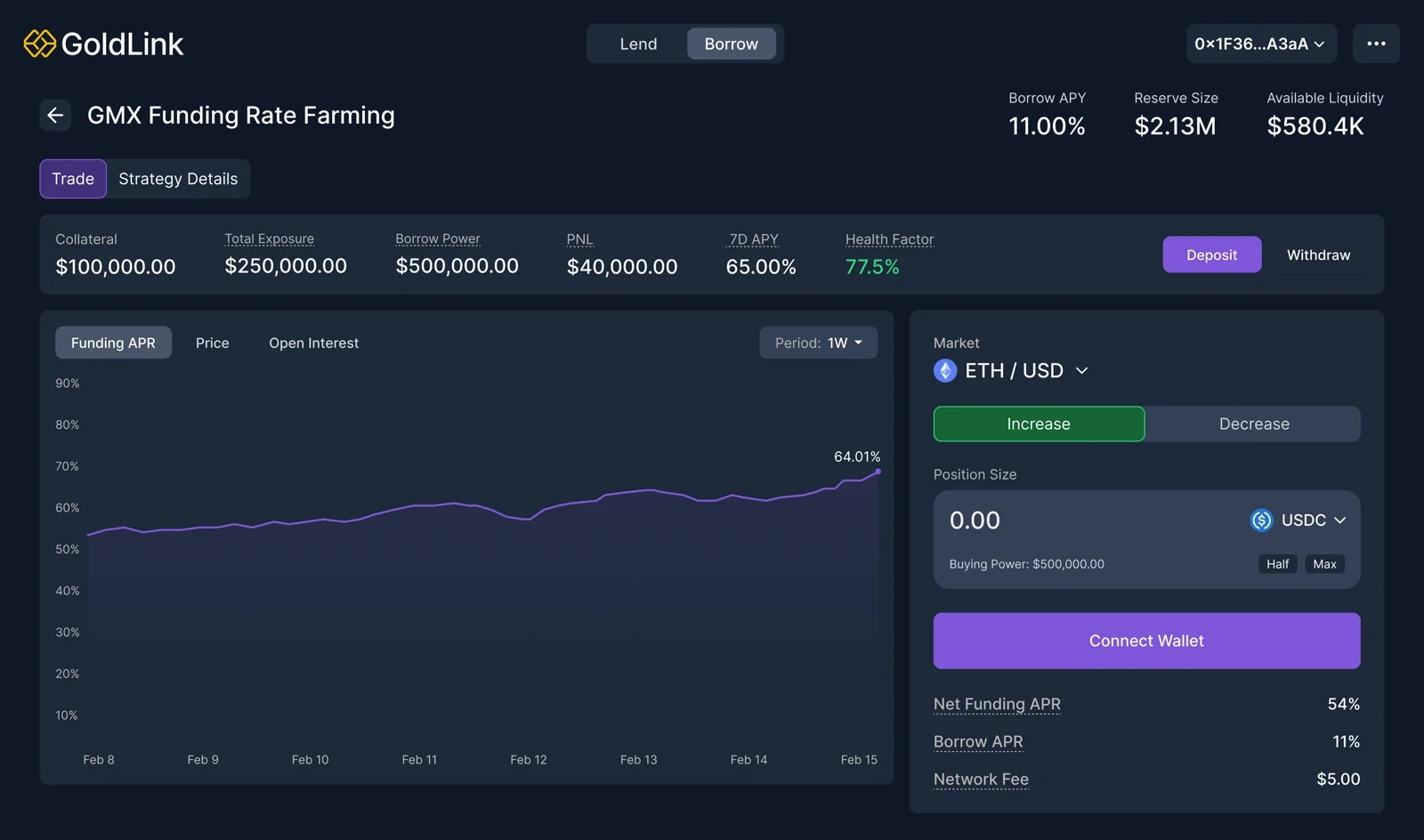
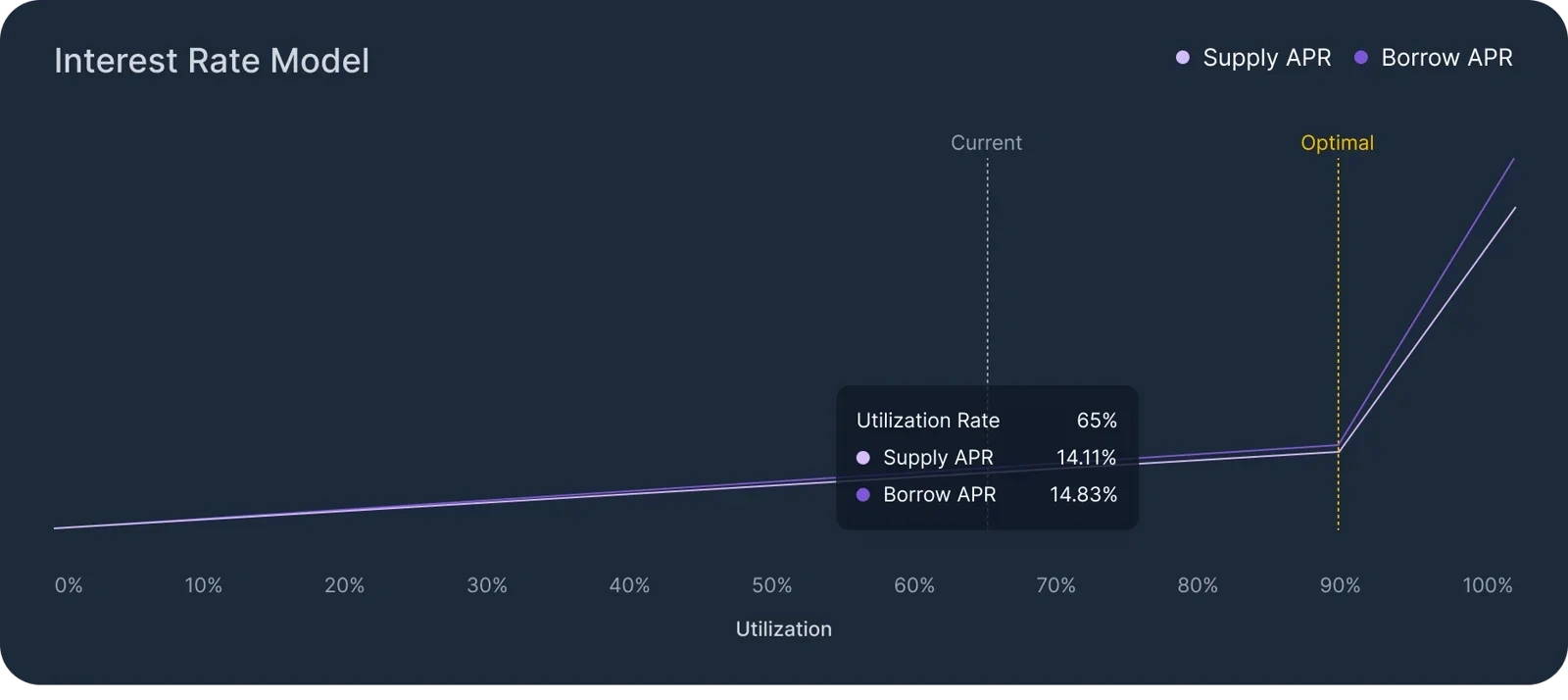
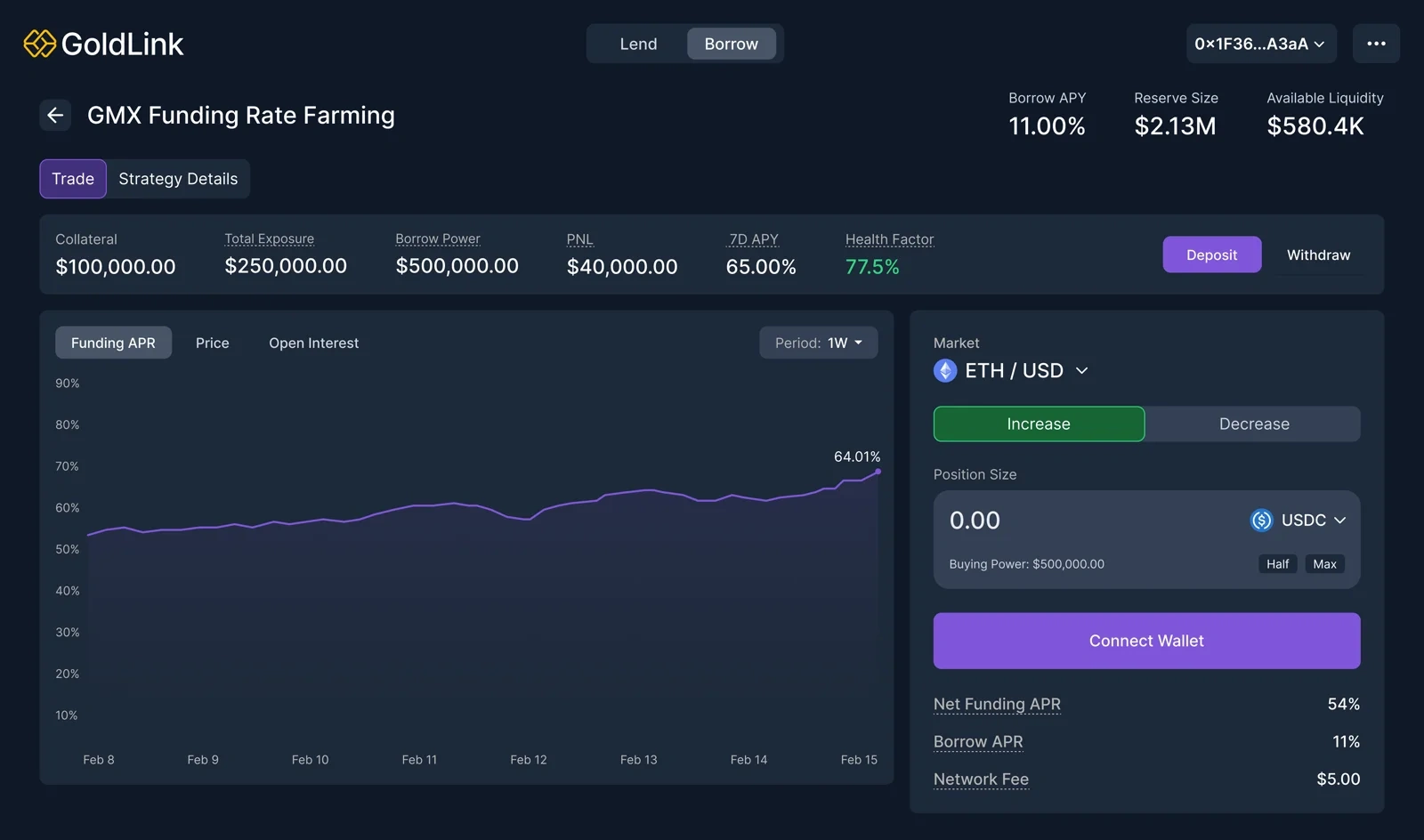
Borrowers needed more density. The deployment flow walked through every parameter — collateral amount, leverage selection, projected APY, borrow rate, liquidation conditions — with contextual explanation built into the UI rather than buried in a docs page. The interface let a borrower simulate position outcomes before signing the transaction.
Once a position was live, the management view surfaced health, P&L, collateral status, and the actions a user could take — add collateral, withdraw, close — without overwhelming the screen with data they didn't need at that moment.
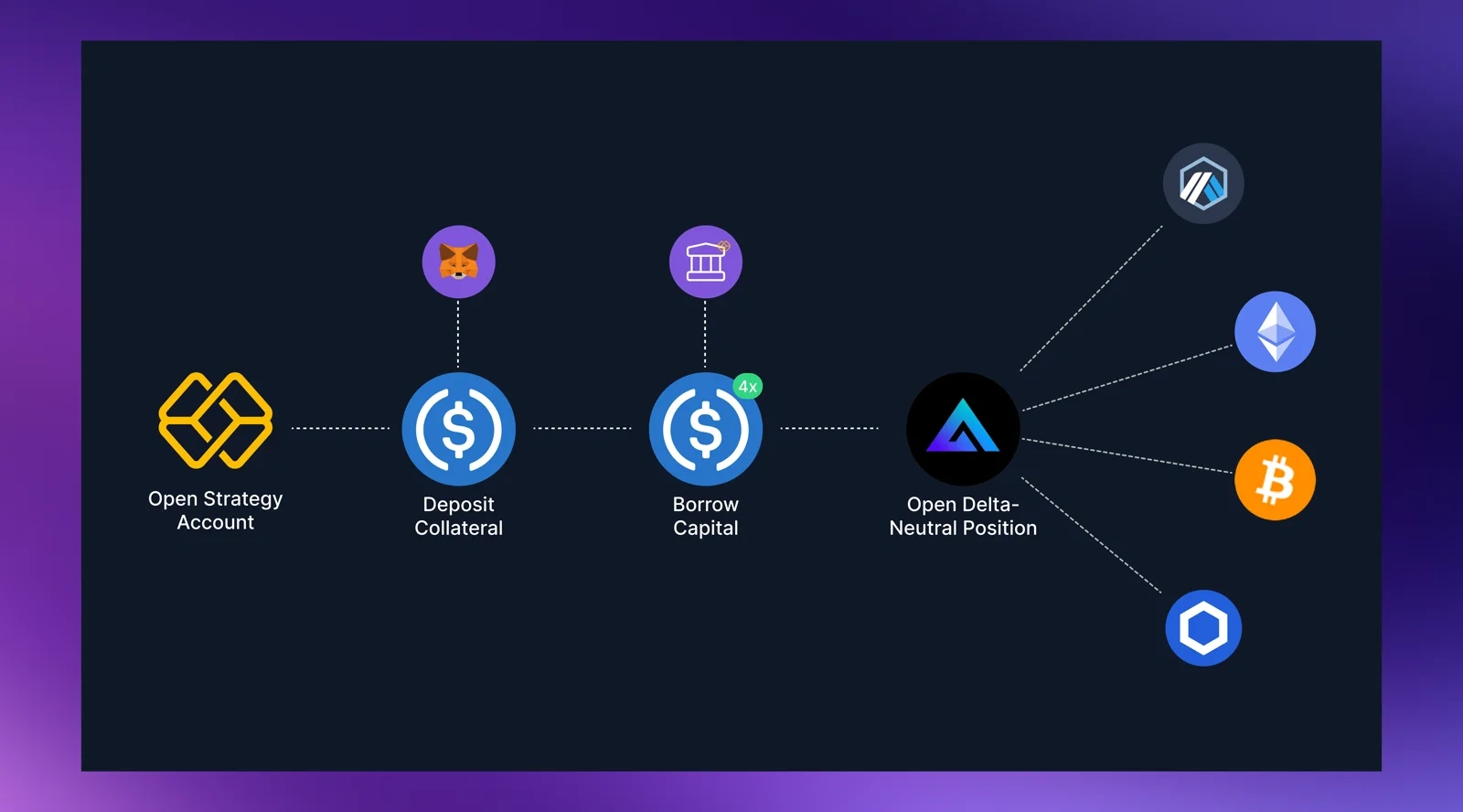
A system view made the protocol's structure legible: how lender capital flowed into reserves, how reserves mapped to strategies, how the health system protected both sides. The same diagram appeared in pitch decks, investor calls, and the product itself — one visual language across every surface.
From zero to $1M+ TVL on Arbitrum.
We shipped three production strategies on Arbitrum mainnet — Scrutinized Leverage Yield Farming, Delta-Neutral Funding Rate Farming, and Price Arbitrage. The lender flow covered deposit, strategy allocation, yield collection across strategies, and granular risk-profile control. The borrower flow covered strategy onboarding, leverage configuration, position deployment, performance tracking, and position management.
$1M+ TVL at launch and trading volume on day one
Polychain Capital seed round
Arbitrum mainnet launch, October 2023
Featured among the new generation of post-FTX transparent DeFi primitives
Closed beta in July 2023, MVP shipped October 2023 — eight months from research to mainnet
What 0→1 as the product co-founder of a DeFi protocol taught me: when the product is genuinely complex, the hardest design decisions aren't about the screens. They're about deciding what the user has to learn before they can use anything, and what the product can teach them along the way. Every screen we shipped earned its weight by either reducing the learning curve or surfacing trust — anything that didn't do one of those got cut.
Co-founding also collapsed the design–engineering distance entirely. Sam wrote the contracts. I shaped the product. We talked through every screen against the on-chain primitive that would run underneath it. That feedback loop — design constraint informing protocol design, protocol mechanics informing UI — is the closest I've worked to what design engineering actually feels like in practice.
Like this project
Posted May 7, 2026
A DeFi protocol focusing on leverage, onboarding clarity, and trust in a post-FTX environment.
Likes
0
Views
4