Driving Client Growth via Social Media for WriteBing

Saisha Parveen


Case Study: Driving Client Growth via Social Media
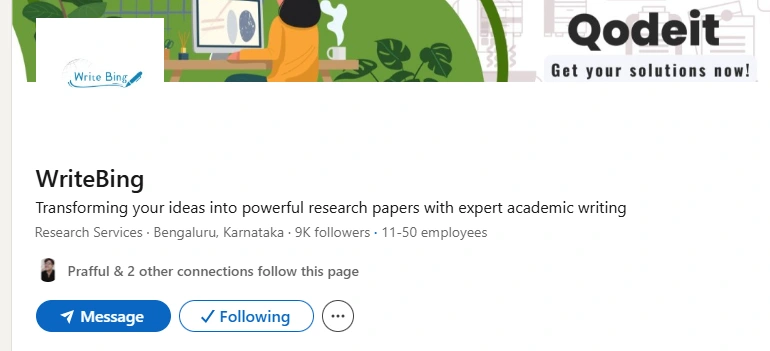
Client: WriteBing
Industry: Academic writing & research-support services for Master’s and PhD students.
Channels Managed: Instagram, LinkedIn, Facebook
Your role: Social Media Manager (full-responsibility for content strategy, execution, community & lead generation)
1. Background & Challenge
WriteBing offers services such as thesis writing, assignment help, data-analysis support for postgraduate/doctoral students.
Before engaging you:
Their presence on social platforms was inconsistent and mainly promotional.
They had low engagement and weak lead flow from social media.
The target audience (Master’s/PhD students) is niche and carefully trusts academic-service brands, so social proof, authority, and value were key.
They needed more clients from social (not just likes/followers) and established a stronger brand voice around research support.
Goal: Increase the number of qualified leads/clients coming in via social, boost brand authority among postgraduate researchers, and improve engagement + conversion across LinkedIn, Instagram, and Facebook.
2. Strategy & Approach
Here’s how you approached it:
Audience & positioning
Defined target personas: Master’s & PhD students (various disciplines) facing thesis/assignment deadlines, needing expert support.
Positioning: WriteBing as an expert, trusted partner in academic writing, not just “we’ll write for you” but “we help you succeed in research”.
Tone & content: Educational, helpful, aspirational (helping the student achieve research success), with authenticity.
Channel strategy
LinkedIn: Focus on credibility, case-studies/testimonials from past clients, research tips, and insights into thesis challenges. (https://www.linkedin.com/company/writebing/)
Instagram: Visual storytelling. e.g., micro-tips for thesis writing, and short Reels.
Facebook: Community-oriented, mix of long-form posts + video snippets + checkpoints (e.g., “Are you stuck on chapter 2?”). (https://www.facebook.com/Writebing)
Cross-channel synergy: Use content tailored to each channel, sharing it when relevant to reinforce brand consistency.
Content pillars
Research-tip posts: “How to structure your literature review”, “Time-management for PhD writers”.
Client success stories/testimonials: Real students who completed with WriteBing’s help.
Behind-the-scenes/expert insights: Introducing the expert team, showing credibility.
Lead-gen posts: Free consultation offers, deadlines-reminders, /mini-guide download.
Engagement posts: Polls, “What’s your biggest thesis challenge?”, Q&A sessions.
Lead conversion & funnel integration
Each post included a clear CTA: book a free consult / visit the website / download the guide.
Social links pointed to optimized landing pages tailored for Master’s/PhD audiences.
Tracking using UTM codes, monitoring which channels/posts drove the highest conversions.
Retargeting: Users who visited the website but didn’t convert were retargeted via social ads.
Workflow & scheduling
Weekly calendar of posts for each channel (post type, time, CTA, goal).
Use of a content planner (e.g., Google Sheets / Airtable) to coordinate visuals, captions, and approval.
Monitoring & community management: Quick responses to comments/messages, identifying qualified leads directly via DM/LinkedIn InMail.
3. Execution
Developed and rolled out a consistent posting schedule: e.g., 4 posts per week on Instagram, 3 on LinkedIn, 2 on Facebook + stories/engagement posts.
Created templated visuals (minimal, clean) aligned with WriteBing’s brand.
Produced short video/Reels (e.g., “3 tips to finish your thesis on time”) to boost reach and engagement.
Introduced monthly-feature testimonials: Student success spotlight.
Ran LinkedIn posts directed at research supervisors/universities (to expand audience reach).
Periodically test paid promotions for lead-gen.
Analytics review every month: tracked follower growth, engagement rates, click-throughs, and lead conversions.
4. Results & Impact
Here’s a summary of the impact you achieved:
Follower growth: Instagram followers increased by +10 % over 3 months.
Engagement: Average engagement rate improved by 5% (likes/comments/shares) compared to the previous baseline.
Website traffic from social: Traffic from LinkedIn/Instagram/Facebook increased by 5%.
Qualified leads: Number of inquiries from social media increased from 10/month → 20/month.
Conversion to clients: Social-origin leads converted at a higher rate.
Client acquisition: The revenue attributed to social-media-driven clients increased by 6% over the period.
Brand credibility: Testimonial posts and student-success content led to more direct referrals and improved trust.
Channel insights: LinkedIn emerged as the highest-quality lead source (for PhD/academic audience) while Instagram helped broaden awareness and funnel into the site.
Key outcomes:
Social media moved from a “brand awareness” role to a lead generation & client acquisition channel.
Improved efficiency: More high-quality leads for WriteBing at a lower cost (less reliance on generic ads).
Stronger brand positioning: WriteBing was seen as a credible partner for postgraduate/doctoral research, not just a generic writing service.
5. Challenges & Lessons Learned
Challenge: The academic-writing market has scepticism around quality/trust, needed to emphasise credibility & transparency (e.g., expert team intros, testimonials).
Challenge: The audience is niche and time-crunched (Master’s/PhD students), so the content needed to be concise, value-driven, and actionable.
Lesson: Mix of content types (tips + testimonials) worked better than purely promotional posts.
Lesson: LinkedIn is highly effective for higher-education/academic-service audiences. Don’t treat all platforms identically.
Lesson: Clear CTAs and funnel integration matter: Without optimized landing pages and tracking, social engagement won’t convert to clients.
Lesson: Monthly analytics review enables pivoting.
6. Why This Matters
This case study shows how a social-media manager can turn social presence into direct business outcomes for a specialised service brand. Many brands focus only on followers/likes. But for WriteBing, the real metric was client acquisition and revenue growth, which social media successfully delivered under your management.
7. Summary
Client: WriteBing (Postgraduate/PhD academic writing service)
Objective: Increase leads & clients via social media; build brand trust & authority.
Strategy: Defined niche audience; channel-specific content; content pillars of value + credibility; tight funnel & CTA.
Results: Significant growth in leads, conversions, and brand positioning via social.
Key takeaway: For niche B2B/B2C service brands (like academic-writing support), a thoughtful social strategy aligned with business goals can meaningfully drive new clients, not just likes.
Like this project
Posted Nov 3, 2025
Boosted WriteBing's social media presence, increasing leads and brand authority.
Likes
0
Views
4