Service Design Exploration in Bookstore Café

OTumininu Paseda

A Step into Service Design
Output of IDEO-U Service Design Course.
Introduction
Setting off on my service design journey, I enrolled in an engaging course offered by IDEO-U. Embracing their philosophy of honing skills through practice, I was given a list of possible projects and asked to choose one I believed would allow me to apply and refine my skills. As I contemplated various options, the allure of Food and Beverages beckoned—it’s an area I’m already passionate about, albeit in a different context. This decision marked the beginning of a journey driven by curiosity and a dedication to crafting exceptional experiences.
Choosing My Service Design Project
Why did you choose this particular service?
In crafting my portfolio centerpiece—a futuristic space station designed for living—I’ve embarked on a colossal project that’s bound to keep me busy for months, if not years. It’s a passion project of mine, one that encompasses everything from workspaces and classrooms to cozy sleeping nooks and social spots. But you know what caught my eye first? The dining hall. As I chatted with friends and folks around me, I realized I hadn’t even scratched the surface of what a dining experience could truly be. When I saw the Food and Beverages option, it seemed like the perfect choice. It’s something I’m already looking into, but in a whole new setting. I’m diving into this exploration hoping to uncover insights that’ll not only make my space station dining hall pop but also guide me as I flesh out the rest of my out-of-this-world project.
Imagining My Ideal Customer
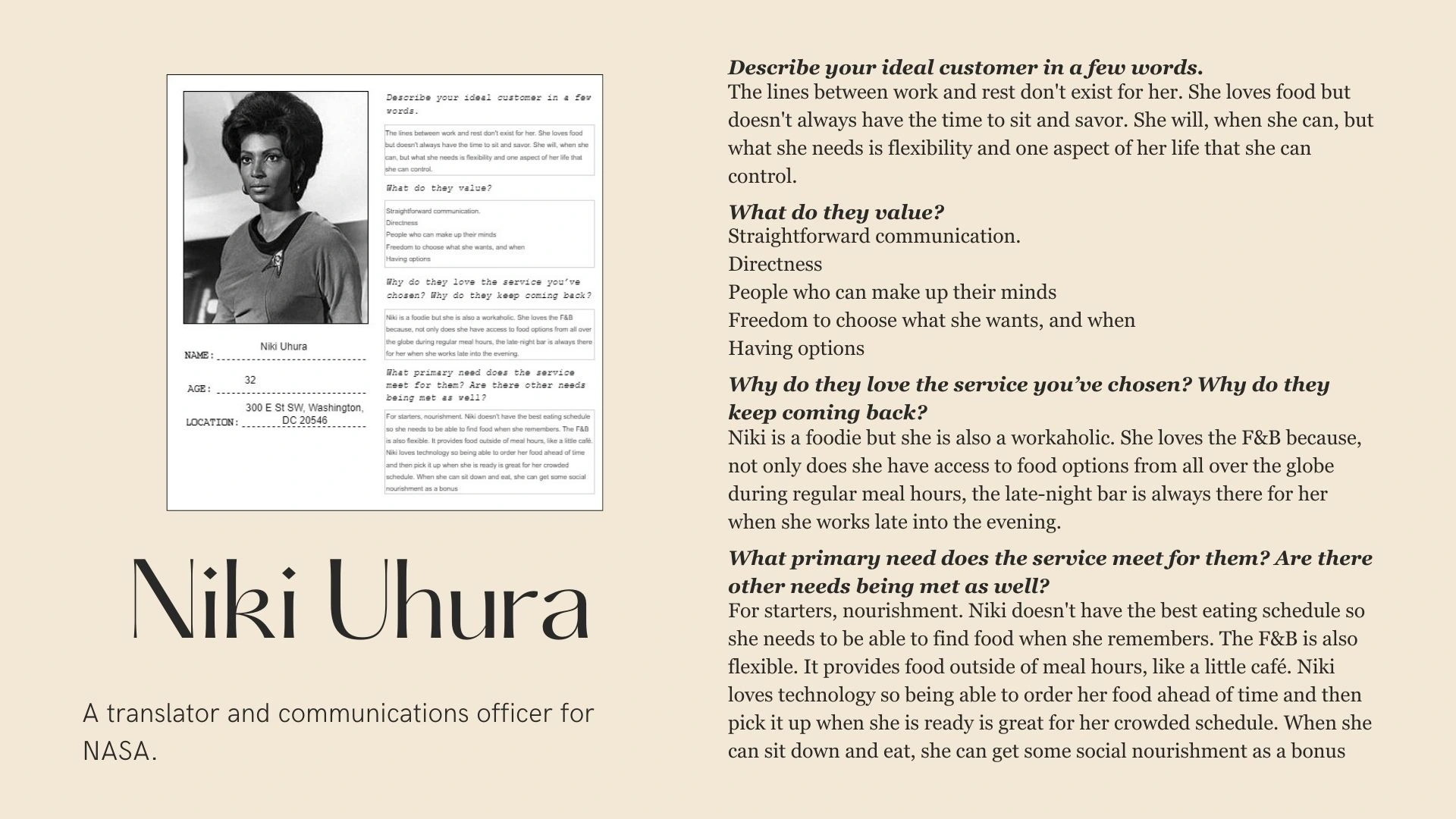
Before diving into my project, it’s crucial to establish the ideal customer. Drawing inspiration from my space station project, I selected a fictional sci-fi character to serve as the embodiment of my ideal customer: Communications Officer Uhura from the Star Trek series. To envision this persona, I meticulously filled out a chart detailing her character traits and values.
That taken care of, I can begin.
1. Expand the Journey
After selecting the project, the first step involves diving into a specific experience and thoroughly understanding it. This phase is all about grasping the complete journey: the good, the bad, and everything in between. I aim to gather insights into every aspect of the service—what users need, how providers deliver, and the methods they use. My approach includes creating a map with three columns (Pre, During, Post) and three rows (Moments, Emotions, Notes). To kick off this process, I start by examining my assumptions.
Chosen Location: Barnes & Noble (Café)
Assumptions
Before I venture into Barnes & Noble, I need to address my assumptions. As any UXer understands, it’s vital to prevent assumptions and biases from interfering with the process of gathering insights. A simple yet effective approach is to lay out these assumptions upfront.
My location is a Barnes and Noble Cafe. There, I expect to see people on their devices. Likely, there will be no more than two people working on food. There will be a younger but diverse group. I expect to see many cups of drinks and not many food items unless they’re baked goods. It will likely be since it is a bookstore, so most people will be either reading books or looking for books. I expect to be able to find a place to sit fairly easily and to be able to get sweet drinks and sweet baked goods, but nothing that would be considered quality food or a real meal.
Journey Map
With assumptions clarified, it’s time to step into the café and immerse myself in the experience. I meticulously observe, experience, and participate in everything around me. Upon returning home, I compile my findings into a Q&A session, which serves as the foundation for creating a comprehensive journey map.
What is your first interaction with the service?
When I walked into the B&N, the first thing I did was walk to the vinyls. The cafe is somewhat hidden from the rest of the bookstore. A virtual divide. I went straight to the counter because I’ve had issues with the app. It as more crowded than intended so it too me a second to find a place to sit. I eventually chose an open space that faced the wall.
What do you observe as the intended goals of the service? Capture examples of how these goals are or are not being met.
There are three types of sitting. Tables, high tables that face the wall and high tables that face the window. The way I look at it, the tables are for people who are with others and want to talk and interact. The high tables by the walla re for privacy and focus and the ones by the window are for people who want to work but don’t mind natural distraction. The high tables also have the easiest access to outlets so they were mostly fille with people on laptops and devices. There were a few people working with others at the high tables.
What are some good and bad elements of the service that you observed?
Having the food menu at the register was uncomfortable. The drinks menu is posted high above the counter so I can take my time choosing my drinks from afar but is I want food, I have to walk up. That is not great for someone with anxiety.
The way the tables were organized to make room for both patrons that want to work/read and those that want to hang out is great design.
When you interact with objects or space, what purpose does it serve you? Capture examples below.
There’s a small condiment area by the pick-up area and that is good. Those things should be close together. There are many outlets which was great for me since I forgot to charge my laptop the night before.
Capture your notes from your experience and observations here, including photos, sketches, and key artifacts from the service (e.g., visitor maps, welcome emails, ticket stubs), to help you understand what has been designed already — and what hasn’t.
When I walked into the B&N, the first thing I did was walk to the vinyls. The cafe is somewhat hidden from the rest of the bookstore. A virtual divide. I went straight to the counter because I’ve had issues with the app. It as more crowded than intended so it too me a second to find a place to sit. I eventually chose an open space that faced the wall.
The sandwich tasted like Jimmy Dean. Maybe worse. It was edible but nothing special. The Matcha latte was yummy enough. Not the best but good enough. The chewy marshmallow treat was really yummy. There are a number of stands all meant to sell things. Smart of them to put the lap desks in this area. The sitting/working area.
A worker came around at least once while I was there to clean up. The area was incredibly well-lit.
With my experiences collected, I created the following Journey Map:
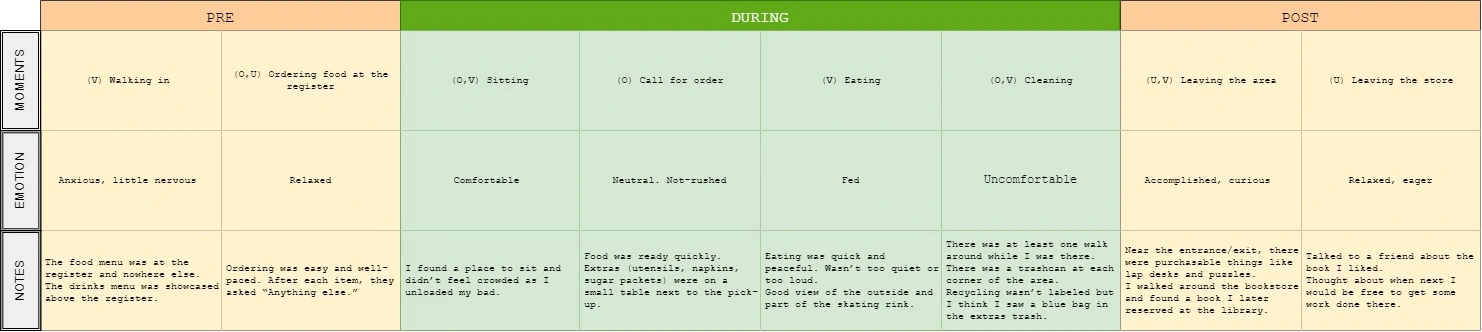
Certain moments are marked with letters O – moments that are critical to a successful operation V – moments that are high-value U – moments that provide a clear opportunity to be unique Moments can be an example of more than one opportunity.
Moments
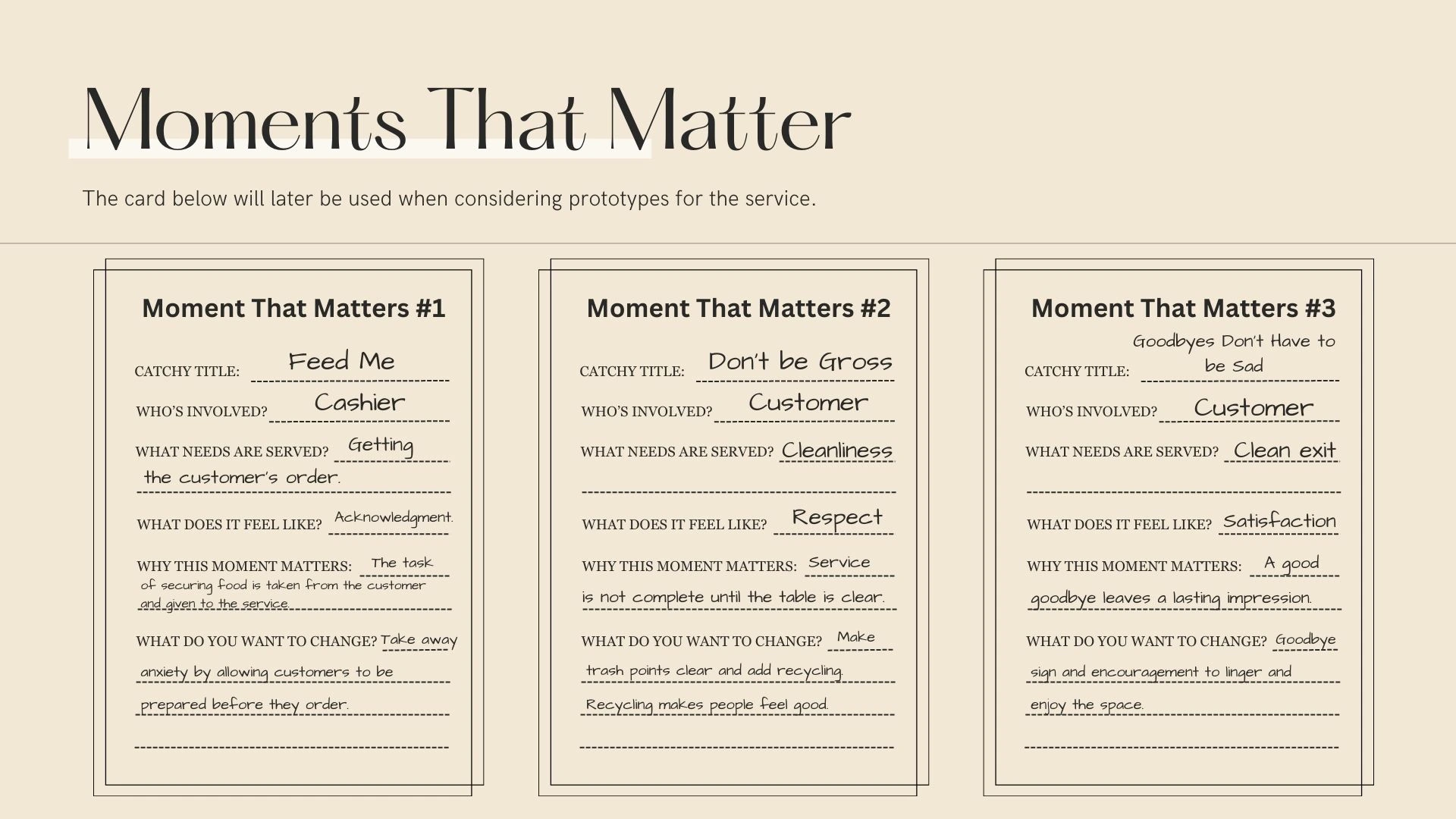
Now that the key moments are identified, given the project’s time constraints, it’s crucial to narrow down the scope. To achieve this, I select three pivotal moments, one from each column section, and delve deeper into them by crafting a “Moments That Matter” card for each.
Making Moments Real
From three to one, I select one specific moment and embark on a brainstorming session. While ideally, this would be a collaborative effort, I must rely solely on myself due to current constraints. As I proceed with the next part of this step, I keep the following prompts in mind:
Consider a spectrum of responsibility for service delivery. Full to self-service
What are the Goals of the Service?
At What Moments in the Journey Can Technology Play an Augmenting Role?
What Types of Interactions Are Your Customers Accustomed to Using, and What Types of Interactions Do They Value?
What Are the Implications of Using Technology?
I also keep the following tips nearby:
Design only the details that matter.
Factor in the before and after.
Act out your service.
Think about moments over time.
Allow people to be their best selves.
Track quantitative and qualitative measures]
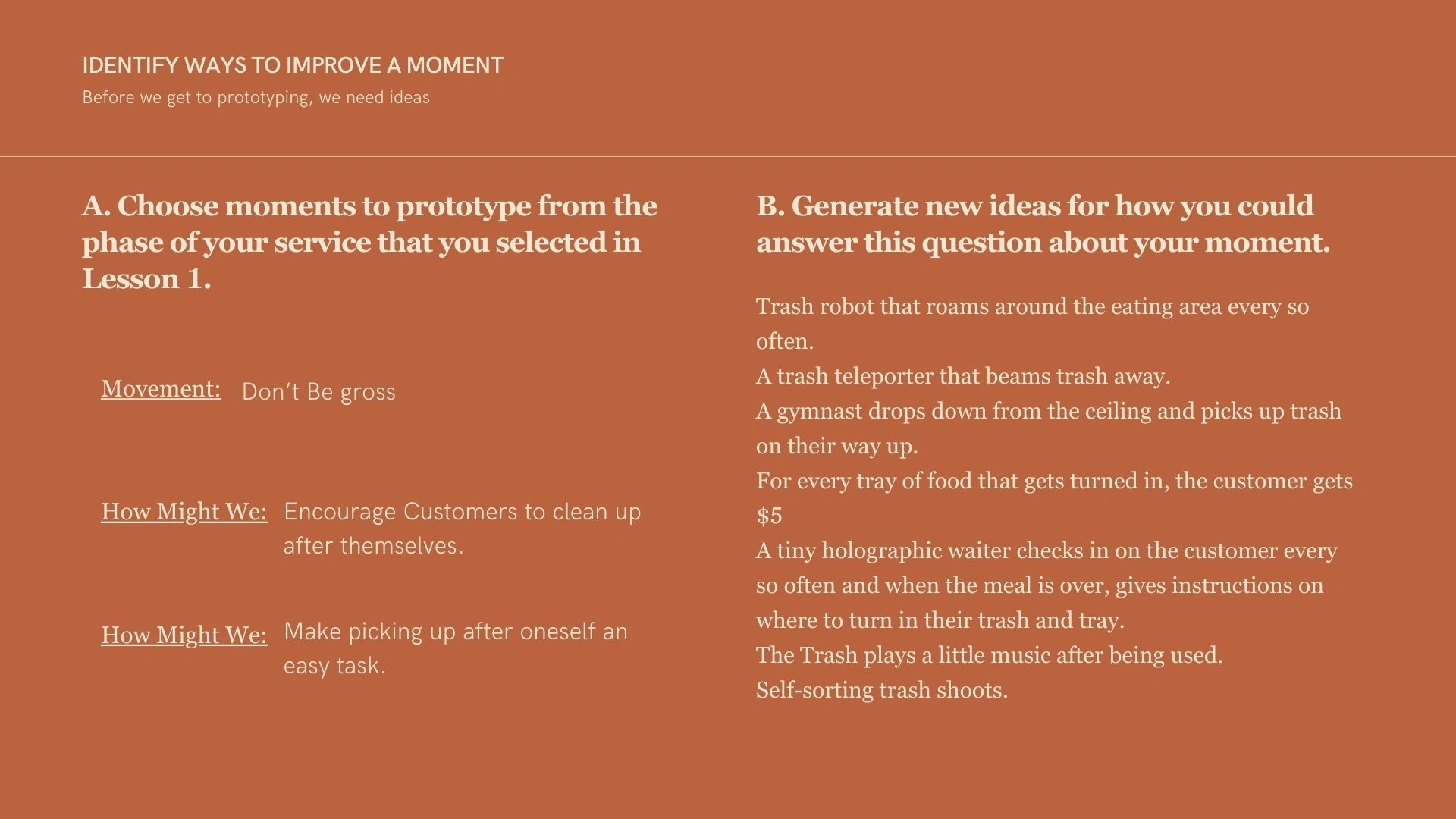
STEP 1: Identify ways to improve a moment
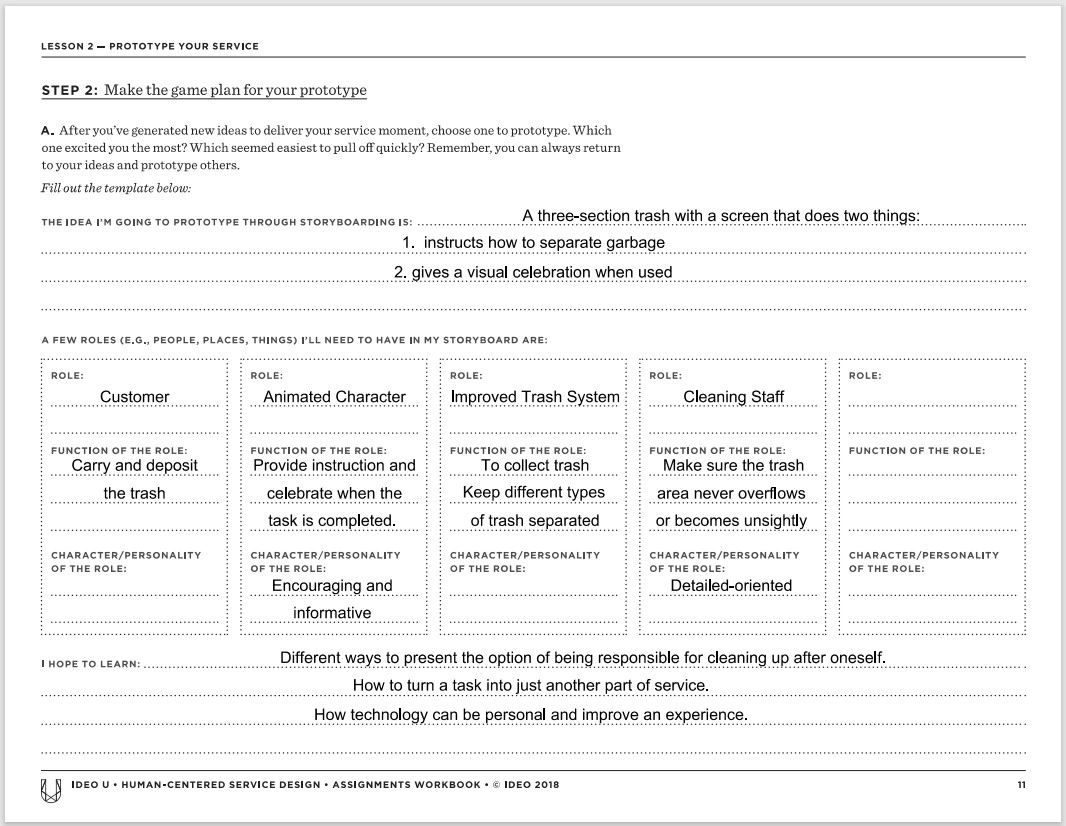
STEP 2: Make a game plan for my prototype
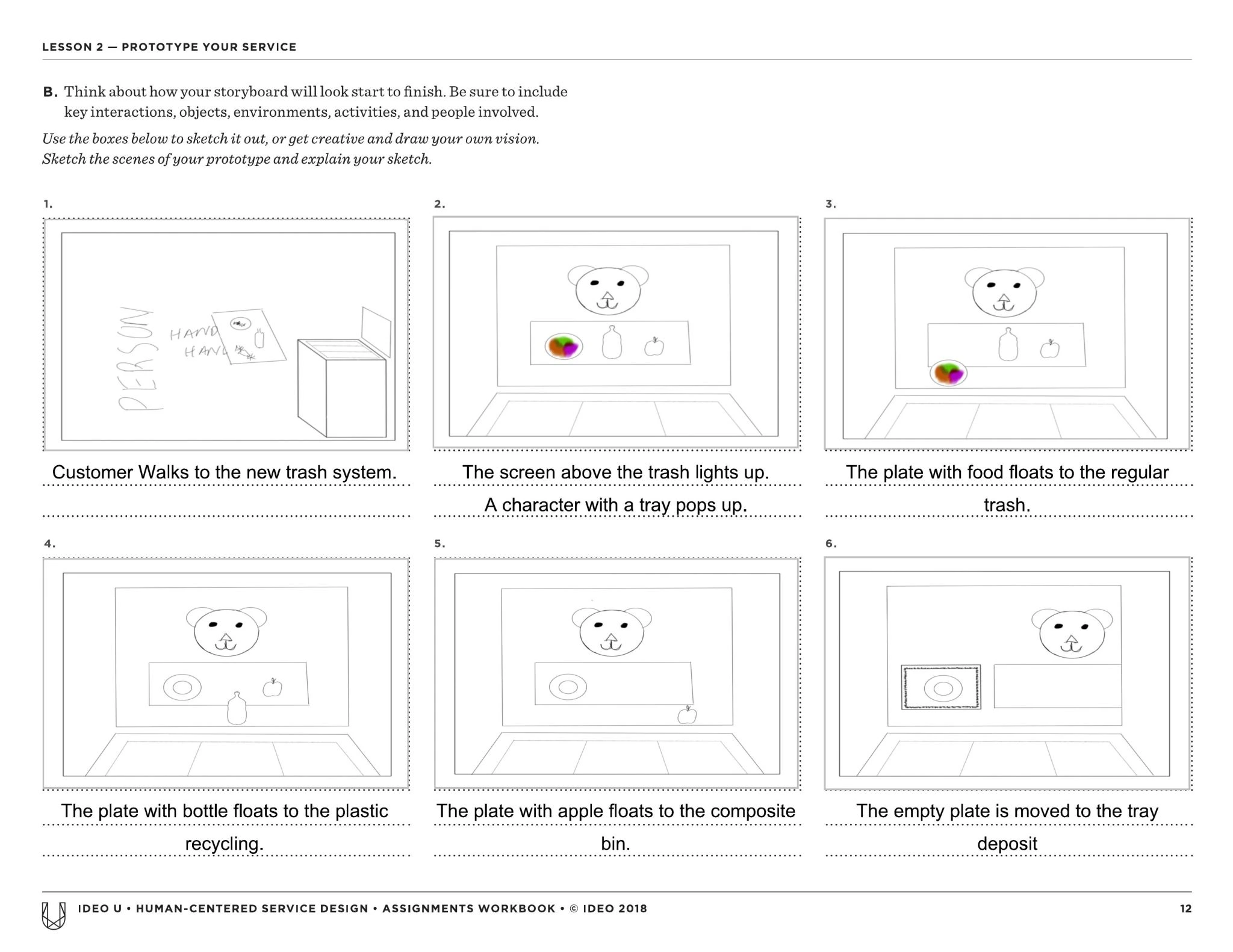
2. Prototype My Service
Finally it’s time to prototype, forgive the adolescents drawing.
3. From Journey Map to Blueprint
Now, it’s time to transform the journey map into a comprehensive service blueprint. This blueprint goes beyond the surface level of the journey map, encompassing every facet of the experience. This includes front-of-house and back-of-house operations, technology and data integration, communication channels, tools and resources, artifacts, assets, and touchpoints. However, before delving into the blueprint, I must first dissect this single moment and explore all its constituent parts.
Expand
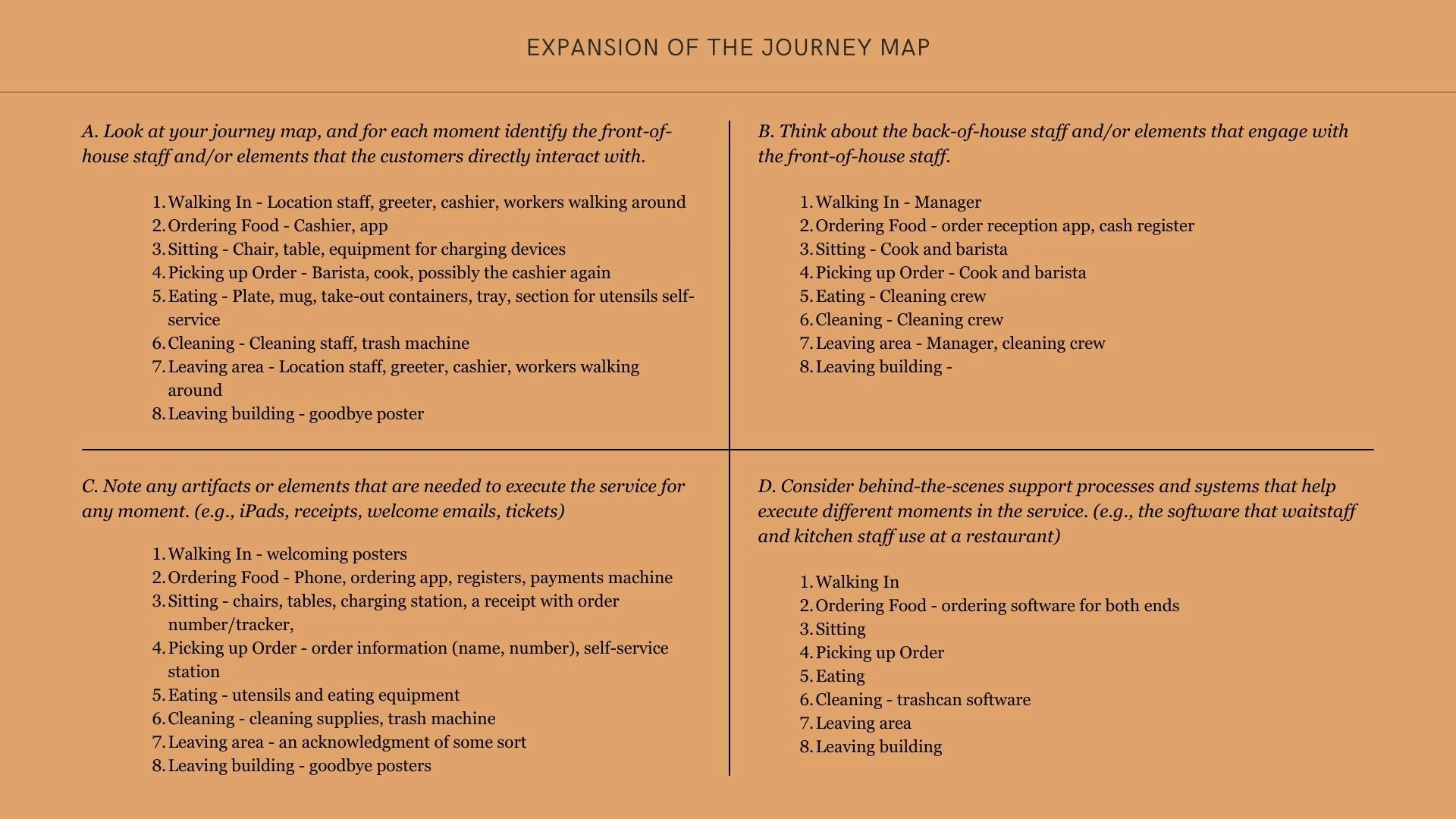
Service Blueprint
Your blueprint is an important artifact to help people see the moments that matter on your journey map, why they’re important, and what’s needed to pull them off. – IDEO-U
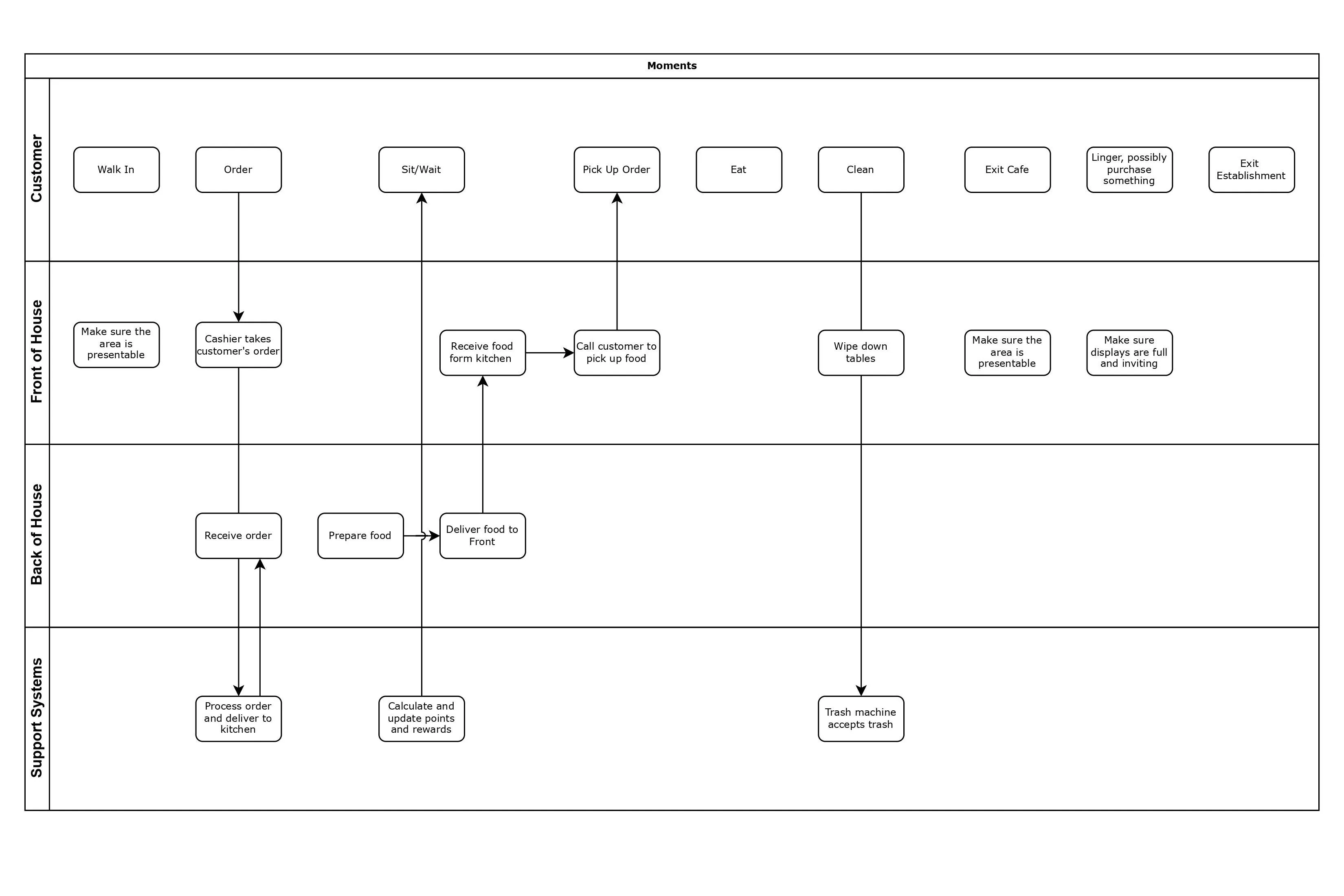
Service Never Stops
While it may not be the most detailed service blueprint yet, it’s a solid beginning. Now, what’s next? To map out the next steps, I received a set of questions. These questions serve as both a recap of what I’ve accomplished so far and a catalyst for exploring future possibilities.
Plan Next Steps
For whom are you designing? This could be a specific customer persona, a general customer persona, or employees.
I’m designing for Uhura, a busy multitasker who values control over her time. When she takes a break to eat, she appreciates the ability to stay connected to work or explore new ideas at a moment’s notice. Directness and clarity are her preferences, and she dislikes anything that feels like a waste of time. Uhura favors the café in the nearby bookstore because it lets her enjoy her meal while remaining connected to the world around her. The presence of outlets at every table is a big plus for her. She doesn’t mind the occasional distraction, especially if it’s a captivating book cover catching her eye on the way out.
Who are the stakeholders who make up the service?
Customers
Cleaners
Cashier
Cooks
Barista
Establishment employees
What will you accomplish in the next 30 days, three months, or over the next year?
30 days – do more testing (such as RP prototyping) in order to tighten up the recommendations. Build out the blueprint into something more detailed.
Three months – start preparing all needed equipment and planning dry runs in the actual establishment. By the end of the three months, we should be ready to roll out the first round of updates.
One year – The new updates should be the norm now. Do a survey of all shareholders to see how their experience has changed particularly at intersecting moments. Take feedback and save them for consideration during the next round of updates.
Conclusion
The course served as an invaluable gateway into the realm of service design, offering a fresh perspective on crafting user experiences. While my passion for UX design remains unwavering, I found myself drawn to the allure of service design for its capacity to broaden the scope of design endeavors. What particularly captivated me was its ability to facilitate collaboration between diverse teams, fostering an environment where every aspect of the service ecosystem could be meticulously shaped and optimized. In essence, service design provided a compelling framework for designing experiences that transcend individual touchpoints, encompassing entire journeys and interactions between users, teams, and technologies.
Like this project
Posted Aug 27, 2026
Completed a service design project for a bookstore café as part of IDEO-U's course.
Likes
0
Views
3
Timeline
Jan 1, 2024 - Apr 22, 2024