
Executive Summary
In the highly competitive automotive service industry, data-driven decision-making is the key to operational excellence. This report demonstrates a sophisticated dimensional modeling approach that transforms raw transactional data into a powerful strategic asset, enabling car repair shops to unlock deeper insights, optimize performance, and drive business growth.
The Business Challenge
Automotive repair shops face critical challenges:
Fragmented data sources
Limited visibility into operational performance
Difficulty tracking customer and service trends
Complex decision-making processes
Traditional database approaches often fall short, creating silos that prevent comprehensive analysis. This project presents a robust solution using Kimball's dimensional modeling methodology, designed to convert complex data into actionable business intelligence.
Dimensional Modeling: A Strategic Methodology
What is Dimensional Modeling?
Dimensional modeling, pioneered by Ralph Kimball, is a data warehousing technique that optimizes data for analysis and reporting. Unlike traditional normalized database designs, this approach:
Simplifies complex data structures
Enables rapid, intuitive querying
Provides flexible, scalable analytics frameworks
Transforms raw data into strategic insights
Key Principles
Grain Definition: Identifying the most granular level of data capture
Fact Tables: Quantitative measurements of business processes
Dimension Tables: Contextual attributes providing rich descriptive information
Star Schema: An optimized database structure for analytical processing
Dimensional Model Architecture
Comprehensive Data Capture
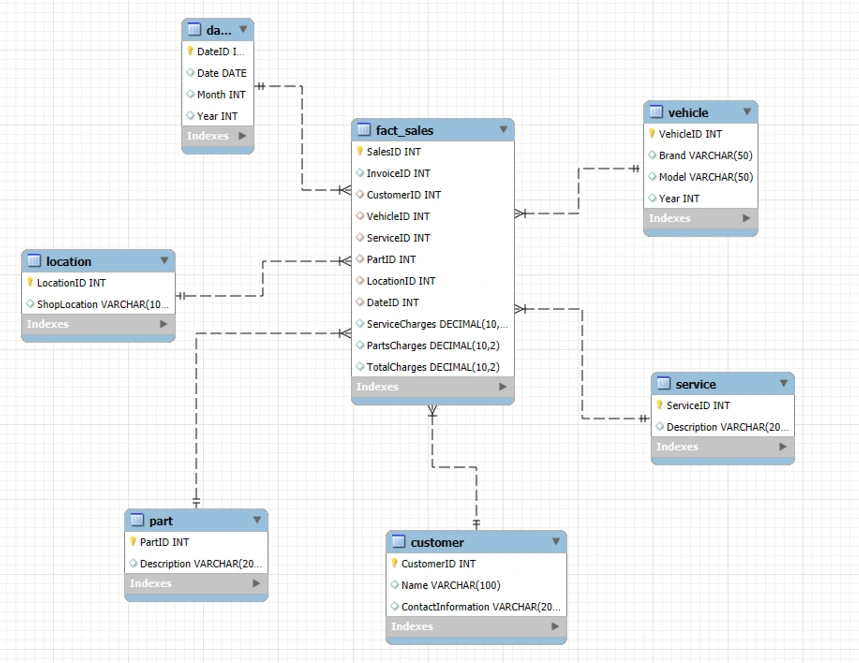
The proposed dimensional model captures a holistic view of automotive service operations through carefully designed components:
Fact Table: Sales Transaction Analysis
Granularity: Individual service line items
Key Metrics:
Service Charges
Parts Costs
Total Sales Revenue
Transaction-level details
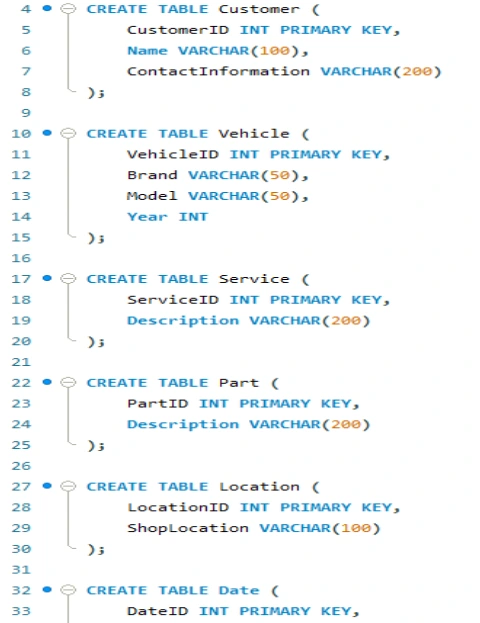
Dimension Tables: Contextual Insights
Customer Dimension
Detailed customer profiles
Contact information
Service history
Vehicle Dimension
Comprehensive vehicle specifications
Maintenance history
Identification details
Service Dimension
Service type categorization
Labor time tracking
Pricing structures
Parts Dimension
Inventory management
Part-specific details
Pricing information
Location Dimension
Multi-location support
Geographic performance analysis
Temporal Dimension
Comprehensive time-based analysis
Trend identification
Seasonal performance tracking
Technical Implementation Highlights
Database Technology: Supports multiple SQL-based platforms
Scalability: Designed for future growth and integration
Performance: Optimized for complex analytical queries
Flexibility: Easily extensible to accommodate evolving business needs
Strategic Benefits
Business Intelligence Capabilities
Operational Insights
Detailed service performance tracking
Resource allocation optimization
Maintenance scheduling efficiency
Customer Understanding
Personalized service recommendations
Predictive maintenance strategies
Customer retention analysis
Financial Performance
Granular revenue tracking
Profitability analysis by service type
Inventory cost management
Real-World Application Scenario
Potential Analysis Example
Consider a query to identify:
Most profitable service types
Average repair times by vehicle make
Customer retention rates
Seasonal service demand variations
Such analyses become straightforward with this dimensional model, enabling data-driven strategic decisions.
Conclusion: Beyond Technical Implementation
The proposed dimensional model is more than a database design—it's a strategic framework for transforming data into a competitive advantage. By providing deep, flexible insights, this approach empowers automotive service businesses to:
Optimize operations
Enhance customer experiences
Drive sustainable growth
About the Methodology
Inspired by Ralph Kimball's dimensional modeling principles, this approach represents a modern, strategic approach to data management, bridging technical excellence with business innovation.
0 likes · 4 views · Dec 2, 2024
Kimball-inspired database architecture that turns raw repair shop transactions into powerful, queryable business intelligence enabling performance tracking.
