
A COURSE REDESIGN DEMONSTRATION
The presenting-skills course and the starting AI outline were created for this self-directed demonstration. This is a design example, with no paying-client result or measured completion improvement claimed.
THE STARTING PROBLEM
The draft contained eight modules, 28 lessons and about seven hours of material. A local six-criterion review gave it 6/24. That score is a structured design judgement, not a validated prediction of course completion. Outcomes were vague, practice started late and progress checks were missing.
WHAT I DESIGNED
The revised structure has four outcomes, four modules and 12 lessons, with about three hours of planned material. Learners move from a baseline recording to a five-minute workplace presentation. Each lesson includes practice, and a four-level rubric makes the capstone requirements visible.
The example also proposes a four-week schedule, catch-up activities, discussion prompts and progress emails. These are design choices to test with learners. They are not evidence of an achieved retention or completion gain.
QUALITY REVIEW
The review checks the link between each outcome, practice task and assessment checkpoint, the order of the learning demands and the clarity of the learner instructions. The worked script demonstrates how a dense explanation can become a short explanation followed by a usable activity.
TRY THE APPROACH
Download the free course redesign sample (https://contra.com/products/vSXAlIZJ-free-course-redesign-sample-from-ai-draft-to-finished-course). For your own course, start with the $290 Course Teardown (https://contra.com/s/McroNYgv-online-course-teardown-and-improvement-plan?r=sulimanabdelaty). The $1,500 Course Design Sprint (https://contra.com/s/mkNUseQo-professional-course-design-sprint?r=sulimanabdelaty) adds course architecture and a developed pilot module.
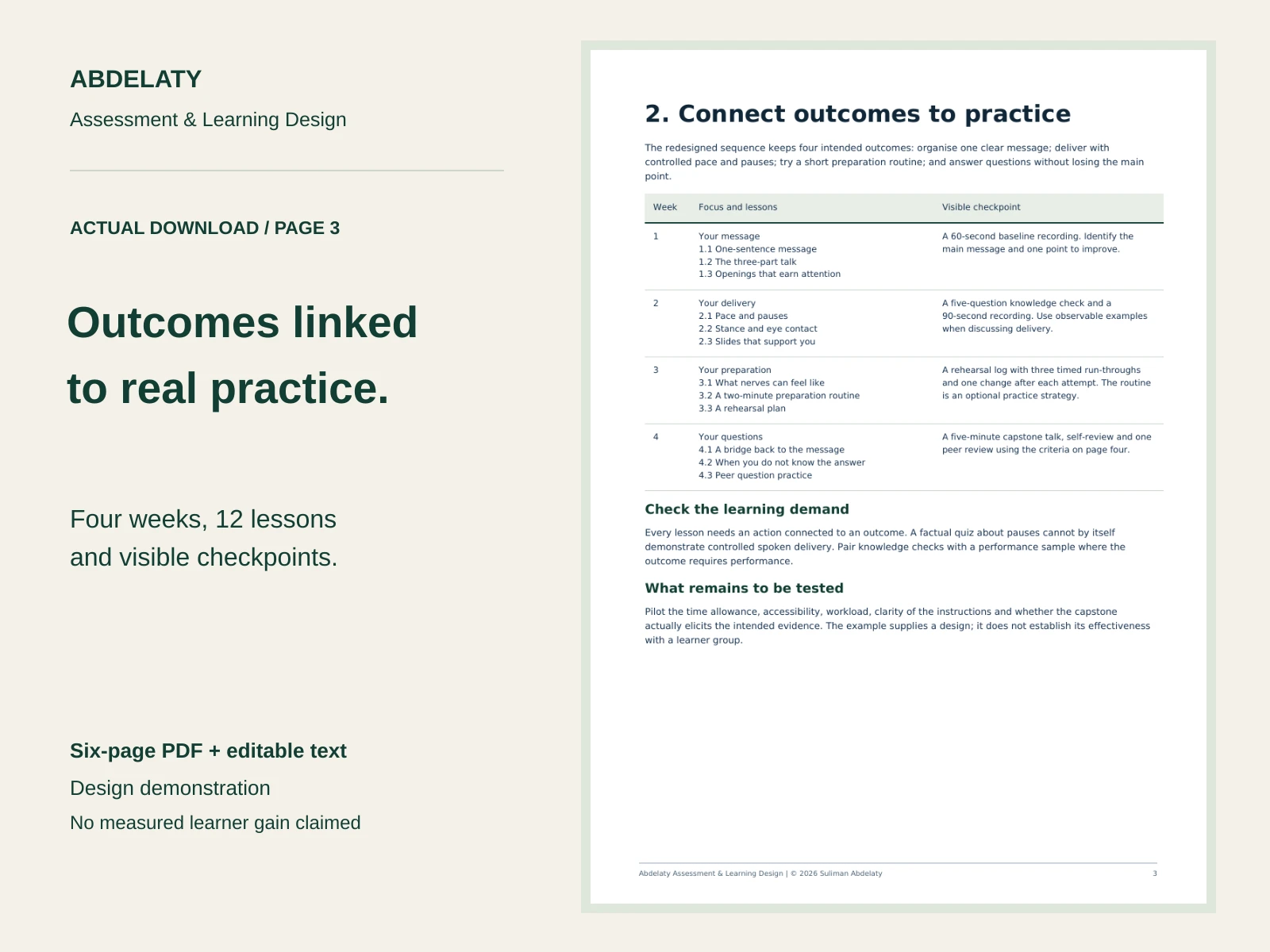
Actual page 3 from the six-page worked course-redesign sample: outcomes, practice and visible checkpoints. Self-directed design demonstration; no measured learner or completion gain.
ESP/EAP curriculum and assessment demonstration
Discuss a small study with care is a second original demonstration for adult university learners preparing for English-medium seminars. The needs profile is constructed; no institution commissioned it and no interviews or learner gains are claimed.
The proposed outcomes are to report a study accurately, distinguish observed change from causation, explain two limitations and write a clear seminar brief with a useful question. Each outcome maps to practice and assessment evidence.
The architecture has three modules of three 40-minute lessons. A developed three-lesson pilot moves from a diagnostic summary to comparing claims, qualifying an interpretation, peer review and revision. Later modules extend the cycle with new texts and independent transfer.
The original assessment asks for a 150–180-word brief about a fictional 12-volunteer feedback study. Its local average rises from 4.2 to 5.8 out of 10; no comparison group or task-equivalence evidence is provided. Learners must report the result carefully and explain the limits of a causal claim.
The feedback rubric covers evidence accuracy, qualification/limitations, organisation/question and academic language on an original local 0–3 scale. It is not a validated CEFR level or pass mark. The five-page example includes a 159-word model and specific feedback.
ESP/EAP needs analysis, curriculum and assessment design are available through the existing Course Design Sprint and Custom English Assessment Pilot. The exact source-material, development and review limits are agreed before commissioning.
0 likes · 4 views · Nov 9, 2026
Original course-redesign and EAP curriculum demonstrations linking needs, outcomes, practice, assessment and feedback. No learner gains are claimed.
