Workplace English Assessment | Speaking & Writing Design

Suliman Abdelaty

Workplace speaking and writing: from brief to reviewable assessment
Original portfolio demonstration. The tasks, responses and design decisions below are illustrative materials prepared for this portfolio. They are not client deliverables, learner data, an official TOEIC examination or evidence of a validated test. No client materials or internal communications are reproduced.
The design problem
An EdTech team needs workplace English tasks that elicit useful evidence and can be scored consistently. A realistic-looking prompt is only one part of the job: the purpose, instructions, expected response and scoring criteria must support the same decision.
This demonstration uses familiar workplace email and spoken-opinion formats to show my assessment-design approach. It targets a provisional B1–B2 design range for adult learners. That intended mapping requires expert review and learner trialling before operational use.
1. Define the evidence before drafting
Purpose: investigate whether a learner can explain a routine change, respond to a colleague's needs and propose a practical next step. Evidence: completion of the requested communication, clear organisation, suitable tone and language control. A writing response cannot establish speaking fluency or pronunciation.
2. Create an original writing task
Situation: You organise a weekly project meeting. Your colleague Alex cannot attend the planned session because a customer visit has moved to the same time.
Task: Write an email to Alex. Acknowledge the problem, suggest a new meeting time and explain how Alex can contribute if the new time is also difficult. For this demonstration, allow 10 minutes and suggest 80–120 words. These are local design choices, not official exam specifications.
Illustrative response: “Hi Alex, thanks for letting me know about the customer visit. Could we move our project meeting to Thursday at 10 a.m.? We can review the draft then and send the final version on Friday. If Thursday is difficult, please add your comments to the shared draft by Wednesday afternoon. I will include them in the meeting and send you the notes afterwards. Please flag any urgent questions in the document so that we can discuss them before the agreed deadline. Let me know which option works for you. Best, Sam.”
3. Make scoring evidence visible
Task fulfilment: look for an acknowledgement, a proposed time and a usable alternative contribution route. Organisation and tone: look for a clear sequence and an appropriate colleague-to-colleague request. Language control: record whether grammatical or lexical choices obscure the message, using evidence from the response.
The sample supports discussion of those features; it has no externally established CEFR rating. A full scoring guide would need criterion descriptors, contrasting response examples, independent judgments and an adjudication record. Do not convert a short local rubric total directly into a CEFR level.
4. Add a speaking task with distinct evidence
Prompt: Your team is choosing between one longer weekly project meeting and two shorter meetings. Which would you recommend, and why? Give a reason and a practical example.
For demonstration, allow 30 seconds of preparation and a 60-second response. Review relevance, development and language alongside audible fluency and intelligibility. These timing and scoring choices require piloting. A transcript alone cannot support the full spoken-performance judgment.
5. Complete a content QA pass
An early instruction such as “write a professional reply” leaves the required evidence unclear. The revised email prompt specifies three communicative actions. The next review checks whether each action can be scored, whether the scenario depends on unnecessary cultural knowledge, whether instructions are accessible and whether the time allowance is workable.
A QA record would keep the task version, issue, severity, evidence, revision and retest decision. This is an example of a review process, not a claim that a learner pilot or reliability study has taken place.
What this demonstrates
A connected design chain: purpose → task specification → original content → scoring evidence → documented QA → learner pilot plan. For a commissioned project, I agree the blueprint first and deliver editable tasks, keys or rationales where appropriate, rubrics, administration guidance and a bounded revision process.
Discuss your assessment brief
For a new form, see Custom CEFR-Aligned English Test Design. For existing tasks and rubrics, start with the English Assessment Quality Audit & CEFR Review.
Send the intended decision, learner group, skills, delivery format and current quality concerns through Contra. I can help define a practical review or development scope.
The three figures below show the original task, response evidence and documented QA decisions.
Demonstration outcome
The desk review makes the three requested writing actions traceable to response evidence. It also identified a sample-length mismatch: the earlier 73-word response was expanded to 91 words to fit the stated 80–120-word range. This is an editorial QA result, not a measured learner outcome. Independent specialist review, learner trialling and scoring evidence remain required before operational use.
For a new assessment, send the intended decision, learner group, skills and delivery format. For an existing test, include the item count and the quality concerns you want investigated. I will confirm fit, a bounded scope and an available start date through Contra.
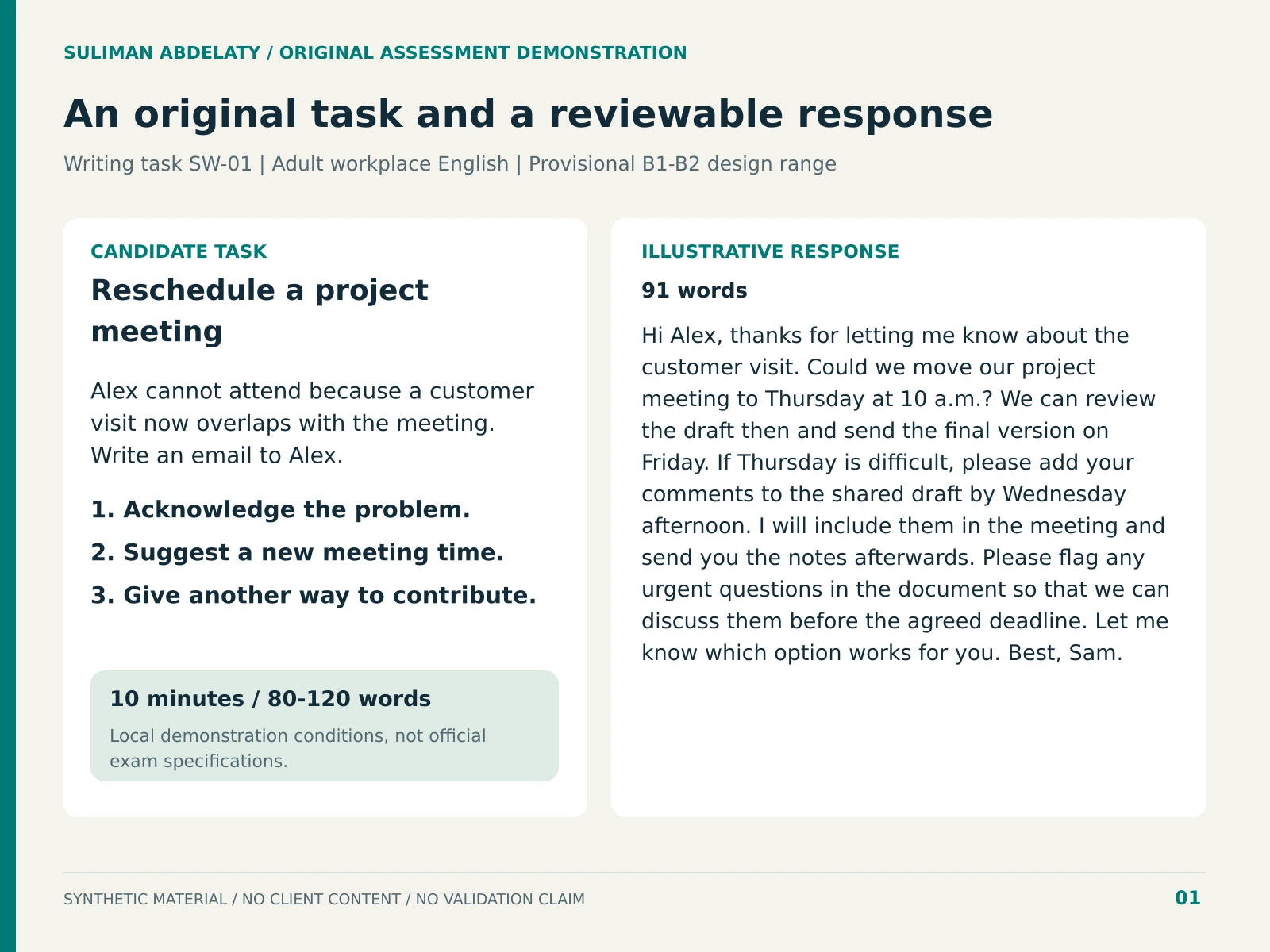
Original task SW-01 and a 91-word synthetic response. Local conditions: 10 minutes and 80–120 words; no official TOEIC or validated CEFR claim.
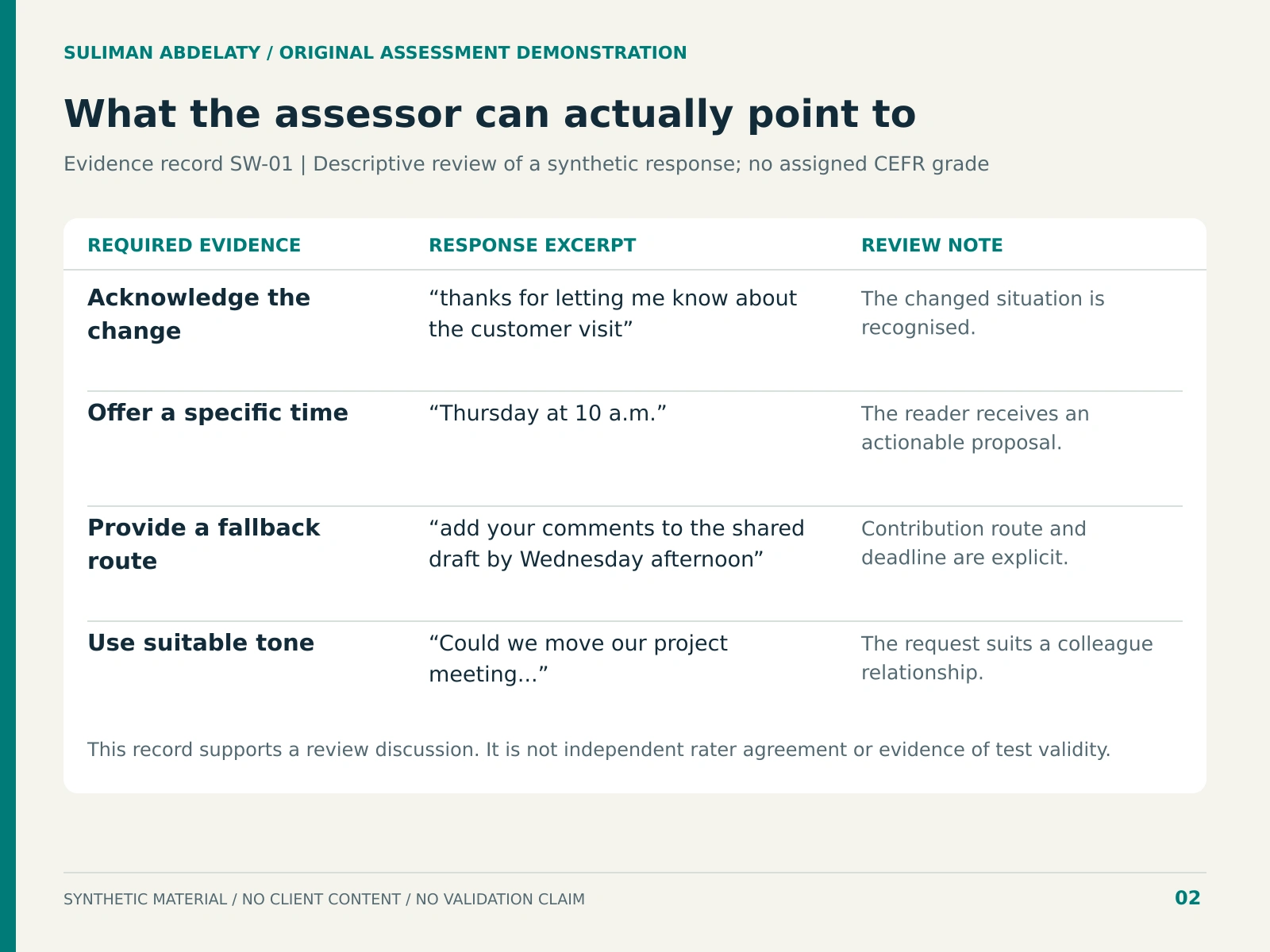
A traceable evidence record: each task requirement is linked to a specific phrase in the synthetic response. No CEFR grade or independent agreement coefficient is assigned.
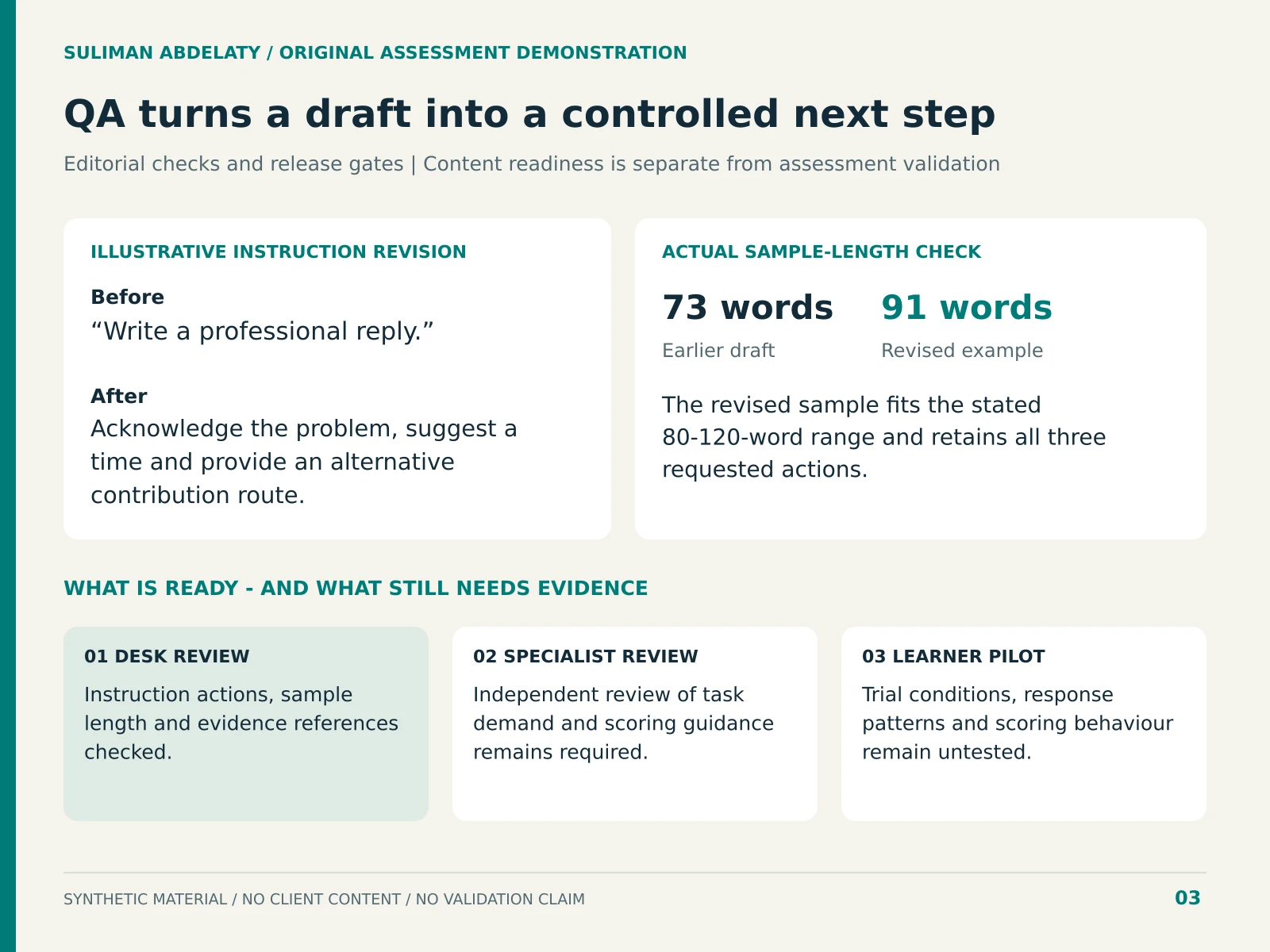
QA separates editorial readiness from validation: the sample-length mismatch is corrected; independent specialist review and a learner pilot remain required.
Like this project
Posted Oct 15, 2026
Original workplace tasks, response evidence and a documented QA fix. A synthetic design demonstration with clear pilot and validation limits.
Likes
1
Views
5