CNN vs CNN-ViT Architectures for Satellite Crop Classification

Filipe Braiman


CNN vs CNN-ViT Hybrid Architectures for Satellite Crop Classification
Cross-Framework Comparison in Keras and PyTorch
Experimental comparison of convolutional and hybrid transformer architectures for satellite crop classification using the EuroSAT dataset, implemented in both TensorFlow/Keras and PyTorch.



Quick Summary
Task: Satellite crop classification (EuroSAT) Problem Type: Image binary classification (Annual Crop vs Permanent Crop) Architectures: CNN vs CNN-ViT Hybrid Frameworks: TensorFlow/Keras vs PyTorch Best Model: Hybrid CNN-ViT (Keras) Best Accuracy: 97.3%
This project explores the performance of Convolutional Neural Networks (CNNs) and CNN–Vision Transformer (CNN-ViT) hybrid architectures for satellite image classification using the EuroSAT dataset.
The goal is twofold:
Architectural comparison Evaluate whether integrating Transformer attention into CNN models improves classification performance.
Framework comparison Implement equivalent architectures in Keras (TensorFlow) and PyTorch to analyze differences in training dynamics, computational efficiency, and predictive performance.
The study focuses on binary classification of annual vs permanent crops, using RGB satellite imagery.
Project Highlights
End-to-end modular deep learning pipeline
Cross-framework implementation (Keras & PyTorch)
Comparison of CNN baseline vs CNN-ViT hybrid architecture
Reproducible experiments with saved models, metrics, and training logs
Comprehensive evaluation and visualization of results
Dataset
This project uses the EuroSAT RGB dataset, a widely used benchmark for land use and land cover classification based on Sentinel-2 satellite imagery.
Binary classification task:
Annual Crop
Permanent Crop
Images are resized to 64×64 RGB for training.
Dataset source:
Notebooks
The project is organized into four main notebooks:
Data Pipeline – dataset preparation, preprocessing, and visualization
CNN Baseline Models – baseline convolutional architectures in Keras and PyTorch
CNN-ViT Hybrid Models – hybrid convolution + transformer architectures
Comparative Analysis – cross-framework and cross-architecture evaluation
Model Architectures Overview
CNN Baseline
A lightweight convolutional architecture designed to capture local spatial features from satellite imagery.
Both the Keras and PyTorch implementations follow an identical structure:
Four convolutional blocks with progressive feature expansion (32 → 64 → 128 → 256 channels)
Batch normalization after each convolution
Max pooling for spatial downsampling
Global average pooling for compact feature aggregation
Fully connected classification head
This design provides a strong convolutional baseline while maintaining computational efficiency.
CNN-ViT Hybrid
The hybrid model extends the CNN baseline by introducing Vision Transformer encoder blocks to capture global spatial relationships.
Architecture overview:
Three convolutional blocks (32 → 64 → 128 channels) for feature extraction
Spatial reduction to an 8 × 8 feature map
Reshaping into 64 tokens (8 × 8 grid)
Learnable positional embeddings
Two Transformer encoder blocks
Reshaping back to spatial format
Final convolutional block (256 channels)
Global average pooling
Fully connected classification head
This hybrid design preserves CNN local inductive bias while enabling global contextual modeling through self-attention.
Experimental Setup
Four models were trained and evaluated:
Model Framework CNN Baseline Keras CNN Baseline PyTorch CNN-ViT Hybrid Keras CNN-ViT Hybrid PyTorch
Evaluation metrics:
Accuracy
Precision
Recall
F1 Score
AUC
Loss
Early stopping and learning rate scheduling were applied to ensure stable convergence.
Methodology
To ensure a fair comparison between frameworks and architectures, the experiments were designed to minimize confounding variables.
Key alignment decisions included:
Identical dataset splits across all experiments
Equivalent model architectures implemented in both frameworks
Matching optimizer configuration and learning rate schedules
Comparable data augmentation strategies
Consistent evaluation metrics and validation procedures
Both CNN and CNN-ViT hybrid models were trained under the same conditions, allowing differences in performance to be attributed primarily to architectural design or framework implementation characteristics, rather than experimental inconsistencies.
Early stopping and learning rate scheduling were used to ensure stable convergence and prevent overfitting.
The objective was not to enforce bit-level reproducibility across frameworks, which is not feasible due to internal numerical differences, but rather to achieve methodological rigor and experimental comparability.
Results
Model Best Epoch Accuracy Precision Recall F1 AUC Loss CNN (Keras) 38 0.967 0.953 0.982 0.968 0.996 0.087 CNN (PyTorch) 31 0.967 0.966 0.968 0.967 0.993 0.106 Hybrid (Keras) 22 0.973 0.959 0.988 0.973 0.997 0.074 Hybrid (PyTorch) 41 0.971 0.966 0.976 0.971 0.995 0.096
Training Dynamics Comparison
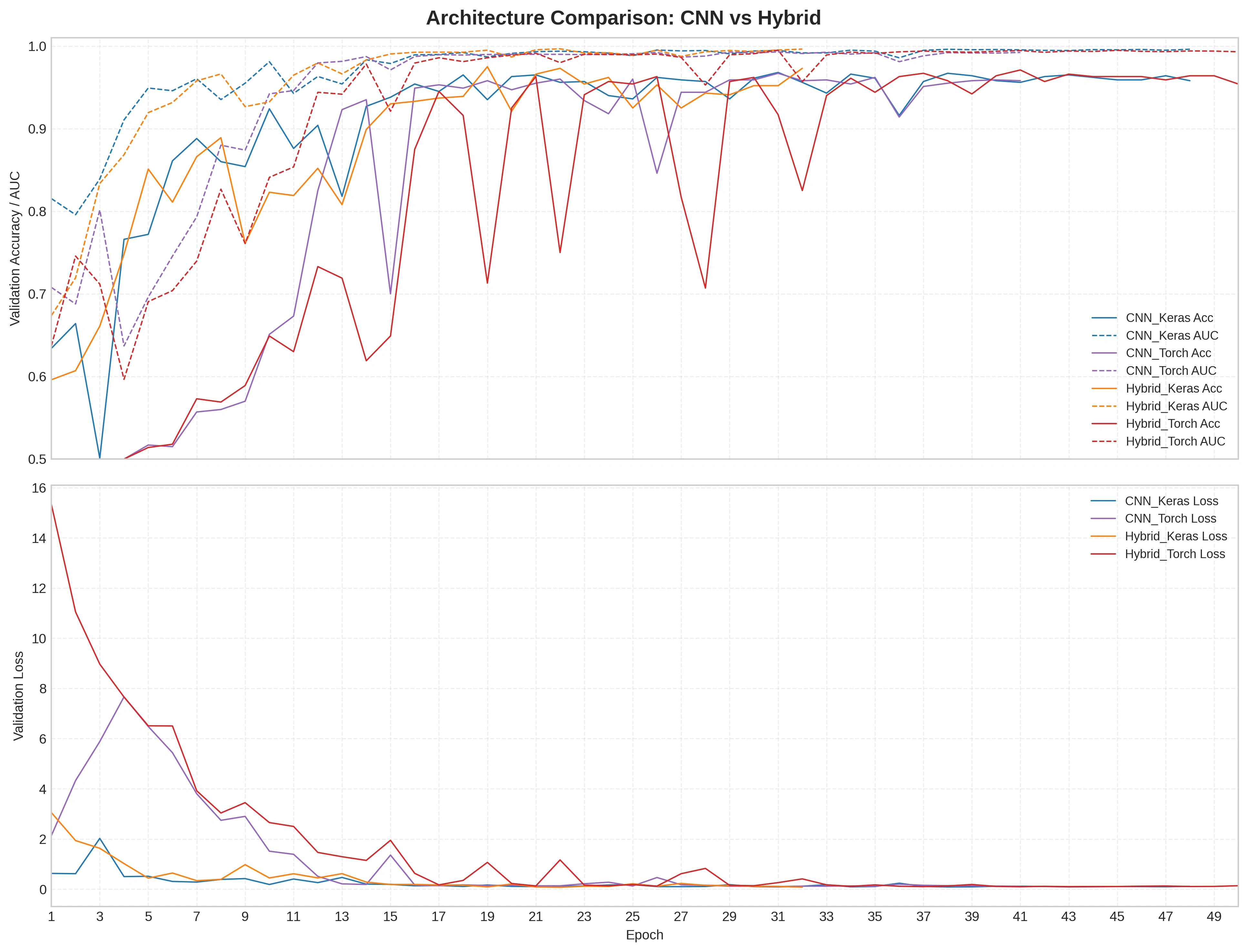
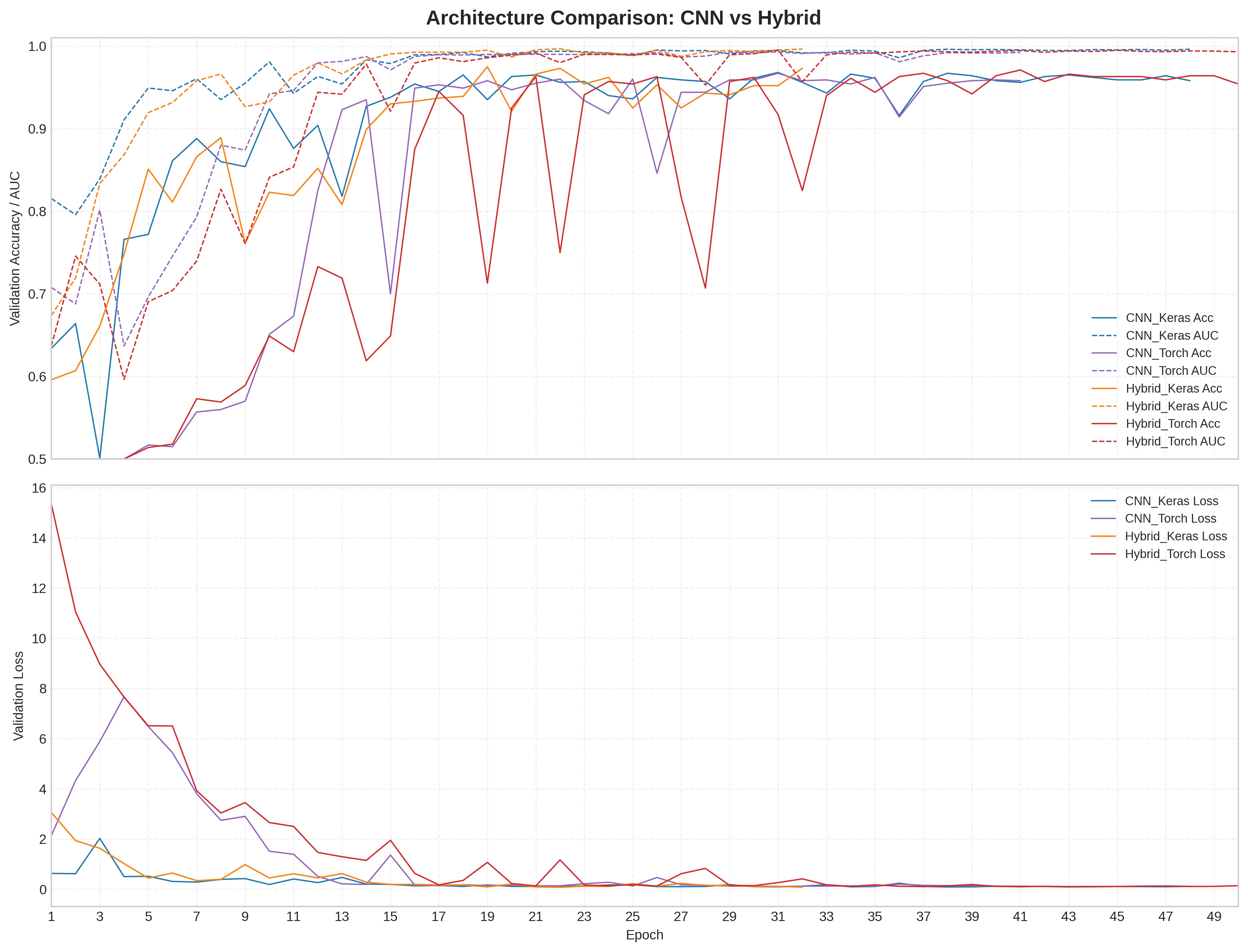
Validation accuracy, AUC, and loss across training epochs for all model variants.
Key Insights
The experiments isolate the effects of architecture choice (CNN vs CNN-ViT hybrid) and framework choice (Keras vs PyTorch) under closely aligned experimental conditions.
Results indicate that architecture selection primarily determines predictive performance, while framework choice mainly affects computational efficiency.
Hybrid CNN-ViT models consistently achieved higher recall and AUC, suggesting that combining convolutional feature extraction with global self-attention improves representation learning for satellite imagery.
Across both architectures:
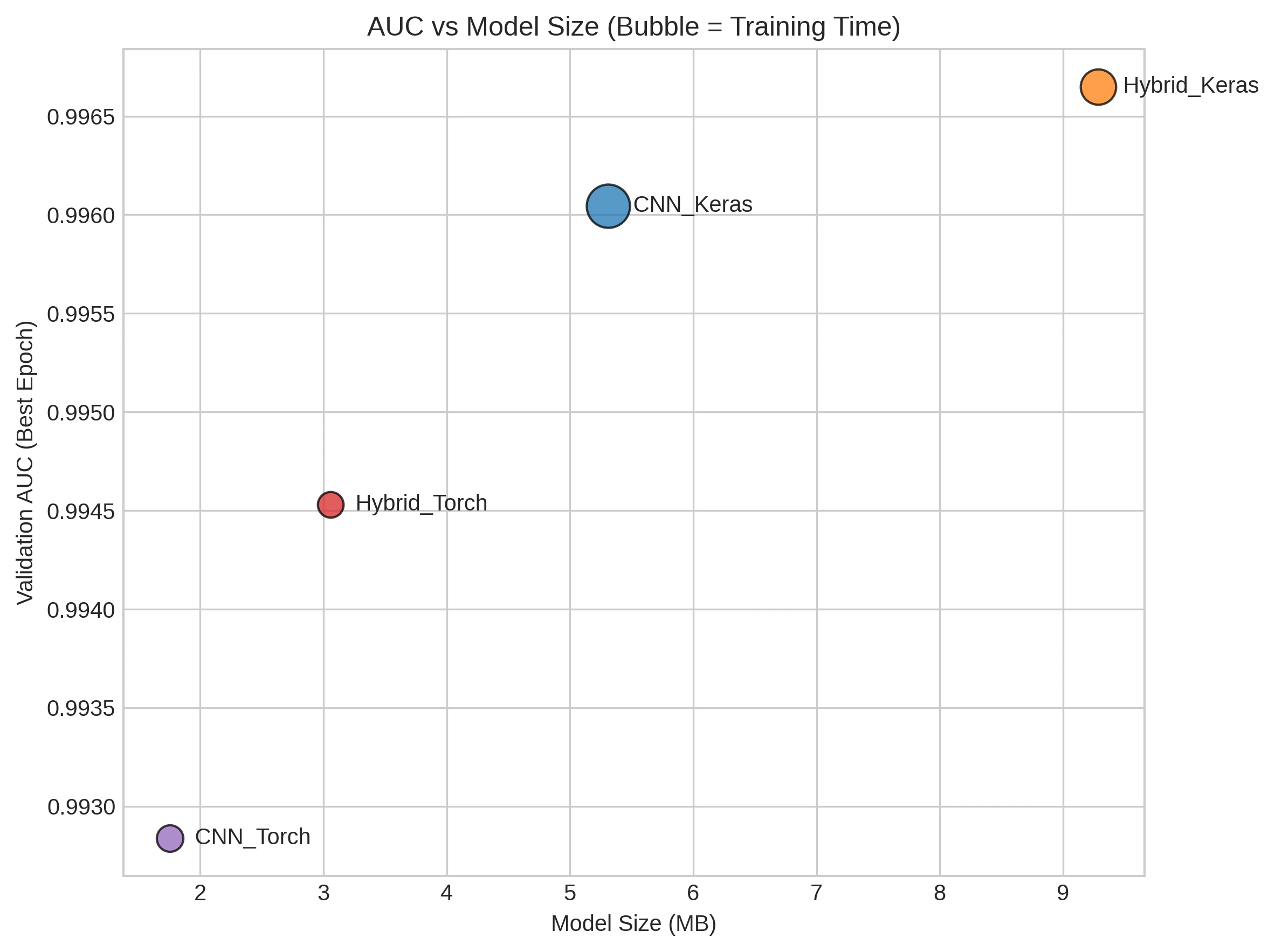
Keras implementations achieved slightly lower loss and marginally higher AUC
PyTorch implementations trained faster and produced smaller model files
Despite these differences, all models achieved very high predictive performance, confirming that both frameworks are suitable for practical deep learning pipelines in remote sensing applications.
Performance vs Model Efficiency
Relationship between model size and predictive performance. Bubble size represents training time.
Practical Recommendations
The optimal model depends on the deployment objective.
Hybrid_Keras
Best overall predictive performance
Highest AUC and recall
Recommended when minimizing false negatives is critical
Hybrid_Torch
Best balance between performance and computational efficiency
Near-top accuracy and AUC
Faster training and smaller model size
CNN_Torch
Most efficient baseline
Simplest architecture
Suitable for constrained environments
In summary, architecture selection primarily determines predictive strength, while framework choice primarily affects computational efficiency.
Limitations
Although strong care was taken to ensure equivalence between frameworks, exact computational parity is not fully attainable.
The Keras and PyTorch implementations were aligned as closely as possible in terms of architecture, hyperparameters, optimizer configuration, learning rate scheduling, and data splits. However, small differences may still arise due to framework-specific numerical implementations, backend libraries, weight initialization behavior, or GPU execution order.
Data augmentation pipelines were conceptually aligned, but minor differences in preprocessing or randomness handling may introduce slight variations in effective training data.
Finally, results were obtained on a single dataset (EuroSAT). While internally consistent, performance differences may vary when applied to other datasets or domains.
Repository Structure
Reproducibility
To reproduce the experiments:
Run the notebooks sequentially:
Data Pipeline
CNN Baseline Models
CNN-ViT Hybrid Models
Comparative Analysis
Development Environment
The experiments in this project were developed and executed primarily using Kaggle Notebooks.
Kaggle provides a convenient environment for:
GPU-enabled training
dataset hosting
experiment reproducibility
Because of this, some file paths in the notebooks are configured for the Kaggle directory structure.
If you run the notebooks locally, you may need to adjust dataset and output paths accordingly (for example replacing Kaggle input paths with local directories).
Conclusion
This project provides a controlled comparison of CNN and CNN-ViT hybrid architectures implemented in both Keras (TensorFlow) and PyTorch, applied to a binary classification task distinguishing annual versus permanent crop images from the EuroSAT dataset.
The analysis evaluates predictive performance, generalization behavior, and computational efficiency while keeping experimental conditions as aligned as possible across frameworks.
Results show that hybrid architectures consistently improve recall and AUC, while framework differences mainly influence training efficiency and model size rather than predictive capability.
Overall, the findings demonstrate that architecture choice has a stronger influence on predictive performance than framework choice, while both frameworks provide robust tooling for applied deep learning in satellite image classification.
The repository also serves as a reproducible experimental pipeline that can be extended with additional datasets, architectures, or experimental settings.
Author
Filipe Braiman Carvalho
Applied AI & LLM Systems | Deep Learning · Transformers · RAG · Computer Vision | End-to-End ML Engineering
Email: filipebraiman@gmail.com
LinkedIn: linkedin.com/in/filipe-b-carvalho
GitHub: github.com/filipe-braiman
About Me
AI and data professional with experience in LLM evaluation, retrieval-augmented generation (RAG), and AI model validation. Currently working in AI R&D at Huawei as an AI Evaluation Specialist, contributing to the reliability and real-world performance of LLM and RAG systems. Strong background in Python-based data and AI workflows, including model assessment, dataset development, and analytical reporting for production-oriented AI solutions. Portfolio projects explore deep learning architectures, computer vision, RAG systems, and applied machine learning experimentation, emphasizing reproducible ML pipelines and practical AI engineering.
Version History
Version Date Changes 1.0 2026-03-08 First publication.
Like this project
Posted Sep 9, 2026
Compared CNN and CNN-ViT architectures for EuroSAT data in Keras and PyTorch.
Likes
0
Views
1