Improving Incident Acknowledgement Speed by 400%

Josh Weissman


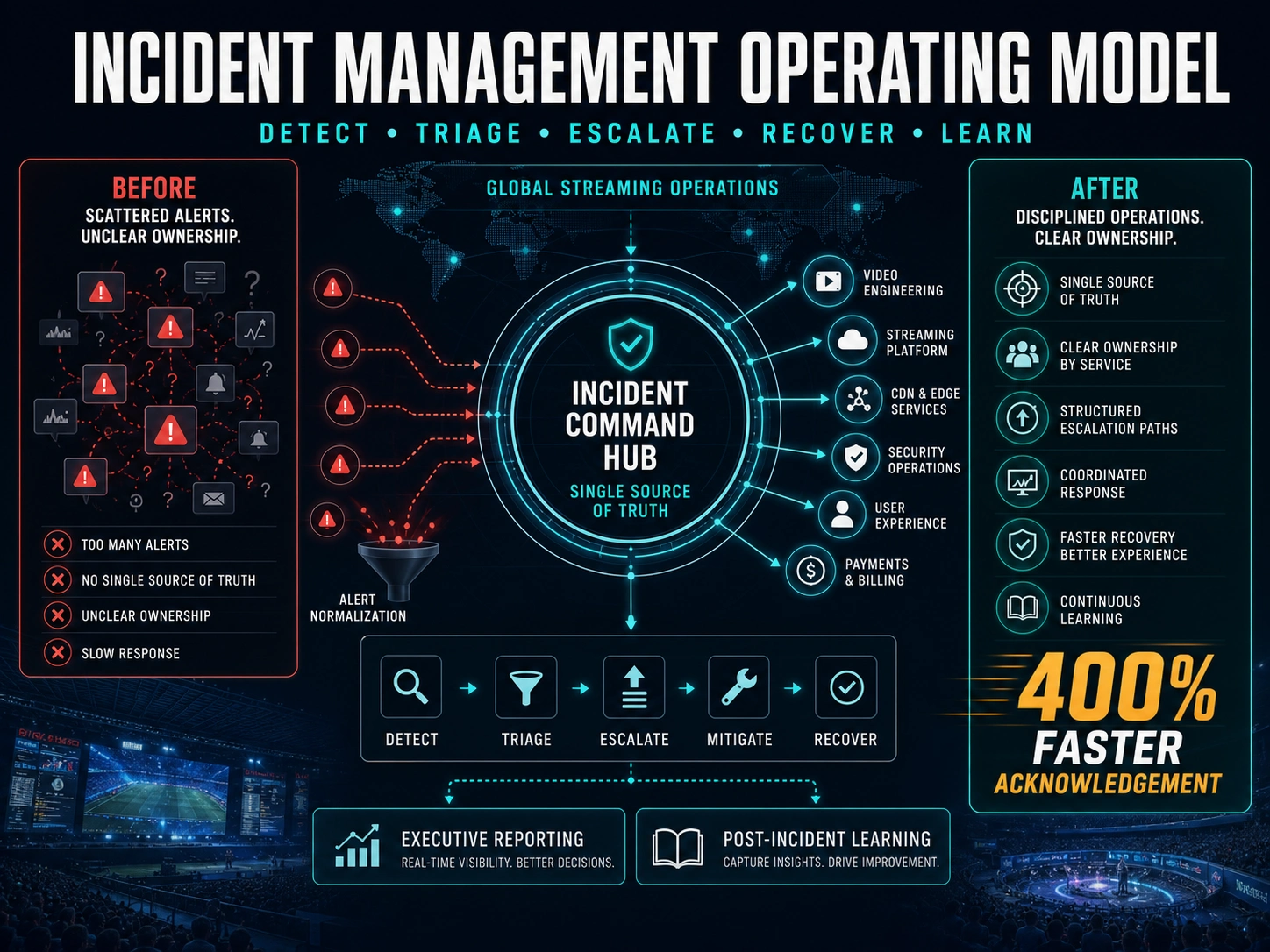
THE CHALLENGE
A major streaming platform launched without a mature incident-management discipline. Alerting, escalation, ownership, status communication, and post-incident documentation varied across teams. Global expansion and organizational change increased the cost of those inconsistencies.
MY ROLE
I owned the design and rollout of a unified incident-management operating model. My job was to create the structure that helped technical teams respond faster while giving business and executive stakeholders a clear picture of customer impact, ownership, and next actions.
THE OPERATING MODEL
I built a repeatable lifecycle across five stages:
• Detect: establish consistent signals and paging expectations
• Triage: define severity, customer impact, and the initial working hypothesis
• Escalate: engage the correct service owners through documented paths
• Coordinate: create clear incident-command roles and communication cadence
• Recover and learn: document decisions, root cause, follow-up actions, and accountable owners
I standardized runbooks, escalation frameworks, triage practices, status templates, and post-incident documentation. During organizational change, I also aligned teams with different operating histories around one shared response model.
THE RESULT
The program improved mean time to acknowledge by approximately 400% and established standards that were adopted across the broader technology organization. It gave teams a consistent way to execute under pressure and gave leadership clearer visibility into platform health and customer impact.
WHAT THIS DEMONSTRATES
• Incident-response program design
• Runbook and escalation development
• Cross-functional change management
• Executive incident communication
• Root-cause and postmortem structure
• Operational performance measurement
Like this project
Posted Jul 20, 2026
Built a unified incident-response system that improved acknowledgement speed by 400% and standardized detection, escalation, triage, and reporting.
Likes
0
Views
6