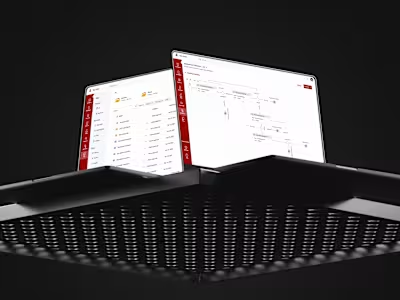
🪙 Korensi – Digital Payment Ecosystem for Transport

Josiah Bello



About the Project
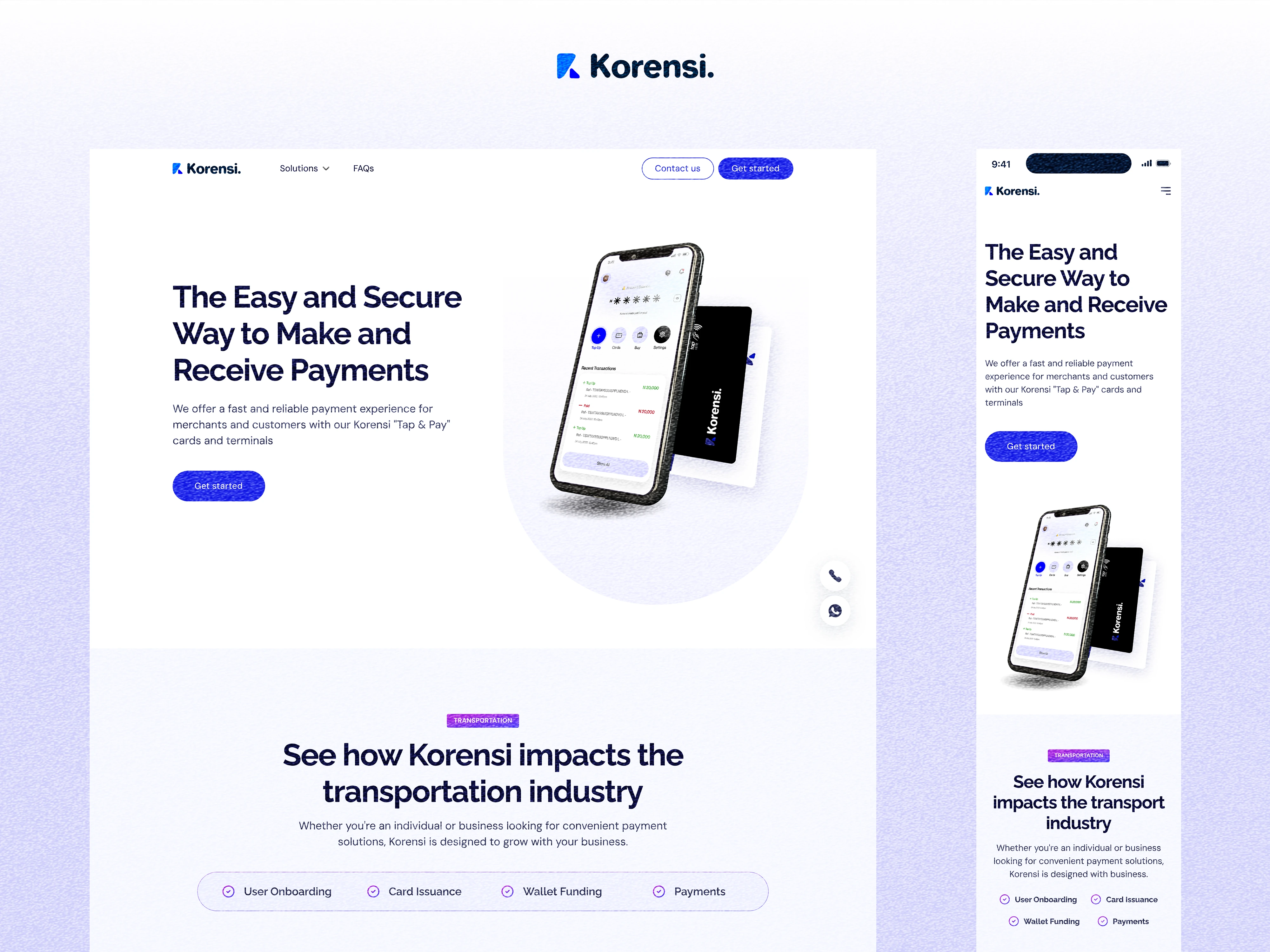
Korensi is a digital payment and transaction management platform built to modernize Nigeria’s transport and taxation systems.
It helps drivers, agents, and administrators transition from cash-heavy processes to transparent, digital-first operations — reducing leakages, enabling real-time transactions, and simplifying financial management.
Designed by Prunedge Development Technologies, Korensi bridges technology and financial inclusion — empowering both the public and private sectors to manage payments, reconcile revenue, and build trust through data transparency.
Client: Prunedge Development Technology
Project Duration: 6 months
Scope: The Korensi project encompassed the end-to-end design and development of a multi-platform digital solution (mobile and web) for various user groups, including drivers, agents, administrators, and system operators.
My design scope included:
User research and persona development
User journey mapping and UX architecture
Wireframes, prototypes, and high-fidelity UI design
Usability testing and design validation
Design-to-development handoff and collaboration
The project timeline spanned six months, moving from research to launch.
While engineers focused on the backend transaction infrastructure, I led the UX strategy and interface design, ensuring that every design decision supported both business transparency goals and user ease of use.
Objectives
Build a user-friendly mobile and web experience for agents, drivers, and administrators.
Simplify complex workflows to reduce cash handling and errors.
Improve revenue visibility and transparency for government and enterprise users.
Develop a scalable design system for future expansion into tolling, ticketing, and micro-finance.
Ensure accessibility for low-literacy and semi-urban users through simple, intuitive interfaces.
Challenges
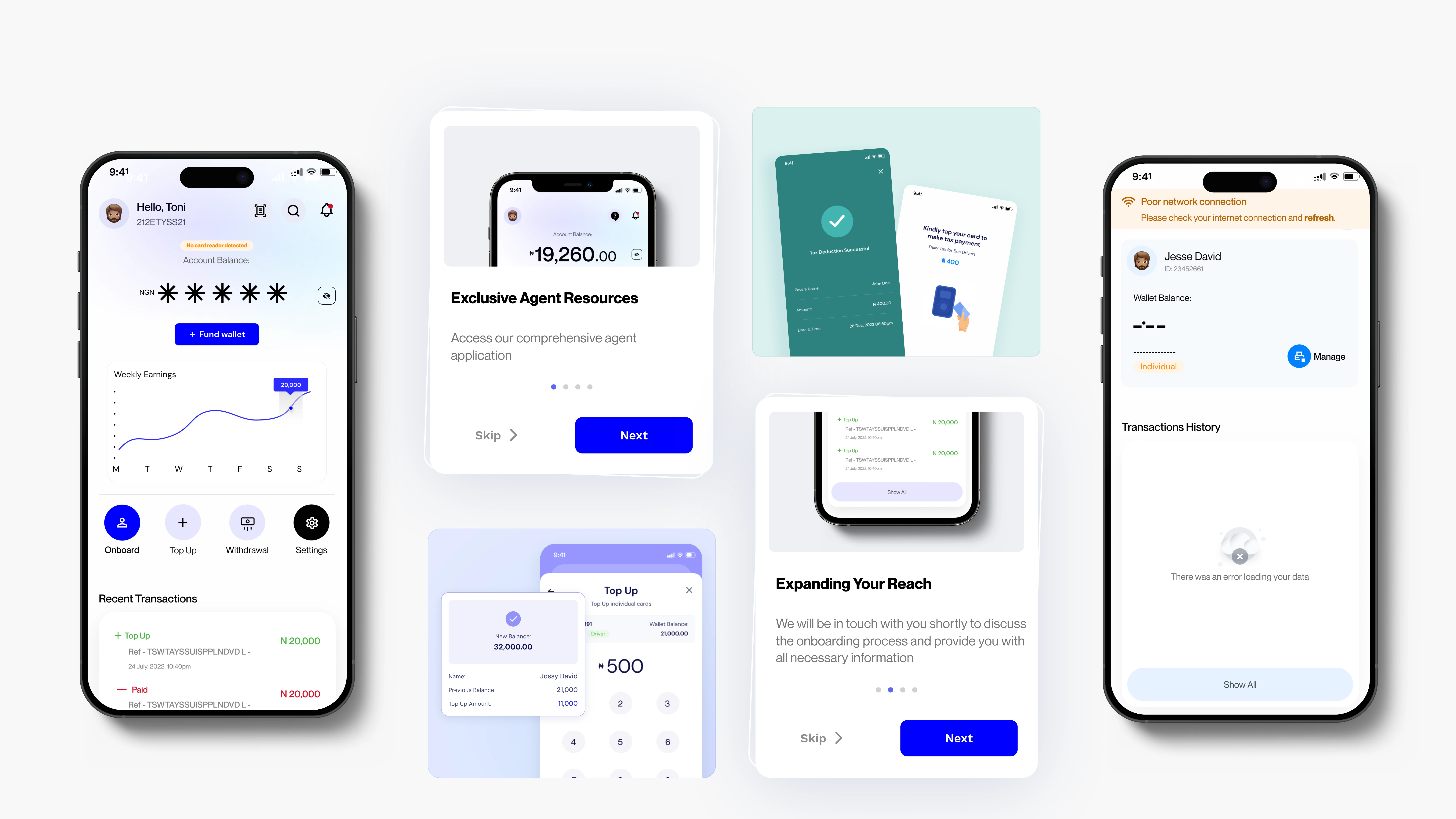
Designing for low or unreliable internet connectivity in rural and semi-urban areas.
Creating trust and ease of use among users unfamiliar with digital payments.
Balancing security and simplicity for quick, on-the-go transactions.
Designing clear, sunlight-readable interfaces for outdoor device usage.
Accommodating multiple user types — from government admins to drivers — in one unified ecosystem.
My Role
As Lead Product Designer, I guided the end-to-end UX process — from discovery to delivery — ensuring that every interaction aligned with both user needs and business goals.
My core responsibilities included:
Conducting field research and user interviews with agents, drivers, and administrators.
Designing user journeys, wireframes, and high-fidelity prototypes for mobile and web.
Creating a scalable design system (Korensi DS) to maintain visual and interaction consistency.
Running usability testing sessions and integrating real-world feedback.
Collaborating with developers and product managers to ensure design fidelity during implementation.
Process
🧭 1. Discovery: I began with field research across multiple user groups — understanding how agents handled cash, tracked payments, and managed reports. This phase uncovered key insights about pain points in transaction reconciliation, recordkeeping, and system trust.
💡 2. Define: Based on user research, I mapped journeys for four main personas — Drivers, Agents, Admins, and System Operators — identifying friction points like delayed confirmations and manual entry errors.
🎨 3. Design: Created low-fidelity wireframes and gradually evolved them into high-fidelity prototypes in Figma.
Interfaces were built to prioritize clarity, legibility, and error prevention — especially for mobile users operating under sunlight or pressure.
🧩 4. Design System: Developed Korensi DS, a modular design system with standardized typography, colors, and components — ensuring scalability across platforms and faster development iterations.
🧪 5. Testing: Conducted usability testing with actual users to validate flows and interface clarity. Iterations were based on user feedback, leading to better comprehension and faster task completion.
🚀 6. Handoff: Collaborated with developers through Figma Inspect and Zeplin handoff, ensuring seamless integration between design and front-end implementation.

Outcome
30% reduction in transaction reconciliation time.
20% increase in adoption among drivers and agents within the first rollout.
Improved transparency in revenue tracking and reporting accuracy.
A scalable design system that supports rapid onboarding of new modules.
Positive user sentiment and strong stakeholder trust during pilot testing.
Key Takeaways
Empathy fuels adoption: Designing for users unfamiliar with technology requires patience, clarity, and real-world observation.
Simplicity wins trust: By reducing steps and visual clutter, users developed confidence in using the system daily.
System thinking matters: A strong design system not only improved consistency but also reduced developer turnaround time.
Design beyond aesthetics: Success came from aligning business impact (transparency and efficiency) with human experience.
Localization drives inclusivity: Language choice, iconography, and offline modes helped bridge cultural and infrastructural gaps.
Impact Snapshot
📊 30% faster reconciliation
📈 20% user adoption growth
💡 4 unique user personas served
🎨 1 scalable design system built from scratch
Final Reflection
Designing Korensi was a lesson in human-centered innovation — turning infrastructural challenges into design opportunities.
The product didn’t just digitise payments — it redefined how financial trust is built in underserved ecosystems.
Like this project
Posted Oct 28, 2025
Korensi is a digital payment and transaction management platform built to modernize Nigeria’s transport and taxation systems.
Likes
0
Views
2
Timeline
Jan 15, 2024 - Jul 12, 2024