Australian Fashion Market & Product Research

Martin Kuai

Australian Fashion Market & Product Research
Client type: Independent fashion retail project — an early-stage fashion retail concept targeting the Australian market.
Engagement: Phase 1 research and decision support
Market focus: Australia
One-line description
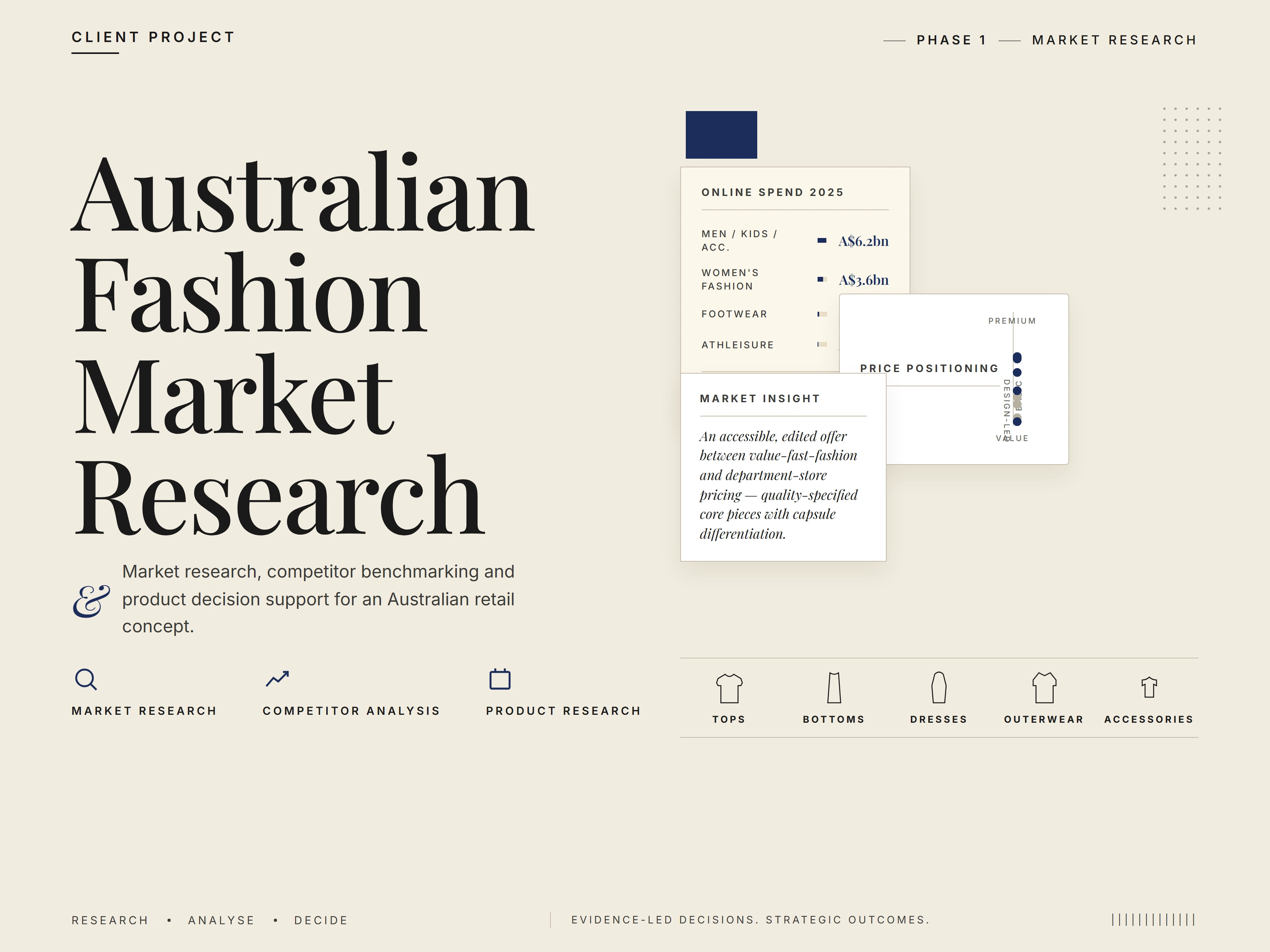
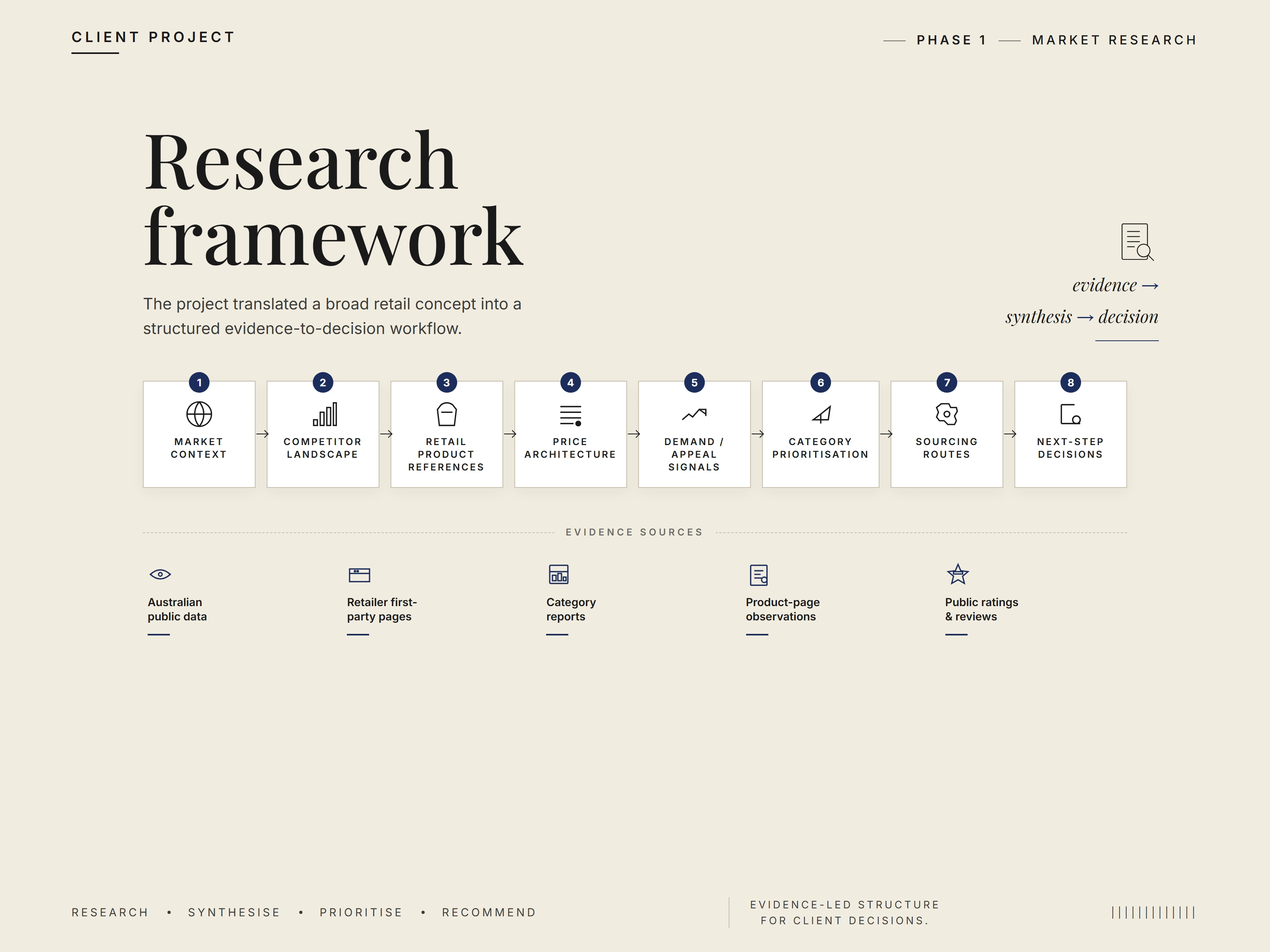
I turned a broad Australian retail concept into an evidence-driven decision framework — market context, competitor benchmarking, 15 dated retail references, a price architecture and a prioritised sourcing route map.
The Challenge
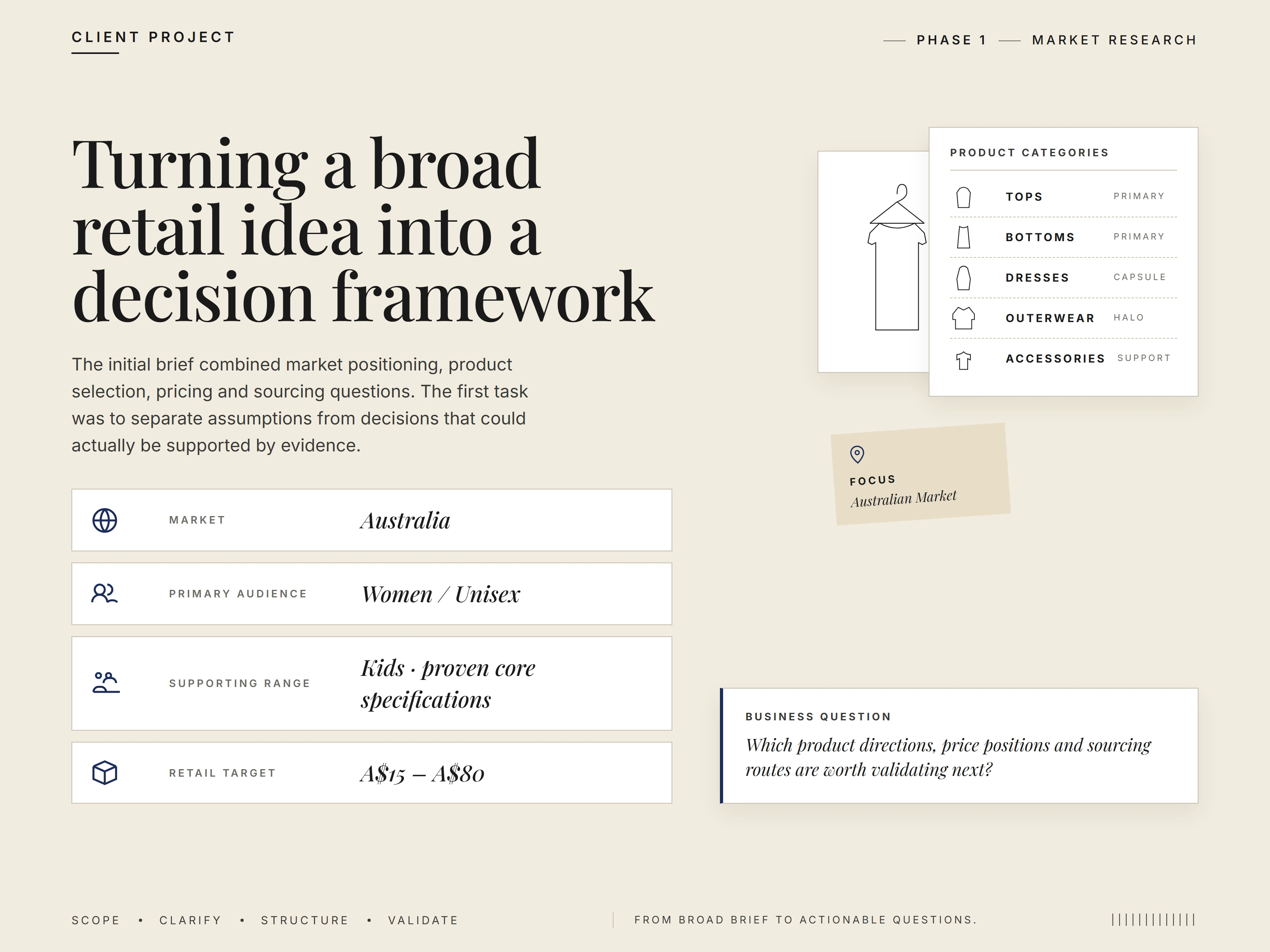
The client arrived with a broad ambition rather than a defined plan: launch a fashion offer in Australia. Market positioning, product selection, pricing and sourcing were all open questions, and they were tangled together — a question about which products to sell kept collapsing into questions about what things cost, who would supply them and whether anyone would buy them.
My first job was not research. It was separation: working out which parts of the brief could actually be answered with evidence in a research phase, and which parts belonged to a later stage that required samples, quotes and costing. Only then could the research be scoped to something that would genuinely inform a decision instead of producing a long document.
The agreed Phase 1 question became narrow and answerable: which product directions, Australian price positions and sourcing routes were sufficiently supported to justify later validation?
My Role
I ran this as a solo engagement and delivered all of the work directly:
Research — Australian market and category data, competitor landscape, retail product benchmarking
Analysis — price architecture, category prioritisation, lower-cost versus higher-quality trade-offs
Structuring — turned a four-way ambiguous brief into a bounded, sequenced set of questions
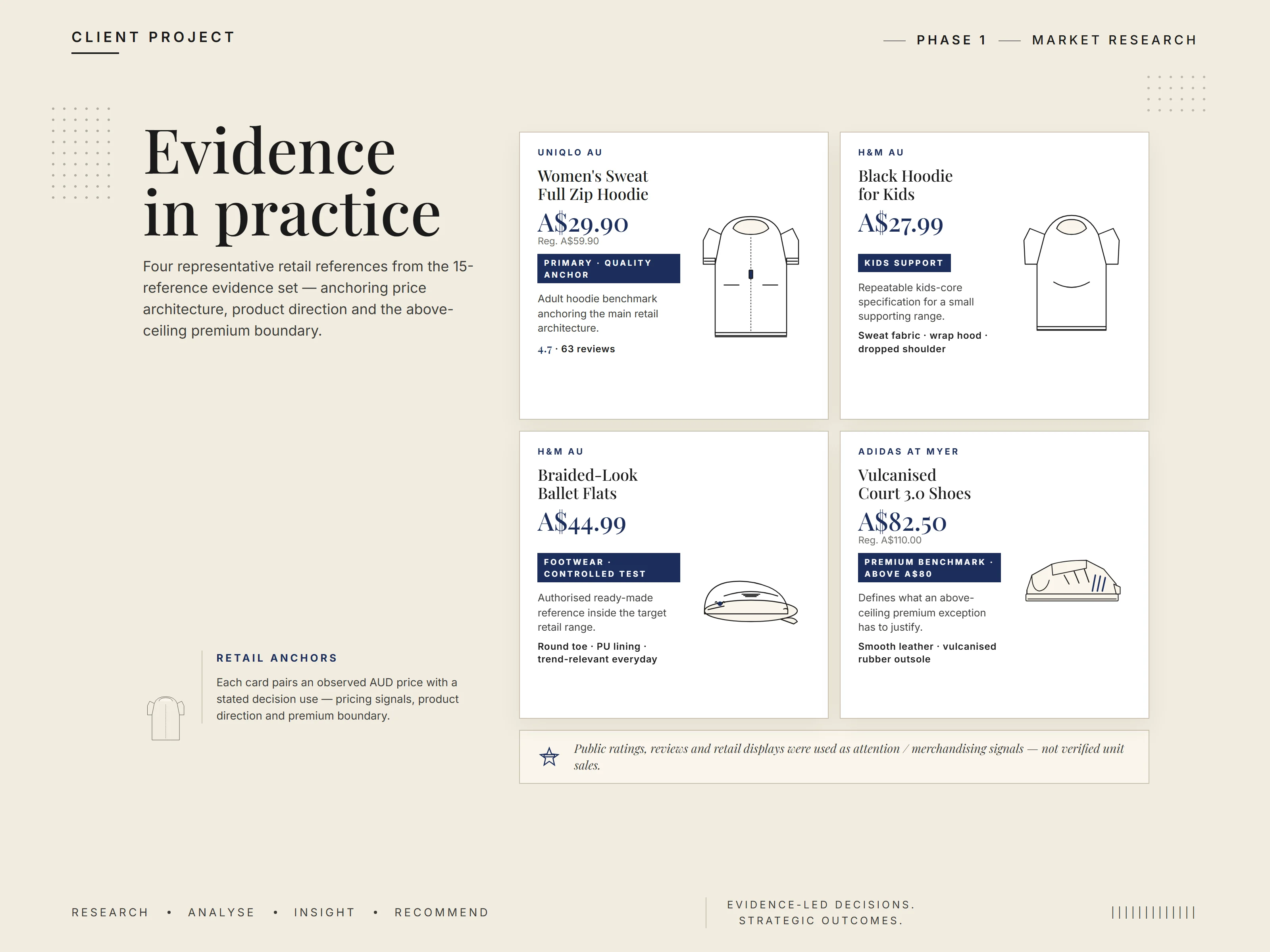
Evidence synthesis — assembled a 15-reference evidence matrix where every product carried a price, a construction note and an explicit decision use
Recommendations — category priorities, sourcing routes by category, Phase 2 next steps
Client deliverables — a written research report, a structured product and evidence matrix, and a next-step framework
I did not select suppliers, request quotes, inspect samples or calculate landed cost. Those were deliberately held outside Phase 1.
Approach
Separate assumptions from decisions. The opening brief mixed market, product, price and sourcing questions. I split them into what evidence could settle now and what required samples, quotes and costing later — then scoped Phase 1 to the first group only.
Build the market picture from public Australian sources. ABS household-spending releases and Australia Post's 2026 eCommerce category reports established category scale, basket sizes and deal-sensitivity — including the finding that only 10% of athleisure shoppers wait for sales while 64% weigh brand reputation, which supported a quality-led core over permanent discounting.
Benchmark against real retail, not impressions. I assembled 15 exact Australian retail references with observed AUD prices, construction descriptions and public signals: nine primary women's/unisex items, three kids and three footwear. Twelve sat inside the A$15–A$80 range; two were below-floor benchmarks and one was an above-ceiling premium benchmark. Each reference carried a stated decision use and a next-check note.
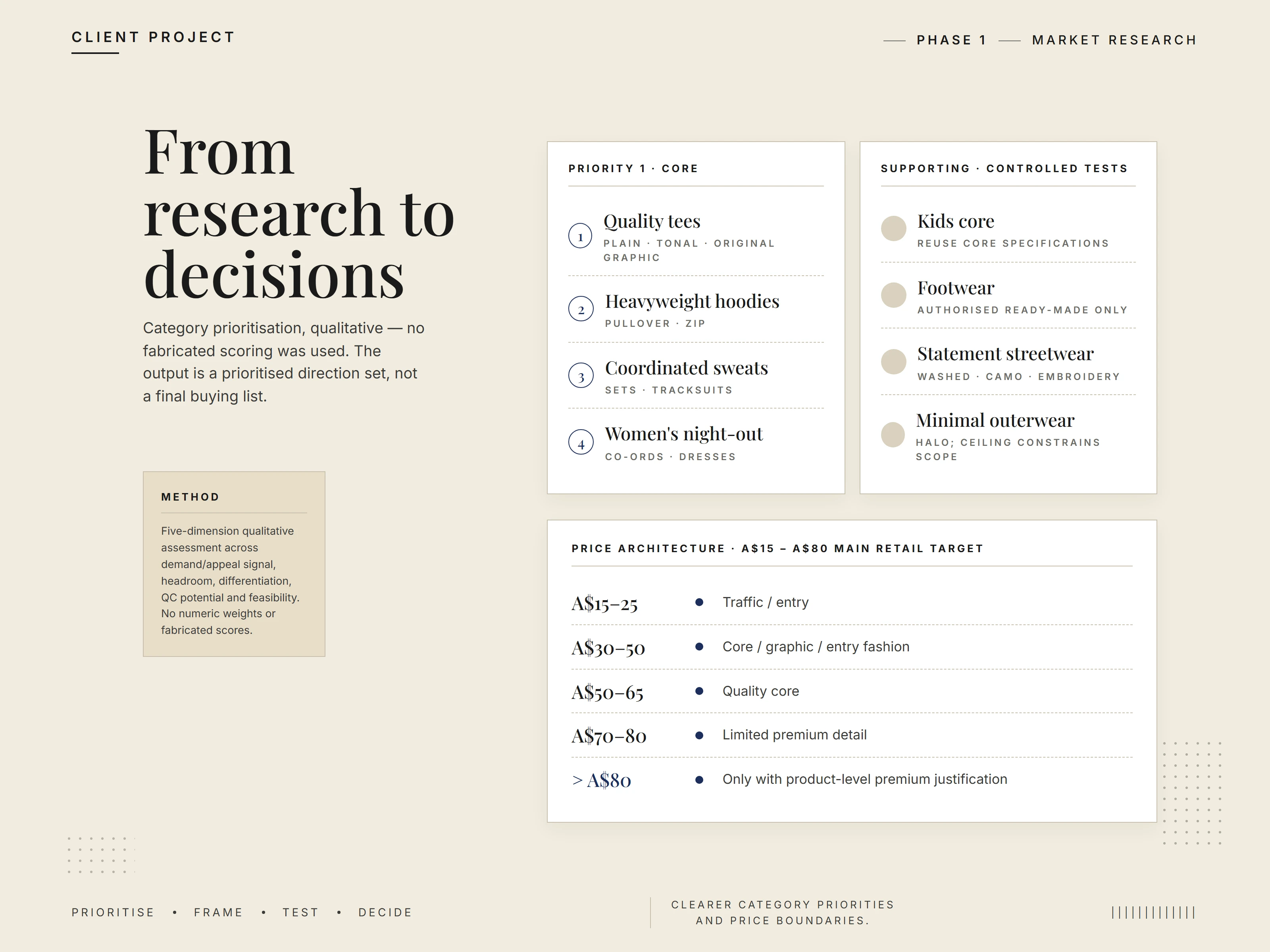
Turn the price target into an architecture. The client's A$15–A$80 figure was treated as a retail target, not a sourcing cost. I converted it into a four-band ladder — traffic, core, quality core, limited premium detail — plus an explicit rule for anything above the ceiling.
Prioritise qualitatively and say so. Categories were assessed across five dimensions without numeric weights or fabricated scores. Priority 1, controlled-test and supporting tiers were stated as directional judgements, with commercial validation assigned to Phase 2.
Keep the evidence boundary visible. Ratings, review counts, promotions and retail displays were labelled throughout as attention and merchandising signals — never as sales, demand or margin proof.
Deliverables
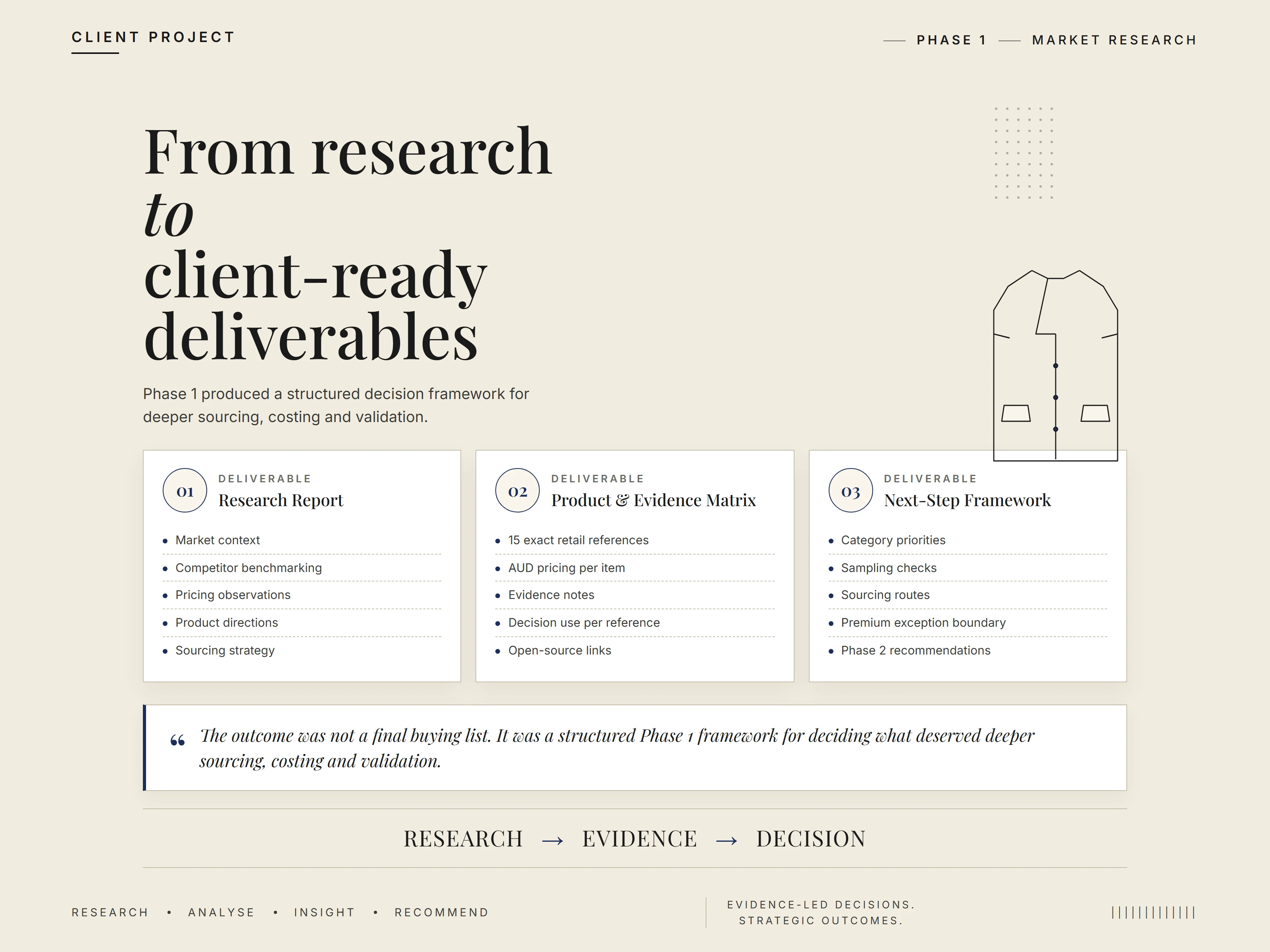
Research report — market context, competitor benchmarking, pricing observations, product directions, sourcing strategy
Product & evidence matrix — 15 exact retail references with AUD pricing, evidence notes, decision use and open-source links
Next-step framework — category priorities, sampling checks, sourcing routes, premium-exception boundary and Phase 2 recommendations
Key Outcome
The client received a structured Phase 1 framework rather than a buying list:
Clearer category priorities — four Priority 1 directions (quality tees, heavyweight hoodies, coordinated sweats, women's night-out) separated from controlled tests and supporting ranges
A defensible price architecture — A$15–25 traffic, A$30–50 core, A$50–65 quality core, A$70–80 limited premium detail, with an explicit product-level approval rule above A$80
Specific retail benchmarks — 15 dated Australian references with observed prices, so future product discussions start from real comparators
Sourcing-route options — blank-plus-customisation, ready-made, private label and small-batch matched to category, with the checks each route requires before commitment
A next-step validation framework — what must be confirmed through sampling, costing and compliance before any supplier or SKU decision
No revenue, margin or conversion outcome is claimed. Phase 1 was research and decision support; supplier selection, sampling and costing followed after it.
Skills
Market Research
Competitive Analysis
Product Research
Business Analysis
Pricing Research
Research Synthesis
Sourcing Strategy
AI-assisted Research
Like this project
Posted Sep 1, 2026
I turned a broad Australian retail concept into an evidence-driven decision framework: market context, competitor benchmarks, pricing and sourcing routes.