EXD-Net v1: Hopfield Drift Memory Model

Emily D


EXD-Net v1: Hopfield Drift Memory Model
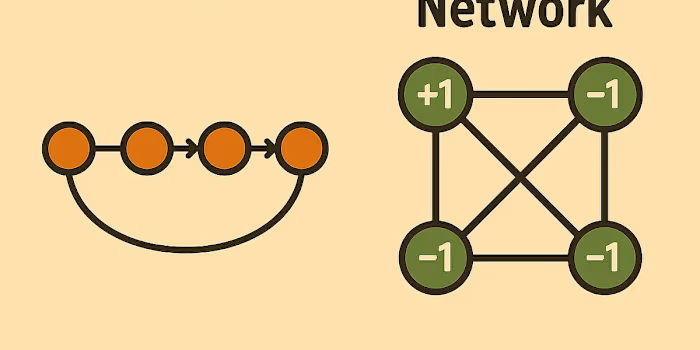
This notebook models emotional memory destabilization and transformation using a classic Hopfield network. Memory scenes are encoded as binary patterns acting as attractors. Over time, new associations (e.g., "Benji") are reinforced, causing the network to drift, destabilize, and rewire.
The result is a computational simulation of:
identity shift
memory drift
nonlinear transformation
EXD-Net v1 simulates how emotional recall is altered by reinforcement and shows how some memories remain resistant, while others suddenly flip. While this first release focuses on emotional memory, EXD-Net is not limited to that domain. It is part of a broader framework designed to explore how instability, dissonance, and reinforcement reshape memory over time. By modeling memory scenes as attractor states and introducing disruptive associations, EXD-Net demonstrates how mental representations can shift, destabilize, and reorganize.
Core Concepts
Memory as Attractors: Each scene is a 32x32 binary pattern stored in a Hopfield network
Memory Drift: Reinforcing a new memory causes gradual or abrupt divergence from the original attractor
Destabilization Points: Some scenes show nonlinear turning points where recall shifts
Energy Landscapes: Hopfield energy is used to analyze the depth and dominance of emotional memory basins
Features
Binary image-based Hopfield network (32×32)
Progressive memory reinforcement with noise-robust recall
Cosine similarity tracking for association shift
Turning point detection (first recall of new association)
Hopfield energy comparison between old and new attractors
Convergence analysis over time
Interpretability through real emotions (e.g., denial, suppression, reattachment)
Repo Structure
Why It Matters
This model offers a computational lens on memory under instability. Not just emotional memory, but memory in flux. From simulating attachment rewiring to exploring cognitive dissonance, EXD-Net v1 shows how systems evolve through reinforcement, resistance, and collapse.
Drift isn't linear. Transformation isn't smooth. And not all memories are equal.
Next Steps
This is the foundational release before EXD-Net becomes a flexible framework for:
Modeling (emotional) memory as a dynamic, high-dimensional system
Simulating cognitive dissonance, destabilization trajectories, and transformation over time
Creating computational experiments rooted in cognitive and psychological theory
If you're interested in contributing, collaborating, or discussing aligned research directions, please reach out directly.
Read more about the theory behind EXD-Net on Substack:
https://exd1000.substack.com
License: Custom non-commercial terms apply. Based on the Apache License 2.0 — reuse allowed with attribution. Commercial use or derivative frameworks require prior written permission from the author.
Like this project
Posted May 31, 2025
Developed EXD-Net v1: a custom memory model that visualizes and quantifies memory drift via destabilization and adaptive learning over time.