When the Person Leaves, Does the Work Survive?

Brandin Gudmundson

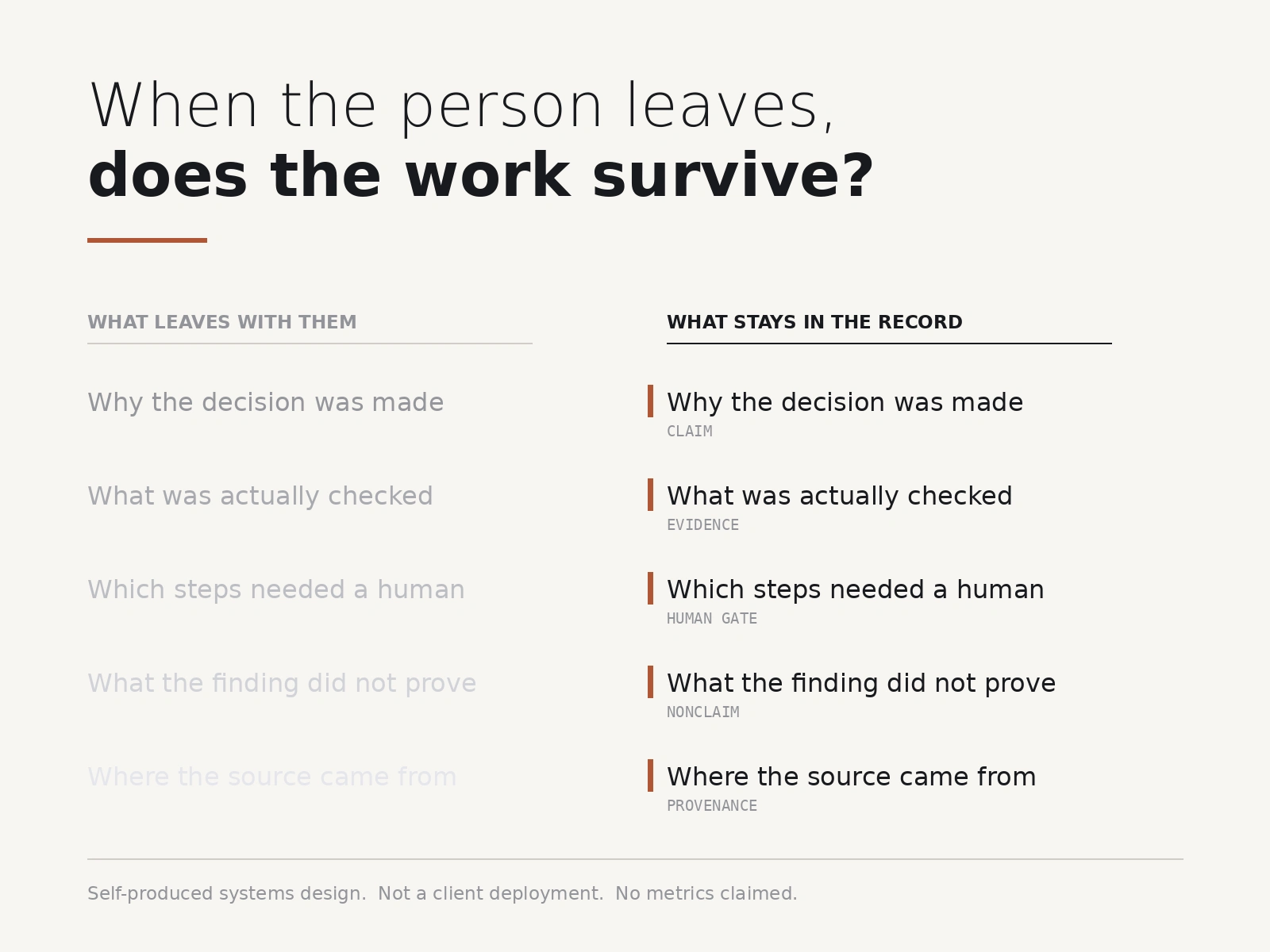
Most operational knowledge lives in one person's head and a chat history. When that person leaves, the organization keeps the files and loses the reasoning — why a decision was made, what evidence supported it, and which steps still require a human.
I designed and stress-tested a system that separates the two.
Decisions get recorded as durable objects with their evidence attached: what was checked, by whom, on what date, and — just as important — what the finding does not establish. Work products can then be rebuilt from that record without the original author present.
The method was developed through repeated failure and correction rather than theory. It carries named failure modes: the specific ways this discipline gets faked in practice. The most common one is a document that passes every structural check while nobody can prove where its source came from.
What it produces
A decision record that outlives the decider
Explicit evidence classes, so a relayed claim never quietly gets promoted to a verified one
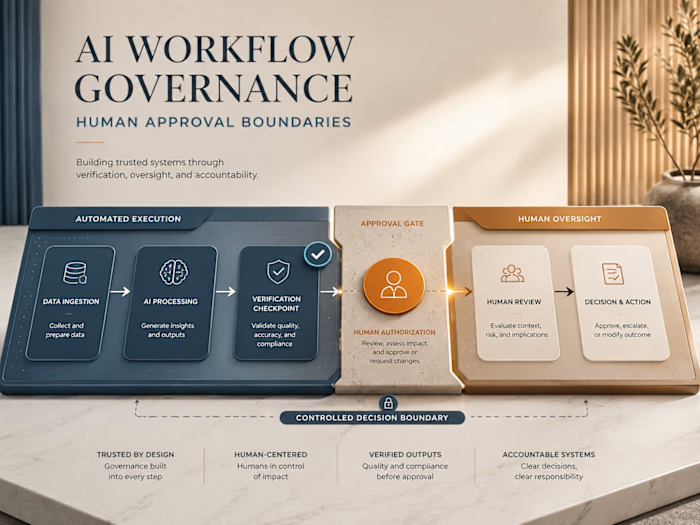
Named human-approval boundaries — which steps a person must still own
Documented failure modes, with the correction preserved beside the original error rather than replacing it
Why the failures stay in the record
A register that lists only the failures you avoided is a marketing document. Keeping the correction next to the original mistake is what lets a successor trust the rest of the record — and what stops the same error from being rediscovered six months later by someone who inherited only the rules.
This is a self-produced systems design project developed through operational work. It is not a client deployment. No participant, employer, or funder records are involved. No performance metrics are claimed.
Like this project
Posted Aug 11, 2026
A self-produced systems design project: making operational decisions and their supporting evidence durable enough to outlive the person who made them.