TOTEM — FLORA Museum Challenge

Natalia Trusova

TOTEM — FLORA Museum Challenge submission
The Challenge: take one real, public-domain object from The Metropolitan Museum of Art's collection and reimagine it into a new world, using FLORA.
The Story
In a world after collapse, a new civilization is born from the remnants of the old. But this is not a story of abandonment or forgetting. It is a story of transformation: how memory survives by changing form.
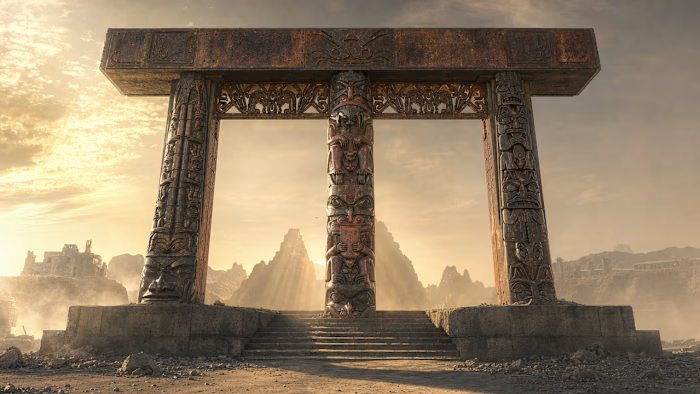
The film shows objects transforming into metal. The form remains the same — monumental, permanent, enduring. In this transformation lies the film's deepest meaning.
The Primary Artifact: Raven Rattle
The heart of TOTEM is a 19th-century rattle by the Xaadas (Haida) people, from Masset, Haida Gwaii. The Met describes it directly: "This raven rattle depicts a perched bird with wings outstretched toward its front — an unusual representation of the raven on a rattle, more typical of the way it would be depicted on a memorial (or totem) pole."
This wasn't simply a musical object. A rattle like this was carried by a chief during ceremonial dances as a mark of rank, spiritual power, ritual performance, and the transmission of knowledge. The rattle was an instrument of authority — a voice that commanded attention and carried meaning between generations.
What the Raven Symbolizes
For the Haida, Raven isn't just a myth character — it's one of the two clan divisions their entire society was built on: Raven and Eagle, inherited through the mother's line. To be Raven is to carry a specific role, a specific responsibility in the social order.
But Raven's significance reaches far beyond one people. Across the Pacific Northwest, Raven keeps reappearing in the same role: a creator and trickster figure, the one who changes the established order and brings a new world into being. Even in Norse mythology, Odin's ravens Huginn and Muninn represent Thought and Memory — the keepers of knowledge that fly across the world and return.
Almost everywhere it shows up, Raven carries the same charge: intelligence, transformation, the thing that adapts and endures.
Why Raven Leads This World
In TOTEM, these meanings converge. The raven becomes the central keeper of memory in a world that has lost its history. The rattle — an instrument of ceremony and rank — becomes a medallion with a single burning eye: the emblem of a civilization built not by forgetting the past, but by carrying it forward in a harder form.
The raven survives not by remaining unchanged, but by changing form. Wood becomes metal. A ceremonial object becomes an idol. A symbol of one tradition becomes the foundation of a new civilization.
These people have not abandoned their ancestors' knowledge. They have transformed it into something that will endure.
All six artifacts used in TOTEM
Primary artifact:
Rattle (Raven) — Xaadas (Haida), 19th century — wood, pebbles, polychrome
https://www.metmuseum.org/art/collection/search/501263
Supporting artifacts, used as visual texture to enrich the world:
Totem Pole Model — Tlingit, 1820–40 — wood
https://www.metmuseum.org/art/collection/search/319073
Totem Pole Model — Haida, 1875–85 — wood, pigment
https://www.metmuseum.org/art/collection/search/319081
Totem Pole Model — Charles Edenshaw, ca. 1890 — argillite
https://www.metmuseum.org/art/collection/search/319092
The full story of the totem poles — how they encode lineage, rank and memory, and what they become in TOTEM:
https://contra.com/community/S5brMMr9-totem-the-gate-bonus-piece
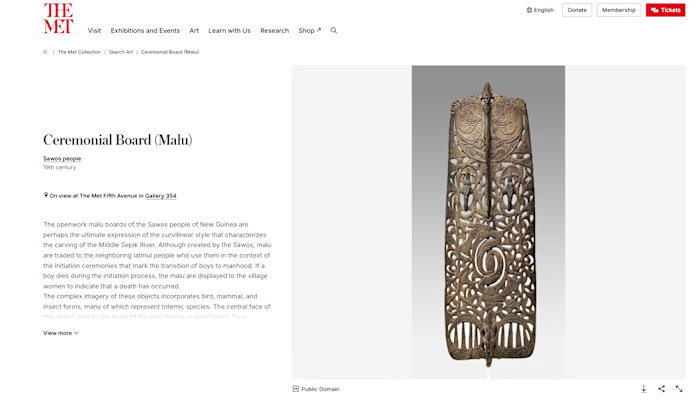
Ceremonial Board (Malu) — Sawos people, 19th century — wood
https://www.metmuseum.org/art/collection/search/311159
The full story of the ceremonial board — the threshold between the visible and the invisible:
https://contra.com/community/4VyUOTHR-totem-the-throne-bonus-piece
Grere'o (Shield) — Solomon Islands, early to mid-19th century — fiber, shell, nut paste
https://www.metmuseum.org/art/collection/search/310073
Four different original materials — wood, stone, shell, and fiber — all reforged into one material in TOTEM- metal.
What the Film Reveals
TOTEM shows that memory is not fragile — it is resilient. It survives not by being preserved untouched, but by being transformed. The objects that once held ceremonial meaning for one people become the symbols of power for another. The wisdom encoded in their forms — their balance, their proportions, their spiritual weight — is not lost. It is reborn in a new material, carrying the same essential truth.
A civilization that remembers is stronger than one that starts from nothing.
Silhouette preserved. Material is not.
🔊 Watch with sound. Half of this world lives in the audio — the film reads differently without it.
#floramuseumchallenge #flora #metmuseum #generativedesign
Like this project