ALMOST LATE: AI-Enhanced Cinematic Storytelling (Flora AI)

Chinwe Owanta-Emenike


ALMOST LATE
A Cinematic Storytelling Exploration with AI
Overview
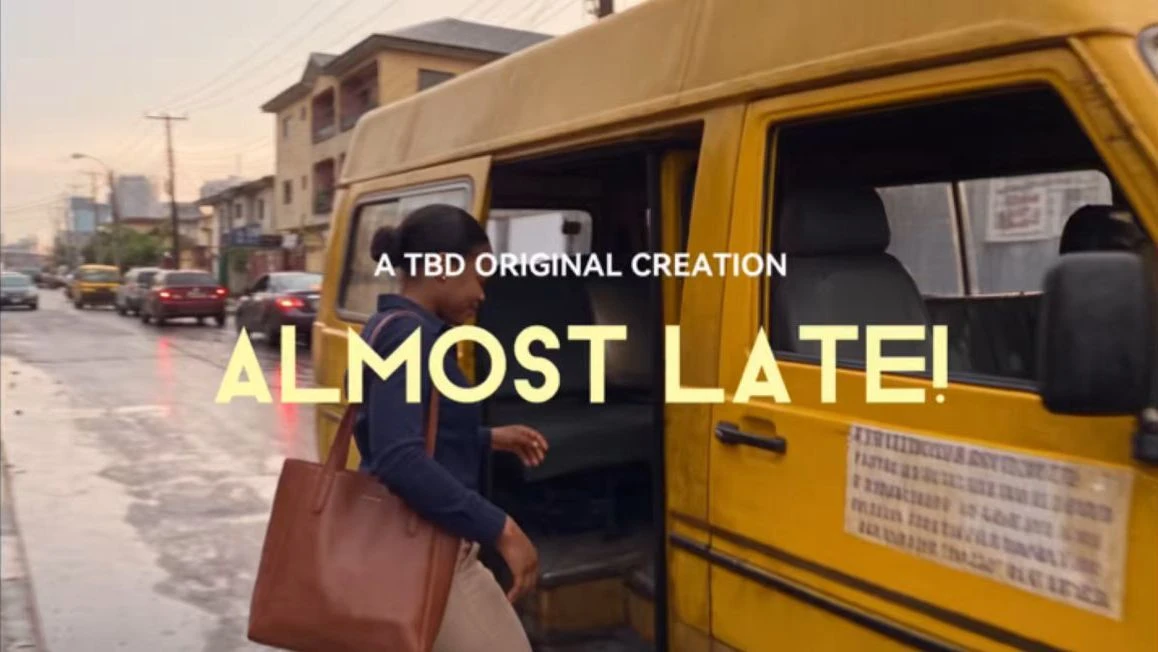
ALMOST LATE! is a personal exploration into AI-assisted visual storytelling, created to explore how an ordinary everyday experience can be transformed into a short cinematic narrative.
The story follows a woman on her way to work. She's running slightly behind schedule, but believes she still has enough time to make it.
Everything seems manageable—until the weather changes.
A sudden downpour delays her journey even further, turning what was initially an almost late situation into one where she actually arrives late.
The project explores how story structure, visual continuity, pacing, and environmental changes can be used to tell a complete story without relying heavily on dialogue.
Context
Storytelling doesn't always need a complicated plot.
Sometimes, the tension comes from watching a familiar situation slowly spiral out of control.
For this project, I wanted to take a very ordinary experience—trying to get to work on time—and build enough visual progression around it to make the audience anticipate what happens next.
The story moves from confidence to uncertainty, then frustration, as an unexpected obstacle changes the outcome.
The central idea was simple:
She thought she had enough time. Then the rain changed everything.
The Challenge
The project wasn't simply about generating individual AI visuals.
The bigger challenge was making those visuals feel like connected moments within the same story.
Each scene needed to maintain:
Character consistency
Environmental continuity
A believable sense of time and movement
Clear emotional progression
A visual relationship with the scenes before and after it
Because each animated sequence began as a still image, every frame also needed to work compositionally before motion was introduced.
The goal was to make the final result feel like a deliberately directed short film—not a collection of unrelated AI generations.
Creative Approach
The creative process focused on three core areas:
01 — Story Structure
I built the narrative around a gradual escalation.
At the beginning, the character is calm and confident that she can still make it to work.
As the journey continues, small moments of delay begin to accumulate.
Then comes the turning point:
The rain.
The weather transforms the situation from manageable to unavoidable, giving the story a simple but clear progression:
Confidence → Waiting → Distraction → Uncertainty → Disruption → Frustration → Resolution
02 — Scene Development
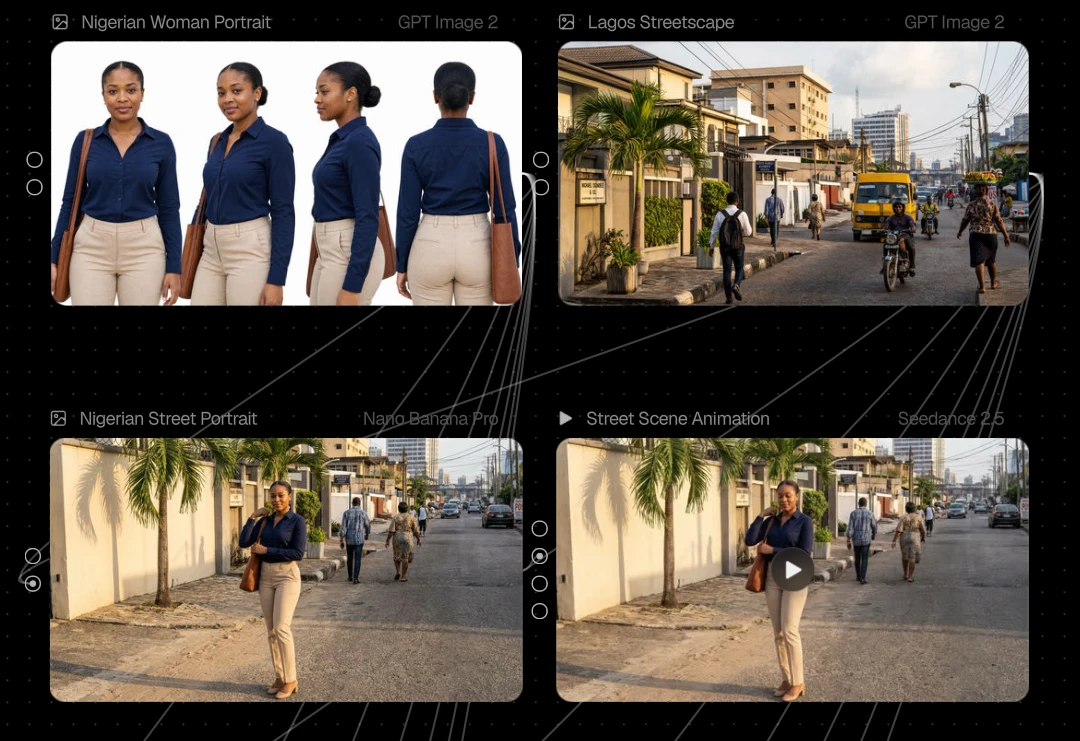
Instead of generating one continuous video, I broke the story into individual cinematic scenes.
Each scene was first developed as a still image, establishing the character, environment, composition, and emotional state.
Those stills were then animated individually before being brought together into one continuous sequence.
This approach gave me greater control over the visual storytelling and allowed each moment to serve a specific narrative purpose.
Scene Breakdown
01 — Leaving the Compound
The story begins with her stepping out of the compound.
She adjusts her bag, checks her phone, and smiles toward the camera before starting her walk.
At this point, everything feels normal.
She isn't worried yet.
02 — Walking the Street
She walks briskly down an Ikoyi street, surrounded by the ordinary rhythm of street life.
The pace is slightly hurried, but still controlled.
She's moving with purpose.
03 — Waiting for Transport
She signals for transport and checks her phone while waiting.
The first signs of impatience begin to appear.
She's still composed, but time is clearly becoming a consideration.
04 — The Hawker Moment
A hawker approaches and briefly captures her attention.
She dismisses the offer and turns her focus back toward the road, watching for a bus.
It's a small moment, but another interruption in a journey where every minute matters.
05 — Thunder Warning
The atmosphere suddenly changes.
The sky darkens.
She looks up with a worried, increasingly frantic expression as thunder rumbles in the distance.
There's still no bus in sight.
The situation is no longer entirely within her control.
06 — Sudden Rain
Then the rain begins.
Her reaction shifts immediately from concern to frustration as she moves quickly toward cover.
The obstacle she was hoping wouldn't happen has finally arrived
07 — Shelter
Under an awning, she wipes the rain from herself and waits.
She's visibly tense.
The journey has now come to a complete stop, and the clock is still moving.
This becomes the quietest but most consequential moment in the story.
08 — Rain Eases, Moving On
Eventually, the rain eases.
An arriving danfo gives her the opportunity to continue, and she hurries to board.
But by now, the damage is done.
She was almost late.
Then the rain made her late.
The sequence ends with a hard cut to black.
Motion Exploration
Each scene was animated individually from its corresponding still image before the sequences were stitched together in CapCut.
The motion was designed to reinforce the narrative rather than simply add movement to static images.
Walking, checking her phone, looking toward the sky, reacting to the rain, seeking shelter, and finally rushing toward the arriving danfo each contribute to the progression of the story.
The final edit connects these individual moments into one continuous journey.
Design Considerations
Throughout the project, I focused on:
Character consistency — maintaining the same character across different scenes and environments
Visual continuity — making each shot feel like part of the same world
Narrative clarity — ensuring the story could be understood through visuals alone
Pacing — gradually increasing urgency as the story progresses
Environmental storytelling — using the street, weather, transport, and surrounding activity to move the story forward
Emotional progression — shifting the character from confidence to impatience, concern, frustration, and urgency
Cinematic composition — treating each still image as an intentional film frame before introducing motion
Outcome
ALMOST LATE! became an exploration of how AI can be used as a storytelling medium rather than simply a way to generate individual images or videos.
By breaking the story into individual scenes, developing each moment as a still image, animating them separately, and finally editing them together, I was able to experiment with the fundamentals of cinematic storytelling:
character → environment → action → tension → consequence.
The project reinforced that compelling AI-assisted storytelling isn't only about how realistic or beautiful a generation looks.
It's about what happens between the frames—and whether each frame gives the next one a reason to exist.
Role & Tools
Role: Creative Direction, Storytelling, Visual Development & Motion Exploration
Primary Tool: Flora AI
AI Models: Claude Sonnet 5, Nano Banana Pro & Seedance 2.5
Editing: CapCut
Like this project
Posted Sep 2, 2026
An ongoing personal project exploring AI as a directing tool — building consistent characters, believable worlds, and genuine emotion, one short story at a time
Likes
2
Views
7
Timeline
Aug 10, 2026 - Aug 11, 2026