
Ouaail ELAOUAD
I help businesses build and improve web applications.
New to Contra
Ouaail is ready for their next project!

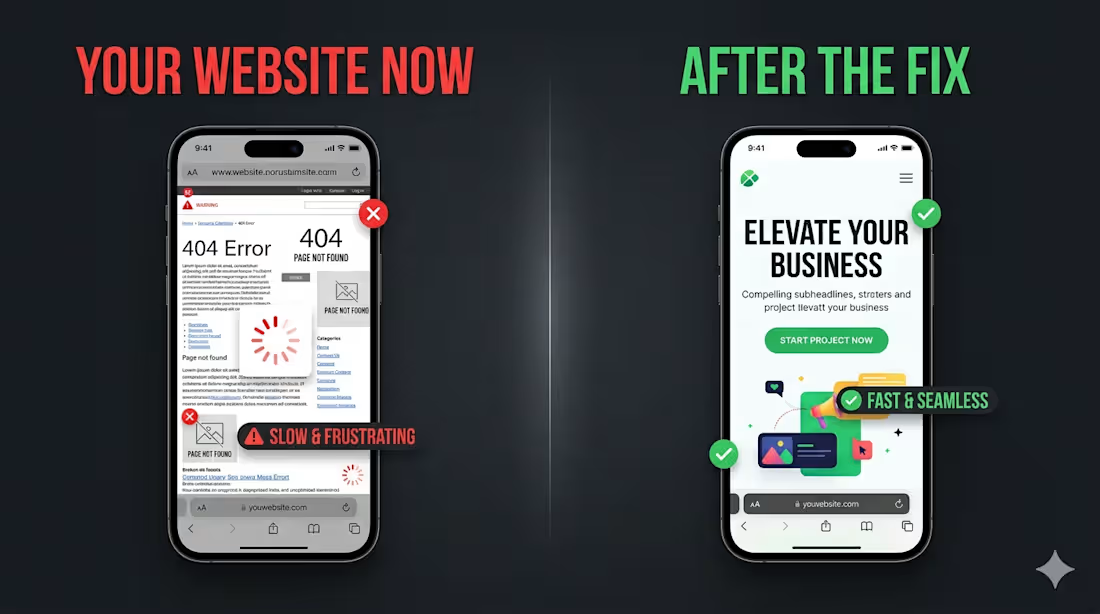
I asked an AI to review 10 small business websites.
The results were brutal.
Here's what came up on almost every single one:
#1 — No clear answer to "what do you do" in the first 3 seconds
Visitors don't read. They scan. If your homepage doesn't instantly say what you do and who it's for — they're gone.
#2 — The contact button is buried
I found contact forms at the bottom of pages, hidden in dropdown menus, or missing entirely. Every extra click costs you a customer.
#3 — Looks broken on mobile
Over 60% of web traffic is mobile. But most small business sites were clearly designed on a desktop and never tested on a phone.
#4 — Loads in 6+ seconds
Google starts penalizing sites after 3 seconds. Slow sites don't just frustrate users — they disappear from search results.
#5 — No trust signals
No reviews. No client logos. No "worked with" section. First-time visitors have no reason to believe you're legit.
The worst part? Most of these are 1–2 day fixes. Not a full redesign. Just targeted changes.
If you're a business owner reading this — go check your own site right now. How many of these do you have
1
69
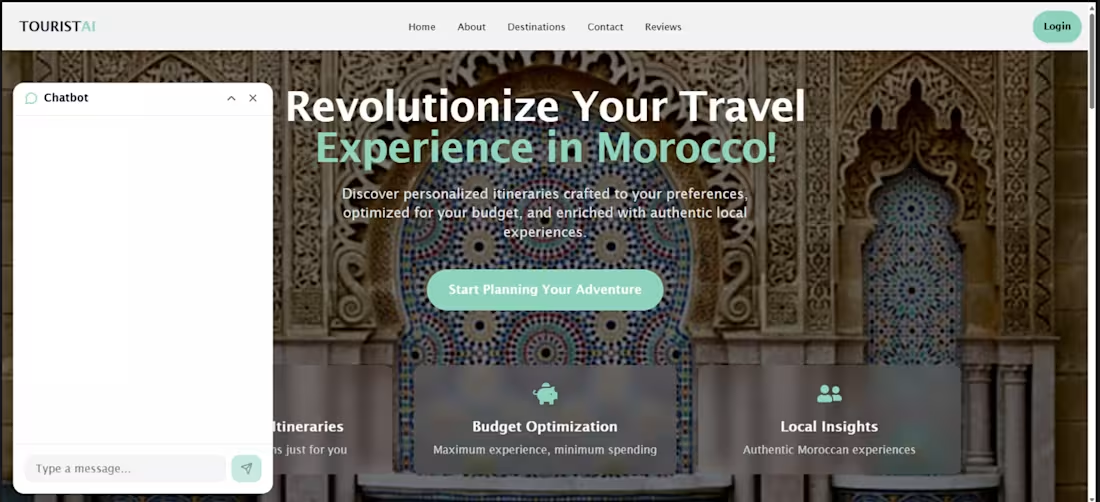
I built an AI-powered travel planner from scratch — here's what I learned.
A few months ago I built a web app where users fill in their travel preferences, and the app generates a complete personalized trip plan in seconds — destinations, itinerary, tips, everything.
The tech behind it:
⚙️ React frontend with a clean, responsive UI
⚙️ FastAPI backend handling all the AI logic
⚙️ Claude API for natural language generation
⚙️ PostgreSQL for storing user sessions and results
The interesting part wasn't the code. It was making the AI output actually useful.
Most people think "AI integration" means calling an API and displaying the response. The real work is:
→ Structuring your prompt so the output is consistent every time
→ Handling edge cases when the AI returns unexpected formats
→ Making the response feel fast even when generation takes 3–5 seconds
→ Formatting the output so it's readable, not a wall of text
The result: a production-ready app that feels smooth, responds intelligently, and actually helps users plan their trip.
If you have a business idea that could benefit from AI — a smart form, a content generator, an automated assistant — this is exactly what I build.
React · Node.js · Claude API · OpenAI · FastAPI 🇲🇦
1
2
107

After building 50+ websites for restaurants, cafés, and businesses, I keep seeing the same mistakes:
❌ No clear call-to-action above the fold
❌ Menu or services page that's hard to find on mobile
❌ Contact form that never gets checked
❌ Slow loading speed killing Google ranking
The fix isn't a full redesign. Usually it's 2-3 targeted changes that take less than a week.
If your website isn't bringing you new clients consistently — it's not working hard enough for you.
I help businesses fix this. React · .NET · Node.js · AI Integration 🇲🇦
2
128

Built a production-ready email automation SaaS platform for a US-based consulting firm in Boston — a full-stack system that replaced manual outreach workflows with automated multi-step email sequences, contact management with segmentation, and real-time dashboards tracking opens, responses, and follow-up status. Developed end-to-end using React, .NET, and Spring Boot, deployed on Windows Server with Docker and CI/CD, and built following clean architecture principles with direct collaboration with company leadership.
2
71