
mifthakurrahmat mizanul ikhsan
Visual designer crafting AI-native creative workflows.
Ready for work
mifthakurrahmat is ready for their next project!


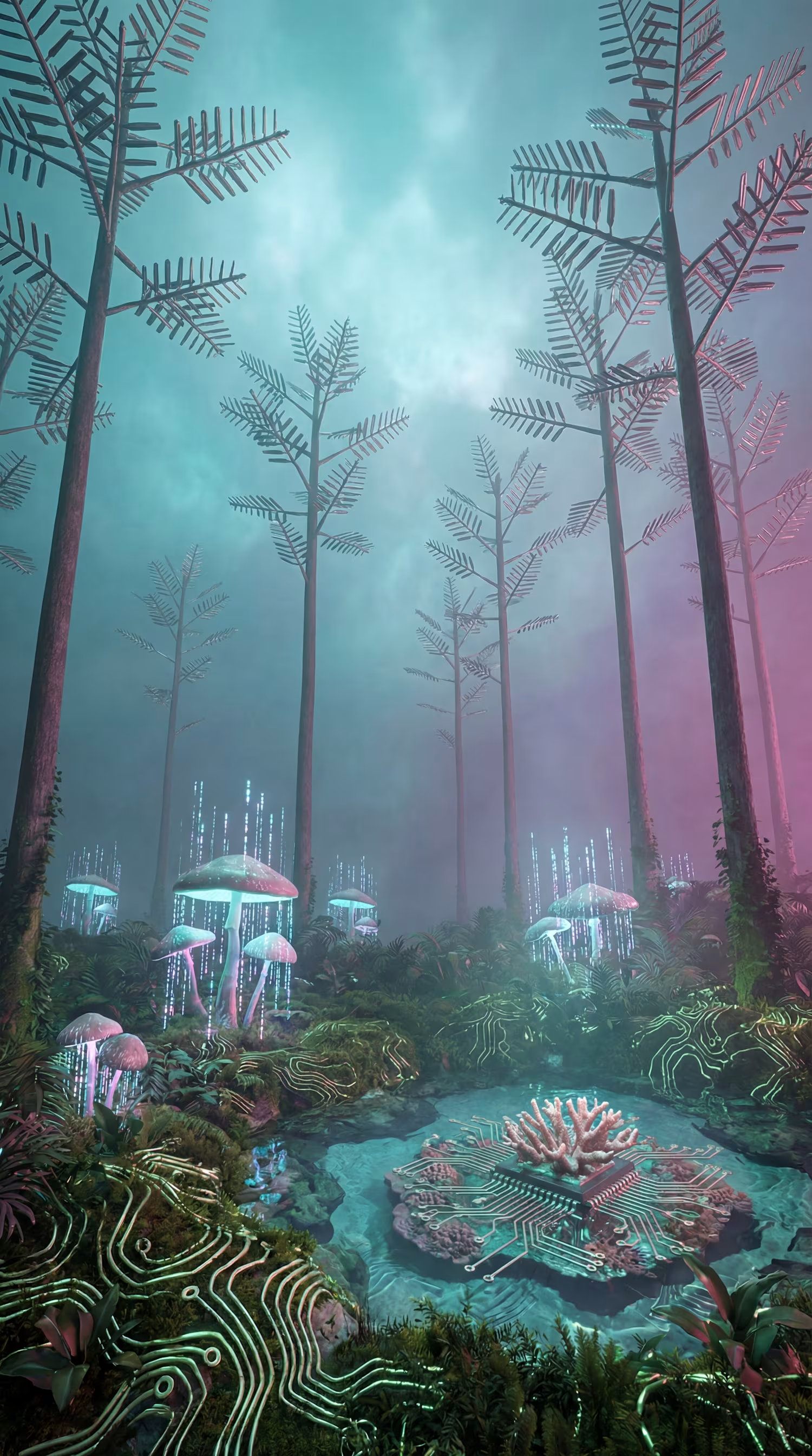
What If You Could Step Inside Your Own Imagination? That's Exactly What I Built This Week.
Most people use AI to create images. I used it to build worlds you can stand inside.
Here's the full story 👇
⚡ The Spark
It started with a simple but audacious question:
"Can I turn AI-generated images into fully immersive 360° VR environments, using nothing but creative code inside Fuser AI?"
Spoiler: Yes. And it broke my brain in the best possible way.
check this the workflow: https://app.fuser.studio/view/7e511999-5d0a-487b-a015-0e402c29d555
🔬 The Experiment: 3 Worlds × 2 Formats Each
I engineered three completely different visual universes, each generated twice, once in standard landscape to validate composition and mood, and once in ultra-wide landscape (2:1 equirectangular), purpose-built for spherical VR wrapping.
🌳 WORLD 01 - The Biophilic Treehouse Mansion
A massive mature oak tree erupting through the center of a luxury living room floor. Honey-warm wood ceilings. Full glass curtain walls dissolving into dense forest. A U-shaped cream linen sectional. Mustard ochre throw pillows. Shaggy rugs. Mezzanine above.
The prompt alone was an architectural brief, specifying 16mm wide-angle perspective, golden hour light direction, biophilic organic modernism, and 8K photorealism.
The result? An interior you don't just look at. You want to live in it.
🏔️ WORLD 02 — The Himalayan Pine Forest at Golden Hour
This one required the most technical precision of the three.
The 360° version wasn't just a pretty landscape. It was a surgically engineered equirectangular projection with:
→ The sun locked at exact horizontal center for correct spherical alignment → Left and right edges pixel-matched for seamless infinite wrapping → Volumetric god rays angled at precise diagonals through atmospheric mist → A lone mountain dog mid-stride at center-frame grounding the infinite in something beautifully human → Color palette calibrated zone-by-zone: warm gold at center, cool blue-grey at edges matching perfectly at the seam
And then came the code.
Inside Fuser AI, I mapped this equirectangular image into a live interactive 360° VR panoramic viewer where you can look up at the pine zenith, down at the dry golden hillside, and rotate through layered misty Himalayan ridges as if you're physically standing at 2,500m elevation.
A still image. Transformed into a place.
🌊 WORLD 03 - The Underwater Canyon
Deep royal blue. Electric cyan god rays piercing downward from a glowing surface. Manta rays gliding in dramatic backlit silence. Coral walls alive with purple sea fans, orange hard coral, bioluminescent crevices. Clownfish. Blue tangs. Schools of silver. An entire reef ecosystem in a single frame.
Generated in portrait for compositional study. Then re-engineered in ultra-wide, wrapping the canyon into a full 360° submersible environment.
Honestly? When this one loaded in the VR viewer for the first time, I actually held my breath.
🛠️ The Technical Layer Nobody Talks About
This wasn't just prompt-and-pray.
Each ultra-wide image required understanding: ✅ Equirectangular projection geometry. top = zenith, bottom = nadir, center = horizon
✅ Seamless horizontal tiling left/right edges must be color-identical for spherical mapping
✅ Sun/light source positioning wrong placement breaks the VR illusion entirely
✅ Creative coding in Fuser AI connecting the generated assets to a live interactive WebXR pipeline
The prompts themselves became spatial architecture documents. not describing a picture, but engineering an environment.
💡 The Bigger Realization
We talk a lot about AI replacing creativity.
But what I found this week is the opposite:
AI amplifies creative ambition to a scale that was previously impossible without a full production studio.
The gap between: → "I can imagine this" → "I can build this" → "I can walk inside this"
Has collapsed to a single afternoon of focused creative work.
The tools are here. The creative code is learnable. The limit is now genuinely just imagination.
So let me ask you this: If you could turn any concept into a world someone could stand inside, what world would you build first?
1
119
Building LUMINOS: A Brand System Experiment
Recently spent some time exploring how far you can push a structured creative workflow, starting from nothing but a concept and building out a complete brand identity system using AI-assisted tools and generative code.
The brand: LUMINOS. A fictional biotech skincare line built around the idea of skin intelligence. The constraint I set: every visual asset had to come from a deliberate, documented process, no happy accidents.
check the workflow here : https://app.fuser.studio/view/eddeccfc-21ba-4cb4-a908-4a4cb17f297f
What this process actually taught
Specificity is everything. The more precisely you can describe intent not just aesthetics but why each element is there the more coherent the output. The same applies whether you're briefing an AI model, a developer, or a designer.
System thinking before execution. Locking the color palette, typographic rules, and blend mode logic before generating anything meant every asset had a shared visual language from the start rather than being reverse-engineered into consistency afterward.
The brand doesn't exist. But the process behind it is the same one that applies to any identity project: define the system first, then build inside it.
2
162
Hi, I’m Isan.
Back again, diving deeper into the world of generative AI challenges.
This time, I joined The Morphic Workflow Challenge by Morphic x Contra with a workflow I’ve been building and refining: “Character Sheet & Cinematic 3x3 Grid.”
The idea is simple, but powerful: turn any subject whether it’s a character, product, or object into a complete creative package. From a clean, labeled multi-angle reference sheet, to optional recoloring, all the way to a fully composed cinematic 3x3 storytelling grid in 4K.
What makes this workflow meaningful to me isn’t just the output, it’s the process.
Every step is intentional. Every generation is gated by user approval. Nothing moves forward unless it’s been seen, reviewed, and confirmed.
This approach solves a problem I kept running into: wasted credits, inconsistent visuals, and too much guesswork. So I designed a pipeline that keeps control in the hands of the user while still pushing for high-quality, cinematic results.
A few things I focused on:
- Maintaining visual consistency from reference sheet to final scenes
- Giving full creative control over style, ratio, and storytelling direction
- Ensuring no unnecessary generation happens without approval
- Making the final output ready-to-publish, including branding support
It’s flexible enough to work across different domains from character design and fashion to products and vehicles, while still keeping a strong cinematic identity when needed.
Still exploring, still iterating, and still learning.
Curious to hear how others are approaching structured workflows in generative AI, especially when balancing creativity with control.
you can try it here 👉🏻 https://studio.morphic.com/en/workflows/019d8f15-de2e-72ea-8fdf-d961e9f4e25d/character-sheet-cinematic-3x3-grid
#morphicworkflows
9
332
For the Flora Technique Challenge, I experimented with a single input image that produces two distinct outputs. The first is a character sheet design, featuring multiple angles and key visual traits to clearly define the character. The second is a 4K cinematic storytelling sequence, composed of 9 scenes arranged in a 3×3 grid.
The goal behind this approach was simple: to ensure that the cinematic storytelling remains visually consistent with the character sheet across every scene. Bridging that gap between design and narrative is something I find incredibly valuable as generative workflows continue to evolve.
For the entire image pipeline, I used Nano Banana 2, while prompt expansion was handled with Claude Sonnet 4.6 inside Flora AI.
Curious to hear your thoughts, how do you approach character consistency in AI-generated storytelling?
you can try it here 👉🏻 https://app.flora.ai/techniques/4k-character-sheets-and-cinematic-9-scenes
#FLORATechnique
2
25
568