
Leonid Zamriy
SEO & GEO specialist with 15+ years of experience


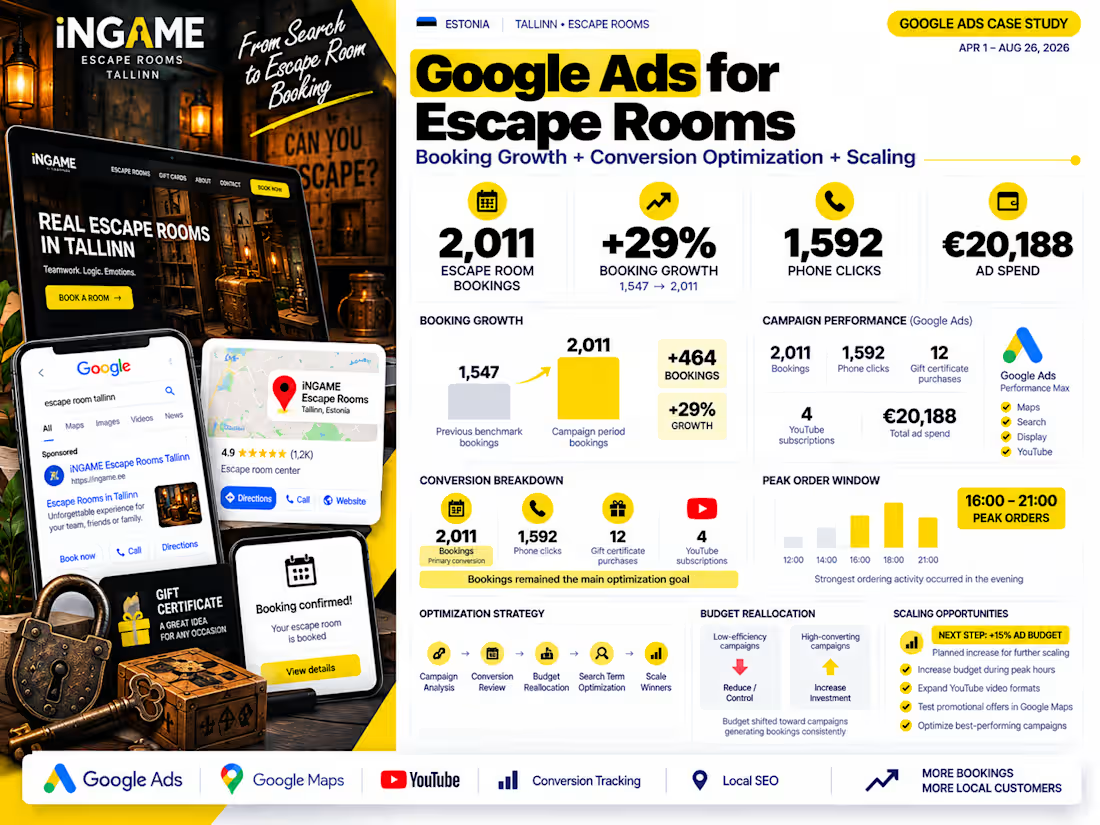
Google Ads PPC for Escape Rooms | 2,011 Bookings in Tallinn
The client, iNGAME, operates escape rooms in Tallinn, Estonia, and wanted to increase online bookings through Google Ads while building a stable flow of customer inquiries and reservations.
The main business objective was to grow completed escape room bookings, not simply increase traffic or secondary interactions. The account also tracked phone clicks, directions, gift certificate purchases, and other user actions to provide a broader view of campaign performance.
Challenges
The main challenge was to increase booking volume without allowing acquisition costs to grow proportionally. Different campaigns delivered different results, so the advertising budget needed continuous monitoring and reallocation.
Another priority was distinguishing primary business conversions from supporting actions. Phone clicks and other interactions provided useful signals, but completed escape room bookings remained the main performance metric.
Strategy & Implementation
I focused the Google Ads strategy on increasing completed bookings and improving campaign efficiency through continuous optimization.
The work included:
- Campaign and conversion analysis: reviewed campaign performance, conversion data, acquisition costs, and user behavior to identify growth opportunities.
- Campaign optimization: refined campaign structure and optimized advertising around the client's key escape room offerings.
- Budget reallocation: concentrated spending on campaigns and directions that consistently generated conversions.
- Performance optimization: regularly reviewed search terms, campaign efficiency, and conversion costs to improve the use of the advertising budget.
- Conversion monitoring: tracked escape room bookings, phone clicks, gift certificate purchases, directions, and other relevant actions.
- Controlled scaling: increased investment in proven campaign segments while continuing to optimize underperforming areas.
This data-driven approach helped prioritize actual bookings and make budget decisions based on campaign performance rather than clicks alone.
Results
From April 1 to August 26, 2026, the Google Ads campaigns delivered:
- 2,011 escape room bookings
- 29% growth in bookings, from 1,547 to 2,011
- 1,592 phone clicks
- 12 gift certificate purchases
- 4 YouTube subscriptions
- €20,188 in advertising spend
The number of bookings increased by 464 compared with the previous benchmark, demonstrating the impact of systematic campaign optimization and scaling.
Business Impact
The project established a stronger and more consistent booking acquisition channel for iNGAME.
By prioritizing bookings as the primary conversion, monitoring supporting actions, and reallocating the budget toward better-performing campaigns, the advertising strategy focused on the outcomes that mattered most to the business.
The campaign also provided a foundation for further growth, with a planned 15% advertising budget increase to support additional scaling.
Conclusion
The iNGAME case demonstrates how Google Ads campaign optimization, conversion-focused management, and continuous budget reallocation can help an escape room business increase reservations in a local market.
The key result was 2,011 bookings and 29% growth over the previous benchmark, supported by ongoing performance analysis and scaling of the most effective campaigns.
0
18
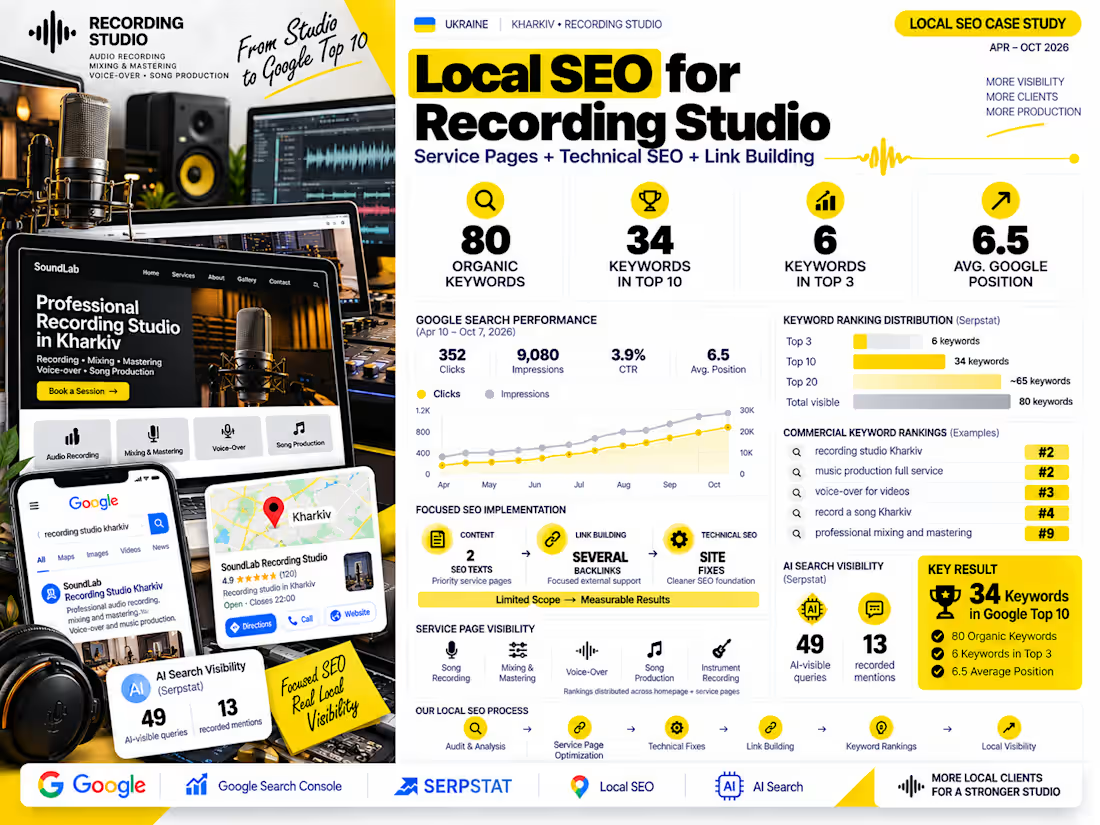
Local SEO for Recording Studio | 80 Keywords, 34 in Top 10 & Position 6.5
The client was a local recording studio offering audio recording, mixing and mastering, voice-over services, and complete song production. The objective was to improve Google visibility for local commercial searches and attract relevant organic traffic without a large SEO budget.
The project demonstrated how a focused, limited scope of SEO work can deliver measurable results in a local niche with relatively low competition.
SEO Strategy & Implementation
The work focused on three areas: content optimization, link building and technical improvements.
I prepared two SEO texts for priority service pages to improve their relevance for commercial search queries. Several backlinks were acquired to support organic visibility, and technical website issues were fixed to establish a cleaner foundation for search performance.
The strategy prioritized pages directly related to the studio's services rather than large-scale content production or broad website restructuring.
Results
According to Google Search Console, between April 10 and October 7, 2026, the website generated:
352 organic clicks
9,080 impressions
3.9% CTR
6.5 average Google position
According to Serpstat, the website achieved visibility for 80 organic keywords, including:
34 keywords in the Top 10
6 keywords in the Top 3
Approximately 65 keywords in the Top 20
Examples of ranking commercial keywords included:
"recording studio Kharkiv" — position 2
"music production full service" — position 2
"voice-over for videos" — position 3
"record a song Kharkiv" — position 4
"professional mixing and mastering" — position 9
The website also appeared in AI-generated search answers for 49 queries, with 13 recorded mentions, according to the supplied Serpstat data.
Business Impact
The project improved organic visibility for searches directly related to the studio's services. Rankings were distributed across the homepage and service pages, including song production, mixing and mastering, voice-over and instrument recording.
The results were achieved without a large content plan, mass link building, a website redesign or paid advertising. The reported organic traffic came from search rather than paid campaigns.
Conclusion
This case demonstrates how a targeted local SEO strategy can improve search visibility with a limited scope of work. By combining two priority-page texts, several backlinks and technical fixes, the recording studio reached 80 visible organic keywords, 34 Top-10 rankings and an average Google position of 6.5.
The next growth opportunities are improving keywords currently ranking in positions 11–20, strengthening service pages that receive impressions but fewer clicks, and gradually expanding visibility in AI-generated answers.
0
28
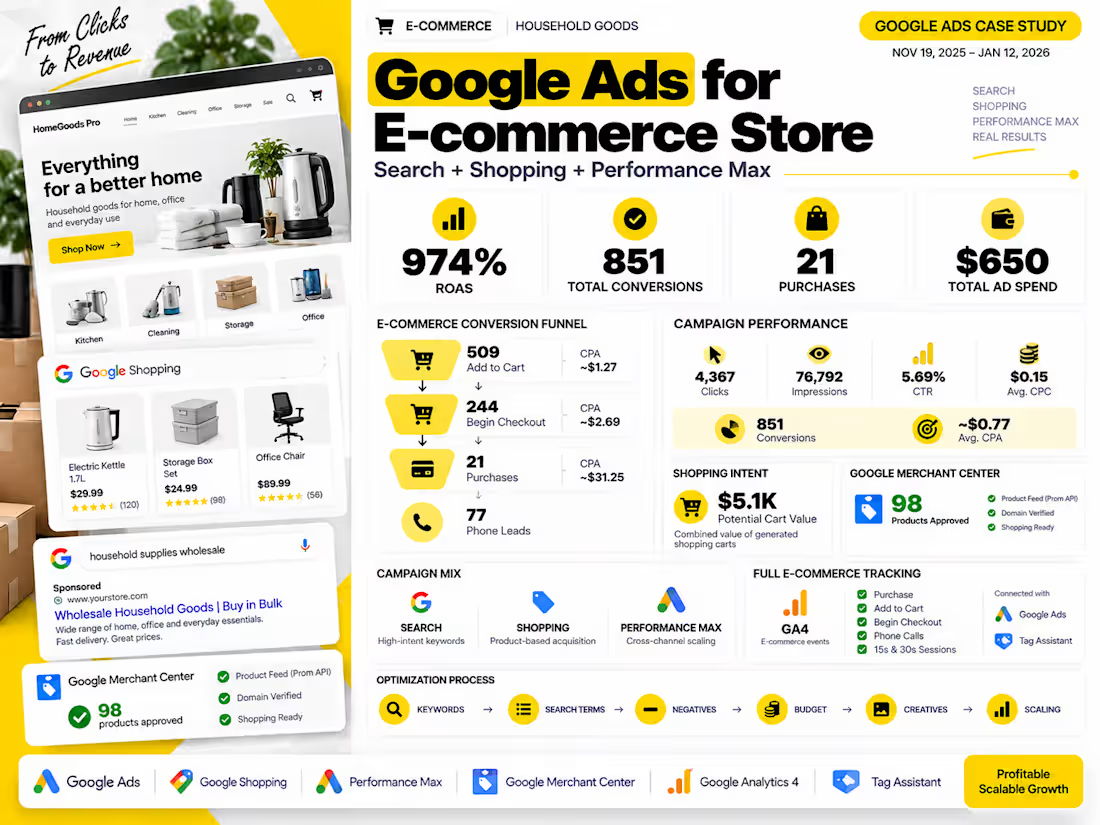
Google Ads for E-commerce | 851 Conversions, 974% ROAS & $713 Ad Spend
IziOpt is an online store selling home, office and everyday products to both retail and wholesale customers. The project ran from November 19, 2025, to January 12, 2026, with the goal of increasing online sales and testing Google Ads as a scalable acquisition channel.
The strategy combined Google Search, Shopping and Performance Max campaigns, supported by e-commerce analytics and continuous optimization. The focus was on identifying high-intent traffic, measuring user behavior throughout the purchase funnel, and preparing the account for future budget growth.
Tracking & Merchant Center Setup
I configured GA4 and Tag Assistant and implemented tracking for key user actions, including purchases, add-to-cart events, checkout initiation and phone leads. I also verified product, transaction ID and conversion value parameters to improve tracking reliability.
Google Ads and GA4 were connected, and Google Merchant Center was configured with a product feed through the Prom API. I verified the website and feed setup, resulting in 98 approved products.
Campaign Strategy & Optimization
I launched Ukrainian- and Russian-language Search campaigns organized by product category, tested Shopping and Performance Max, and created multiple ad variations with relevant extensions.
The optimization strategy prioritized high-intent commercial searches containing terms such as "buy," "wholesale" and "in bulk." I monitored search terms daily, added negative keywords, reviewed campaign performance and balanced budgets between Search, Shopping and Performance Max.
The project followed two stages: first, validating the channel and establishing baseline performance; then, removing inefficient combinations, focusing spend on stronger commercial opportunities and preparing the account for scaling.
Results
During the campaign period, the account generated:
851 total tracked conversions
974% ROAS
$713 in advertising spend
4,367 clicks
76,792 impressions
5.69% CTR
$0.16 average CPC
$0.83 average cost per tracked conversion
Conversion funnel breakdown:
21 purchases at approximately $33.82 per purchase
244 checkout initiations at approximately $2.91 each
509 add-to-cart events at approximately $1.38 each
77 phone leads
Revenue Potential & Business Impact
Users added products to their carts with a combined value of approximately $5,545, indicating meaningful purchase intent and potential for further optimization.
The campaign established a measurable acquisition funnel, connected product advertising with e-commerce tracking, and provided performance data to guide future budget allocation. The results also highlighted the importance of distinguishing completed purchases from intermediate actions when evaluating campaign efficiency.
Conclusion
The IziOpt project established Google Ads as a measurable channel for testing e-commerce demand across Search, Shopping and Performance Max. With 851 tracked conversions, 974% ROAS and approximately $713 in ad spend, the campaign provided a foundation for continued optimization and scaling.
0
47
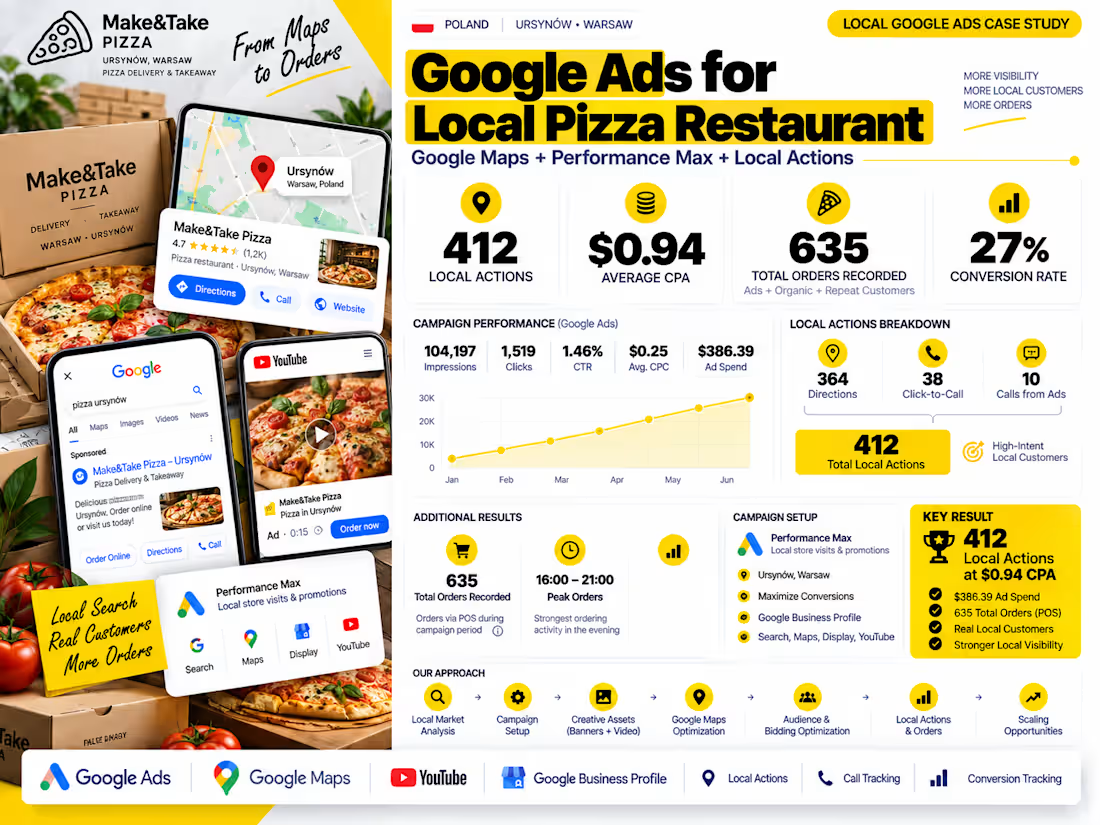
Google Ads PPC for Local Restaurant | 412 Local Actions at $0.94 CPA
Make&Take Pizza is a local restaurant specializing in pizza delivery and takeaway in Ursynów, Warsaw, Poland. The main objective was to attract users with high purchase intent and turn local search demand into real visits, calls and orders.
Instead of focusing only on website traffic, the campaign was built around local actions and Google Maps visibility. I launched and optimized a Google Performance Max campaign using Google Maps, Search, Display and YouTube placements.
Campaign Setup
The campaign used the Performance Max "Local store visits and promotions" objective with a Maximize Conversions bidding strategy and local targeting focused on Ursynów.
I analyzed the local market and business location, configured the Google Ads account, synchronized the Google Business Profile, and completed advertiser verification and moderation.
The campaign was optimized around three key local conversion actions:
Directions
Click-to-Call
Calls from Ads
Optimization
During the learning phase, I monitored impressions, clicks, CTR, CPC, conversions and advertising spend, while gradually improving the campaign structure and creative assets.
I expanded the creative pool with banners and video, integrated YouTube Shorts, and focused optimization on high-intent actions such as directions and calls.
I also analyzed the hours generating the strongest demand and adjusted the campaign approach around the restaurant's peak ordering period.
Results
The campaign generated:
104,197 impressions
1,519 clicks
1.46% CTR
$0.25 average CPC
$386.39 total ad spend
412 local actions
$0.94 average CPA
27% conversion rate
Local actions included:
364 Directions
38 Click-to-Call
10 Calls from Ads
Business Impact
During the campaign period, the restaurant recorded 635 total orders through its POS system, including orders influenced by advertising, organic traffic and returning customers.
The campaign demonstrated that local Google Ads activity can influence offline purchasing behavior. Users could first discover the restaurant through Google Maps, request directions or call the business, and complete the purchase later by phone or in person.
The strongest ordering activity occurred between 16:00 and 21:00, providing a clear opportunity to concentrate future advertising activity around peak demand.
Scaling Opportunities
The next optimization stage included increasing the budget during peak hours, expanding video formats such as YouTube Shorts, testing promotional offers in Google Maps, and creating separate asset groups for takeaway and delivery.
Conclusion
The campaign created a consistent flow of local users and achieved 412 local actions at a $0.94 CPA. With $386.39 in advertising spend and 635 total orders recorded during the campaign period, the project demonstrated the potential of Performance Max and Google Maps to support real-world restaurant sales and local demand.
1
91