Freelancers using Gemini GemsFreelancers using Gemini Gems.The Future of Blog Images — Why Flora + SDXL Is the New Creative Pipeline**
In the last two years, the way companies produce blog images has shifted from manual prompting and inconsistent visuals to automated, brand‑safe pipelines powered by workflow engines like Flora and image models like Stable Diffusion XL (SDXL). This shift isn’t just technological ; t’s operational.
It changes how content teams think, plan, and scale.
Most companies today still generate images the old way:
someone opens an AI tool, writes a prompt, tweaks it, regenerates, downloads, crops, and hopes the final result matches the brand. It’s slow, inconsistent, and impossible to scale across dozens of posts per month.
Flora changes that.
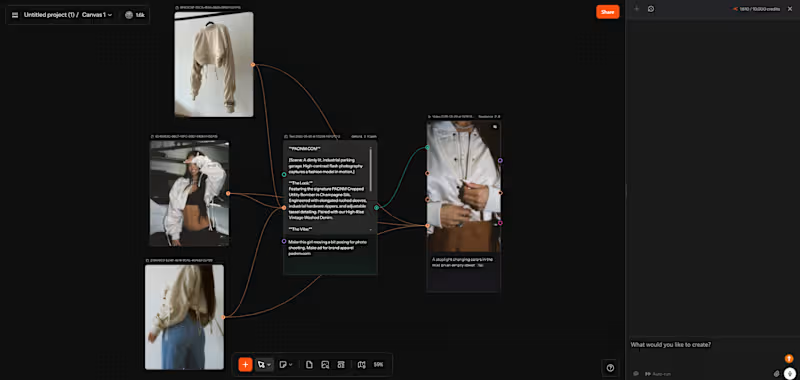
Flora is a workflow‑native system designed for creative logic. It doesn’t generate images - it orchestrates them. It takes a blog summary, routes it through SDXL, generates multiple visual directions, lets the user choose, and then produces a full set of final images. The result is a repeatable, automated pipeline that removes the manual friction from content‑ops.
SDXL is the perfect engine for this. It’s open, customizable, and capable of producing consistent, brand‑aligned visuals when fine‑tuned. Unlike closed models, SDXL can be shaped to match a company’s identity ; colors, textures, tone, and visual language. When paired with Flora, it becomes a scalable image factory.
The real power is in the logic:
input → direction generation → selection → final images → QC → output.
This structure ensures every blog post receives images that feel intentional, cohesive, and aligned with the brand. No more random styles. No more mismatched tones. No more manual prompting.
For companies publishing at scale — especially in technical fields like cloud security; his workflow becomes a competitive advantage. It reduces production time, increases consistency, and frees teams to focus on strategy instead of image generation.
Flora + SDXL isn’t just a toolchain.
It’s the new creative pipeline for modern content teams.
⚙️ Stable Diffusion XL — The Engine Behind Modern Creative Automation
If Flora is the conductor, Stable Diffusion XL (SDXL) is the orchestra. It’s the model that turns creative logic into visual reality — the engine that powers automation, consistency, and scale for modern content teams.
Before SDXL, image generation was chaotic. Each prompt produced a different style, tone, and texture. Teams spent hours tweaking outputs, chasing brand alignment that never quite landed. SDXL changed that forever.
Released in mid‑2023 by Stability AI and the CompVis research group, SDXL became the first open‑source model capable of producing high‑resolution, brand‑consistent visuals at scale. It wasn’t just an upgrade — it was a philosophical shift.
Instead of “prompt and pray,” SDXL introduced control, fine‑tuning, and repeatability.
Companies could now train SDXL on their own brand assets — colors, typography, lighting, tone — and generate hundreds of images that looked like they came from the same designer. It turned AI art from novelty into infrastructure.
The magic lies in its architecture:
a dual‑encoder system that understands both semantic meaning and visual composition, allowing it to interpret complex prompts with precision. When paired with workflow engines like Flora, SDXL becomes a creative factory — producing multiple image directions, refining them through logic, and delivering final outputs that feel intentional.
For blog teams, this means no more mismatched visuals.
For founders, it means brand consistency without design bottlenecks.
For agencies, it means scalable creative production that feels human.
SDXL isn’t just an image model.
It’s the engine of creative automation — the silent powerhouse behind every modern workflow that values speed, consistency, and brand identity. I was brought in to improve performance and boost views for YouTube channels through high-CTR thumbnail design. As a thumbnail specialist, I created eye-catching, clickable thumbnails using bold typography, strong visual hierarchy, and clear storytelling visuals across finance, business, and viral content.
Each thumbnail was designed to increase click-through rate (CTR), attract attention, and drive more views using proven YouTube thumbnail strategies.
Result:
Generated 87M+ total views, with higher CTR, better audience engagement, and stronger video performance across multiple channels. [PROBLEM]
Most organizations rarely fail because of a poor strategy. They fail because of poor alignment around that strategy. Leaders assume that once a vision is communicated, it’s understood—but communication is not comprehension.
The default state of any company isn't unity; it's fragmentation. While the executive team sees a clear roadmap, the frontline is often operating on "narrative battlegrounds" where competing department stories quietly undermine execution. This "Strategic Blind Spot" is the silent killer of productivity and growth in modern enterprise.
[SOLUTION]
Strategic alignment is not a passive byproduct of a quarterly roadmap—it’s a weekly discipline of Contextual Stitching. I’ve architected a deep dive into how leaders can move beyond the "Illusion of Shared Understanding" to build a unified organizational narrative that actually scales.
The Leader’s Blind Spot:
Why Most Organizations Fail at Strategic Alignment "Strategic alignment is the most overused phrase in business and the least understood. Most leaders assume alignment is a natural byproduct of a good strategy. It isn’t. In fact, the default state of any organization is misalignment—and it spreads silently until it kills execution."
We’ve all seen it: Finance tells a story of cost control while Product tells a story of experimentation. When your teams are operating on fragmented narratives, your strategy becomes mere noise. You aren't failing because the plan is bad; you're failing because your organization is a narrative battleground of competing priorities.
" Alignment isn't a kick-off meeting; it’s a weekly discipline of Contextual Stitching. I’ve architected a deep dive into the "Leader’s Blind Spot," revealing how to move from the illusion of shared understanding to a unified strategic narrative that scales." It is not passive. It is not the default state of an organization. In fact, the default state is misalignment — and most leaders don’t realize how quickly it spreads, how quietly it compounds, or how deeply it undermines execution.
The uncomfortable truth is this: organizations rarely fail because of poor strategy. They fail because of poor alignment around the strategy. And the root cause is almost always the same — a leadership blind spot around how humans interpret information, incentives, and narrative.
1. The Illusion of Shared Understanding
Most leaders assume that once a strategy is communicated, it is understood. But communication is not comprehension. A strategy that feels obvious to the executive team often feels abstract, distant, or irrelevant to frontline employees. The further a message travels down the hierarchy, the more it fragments.
This is not because employees are disengaged — it’s because humans interpret information through the lens of their role, pressures, and incentives. A product manager hears the strategy differently than a sales director. A customer success lead hears it differently than a finance analyst. Without deliberate translation, the strategy becomes a collection of competing interpretations rather than a shared mental model.
Leaders underestimate how much contextual stitching is required to turn a strategic idea into a unified organizational narrative.
2. Narrative Fragmentation: The Silent Killer of Alignment
Organizations are storytelling ecosystems. Every team tells a story about what matters, what success looks like, and how decisions should be made. When these stories conflict, alignment collapses.
A company may claim to prioritize innovation, but if:
Finance tells a story about cost control
Operations tells a story about risk avoidance
Marketing tells a story about speed
Product tells a story about experimentation
…then the organization becomes a narrative battleground.
Alignment requires one coherent story — a strategic narrative that every team can translate into their own context without distorting the core message. Without narrative coherence, even the best strategy becomes noise.
3. The Priority Paradox: When Everything Matters, Nothing Does
One of the most common leadership blind spots is the belief that more priorities create more progress. In reality, more priorities create more fragmentation.
When leaders articulate too many priorities, teams default to local optimization:
“What helps my department?”
“What protects my metrics?”
“What keeps my team safe?”
This is how organizations drift — not through dramatic failures, but through thousands of micro‑decisions made in isolation.
Alignment requires ruthless prioritization. Leaders must define:
What matters most
What matters next
What doesn’t matter at all
Without this clarity, teams fill the ambiguity with their own assumptions, and alignment dissolves.
4. The Missing Feedback Loop
Most organizations treat strategy as a one‑way broadcast: leadership speaks, the organization listens. But alignment is not a speech — it’s a conversation.
High‑alignment organizations build feedback loops that surface misalignment early:
Are teams interpreting the strategy correctly?
Are priorities understood the same way across functions?
Are decisions being made in alignment with the narrative?
Are incentives reinforcing or undermining the strategy?
Without feedback loops, leaders operate in an echo chamber. They assume alignment because no one is telling them otherwise. But silence is not alignment — silence is a lack of psychological safety.
5. Cognitive Bias: The Leader’s Hidden Enemy
Leaders often assume their perspective is the organization’s perspective. They underestimate how much context they possess and how little context others have. This creates a gap between intention and interpretation.
Leaders think in frameworks. Teams think in tasks. Leaders think in horizons. Teams think in deadlines. Leaders think in narratives. Teams think in deliverables.
Alignment is not achieved when leaders think clearly — it is achieved when everyone thinks clearly. And that requires leaders to decentralize understanding, not just delegate execution.
6. The Organizations That Get Alignment Right
The companies that master alignment share three traits:
A. They communicate strategy as a narrative, not a document.
They don’t rely on slides. They rely on story. They articulate:
the problem
the stakes
the opportunity
the path forward
the role each team plays
Narrative creates coherence. Coherence creates alignment.
B. They operationalize priorities with precision.
They don’t say “everything is important.”
They say “this is what matters now.”
They define:
the one priority that drives the next 90 days
the metrics that matter
the trade‑offs they are willing to make
This eliminates ambiguity and accelerates execution.
C. They build alignment as a continuous practice.
Alignment is not a kickoff meeting.
It is not a quarterly ritual.
It is a weekly discipline.
High‑alignment organizations:
revisit priorities
recalibrate narratives
reinforce context
adjust based on feedback
communicate relentlessly
Alignment is maintained through rhythm, not intensity.
7. The Leadership Imperative
In a world where complexity is rising and attention is shrinking, alignment is no longer a “nice to have.” It is a competitive advantage. It determines:
speed
clarity
execution quality
employee engagement
customer experience
organizational resilience
Leaders who master alignment build organizations that move as one — fast, focused, and confident. Leaders who ignore alignment build organizations that move in fragments — slow, confused, and reactive.
The difference is not strategy.
The difference is clarity.
The difference is narrative.
The difference is leadership.
SHARE or forward the full Executive White Paper: [Insert Bitly Link]
strategiccopywriting (https://contra.com/community/topic/strategiccopywriting)
fintechdesign (https://contra.com/community/topic/fintechdesign)
agenticarchitecture (https://contra.com/community/topic/agenticarchitecture)AI Agent Engineer (https://contra.com/community/topic/ai-agent-engineer)AI Automation (https://contra.com/community/topic/ai-automation)AI Fact Checking (https://contra.com/community/topic/ai-fact-checker)
Google Gemini (https://contra.com/community/topic/google-gemini)
Mural (https://contra.com/community/topic/mural)
synthflow Ai (https://contra.com/community/topic/synthflow-ai)