Freelancers using FuserFreelancers using Fuser
AI Image & Video Producer | AI Ads | AI UGC
$10k+
Earned
7x
Hired
5.0
Rating
290
Followers
AI Image & Video Producer | AI Ads | AI UGC
3D illustrator, icon designer, creative geek,
$5k+
Earned
1x
Hired
5.0
Rating
29
Followers
3D illustrator, icon designer, creative geek,
AI & No-Code Builder | Founder of Onyx Labs Agency
1x
Hired
4.2
Rating
27
Followers
AI & No-Code Builder | Founder of Onyx Labs Agency
UI/UX Designer • No-code Builder • AI Architect
$1k+
Earned
62
Followers
UI/UX Designer • No-code Builder • AI Architect
Cover image for A product is easy to
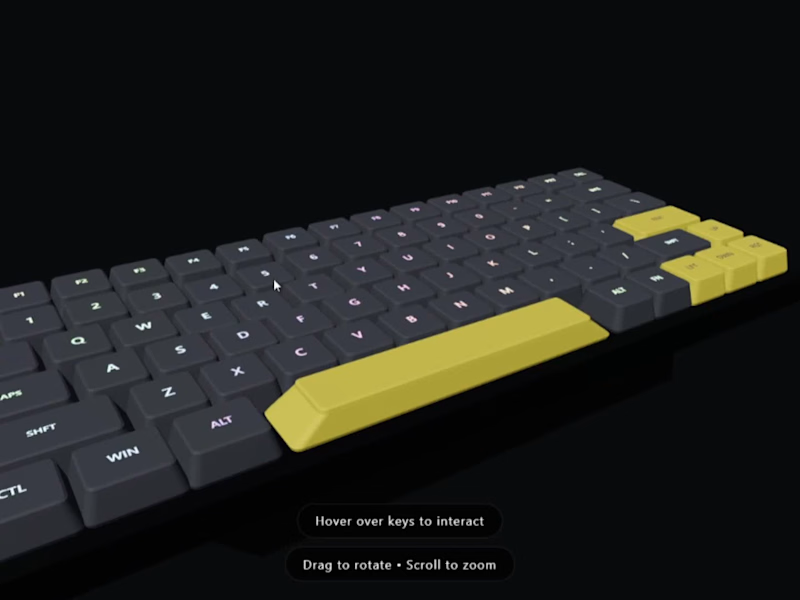
A product is easy to build. A brand is what makes it unforgettable. So I built BRANDRY! A workflow that takes a single input—a keyboard—and expands it into a complete, premium brand system. — I didn’t want random outputs. I wanted something that thinks like a design studio. Everything starts with the input image. I analyze: • materials • lighting • form • design language From that, the entire brand direction is derived. — Then the system builds across four layers: 1. Logo: A refined mark inspired by the product—never copied, always reinterpreted. 2. Moodboard: Colors, textures, and visual cues extracted and elevated into a cohesive direction. 3. Brand Identity: A dark, premium system—typography, palette, and visual language working together. 4. Website Mockup: A cinematic presentation—displayed on devices, placed in a real environment, lit like a product ad. And to bring everything together, I leaned heavily on the Compositor Node. Every output is carefully layered: • controlled lighting • depth and shadows • balanced composition Then inside the Creative Code Node, I used Three.js to construct a 3D version of the product. That added: • real depth • accurate lighting interaction • natural integration into scenes Workflow: https://app.fuser.studio/view/03af9496-bc89-4f76-a1b7-00c25c7fb513 The product doesn’t feel placed—it feels built into the frame. …this one’s my second submission.
6
7
266
Cover image for The Memory Constellation✨
Reimagining family memory
The Memory Constellation✨ Reimagining family memory preservation through an interactive constellation of stories, photos, and relationships. The Problem: Every family has stories worth preserving, yet most of them slowly disappear over time. Photos remain scattered across devices and albums. Important memories live only in conversations. Voice recordings are rarely preserved. As generations pass, family history becomes fragmented, leaving future generations with names and dates but little understanding of the people behind them. Traditional family tree tools focus on genealogy and structure, but they rarely capture the memories, relationships, and personal stories that give those connections meaning. The Solution🧠 : The Memory Constellation transforms family history into a living, interactive experience. Instead of viewing a family tree as a static hierarchy, family members are represented as connected stars within a constellation. Each person becomes a gateway to preserved memories, photographs, recordings, and stories that future generations can explore and revisit. The experience encourages users to discover not only who their relatives were, but also the moments, relationships, and memories that shaped their lives. Key FeaturesšŸ’Æ : ✦ Interactive constellation-based family tree ✦ Multi-generational relationship visualization ✦ Personal memory portals for each family member ✦ Photo, story, and recording preservation ✦ Immersive storytelling experience designed around legacy and remembrance ✦ Constellation mode for exploring family connections in a more meaningful and memorable way Project: The Memory Constellation (https://fix-kiosk-81656652.figma.site/)File: Community File (https://www.figma.com/community/file/1649669107824793734) Why This Matters: Family history is more than a collection of names. It is a collection of experiences, relationships, traditions, lessons, and memories that define who we are. The Memory Constellation was designed to help families preserve these stories in a way that feels emotional, beautiful, and accessible to future generations. Rather than creating another database of family records, the goal was to create a digital heirloom—something that can be explored, shared, and passed down across generations. Design Approach: The visual experience is inspired by the idea that the people we love never truly disappear. Their stories continue to guide future generations, much like stars that remain visible long after their light began its journey. This concept informed every design decision, from the constellation-inspired family structure to the atmospheric night-sky environment and memory-focused interactions. The result is an experience that feels less like navigating software and more like exploring a living archive of family history. Workflow: The Memory Constellation was designed and prototyped using Figma's latest tools, with Figma Make playing a central role in rapidly exploring interactions, visual storytelling, and interface concepts. Through iterative prompting, refinement, and experimentation, I was able to transform a traditional family tree concept into an immersive experience focused on memory preservation and emotional connection. Looking Forward: The Memory Constellation explores a future where family memories are no longer lost between generations. A future where stories, voices, photographs, and relationships remain connected and discoverable—allowing families to preserve their legacy for generations to come.
6
8
185
AI & Media Artist | Creative Technology Practice
8
Followers
AI & Media Artist | Creative Technology Practice
Strategist | PM/OPS + HR/Talent + Content + Social Impact
110
Followers
Strategist | PM/OPS + HR/Talent + Content + Social Impact
Brand & Product Designer | AI-Powered Workflow

7
Followers
Brand & Product Designer | AI-Powered Workflow
Cover image for Building PULS – A Cycling
Building PULS – A Cycling App That Makes Every Ride Worth Sharing PULS is a dedicated cycling tracker designed for riders who want more than just numbers. It focuses on clean ride tracking, meaningful progress, and beautiful achievement cards that are ready to share. The app lets cyclists track distance, speed, elevation, cadence, and duration in real time. After every ride, users get a clear summary and can turn their performance into a custom visual card — complete with route map, key stats, and personal highlights — then share it directly to Instagram, WhatsApp, X, and more. How I built it: Step 1. I started by writing a detailed Product Requirements Document using Claude through MCP. This PRD became the foundation for the entire product. Step 2. I used Flowstep to generate the initial UI designs directly from the PRD. This gave me a complete starting point for the full user flow — from onboarding and live tracking to ride summaries and the achievement card editor. Step 3. I moved everything into Figma to refine the design system, improve visual hierarchy, polish spacing, and make every screen feel consistent and premium. Step 4. Once the designs were finalized, I brought them back into Flowstep to create interactive prototypes and validate the experience. Step 5. Finally, I used Claude via MCP again to help turn the polished designs and prototype into a working product. The result is a focused cycling app that combines accurate tracking with a shareable, aesthetic layer that most fitness apps still lack. https://app.flowstep.ai/file?activeFileId=beabc6f4-e8a6-48f6-b457-0b91fdb15f62
3
7
287
Visual designer integrating AI into creative practice.
17
Followers
Visual designer integrating AI into creative practice.