Projects using PostgreSQL in SindhProjects using PostgreSQL in SindhExpert in building WhatsApp chat automation systems for automated messaging, customer support, lead management, notifications, and conversational workflows. Experienced with WhatsApp Business Cloud API, Node.js, Python, React/Next.js, REST APIs, webhooks, PostgreSQL/MongoDB, OpenAI APIs, authentication, and cloud deployment, delivering reliable, production-ready automation with real-time message handling and seamless third-party integrations.
Multi-Tenant CMS and Website Platform for Multi-Brand Organizations
Description:
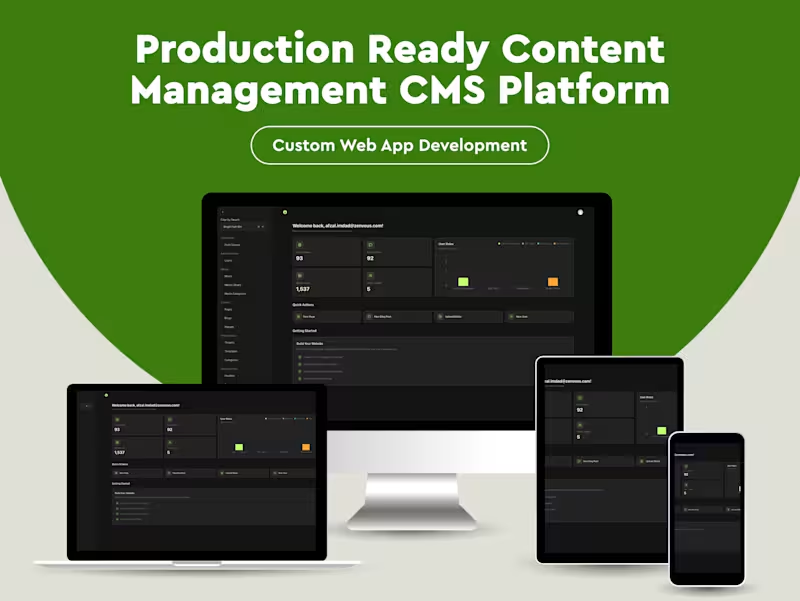
A production-ready multi-site CMS that lets one team run many branded websites from a single admin. It includes tenant isolation, a block-based page builder, automated WordPress migration, AI-assisted page building, and AWS infrastructure.
The challenge:
The client needed to manage many separate websites from one CMS. Each site had its own domain, theme, content and users. The platform had to do four things at once:
• keep tenants fully isolated from each other
• give editors reusable building blocks instead of one-off pages
• make moving existing WordPress sites in fast instead of a manual rebuild
• run reliably in production, not just work as a prototype
What I built:
1. Multi-tenant Payload CMS.
Tenant isolation, per-tenant domains and themes, and role-based access control, so every brand stays separate within one admin.
2. Block-based page builder.
Reusable content blocks, plus blog and form support, so editors build pages without a developer.
3. WordPress migration automation.
Existing sites are imported automatically, and content import and export runs through structured workflows.
4. AI-assisted page and component generation.
Claude turns screenshots and layouts into ready-to-use pages and components, which speeds up new-site setup.
5. Performance and SEO.
Static site generation with Next.js, semantic HTML, and Tailwind CSS for fast, search-friendly pages.
6. Production AWS infrastructure.
Defined in CloudFormation with RDS (PostgreSQL), S3, CloudFront, ACM, SES, Lambda and WAF, with separate staging and production environments.
7. Production-readiness work.
Improvements to admin UX, data workflows, environments and infrastructure security, plus Playwright in the tooling.
The outcome:
The product went from concept to a production-ready multi-site platform. One team can now launch and run many branded websites from one place. Each site is isolated, fast and SEO-friendly. Migrations and new builds take a fraction of the manual effort.
Key takeaway:
A white-label CMS only scales when flexible content tooling comes with real production engineering: isolation, migrations, infrastructure and security.
Good fit for: agencies, franchises, multi-brand organizations, and SaaS teams managing many websites from one platform.
Skills and tools used:
Next.js · Payload CMS · PostgreSQL · Tailwind CSS · AWS · CloudFormation · CloudFront · RDS · S3 · Lambda · SES · WAF · Playwright · Claude API · Multi-Tenant SaaS · Headless CMS · WordPress Migration · SEO Kodsinc Home Services CRM
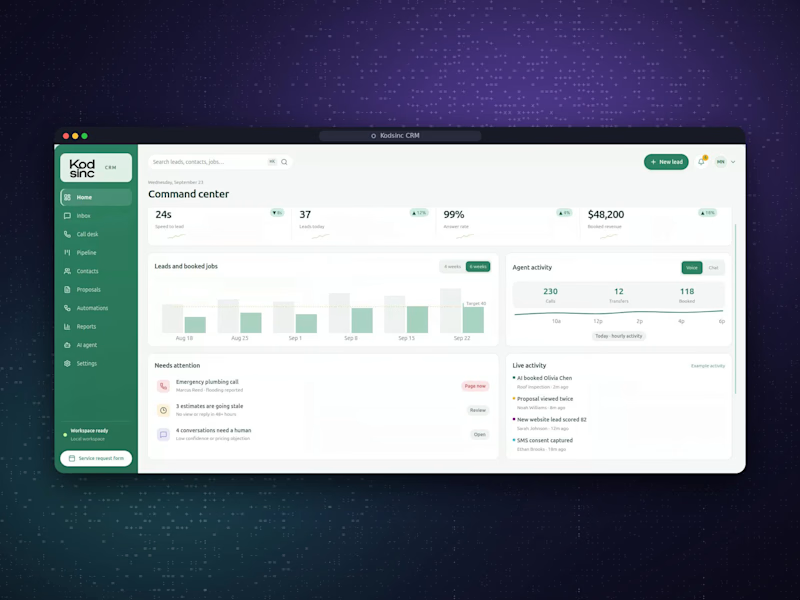
I designed and built this AI-first CRM for home service businesses such as HVAC, plumbing and roofing companies. The goal was to make a powerful system feel simple for teams who are busy in the field, not sitting at desks.
The product is organised around real daily work rather than generic CRM modules. The Call Desk shows the AI in action: it detects emergencies, streams the transcript live, extracts lead details automatically, suggests the next question and offers available emergency time slots.
I kept the interface light and clean, with a deep green sidebar and soft mint accents, so dense information stays readable. Every screen uses realistic data and workflows instead of placeholder dashboards.
The system covers the full customer journey: an inbox, a visual pipeline, contact profiles and good/better/best proposals with financing. It also includes automated follow-up cadences, performance reports and a trainable AI agent with its own knowledge base.
Each feature answers one practical question: what needs attention now, who to call next and how to close the job. That keeps the product focused on what matters. Moving From Prototype to Production
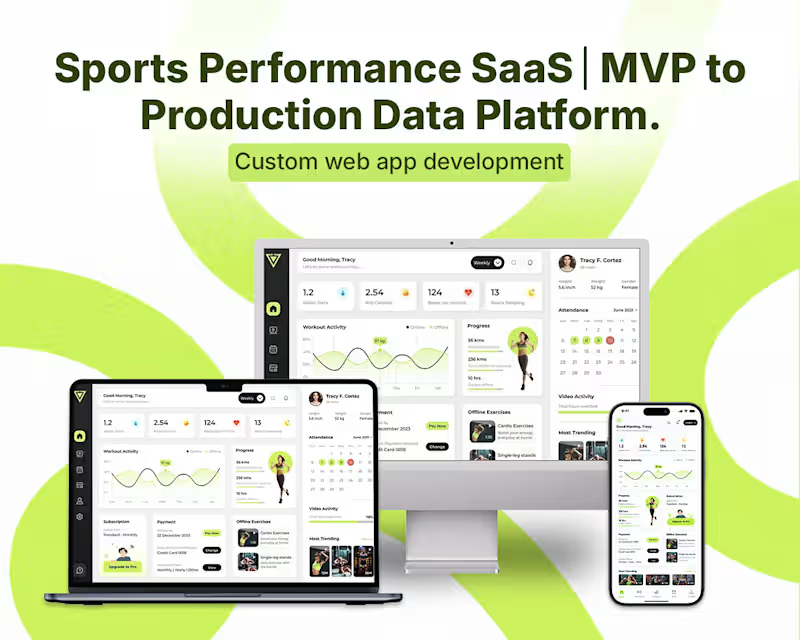
Our focus wasn't to redesign the product from scratch.
The original UX already reflected how performance teams actually work, so we preserved the existing product experience while rebuilding the underlying infrastructure.
Real-Time Data Infrastructure
We replaced static datasets with a structured ingestion architecture capable of receiving information from multiple sources.
The system was designed around:
GPS and wearable data
HRV and recovery metrics
Sleep information
Wellness submissions
Training-load records
External performance systems
Each integration required validation, normalization, and error handling so inconsistent or incomplete data wouldn't compromise the platform.
Live Performance Calculations
Static calculations were replaced with dynamic processing.
The platform could evaluate:
ACWR
Training-load trends
Readiness scores
Historical performance
Rolling training windows
Individual athlete baselines
This allowed performance metrics to evolve with the athlete instead of remaining fixed to predefined values.
Intelligent Performance Insights
We replaced simulated recommendations with a data-driven inference layer.
Insights were generated based on actual athlete conditions and predefined performance rules.
For example, when training load increased significantly while recovery indicators dropped below an athlete's baseline, the system could surface an appropriate risk signal rather than displaying a generic recommendation.
Role-Based Access
Athliq required different users to work with different levels of information.
We implemented role-based access so that:
Performance Directors could monitor squad-level performance
Sport Scientists could analyze training and performance metrics
Physiotherapists could access injury and return-to-play information
Coaches could focus on readiness and daily training
Athletes could access relevant individual information
Access restrictions were enforced at the system level rather than simply being controlled through the interface.
Monitoring & Reliability
Production systems need visibility when something goes wrong.
We introduced logging and monitoring across data ingestion, calculations, and system events.
The platform could identify issues such as:
Missing data
Delayed integrations
Invalid records
Calculation anomalies
Stale data sources
Application errors
This helped prevent outdated information from being presented as current performance data.
Technology Stack
Frontend: React 19, Vite, Tailwind CSS, Recharts, React Router
Backend: Node.js, Fastify
Database: PostgreSQL, TimescaleDB
Infrastructure: Redis, Vercel, Railway / Render, Supabase Storage
Integrations: Catapult, Polar, Garmin, Google Forms, Typeform
Authentication & Security: Auth0, Row-Level Security
Monitoring: Sentry, Datadog
The Result
Athliq transformed a fragmented performance-monitoring workflow into a centralized platform.
Instead of moving between multiple browser tabs, spreadsheets, forms, and communication channels, performance teams could access their core athlete information through a unified dashboard.
The platform provided role-specific views, continuously updated performance information, historical context, and actionable signals from integrated data sources.
More importantly, it created a shared data layer for coaches, sport scientists, physiotherapists, and performance directors.
The product evolved from a concept-validation prototype into a production-ready performance intelligence platform.
What Made the Project Interesting
The biggest challenge wasn't simply building another analytics dashboard.
It was translating real-world sports performance workflows into reliable software infrastructure.
The original product concept came from someone deeply familiar with the domain. Our role was to preserve that domain knowledge while introducing the engineering foundations required for scalability, reliability, security, and live data processing.
The result was a system designed around the questions performance teams actually need answered—not simply around the data available to them.
Athliq Today
Athliq has evolved into a multi-role sports performance platform supporting professional and university-level performance environments.
The platform brings together data from multiple sources and transforms it into role-specific performance insights, giving teams a centralized environment for monitoring readiness, training load, recovery, and athlete progression.
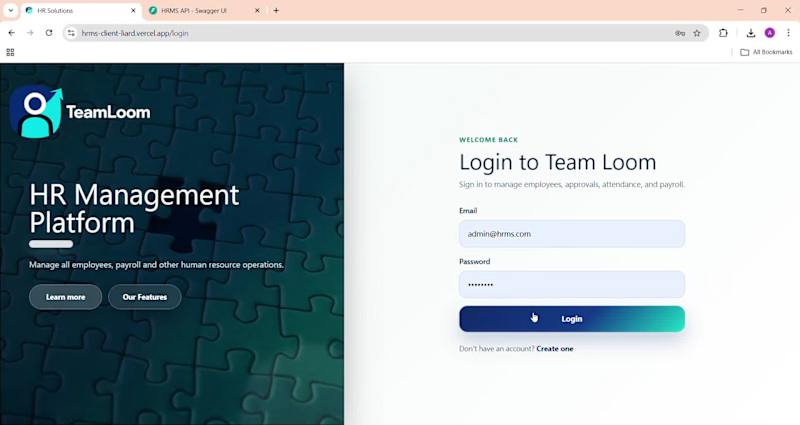
From a coach's notebook and fragmented data sources to a scalable performance intelligence platform. Built a full-stack HRMS in under 2 weeks as a side project to dive deeper into Python and backend development!
Features so far:
Employee management with role-based access (Admin / HR / Employee)
Leave request workflow with approval/rejection
Attendance tracking — clock in/out, monthly calendar view
Payroll engine — tax brackets, overtime, pro-rated salary, PDF payslip download
Notifications, search, pagination, CSV exports
Dockerized and deployed
Stack: Next.js · TypeScript · Tailwind · FastAPI · PostgreSQL · SQLAlchemy
The backend was a new challenge for me: SQLAlchemy relationships, Alembic migrations, Decimal precision for payroll calculations, streaming PDF responses — all of it was tricky at first, but I’ve learned a lot along the way.
URL: https://lnkd.in/dRg86PtQ
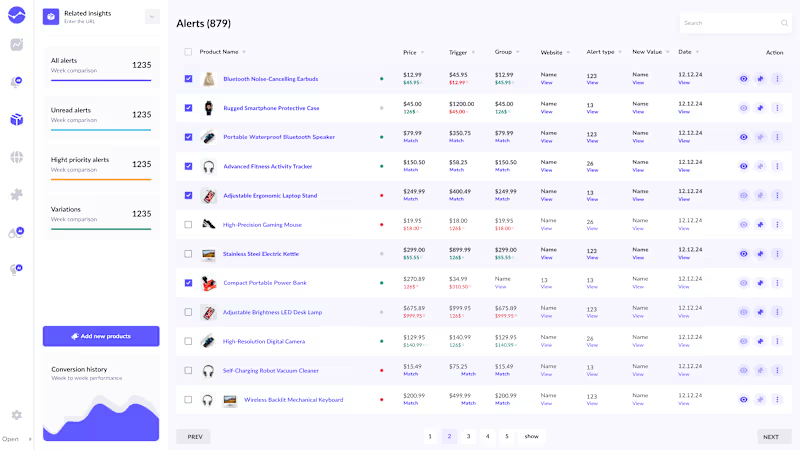
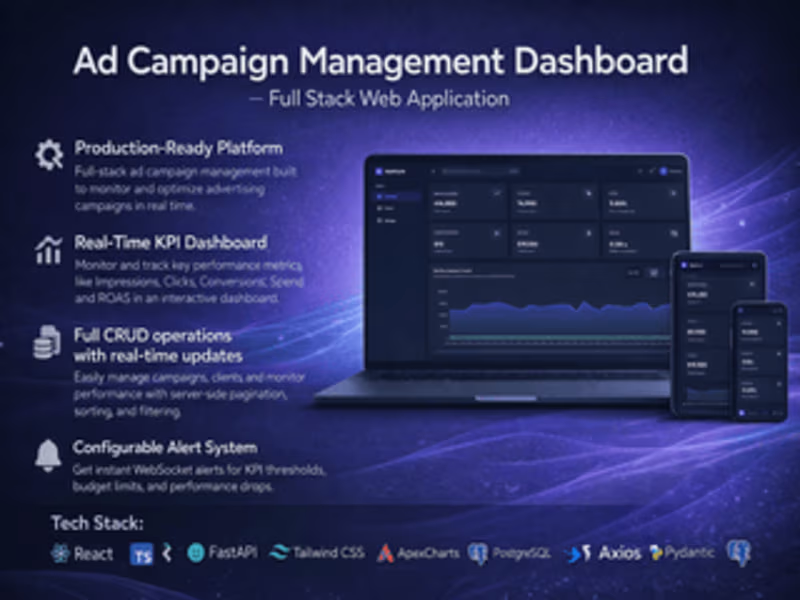
(https://lnkd.in/dRg86PtQ)This is just the beginning! I plan to add many more features. Full-stack Ad Campaign Management Dashboard built with React & FastAPI. Features include live KPI tracking (Impressions, Clicks, CTR, Spend, ROAS), interactive performance charts, full campaign CRUD with pagination, client management, and JWT authentication. Includes a WebSocket-based real-time notification system that instantly alerts account managers when campaign metrics cross configurable thresholds (CTR drops, budget exceeded, low ROAS). Alert history persisted in PostgreSQL. Clean architecture with repository pattern and service layer.