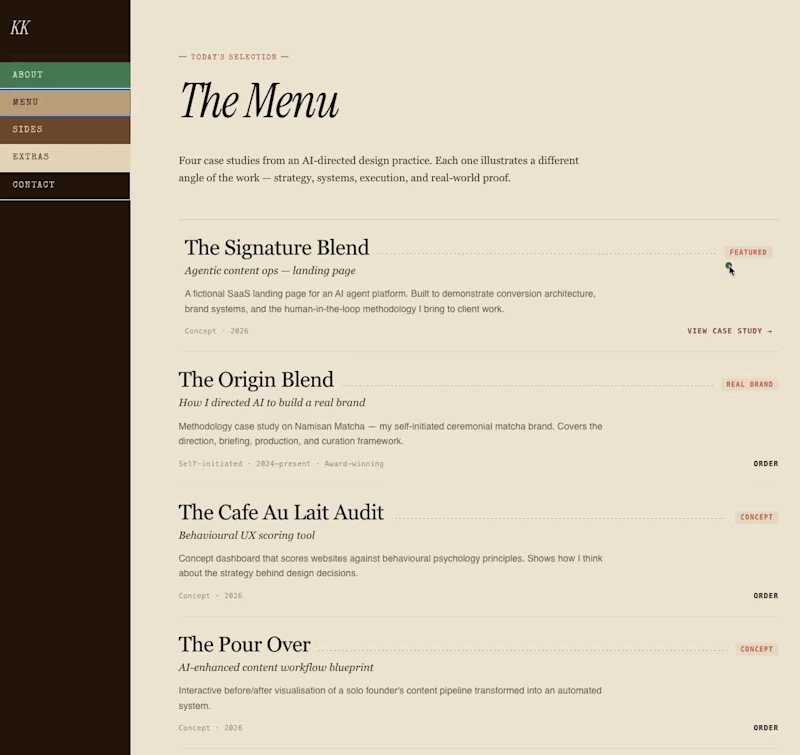
Projects using Claude in Macquarie ParkProjects using Claude in Macquarie ParkClaude, Cursor, v0, they'll all default to the same grey SaaS look unless you give them something better to work from.
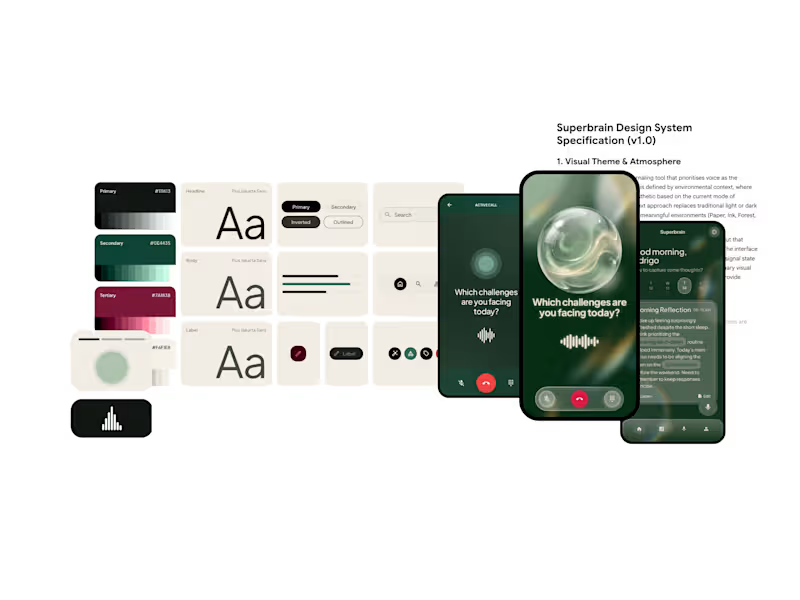
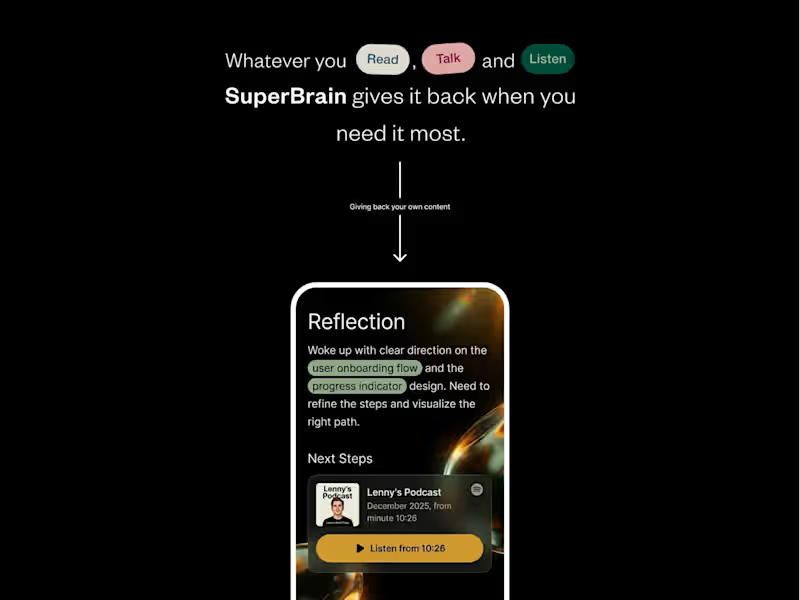
Before building Superbrain, a voice-first journaling tool, I wrote the entire design system in a single Markdown file. Colours, type, components, atmosphere, right down to how the interface shifts with context. Every AI tool reads that design.md (http://design.md) before generating a single screen.
The result was screens landing on brand the first time, across every surface. No endless rounds of nudging the output back towards something that feels like the brand.
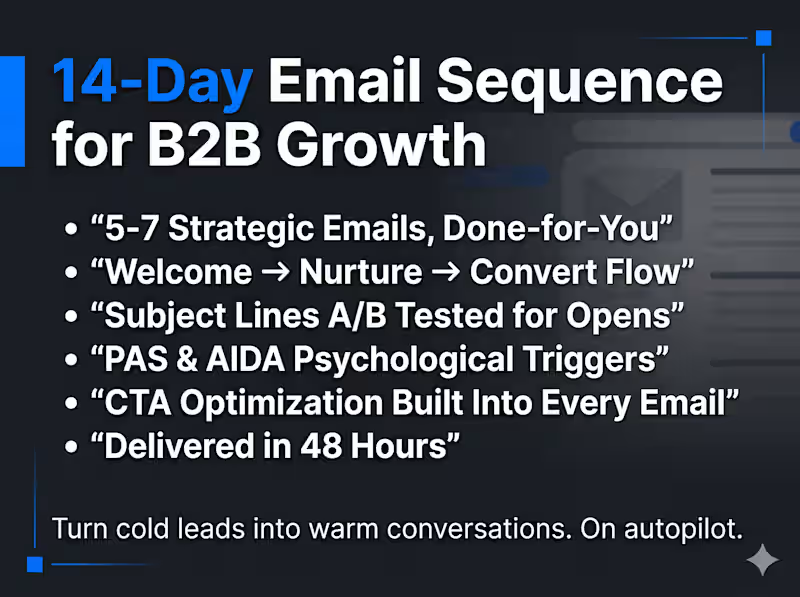
A design system used to be documentation you wrote after the work. Now it's the brief the AI builds from. One file, and suddenly the machines have taste. 14-Day Email Sequence & Nurture Copy for B2B Growth
You're getting leads. But they go cold before they buy.
Someone visits your site, downloads your guide, books a discovery call, or signs up for your list. Then... silence. No follow-up. No nurture. No conversion. They forget you exist by Tuesday.
The problem isn't your offer or your audience. It's that you have no system turning interest into trust, and trust into revenue.
What I build for you
A 14-day email nurture sequence engineered to take a cold lead from "who are you?" to "let's work together." Plus a 400-word anchor nurture piece (welcome email, lead magnet follow-up, or onboarding email) that sets the tone for the entire relationship.
Every email is written with strategic intent: each one has a job, whether that's building credibility, handling objections, creating urgency, or driving a specific action. This isn't "just checking in" email. It's a conversion system.
Built for B2B professionals who sell expertise
This service is specifically designed for:
Consultants & coaches who need to warm leads between discovery call and close
Lawyers & accountants who want to nurture referrals and inbound inquiries without sounding salesy
Real estate agents who need drip sequences that keep them top-of-mind through long buying cycles
Small business owners who know they should be emailing their list but don't know what to say
SaaS founders who need onboarding sequences that reduce churn and drive activation
How it works
Intake & Strategy: I learn your business, audience, and conversion goal. What action should the reader take by Day 14? We start there and reverse-engineer the sequence.
Anchor Nurture Piece (400 words): I write your foundational email, the one that sets your voice, establishes authority, and frames the relationship. This is typically your welcome email or lead magnet follow-up. Short, sharp, and high-impact.
14-Day Email Sequence (14 emails, 150-200 words each): Each email is strategically sequenced using a trust-building arc: introduce, educate, prove, handle objections, create urgency, convert. Every email has a clear purpose and a single call to action.
Delivery: Complete sequence delivered in a formatted Google Doc with subject lines, preview text, send-day recommendations, and CTA labels clearly marked. Ready to paste into Mailchimp, ConvertKit, ActiveCampaign, or any email platform.
FAQs
I'm not a tech company. Will this work for my industry?
What email platform do I need?
What's the difference between the anchor nurture piece and the 14-day sequence?
Can you write for a specific conversion goal?
What if I don't have a lead magnet or opt-in yet?
Do I need to write anything myself?
What if I want to adjust the tone or messaging? Your landing page exists. But nobody finds it.
You built the product. You launched the site. But organic traffic is flat, bounce rates are high, and the page reads like it was written for a search engine from 2018.
The problem isn't your offer. It's that your copy doesn't match what your buyer is actually searching for, and it doesn't move them once they arrive.
What I build for you
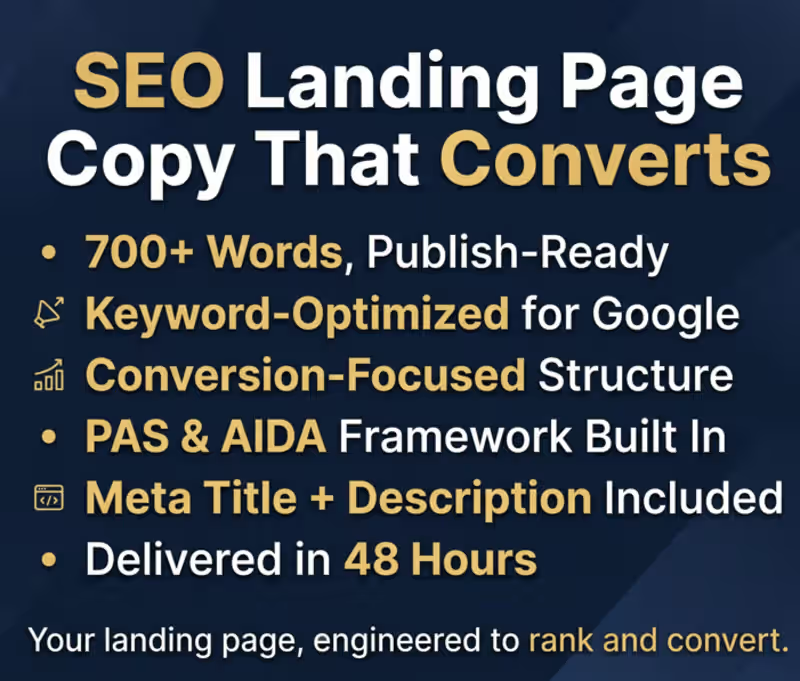
I write a conversion-focused SEO landing page grounded in real keyword research, not guesswork. Every headline, subhead, and paragraph is engineered to rank for the terms your buyers actually type, and structured to move them from curiosity to action.
This isn't keyword stuffing. It's strategic copywriting built on proven psychological frameworks (PAS + AIDA) layered with SEO architecture so your page works for both Google and humans.
I've done this for SaaS companies targeting competitive terms like "humanized AI" and delivered 2,000+ word pages built from multi-phase keyword research across intent clusters. You can see the full case study in my portfolio.
How it works
Keyword Research Phase: I research 3 primary keywords and 5 supporting sub-terms, analyzing search intent, competition, and opportunity.
Structural Architecture: I map your page structure: H1 headline, 2-3 H2 subheads, body content, and meta description, all aligned to your keyword strategy.
Copywriting Phase: I write 700+ words of conversion copy using PAS (Problem-Agitation-Solution) and AIDA (Attention-Interest-Desire-Action) frameworks.
Q&A Section: 7 strategically written questions and answers that target long-tail search queries and reduce buyer objections simultaneously.
Delivery: You receive the complete page copy in a clean Google Doc, ready to hand to your developer or paste into your CMS.
Who this is for
SaaS founders who need a landing page that ranks and converts
Startups launching a new product or feature page
Service businesses tired of paying for ads because organic isn't working
Anyone who has a landing page that "looks fine" but generates zero inbound traffic
FAQs - CHECK My Services for Answers
Can you write for my specific industry or niche?
What if I need more than 700 words?
Do you just write copy, or do you also handle the SEO strategy?
What do you need from me to get started?
Can I get it faster than 2 days?
What makes this different from hiring a regular copywriter?
Do you offer revisions? 🚀 The 24‑Hour Pitch Deck + 90‑Second Video System
(300 words)
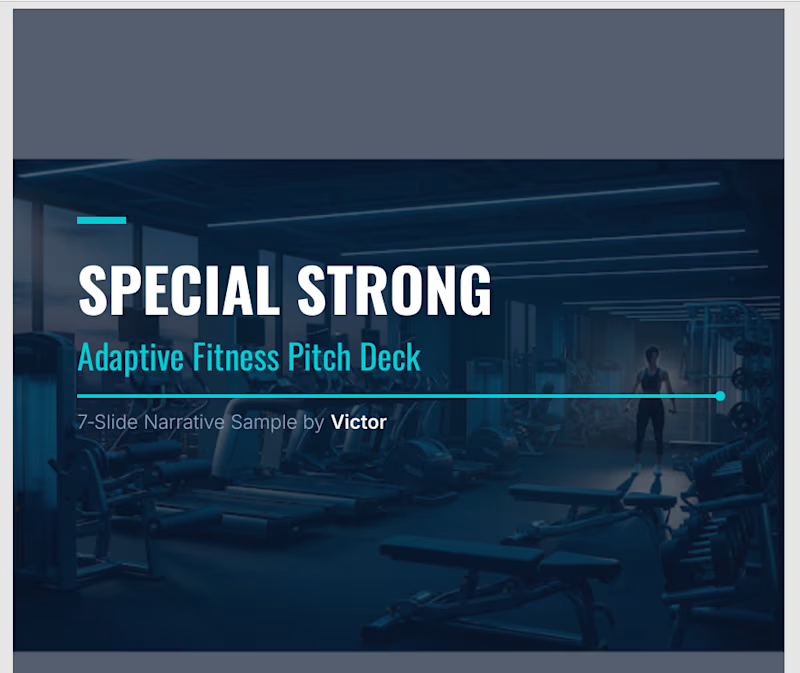
Every great pitch needs two things: a clear story and a compelling delivery. My Pitch Deck System gives founders, executives, and creators both—delivered fast, polished, and ready to present within 24 hours.
I build 13‑slide, investor‑grade pitch decks using a proven narrative architecture that blends clarity, tension, and visual rhythm. Each deck is crafted in a slick, modern PowerPoint format with premium graphics, clean layouts, and optional tables, charts, or data visuals depending on what the executive needs. The result is a deck that feels sharp, confident, and easy to present.
Your deck includes the full strategic arc:
Title + Positioning
Problem
Market Insight
Opportunity
Solution
Product Snapshot
Value Proposition
Business Model
Traction
Market Size
Competitive Landscape
Roadmap
Call to Action / Closing Slide
But the system doesn’t stop at slides.
To help you pitch with authority, I also create a 90‑second scroll‑stopping video summarizing the entire deck. This can be a talking‑head style video, a clean voice‑over with visuals, or a hybrid format—perfect for LinkedIn, investor outreach, or internal leadership communication.
The video distills your message into a tight, high‑impact narrative that captures attention and reinforces the key points of your deck. It’s designed to be shareable, memorable, and aligned with your brand.
Everything is delivered within 24 hours:
✔ 13‑slide premium PowerPoint deck
✔ 90‑second video summary
✔ Script + messaging architecture
✔ Visual consistency + brand alignment ⭐ POST — The 5‑Step Psychological Script Method™
Most creators write scripts that sound good.
I write scripts that convert — because they’re built on psychology, not guesswork.
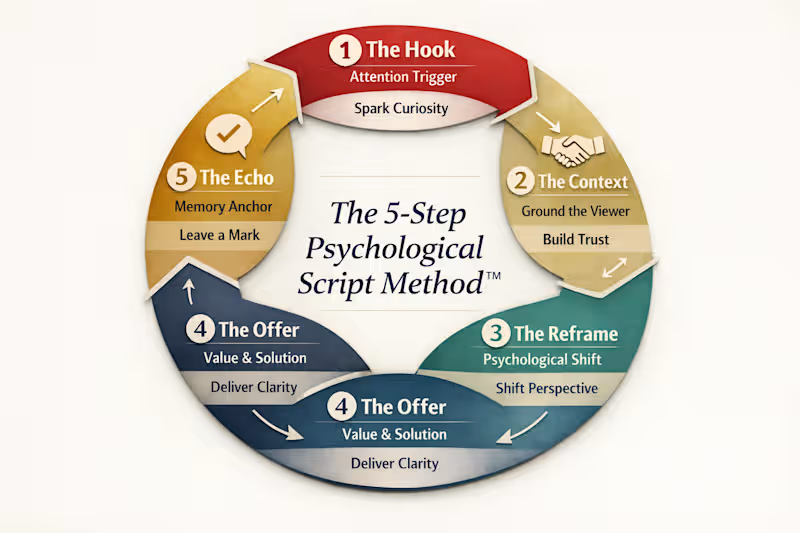
Here’s the Victor Narrative Architect 5‑Step Psychological Script Method™ I use to engineer retention and emotional engagement across TikTok, Instagram, YouTube Shorts, LinkedIn, and long‑form storytelling.
1️⃣ The Hook — Attention Trigger
Stop the scroll by activating an unresolved question in the viewer’s mind.
Use tension, contrast, or a micro‑promise that sparks curiosity.
2️⃣ The Context — Grounding the Viewer
Once attention is captured, ground the viewer with a relatable moment or shared frustration.
This builds trust and primes them for the emotional shift that follows.
3️⃣ The Reframe — Psychological Shift
Introduce a new angle or counter‑intuitive truth.
This creates cognitive dissonance — the engine of retention.
The viewer stays because they want the tension resolved.
4️⃣ The Offer — Resolution + Value Drop
Deliver the insight, the solution, the “aha” moment.
Make it clear, concise, and emotionally satisfying.
This is where authority is built.
5️⃣ The Echo — Memory Anchor
End with a one‑line takeaway, a punchy summary, or a callback to the hook.
It’s the imprint that makes the message stick.
Why it works
Because it mirrors how the human brain processes curiosity → tension → resolution → memory.
It’s not a template.
It’s a narrative operating system.
Teaser
That was just a warm‑up.
You should see the full detailed system in its entirety — but then again, I can’t reveal it all in one go.
Drip… drip… drip… 😉 .The Future of Blog Images — Why Flora + SDXL Is the New Creative Pipeline**
In the last two years, the way companies produce blog images has shifted from manual prompting and inconsistent visuals to automated, brand‑safe pipelines powered by workflow engines like Flora and image models like Stable Diffusion XL (SDXL). This shift isn’t just technological ; t’s operational.
It changes how content teams think, plan, and scale.
Most companies today still generate images the old way:
someone opens an AI tool, writes a prompt, tweaks it, regenerates, downloads, crops, and hopes the final result matches the brand. It’s slow, inconsistent, and impossible to scale across dozens of posts per month.
Flora changes that.
Flora is a workflow‑native system designed for creative logic. It doesn’t generate images - it orchestrates them. It takes a blog summary, routes it through SDXL, generates multiple visual directions, lets the user choose, and then produces a full set of final images. The result is a repeatable, automated pipeline that removes the manual friction from content‑ops.
SDXL is the perfect engine for this. It’s open, customizable, and capable of producing consistent, brand‑aligned visuals when fine‑tuned. Unlike closed models, SDXL can be shaped to match a company’s identity ; colors, textures, tone, and visual language. When paired with Flora, it becomes a scalable image factory.
The real power is in the logic:
input → direction generation → selection → final images → QC → output.
This structure ensures every blog post receives images that feel intentional, cohesive, and aligned with the brand. No more random styles. No more mismatched tones. No more manual prompting.
For companies publishing at scale — especially in technical fields like cloud security; his workflow becomes a competitive advantage. It reduces production time, increases consistency, and frees teams to focus on strategy instead of image generation.
Flora + SDXL isn’t just a toolchain.
It’s the new creative pipeline for modern content teams.
⚙️ Stable Diffusion XL — The Engine Behind Modern Creative Automation
If Flora is the conductor, Stable Diffusion XL (SDXL) is the orchestra. It’s the model that turns creative logic into visual reality — the engine that powers automation, consistency, and scale for modern content teams.
Before SDXL, image generation was chaotic. Each prompt produced a different style, tone, and texture. Teams spent hours tweaking outputs, chasing brand alignment that never quite landed. SDXL changed that forever.
Released in mid‑2023 by Stability AI and the CompVis research group, SDXL became the first open‑source model capable of producing high‑resolution, brand‑consistent visuals at scale. It wasn’t just an upgrade — it was a philosophical shift.
Instead of “prompt and pray,” SDXL introduced control, fine‑tuning, and repeatability.
Companies could now train SDXL on their own brand assets — colors, typography, lighting, tone — and generate hundreds of images that looked like they came from the same designer. It turned AI art from novelty into infrastructure.
The magic lies in its architecture:
a dual‑encoder system that understands both semantic meaning and visual composition, allowing it to interpret complex prompts with precision. When paired with workflow engines like Flora, SDXL becomes a creative factory — producing multiple image directions, refining them through logic, and delivering final outputs that feel intentional.
For blog teams, this means no more mismatched visuals.
For founders, it means brand consistency without design bottlenecks.
For agencies, it means scalable creative production that feels human.
SDXL isn’t just an image model.
It’s the engine of creative automation — the silent powerhouse behind every modern workflow that values speed, consistency, and brand identity. Heres a massive Assignment project I did for Upwork. I think I did a great Job. 😉
TASK - Write a publish-ready landing page (2,000+ words) targeting the keyword: "humanized AI" for AISEO (https://aiseo.ai/).
You must use Claude Cowork as your primary tool throughout the entire process — research, outlining, drafting, and editing.
Requirements
Proper heading hierarchy (H1, H2, H3)
Primary keyword in title, intro, and naturally throughout
Meta title (≤60 characters) and meta description (≤155 characters)
3–5 internal linking suggestions to other AISEO pages/tools
2–3 external reference citations
Content should read naturally — not like raw AI output
SOLUTION 😊
“AISEO Landing Page — Publish-Ready Draft”
Primary Keyword: Humanized AI Target Buyer: SEO professionals, agency operators, in-house content teams Tone: 70% Educational / 30% Conversion | Authoritative · Strategic · Calm
[Meta Title — 58 characters] Humanized AI Content That Ranks & Reads Human | AISEO
[Meta Description — 152 characters] AISEO transforms AI-generated drafts into undetectable, EEAT-ready content. Built for professionals who need rankings — not just rewrites.
The full draft has 6 main sections (H2s), plus an intro:
Intro — The hook/diagnosis (no H2, opens the page)
The Problem Isn't Your AI Tool. It's What Comes Out of It.
What "Humanized AI" Actually Means for SEO in 2026
How AISEO Humanizes AI Text at the Professional Level
Real Results: Humanized AI Content That Passes and Performs
The Strategic Play — Humanized AI Content for Blogs and Long-Form
Start Writing Humanized AI Content Today
So 7 blocks total (intro + 6 sections), each with 2–3 H3 subsections sitting underneath them. That gives you 7 natural vertical breaks to work with when you restructure the layout.
⭐ SECTION 1 — INTRO (Verticalized + Refined)
Humanized AI: The Professional Standard for Content That Earns Trust in 2026
There is a moment every content professional recognises.
You paste your AI‑generated draft into a detection tool.
The score comes back red.
73% AI.
81%.
Sometimes higher.
The instinct is to treat this as a technical problem:
find the right tool
shuffle the sentences
swap the synonyms
run it again
watch the score drop
ship it
That instinct is the wrong diagnosis.
The professionals who have already solved this are quietly building publishing operations that:
outrank
out‑convert
outlast
…those still chasing detection scores.
Their insight is simple:
Detection is a symptom.
The real problem is cognitive texture.
Unmodified AI output lacks the intellectual signature that human readers — and Google’s quality systems — recognise as authority.
Humanized AI is not a workaround.
It is the new baseline for content that earns trust at scale.
→ Scroll to see why detection was never the real problem.
⭐ SECTION 2 — THE PROBLEM ISN’T YOUR AI TOOL (Verticalized + Refined)
The Problem Isn't Your AI Tool. It's What Comes Out of It
AI language models are extraordinarily capable.
They retrieve, synthesise, and structure information faster than any human writer.
But they optimise for plausibility — not authenticity.
The sentences are grammatically sound.
The logic holds.
The structure is clean.
But the prose is flat in a way that is difficult to name and immediately felt.
This is not a limitation the next model update will fix.
It is structural.
These systems generate the most probable next token — which means they produce, by definition, the most average sentence.
And in writing, average is the opposite of authority.
Why AI Detectors Are Getting Smarter — And Why That Misses the Point
Detection tools have become significantly more sophisticated over the past eighteen months.
GPTZero, Originality.ai (http://Originality.ai), and Turnitin now operate with accuracy levels that make evasion through basic rewording increasingly unreliable.
The tools that cleared detectors in 2023 no longer perform reliably in 2026.
But here is the more important point the arms‑race framing obscures:
Human readers have always been better detectors than any algorithm.
Readers do not need to run your content through a tool to know something is off.
They experience it as:
thinness
a lack of perspective where there should be one
neutrality where specificity was expected
polish that covers for an absence of genuine thought
They skim faster.
They leave sooner.
They do not share, cite, or return.
And the signals that matter most to long‑term SEO performance:
dwell time
return visits
backlinks
branded search growth
…all decline when content fails the reader’s instinctive credibility check.
That decline happens regardless of what any AI detector scores it.
The Human Trust Test: What Readers Are Actually Measuring
The characteristics that make content feel authoritative are specific and learnable.
They include:
variation in sentence rhythm
genuine perspective rather than careful balance
precise word choices that signal a mind engaged with the subject
the willingness to be specific where generality would be safer
AI models produce content that is:
neutral where it should hold a position
general where specificity would demonstrate knowledge
perfectly consistent in a way real expert writing never is
These are the signatures readers register — consciously or not — when deciding whether to trust what they are reading.
Passing this test is not a surface‑level problem.
It requires cognitive alignment:
the alignment between how information is presented and how a genuine expert would actually think about that topic.
→ This is the gap AISEO is designed to close.
⭐ Section 3 — Samples
3. Samples
Email Sequences (Sample Description)
A 7‑email nurture sequence for a B2B automation platform targeting operations managers. The sequence reframed the problem around hidden operational drag, built belief through micro‑case studies, and used soft‑close CTAs to increase booked demos without triggering resistance.
Talking‑Head VSL Scripts (Sample Description)
A 2‑minute talking‑head VSL for a consulting offer, structured around a tension‑based hook, a mechanism reveal, and a narrative pivot that positioned the founder as the only credible solution. The script was designed for cold audiences and optimized for retention in the first 8 seconds.
B2B Nurture Flow (Sample Description)
A modular nurture flow for a high‑ticket B2B service, built around insight‑driven emails that moved prospects from awareness → belief → urgency. Each email was engineered to shift one psychological lever at a time, reducing friction and increasing sales‑qualified conversations.