Freelance Game Developers in LondonFreelance Game Developers in London
Creative Experience Technologist
2x
Hired
5.0
Rating
6
Followers
Creative Experience Technologist
Game Designer & Media Artist | Unity, Unreal, Figma, Maya
AI Product Engineer | Building Production Ready AI Apps
23
Followers
AI Product Engineer | Building Production Ready AI Apps
Cover image for From Code to a Real
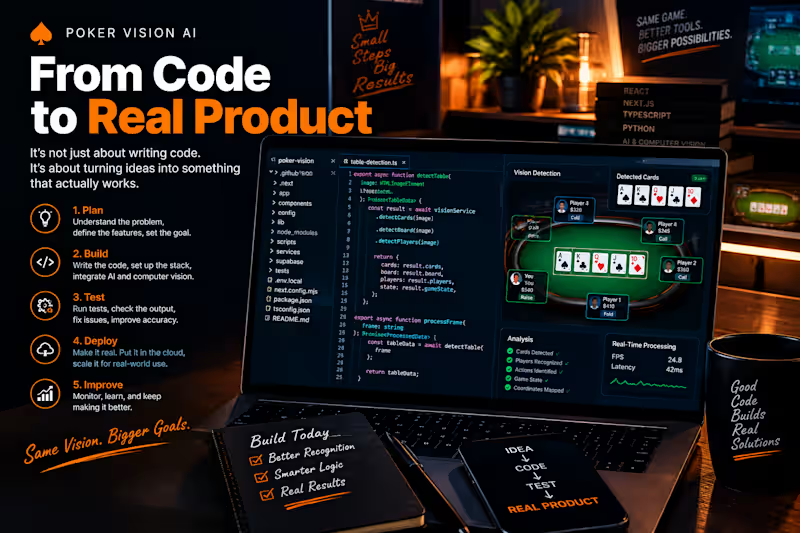
From Code to a Real Product That’s Where the Real Work Begins. A lot of projects start with a simple idea: “What if we built this?” But turning that idea into something people can actually use is a completely different challenge. With my current project, I’m going beyond writing components and making the UI look good. I’m working through the entire process: Plan Understand the problem and define what the product needs to do. Build Turn the idea into real application logic, integrate the right technologies, and connect the different pieces. Test Break the system, inspect the output, find edge cases, and fix what doesn't behave as expected. Deploy Take it out of the development environment and make it accessible as a real product. Improve Monitor what happens, identify weaknesses, and keep iterating. The biggest lesson I'm learning is this: A project isn't finished when the code works on your computer. It's finished when the product works for the person using it. That's why I'm becoming more interested in the parts of development that happen after the first successful build: Testing the real workflow. Handling unexpected input. Improving reliability. Making the experience smoother. And turning a collection of code into something that actually solves a problem. AI can help me move faster. But building the right thing, validating it, and taking it all the way to a usable product is still the real challenge. Idea → Code → Test → Deploy → Real Product. That's the journey I'm documenting. What do you think is the biggest difference between a working project and a real product? 👇
0
19
Cover image for $10,000,000 was sitting at the
$10,000,000 was sitting at the top of the 2026 WSOP Main Event. That number is one of the reasons I became interested in building this. Poker isn't just cards on a screen. At the highest level, millions of dollars can depend on thousands of individual decisions. So I'm building something around a question that I find technically fascinating: Can software understand what is happening on a poker table from visual data? That's what I'm working on with my Poker Vision project. The system is being designed to recognize and structure information such as: → 🃏 Hole cards → 🎴 Board cards → 👤 Player positions → 💰 Betting actions → 🔎 OCR information → 📍 Table coordinates → 🧠 Game-state changes Then the challenge becomes turning all of that raw visual information into reliable structured data that another part of the application can understand. And that's where the engineering gets serious. A single recognition mistake can completely change the state of the game. So I'm not interested in building something that simply looks intelligent. I want to build something that can: Detect → Interpret → Validate → Test → Learn from errors → Improve. One important boundary: I'm building this as a research/analysis and development project, not a real-time system that tells someone what action to take during live-money play. Major poker platforms prohibit real-time assistance that influences decisions during play. PokerStars (https://www.pokerstars.com/poker/room/prohibited/?utm_source=chatgpt.com) The bigger idea is what excites me: Computer vision + AI + poker data + software engineering. When the stakes can reach millions, even a small technical problem becomes an interesting engineering problem. And that's exactly the kind of problem I enjoy building. 🔥 If you were building this system, what would you tackle first: card recognition, player tracking, OCR, or game-state detection?
2
63
Cover image for I’m not just building a
I’m not just building a poker UI. I’m building a system that can understand the table. This project started with a simple idea: Can software look at a poker table and turn what it sees into structured game logic? The deeper I get into it, the more interesting the engineering becomes. The system has to deal with things like: → Card recognition — identifying cards from the screen → Board detection — understanding the current board state → Player positioning — determining where players are located → Action recognition — interpreting Fold, Call, and Raise → OCR — extracting information from visual elements → Coordinate mapping — knowing where important elements exist on different layouts → Game-state logic — turning all that visual information into something the application can actually understand And this is where AI-assisted development becomes powerful. I can use an AI coding agent to help investigate the codebase, implement changes, run tests, and work through bugs. But the outcome still depends on how I design the logic, test the edge cases, and verify what the system is actually seeing. The goal isn't: “Make AI write a poker application.” The goal is: “Build a system that can reliably understand what is happening on the table.” That's a completely different engineering problem. Right now I'm focused on making the recognition and game-state pipeline more reliable because one incorrect card, coordinate, or player action can affect everything that comes after it. Computer vision + AI + software engineering = some seriously interesting problems. 🧠🔥 What would you build with this kind of technology if you had reliable real-time visual recognition?
1
18
Data Scientist | Data Engineering
No tech beyond us
No tech beyond us