Mobile Development Projects in KarachiMobile Development Projects in KarachiGPUStore: A Modern GPU Shopping and Discovery App
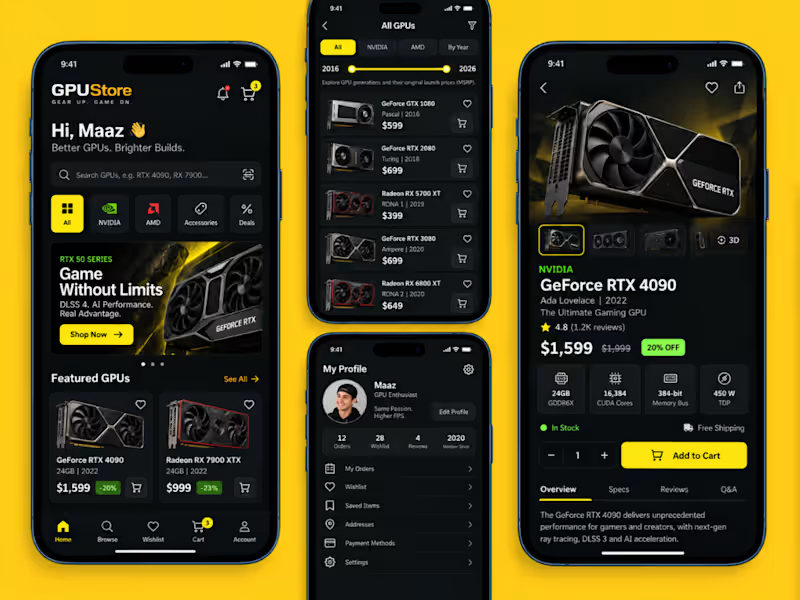
I designed GPUStore to make buying graphics cards feel less like decoding a spec sheet and more like exploring a well-organized catalog. Instead of overwhelming users with dense tables and inflated resale listings, I structured the product around what PC builders actually ask: which generation is this, what did it originally cost, and what will it do for me?
The visual identity pairs a dark charcoal interface with electric lime green accents. The green guides interaction. It marks active filter tabs, the Shop Now and Add to Cart buttons, the cart badge, saved hearts, and the NVIDIA brand label. Dark cards and high-contrast product renders give each card a premium, showroom feel while keeping specs and prices easy to read.
The home screen opens with a personal greeting, a search bar with a real example query ("RTX 4090"), and quick category chips for All, NVIDIA, AMD, Accessories, and Builds. A bold RTX 50 Series banner promotes new releases, followed by a "Featured GPUs" section. Each card shows the architecture, release year, launch price, and a one-tap cart button.
The All GPUs screen turns browsing into a timeline. Segmented filters (All, GTX, RTX, By Year) sit above a 2016 to 2026 range slider, so users can explore generations and their original launch prices (MSRP). Seeing the GTX 1080 at $599 next to the RTX 4090 at $1,599 makes a decade of pricing history readable at a glance.
The product detail screen prioritizes clarity. An image carousel with wishlist and share actions leads into the architecture and release date, then a dedicated MSRP panel. A compact Key Specifications table follows (Ampere architecture, 8,704 CUDA cores, 10 GB GDDR6X, 320-bit memory bus, 320 W TDP). A sticky quantity stepper and Add to Cart button stay within thumb reach. A short note clarifies that launch price shows original MSRP and actual market prices may vary.
The profile screen gives users a personal hub with their saved items, orders, builds, and member-since year. Wishlist, Orders, and Settings tabs keep everything in one place, and saved cards show the date each item was added. Across the app, a five-tab bottom navigation (Home, Browse, Wishlist, Orders, Account) keeps the structure predictable.
Frontend
I built the client as a cross-platform mobile app using React Native with TypeScript. React Navigation handles the bottom tabs and the stack flows between listing, detail, and cart. TanStack Query manages server data, caching, and loading states, while Zustand holds lightweight local state such as cart count, wishlist toggles, and active filters. The year-range slider and category filters update query parameters, so results refresh without a full reload. Reusable components (GPU card, spec row, filter chip, quantity stepper) are driven by a shared design-token file for the dark theme and green accent, keeping the UI consistent across screens.
Backend
The backend is a Node.js REST API (Express or NestJS) backed by PostgreSQL through Prisma. The core schema covers users, GPUs, wishlists, carts, cart items, orders, order items, and builds. Each GPU record stores brand, series (GTX or RTX), architecture, release date, MSRP, CUDA cores, memory size and type, bus width, and TDP. MSRP is stored separately from the live selling price, which matches the app's "launch price vs. market price" approach, and all money values are stored as integer cents to avoid rounding errors. Endpoints support search, brand, series, and year-range filtering (GET /gpus?series=RTX&yearFrom=2016&yearTo=2026), product details, cart and wishlist actions, and order history. Authentication uses JWT with refresh tokens, images are served through a CDN, and Stripe handles checkout.
The result is a GPU shopping experience that feels premium, informative, and easy to navigate, built for gamers and creators. Zultec Barcode Solutions — Barcode, PDA & WLAN-Based Business Solutions
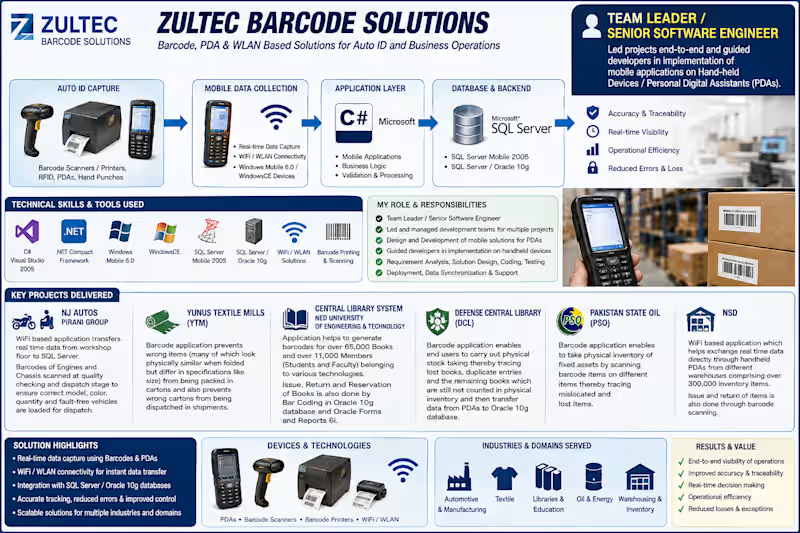
As Team Leader / Senior Software Engineer at Zultec, I designed and guided the development of mobile and barcode-based solutions connecting handheld PDAs, barcode scanning, WLAN/WiFi connectivity, applications, and enterprise databases.
The solutions were developed using C# with Visual Studio 2005, .NET Compact Framework, Windows Mobile 6.0, WindowsCE, and SQL Server Mobile 2005, with integration with SQL Server and Oracle databases where required.
I guided developers in implementing mobile applications on handheld devices and PDAs for a range of operational environments, including:
• NJ Autos, Pirani Group — WiFi-based real-time transfer of workshop-floor data from handheld PDAs to SQL Server, with barcode scanning of engine and chassis information through quality checking and dispatch.
• Yunus Textile Mills (YTM) — Barcode-based verification to prevent incorrect items from being packed and incorrect cartons from being dispatched.
• Central Library System, NED University — Barcode generation and circulation for more than 65,000 books and 11,000 members, including issue, return and reservation using Oracle 10g and Oracle Forms/Reports.
• Defense Central Library (DCL) — PDA-based physical stock taking to identify lost books, duplicate entries and uncounted inventory, with transfer of collected data to Oracle 10g.
• Pakistan State Oil (PSO) — Barcode-based physical inventory of fixed assets to trace mislocated and lost items.
• NSD — WiFi-based real-time data exchange through handheld PDAs across warehouses containing more than 300,000 inventory items, including barcode-based issue and return.
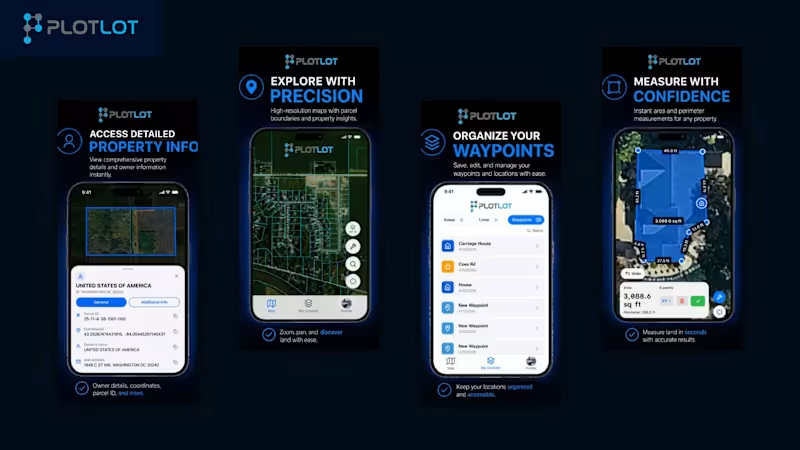
This work combined mobile application development, barcode technology, PDA-based data capture, WLAN connectivity and database integration to support accurate and traceable operational processes across automotive, textile, education, library, oil & energy, and warehouse environments. Built the mobile experience for Plotlot, focusing on creating a practical, GPS-driven utility app that helps users understand and manage real-world land and property boundaries with ease.
The goal was to design a simple yet powerful interface where users like homeowners, realtors, and surveyors can quickly access property insights, measure land areas, calculate distances, and view approximate boundaries using GPS data. I focused on structuring complex geolocation features into an intuitive flow that makes land visualization and measurement accessible for non-technical users.
Special attention was given to usability in outdoor conditions, ensuring the app remains responsive, clear, and reliable during real-time location tracking and mapping interactions.
Mobile App Development
UI/UX Design (GIS / Mapping Interface)
GPS & Location-Based Systems
Data Visualization (Land Mapping UI)
Performance Optimization for Mobile
Tools & Technologies:
Swift, iOS SDK, Core Location, MapKit, Figma, REST APIs Alma Collective, a fitness booking platform for the Greek market, was stuck: half-built by a previous developer, unstable, and nowhere near launch-ready.
I took over the codebase, stabilized it, completed the missing core flows, and carried it to public launch across web and mobile (React Native).
What shipped:
User app: discover and filter classes (yoga, Pilates, dance), book and pay per session, QR check-in on arrival
Partner portal: venue listings, class scheduling, payouts, subscriptions
Payments: Stripe with Apple Pay and Google Pay, pay-as-you-go and subscriptions