AI Development Projects in KarachiAI Development Projects in KarachiPaytrix: From Interface Logic to Compensation Infrastructure
The Insight
The builder behind Paytrix understood compensation deeply, not as a payroll function, but as a structural problem. They knew that most companies manage salary bands in spreadsheets, that job title normalization is a nightmare at scale, and that equity analysis gets ignored until it becomes a legal liability. They knew this because they lived it.
So they built what they knew. Fast.
What Existed
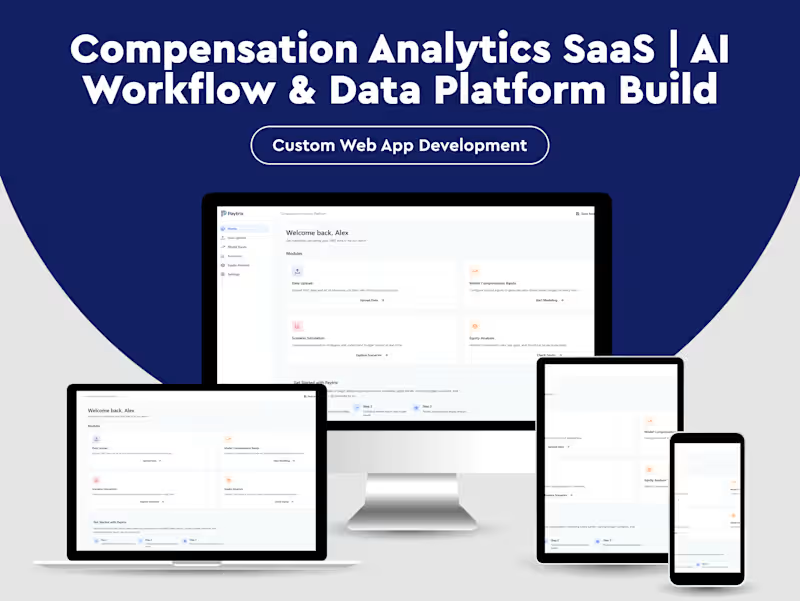
Paytrix, as delivered, was a polished React application, built with Vite, Tailwind, Radix primitives, and Recharts, spanning six distinct modules: a dashboard, an HRIS data upload flow, a compensation modeling engine, a scenario simulator, an equity analysis suite, and a settings panel. The interface was sharp. The workflows were correct. A user could upload employee data, watch AI "normalize" job titles into a structured architecture, model salary bands against market percentiles, run budget impact scenarios, and review compression risks across career levels.
It looked like a product.
But every piece of logic lived on the client.
Where It Breaks
The 114 employees in the system are not uploaded. They are hardcoded in a TypeScript file. The "AI normalization" is a setInterval cycling through four progress labels over two seconds. Market benchmarks are arithmetic constants (industryPremium = 0.08). The equity analysis, compa-ratios, range penetration histograms, compression heatmaps, renders from static arrays defined at the top of the component. Scenario simulation multiplies a base salary by a percentile offset. The entire application state persists to localStorage.
None of this is a criticism. It's what a vibe-coded prototype should be: directionally correct, visually convincing, structurally hollow.
The problems emerge when you try to use it:
• No persistence. Clear your browser, lose your scenarios. There's no database, no user accounts, no tenant isolation.
• No real data ingestion. The upload flow accepts nothing. There's no CSV parser, no file handler, no validation pipeline. The "AI" that maps "Sr. Software Engineer" to "Engineering / L3 - Mid-Level" is a pre-written array with confidence scores already assigned.
• No market data layer. Salary benchmarks are invented constants. There's no connection to BLS, Radford, Mercer, or any compensation data provider. The "industry premium" and "funding stage adjustment" are fixed floats that don't change regardless of input.
• No computation engine. Compa-ratios, range penetrations, and compression risks are display values, not derived metrics. Change an employee's salary in the mock data and the equity charts do not move, because the charts read from a different hardcoded array.
• No multi-user support. "Welcome back, Alex" is a string literal. There's no auth, no RBAC, no concept of who should see what.
The logic was all there. It just had nowhere to live.
The System That Needed to Exist
What Paytrix required was not more UI work. It required the invisible layer that makes compensation software trustworthy.
Data Ingestion Pipeline
A backend service that accepts HRIS CSV uploads, validates schema (employee ID, title, department, salary, location, demographics), handles malformed data gracefully, and stages records for processing. This is not a file drop. It is an ETL pipeline with column mapping, deduplication, and audit logging. The upload endpoint needs to support files from Workday, BambooHR, Rippling, and manual exports, each with different schemas.
Job Architecture Normalization Service
The prototype simulates AI-driven title mapping. In production, this is a classification service, likely backed by an LLM or a trained model, that ingests raw job titles and maps them to a canonical taxonomy of families and levels. It needs to handle ambiguity ("Sr. Software Engineer" vs. "Senior Software Engineer" vs. "SWE III"), surface confidence scores that reflect model uncertainty, and support human-in-the-loop correction that feeds back into the model. This is a backend job queue, not a frontend animation.
Market Data Integration Layer
Compensation modeling requires real benchmark data. The system needs API integrations with at least one primary data provider (Radford, Mercer, Comptryx) and the ability to ingest custom survey data. Market rates need to be indexed by role, geography, industry, company size, and funding stage. This is a multi-dimensional lookup that changes quarterly. This data must be versioned and cacheable, with fallback logic when specific cuts are not available.
Compensation Calculation Engine
The core math, midpoint derivation, band construction, compa-ratio computation, range penetration, compression detection, needs to run server-side against real employee records and real market data. The prototype calculates midpoint = baseMarket * (1 + industryPremium + fundingAdjustment) * percentileMultiplier. In production, this becomes a parameterized model where each variable is resolved from the market data layer, scoped to the company’s configuration, and applied across every employee in the dataset. Band width, skills premiums, and geographic differentials are all configurable per job family.
Scenario Persistence and Comparison
The prototype stores scenarios in React context backed by localStorage. Production requires a database-backed scenario system where a user can save named configurations, compare them side by side, share them with stakeholders, and track which scenario was ultimately adopted. Each scenario needs to carry its full parameter set, the resulting budget impact, and a snapshot of the employee population it was run against.
Equity Analysis Engine
The hardcoded charts need to be replaced by a statistical analysis service. Gender and ethnicity pay gap calculations require controlled regression, adjusting for level, tenure, location, and department, not raw averages. Compression detection needs to compare adjacent levels within the same job family dynamically. Flagged roles need to be generated algorithmically, not listed manually.
Authentication, Tenancy, and Access Control
Compensation data is among the most sensitive in any organization. The system needs proper auth (SSO at minimum for enterprise), tenant isolation so each company sees only its data, and role-based access so an HR analyst sees different things than a VP of People. Audit logging is non-negotiable. Every view, edit, and export must be tracked.
What Changed
The interface did not need to be rebuilt. It needed something behind it.
What was a demo became a system. What was localStorage became a database. What were constants became integrations. What was a progress bar became a processing pipeline.
The prototype proved the idea was right. The architecture made it real.
From demo-ready to production-ready. From UI-driven logic to system-driven reliability.
We built the layer that made it dependable. Aureum
Most luxury brand sites look the same: a big hero, a few stock photos, done. Aureum is my take on a landing page that feels like stepping into a space instead of reading a page.
It’s a scroll-driven, cinematic experience built around light, texture, and restraint. A golden ring animates as you scroll, the copy is sparse and deliberate, and every section is paced so nothing feels rushed. The goal was a premium, quiet-luxury feel that holds attention without shouting.
I handled the concept, design direction, copy, and front-end build, from the story structure to the motion and performance. It’s a concept project, but the approach works for high-end brands, studios, and product launches that need to feel premium from the first second.
If you want a site that makes people stop scrolling and actually feel your brand, let’s talk. What if your next campaign looked like this?
I created this AI-generated commercial to explore how far we can push AI advertising — cinematic visuals, creative direction, product-focused storytelling, and a premium brand feel, all produced with AI.
This is the kind of creative I can build for brands that want to:
→ Stop the scroll
→ Launch products with standout visuals
→ Create multiple ad concepts quickly
→ Turn simple ideas into cinematic campaigns
→ Produce content for Instagram, TikTok, Meta Ads & more
No generic AI images.
No template-style videos.
The goal is to create advertising people actually want to watch.
If you have a product, brand, property, or campaign that deserves better creative, send me the idea.
I’ll turn it into something people remember.
#AIAdvertising
#ContentCreation #AIAdvertising
#AdCreative #AIMarketing #AIVideo StudySpace — AI-Powered Study & Learning Platform
Transforming Course Materials Into Personalized, Exam-Ready Learning
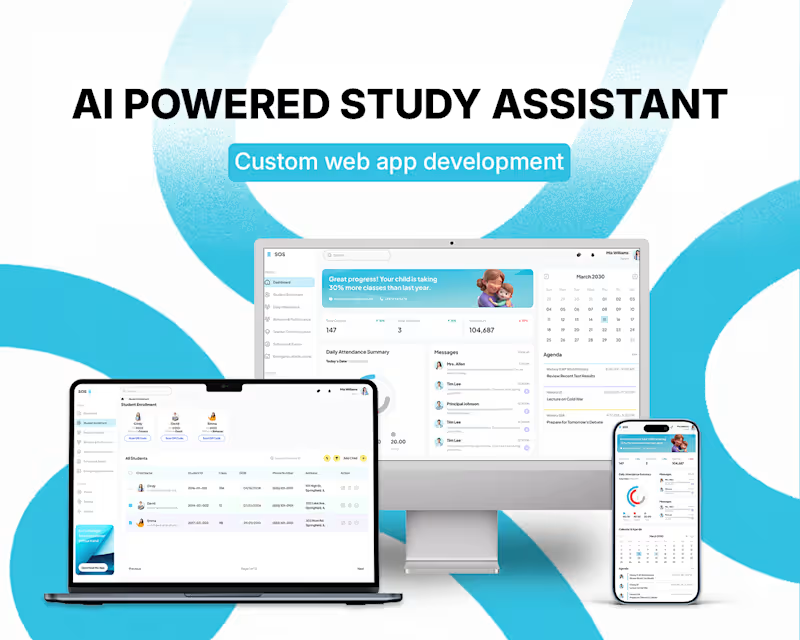
StudySpace is an AI-powered learning platform designed to turn unstructured academic content into organized, personalized study resources.
Instead of manually working through lecture slides, textbooks, PDFs, and past examinations, students can upload their materials and use AI to transform them into an interactive learning environment.
The Challenge
Students often have plenty of study material but lack an efficient way to turn it into structured preparation.
Common challenges include:
Large volumes of disconnected course material
Passive note-reading instead of active recall
Difficulty identifying weak areas
Generic study tools that don't adapt to individual goals
Limited connection between generated study content and original source material
StudySpace was designed to bring these activities into one intelligent workspace.
AI-Powered Content Processing
Students can upload PDFs, lecture materials, textbooks, and previous exams.
The platform processes these documents through a multi-stage AI pipeline that identifies:
Topics
Concepts
Themes
Important sections
Exam-relevant information
The extracted knowledge then becomes the foundation for the student's personalized study environment.
Automated Study Material
StudySpace generates learning resources directly from uploaded content, including:
Condensed study notes
Spaced-repetition flashcards
Practice questions
Topic-based quizzes
Exam simulations
Generated content remains connected to the original material, allowing students to trace information back to its source.
Personalized Study Planning
The platform adapts the learning experience around each student's objectives.
During onboarding, students can define their:
Academic level
Learning goals
Exam date
Study preferences
Areas requiring additional attention
The system then builds a personalized study plan and adjusts recommendations as the student's progress changes.
Course Workspace
Each uploaded document becomes an interactive study environment.
Students can navigate through topics, review AI-generated notes, access source references, practice flashcards, and complete quizzes from a centralized workspace.
The interface brings the complete learning workflow into one structured experience rather than requiring students to switch between multiple study tools.
SpaceBot & Personalized Dashboard
StudySpace also includes an AI learning assistant designed to answer questions using the student's own uploaded materials.
SpaceBot can adapt its communication style based on the student's preference, including:
Friendly explanations
Formal academic responses
Socratic questioning
The dashboard provides an overview of the student's current learning activity, including:
Today's study sessions
Exam countdowns
Upcoming objectives
Weak topics
Progress indicators
What We Built
The final platform included:
AI-powered document processing
PDF upload and content extraction
Automated topic discovery
AI-generated notes
Flashcard generation
Adaptive quizzes
Personalized study planning
Source-level content attribution
Exam simulation
AI study assistant
Progress tracking
Personalized onboarding
The backend was designed around a multi-stage processing pipeline capable of handling document extraction, content generation, study planning, and adaptive review.
Results
The platform delivered measurable improvements across the study workflow:
90% reduction in time required to transform uploaded material into structured study resources
3× improvement in reported retention through flashcard and quiz engagement
100% source traceability for generated learning content
A centralized learning environment combining content processing, AI assistance, planning, and assessment
Technology Stack
Frontend: React, Vite, Tailwind CSS
Backend: FastAPI
Database: PostgreSQL
Processing: PyMuPDF, Celery, Redis
AI: OpenAI GPT-4o
Authentication: Clerk
Infrastructure: Docker
The Result
StudySpace turned static academic content into an interactive, personalized learning system.
Instead of simply giving students another place to store notes, the platform creates a workflow that moves from:
Upload → Understand → Organize → Practice → Track → Prepare
The result is an AI-powered study environment built around the student's own material, goals, and learning progress.