AI Automation & Full-Stack Developer | Agents, Apps, n8n
- $25k+
- Earned
- 4x
- Hired
- 5.0
- Rating
- 31
- Followers
AI Automation & Full-Stack Developer | Agents, Apps, n8n




👂 Attentive UX/UI Design & Data Scientist
👂 Attentive UX/UI Design & Data Scientist

AI and Data Science Engineer, RAG, MCP and LLM Automation
- 16
- Followers
AI and Data Science Engineer, RAG, MCP and LLM Automation
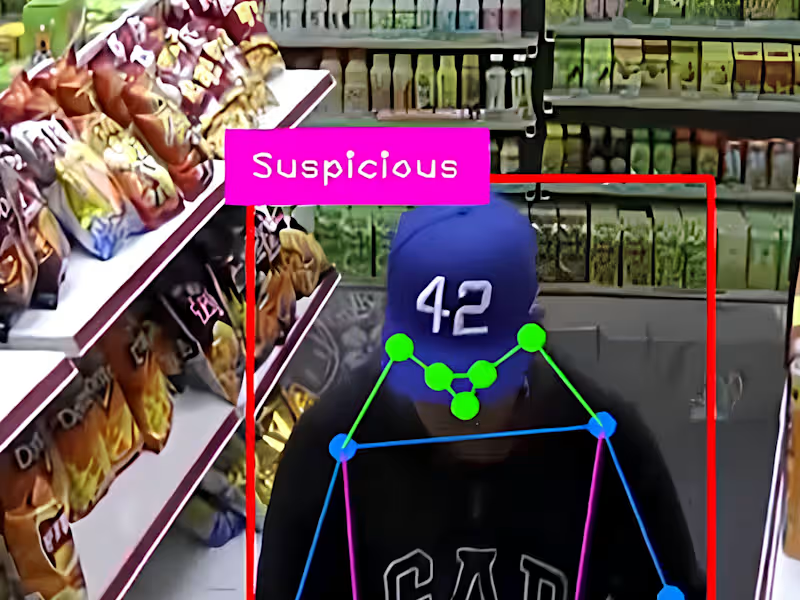
Smart Security Monitoring: YOLOv11 Pose Estimation & Behavior Tracking.
In July 2024, I engineered an advanced computer vision surveillance solution for an American retail client managing a chain of supermarkets. The primary objective was to modernize their loss prevention strategy by automatically monitoring customer behavior inside the stores to detect potential theft. Traditional surveillance relies heavily on manual human observation, which is prone to fatigue and missed events. This project aimed to solve that vulnerability by delivering a proactive AI system capable of analyzing live camera feeds and alerting security teams to suspicious activity in real-time.
To build a highly accurate detection system, I constructed a custom dataset tailored specifically to the client's retail environment. Using raw video data provided by the client, I systematically extracted and meticulously annotated thousands of individual frames. This critical data preparation phase involved labeling complex human poses, movements, and interactions with store merchandise. By building this tailored dataset, I created a robust training foundation that enabled the AI to accurately differentiate between standard shopping behaviors and high-risk actions.
The core of the architecture is powered by a YOLOv11 object detection and tracking model, fine-tuned specifically for abnormal behavior recognition. The system processes live surveillance footage, applying real-time skeletal tracking and spatial analysis to monitor individuals as they navigate the store aisles. By continuously evaluating motion sequences—such as reaching for a product and concealing it—the model dynamically calculates probability scores for specific actions. When the system detects suspicious behavior crossing a defined confidence threshold, it immediately triggers a high-priority alert.
The final solution was successfully delivered as a real-time monitoring application achieving an impressive accuracy rate of approximately 85 percent. This seamless deployment allowed the retail client to integrate proactive, AI-driven video analytics directly into their existing security infrastructure without disrupting operations. Ultimately, the automated alerting system significantly reduced their reliance on manual monitoring, drastically improved rapid-response times for security personnel, and established a scalable, highly effective loss prevention strategy across multiple store locations.
1
218
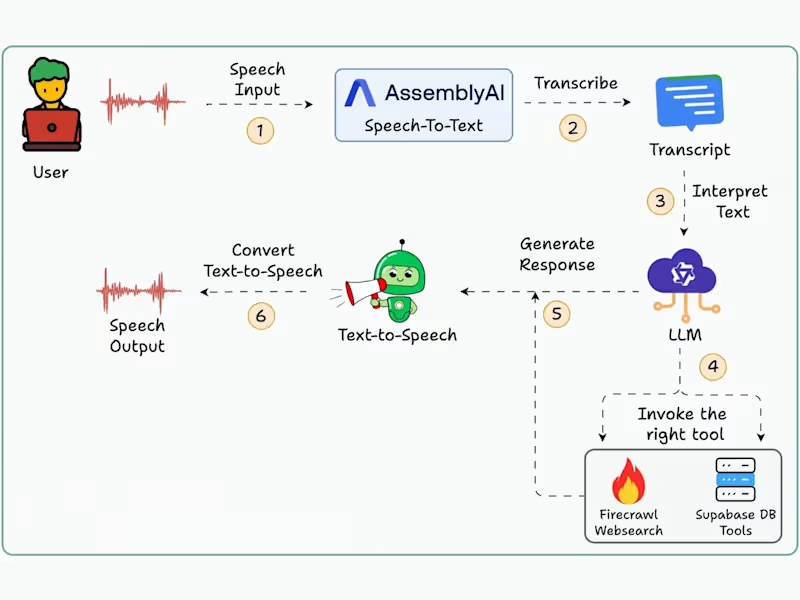
MCP-Powered Voice Agent: AI Speech-to-Text & Data Orchestration.
I recently engineered a Model Context Protocol (MCP) driven voice agent for a client who needed a seamless, hands-free way for their users to query internal databases and retrieve real-time internet data. The client faced a significant challenge: their users were experiencing friction when manually searching through complex internal records, and existing text-based chatbots were too slow and cumbersome for their fast-paced, on-the-go operational environment. They needed a highly responsive, voice-native AI solution capable of intelligently routing queries between proprietary data and external web searches without requiring manual intervention.
To solve this, I designed a real-time voice orchestration pipeline utilizing LiveKit for seamless audio management. The workflow begins when a user speaks into the system, which immediately processes the audio through AssemblyAI for highly accurate Speech-to-Text transcription. Once transcribed, the text is routed to the Qwen3 Large Language Model (served locally via Ollama), which acts as the central reasoning engine to interpret the text. By leveraging the Model Context Protocol, the agent can dynamically discover and evaluate available tools based on the exact intent of the user's spoken request.
The core implementation relies on intelligent, autonomous tool invocation. If the Qwen3 LLM determines the user's query is related to internal records, it securely invokes the right tool to query the client's Supabase database via dedicated MCP connections. If the required information is not found internally, or if the user asks a broader question, the system automatically falls back to utilizing Firecrawl to perform a live web search. After fetching the necessary data from either source, the LLM generates a cohesive text response, which is instantly converted back into natural audio via a Text-to-Speech module and delivered as speech output to the user.
The client was highly satisfied with the final deployment. The MCP architecture provided an incredibly robust and scalable framework, allowing them to easily and securely expose new database tables to the AI in the future without rewriting the core voice logic. By effectively eliminating the manual search bottleneck and delivering near-instantaneous, accurate voice responses, the project successfully modernized their data retrieval process and dramatically improved overall workflow efficiency.
1
354
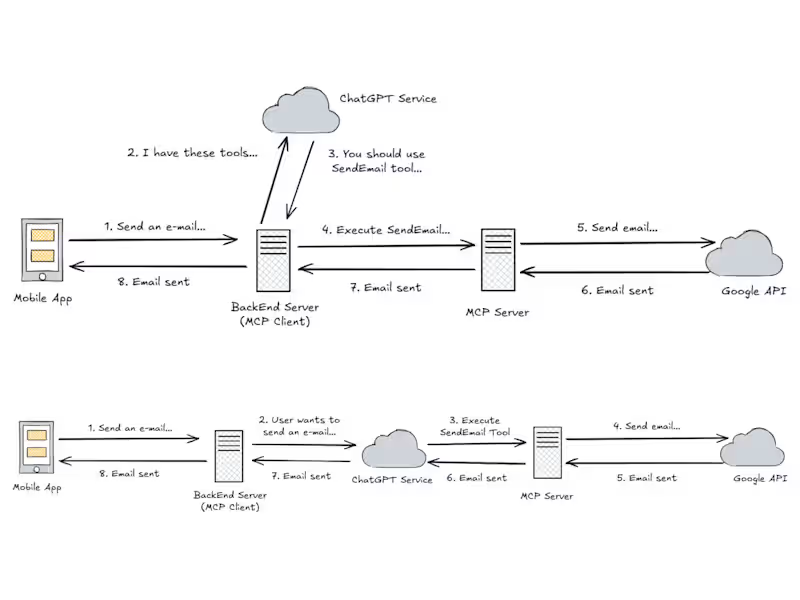
AI Agent Architecture: Model Context Protocol (MCP) & API Integration.
Recently, I architected a highly scalable, AI-driven backend infrastructure for a corporate client utilizing the open-source Model Context Protocol (MCP). The client, who was developing a next-generation mobile application, faced a critical problem: they needed to safely connect Large Language Models (LLMs) to external services, like email, without exposing sensitive credentials or building fragmented, custom connections for every new tool. They required a secure, decoupled infrastructure that would allow their mobile application to interpret user intent and autonomously execute tasks through Google APIs without compromising system security.
To solve this challenge, I engineered two distinct architectural flows that leverage MCP, a universal open standard for connecting AI systems with external tools and data sources. In the primary agentic flow, the backend acts as an intelligent MCP Client that intercepts the mobile user's request, such as sending an email, and passes it to the ChatGPT service alongside a manifest of available system tools. The LLM acts purely as a reasoning engine, evaluating the request and instructing the backend to utilize the SendEmail tool. The backend then safely orchestrates this command by communicating with an isolated MCP Server to execute the payload.
Additionally, I designed a streamlined alternative flow where the ChatGPT service is configured to evaluate the user's intent and directly trigger the SendEmail tool on the MCP Server. In both configurations, the MCP Server is strictly responsible for handling the actual Google API integration and external data transmission. Once the email is successfully dispatched via Google's servers, the confirmation cascades back through the MCP network to the backend, ultimately updating the mobile app interface. This client-server design ensures a clear separation of concerns, securely isolating the LLM from the actual API execution environment.
The client was exceptionally satisfied with the final deliverable. They praised the system's robust security and modularity, noting that the standardized MCP framework dramatically simplified their backend and accelerated the integration of future AI tools. Because the architecture successfully resolved their complex orchestration and security bottlenecks, they rated the project a complete success and seamlessly deployed the solution into their production environment.
1
351
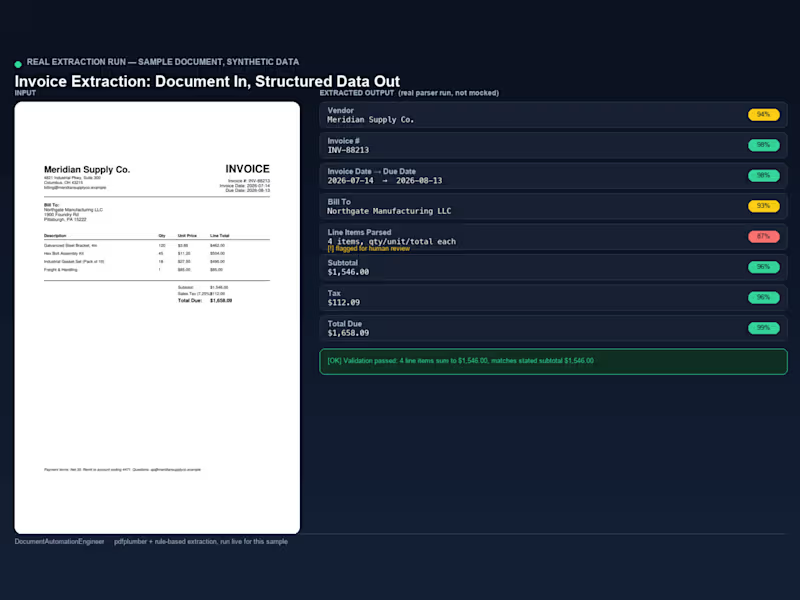
Document Automation Engineer: AI OCR & Regex Data Extraction.
The primary objective of this project was to modernize data operations for a humanitarian NGO struggling with high volumes of physical forms, paper beneficiary logs, and handwritten field reports. The organization faced severe bottlenecks due to slow, manual data entry, which often introduced transcription errors and created a high risk of duplicate or corrupted beneficiary data during spreadsheet imports. To solve this, I engineered an automated document processing pipeline capable of ingesting these unstructured paper records and converting them into structured, queryable database formats.
To tackle the varying scan qualities and inconsistent field layouts, I built a robust extraction layer utilizing Python and Tesseract OCR. By combining these tools with pdfplumber and custom rule-based extraction scripts, the system intelligently navigated chaotic document structures. It accurately parsed targeted data points such as IDs, dates, and financial figures directly from the scanned files, effectively converting static images into machine-readable text components.
Once the raw text was extracted, it passed through a sophisticated transformation layer powered by regex-driven validation scripts. This logic automatically cleaned, normalized, and verified the parsed entries against strict business rules, performing automated cross-checks such as confirming that extracted line items mathematically matched the stated subtotals. The pipeline also featured dynamic confidence scoring and error-flagging logic. Highly legible fields would clear with 93% to 99% confidence, while more complex or degraded sections with lower scores (e.g., 87%) were automatically flagged and isolated for human review, ensuring no bad data slipped through.
The final pipeline culminated in an automated end-to-end export to structured CSV and database storage. By replacing the manual transcription bottleneck with this AI-driven OCR architecture, the solution cut data entry time by over 80%. Ultimately, this streamlined the NGO's reporting capabilities, eliminated the risk of database corruption, and ensured that all beneficiary data remained highly reliable and fully audit-ready for their donors.
1
401

Turning Your Ideas Into Digital Products
Turning Your Ideas Into Digital Products

Data Engineer Specializing in Data, APIs & Automation
- 7
- Followers
Data Engineer Specializing in Data, APIs & Automation