Projects using GitHub in Buenos AiresProjects using GitHub in Buenos Airesnotion-mcp-hono — Remote MCP server with a live playground
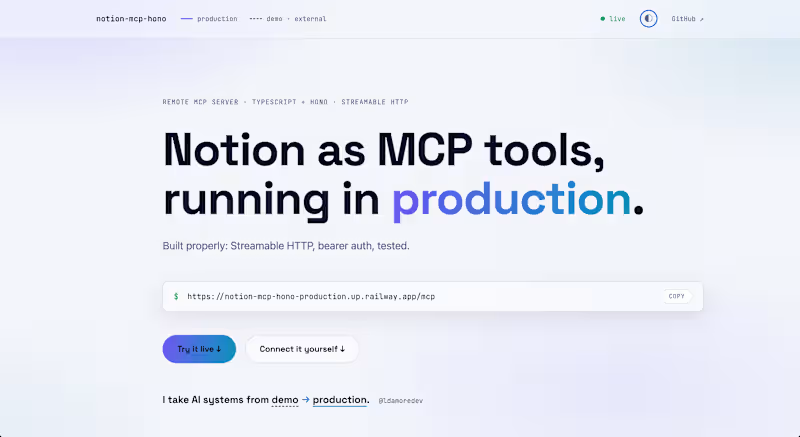
Most MCP servers are local stdio scripts. This one is a remote, production-deployed MCP server for Notion — with a public playground where you can run the actual tools right now, no setup: notion-mcp-hono-production.up.railway.app (http://notion-mcp-hono-production.up.railway.app)
What's in it:
→ Streamable HTTP transport on Hono, deployed on Railway — connectable from claude.ai (http://claude.ai) or Claude Code in under a minute
→ Bearer-token auth with timing-safe comparison; the demo playground runs server-side against a sandboxed workspace, read-only, rate-limited — credentials never touch the browser
→ Clean architecture: transport / MCP / Notion layers with dependencies pointing inward — the Notion integration is swappable without touching tool code
→ Five tools, Zod-validated, with descriptions written for the LLM that consumes them and errors translated into actionable messages
→ Built test-first (Vitest, mocked Notion API), conventional commits, MIT-licensed
Try the live playground, or connect the server to your own Claude in one command — both on the site. Source: github.com/ldamoredev/notion-mcp-hono
This is what I mean by taking AI systems from demo to production: not a bigger demo — the same engineering discipline you'd expect in any production service, applied to AI infrastructure. Hermes — Local AI Agent OS with production-grade guardrails
Hermes is a multi-actor agent system I built to run my own freelance operation: it scans job opportunities, scores them against hard criteria, and drafts proposals — but never sends anything. Every output lands in a drafts folder for human review.
What makes it interesting as an engineering project:
→ Multi-actor architecture: specialized agents (opportunity radar, filtering, drafting) each running on the cheapest model that can do the job — volume tasks on lightweight models, premium models reserved for high-stakes output
→ Hard filters that are actually hard: no "when unsure, keep it" escape valves that let LLMs rationalize around clear disqualifications
→ Regression fixtures for prompts: every prompt change runs against a fixed batch of real-world cases before shipping — TDD discipline applied to agent behavior
→ Draft/approval mode by design: the system augments human judgment, it never replaces it
→ Built on the Anthropic SDK with structured context files (profile, rules, scoring criteria) as the agent's operating system
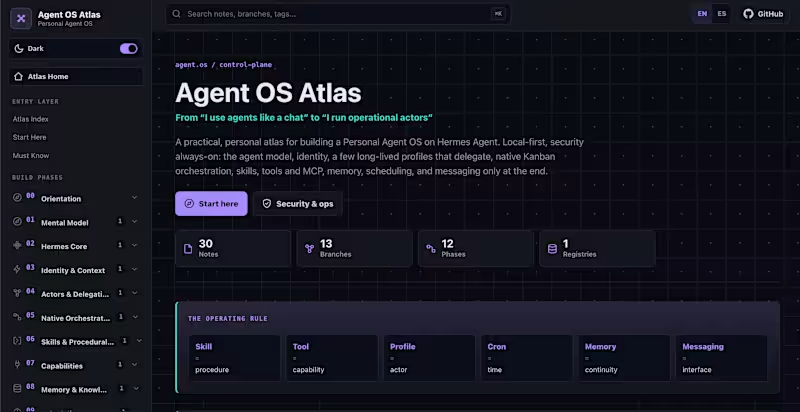
Full architecture notes (in Spanish): ldamoredev.github.io/personal-agent-os-notes/es/
This project is my testbed for the patterns I ship to clients: agent systems that are cheap to run, safe to operate, and tested like real software.