The network for creativity
Join 1.25M professional creatives like you
Connect with clients, get discovered, and run your business 100% commission-free
Creatives on Contra have earned over $150M and we are just getting started
Back to feedPost

TraceLayer
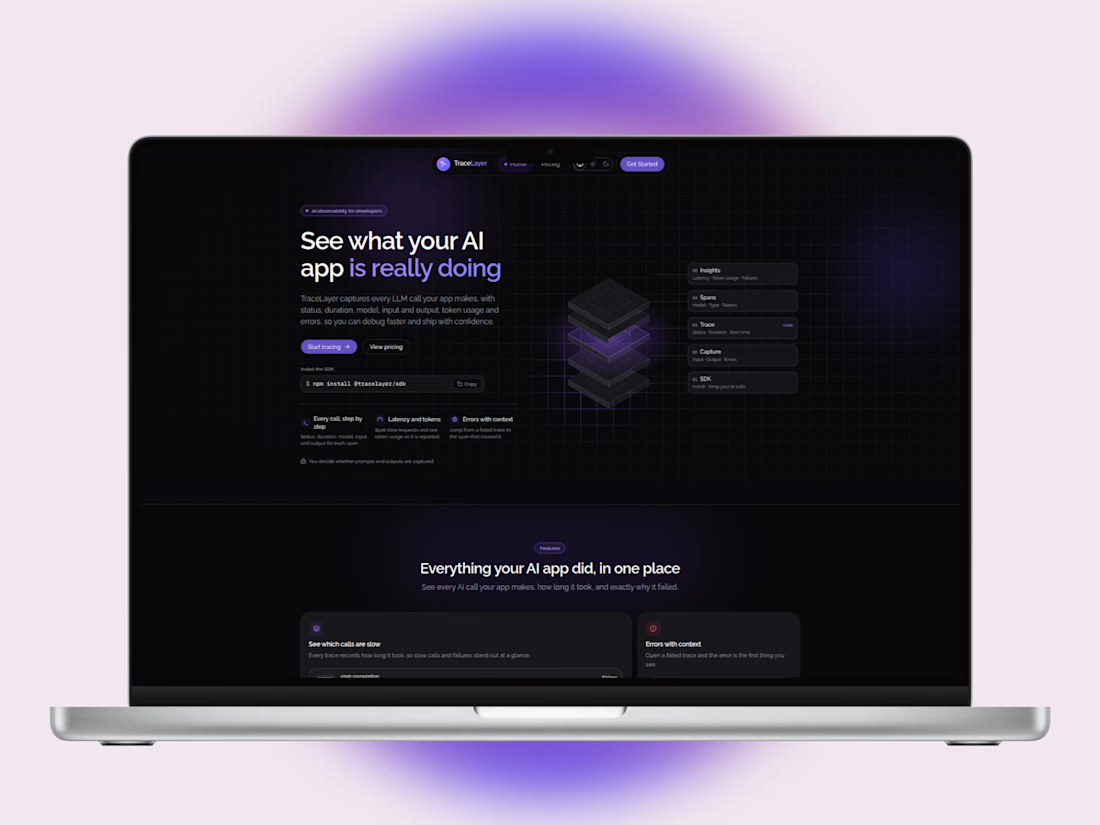
TraceLayer shows developers what their AI app is doing. You add a small SDK to your app, and every LLM call shows up in a live dashboard with its status, duration, model, input and output, token usage and errors.
A few things I cared about
Honest numbers. If a provider doesn't report token usage, the dashboard shows a dash, not a zero.
Sensitive data. API keys are shown once, when you create them. After that you only see the prefix and it works on a phone without sideways scrolling.
The hero has an interactive stack that opens up on hover to explain how the product works.


The network for creativity
Join 1.25M professional creatives like you
Connect with clients, get discovered, and run your business 100% commission-free
Creatives on Contra have earned over $150M and we are just getting started





Related posts


I designed and built an interactive plan builder for an AI SaaS product. Instead of a traditional pricing table, users choose their workspace and their AI capacity separately, so they only pay for the AI usage they actually need.
The summary panel updates instantly as selections change. Each price change rolls digit by digit, plan names swap character by character, and the layout adjusts its width smoothly. The motion is built with GSAP and respects reduced-motion preferences, with accessible text kept for screen readers.
Design and front-end engineering, handled end to end.


Great work!

A full-stack RAG application that answers questions from a team's own documents, with every answer cited to the source document and page. I designed, built, tested and deployed it end to end:
document ingestion with content-based file validation;
semantic search with PostgreSQL + pgvector;
streaming answers over Server-Sent Events, with server-side citation verification;
multi-tenant workspaces with role-based access;
usage metering with quotas and a cost dashboard;
a crash-safe PostgreSQL job queue.
Deployed as a public demo on free tiers (Vercel, Render, Supabase) with hard caps on AI spend.
Citations verified against the retrieved passages; unsupported answers return "not found"
Tenant isolation in every query; Supabase Data API locked down (verified on production)
Durable ingestion queue (SKIP LOCKED, leases, retries): kill -9 under load lost nothing
Costs reserved before every AI call; per-user, per-workspace and deployment-wide caps
Data-driven model migration (5 configurations evaluated; about 74% cheaper per answer)
1,099 backend + 393 frontend tests; load-tested; encrypted, restore-verified backups
https://knowledgepilot-ai-olive.vercel.app/


The reservation before the AI call is the detail most teams miss: you can add cost metering later, but you cannot un-spend the money after a runaway loop. On the crash-safe queue, with SKIP LOCKED plus leases, what happens to a lease held by a worker that is alive but stuck, do...

Created a SaaS product explainer for LotIQ, showcasing its land analysis platform through engaging UI animation, voiceover, and motion graphics.


Looks great!!


