The network for creativity
Join 1.25M professional creatives like you
Connect with clients, get discovered, and run your business 100% commission-free
Creatives on Contra have earned over $150M and we are just getting started
Back to feedPost

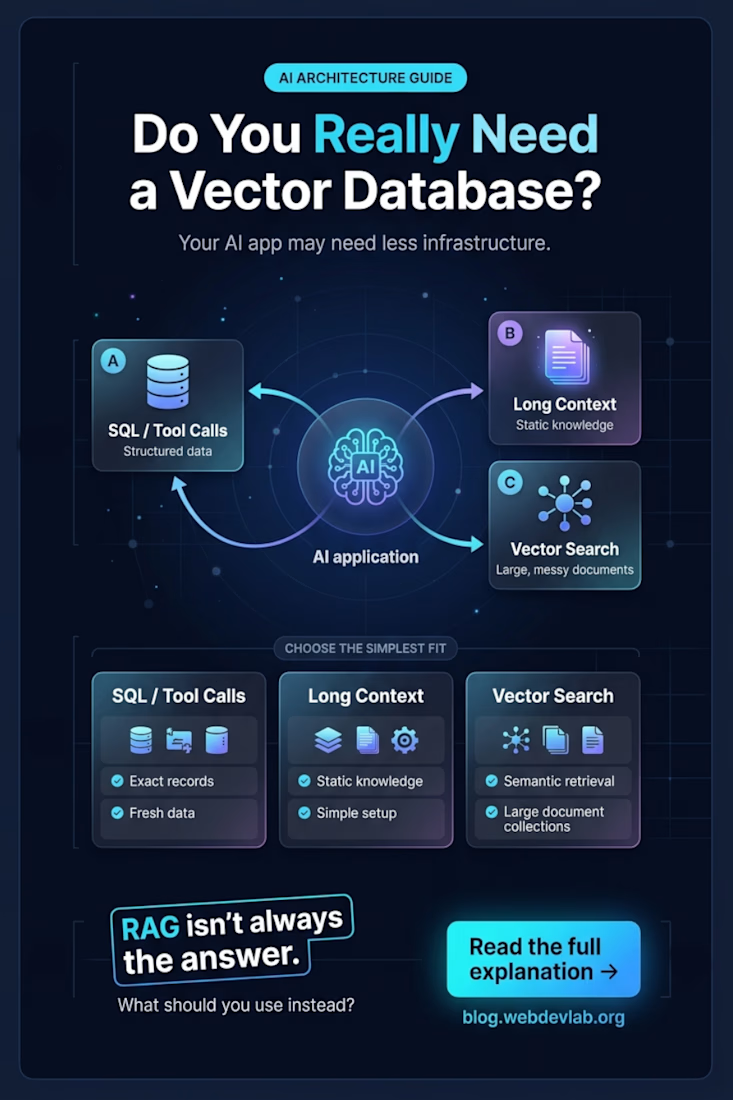
🚨 Not every AI app needs a vector database.
Yet many developers jump straight into RAG, embeddings, and vector search without asking one simple question:
Do we really need it?
Sometimes, your existing SQL database is enough.
Sometimes, a longer context window does the job.
Sometimes, simple files are all your AI agent needs.
A vector database can solve real problems, but it also adds complexity, maintenance, and cost.
My rule?
Start simple. Measure what breaks. Add complexity only when you need it.
I wrote an article explaining when a vector database makes sense, when it doesn't, and how to decide before building your next AI feature.
👉 Read the full article:
https://blog.webdevlab.org/do-you-need-a-vector-database
What would you choose for your next AI project: RAG or a simpler approach?
#AI #RAG #VectorDatabase #SoftwareEngineering #WebDevLab
The network for creativity
Join 1.25M professional creatives like you
Connect with clients, get discovered, and run your business 100% commission-free
Creatives on Contra have earned over $150M and we are just getting started








Related posts

Building an LLM application that doesn't hallucinate? It’s all about the context. 🧠
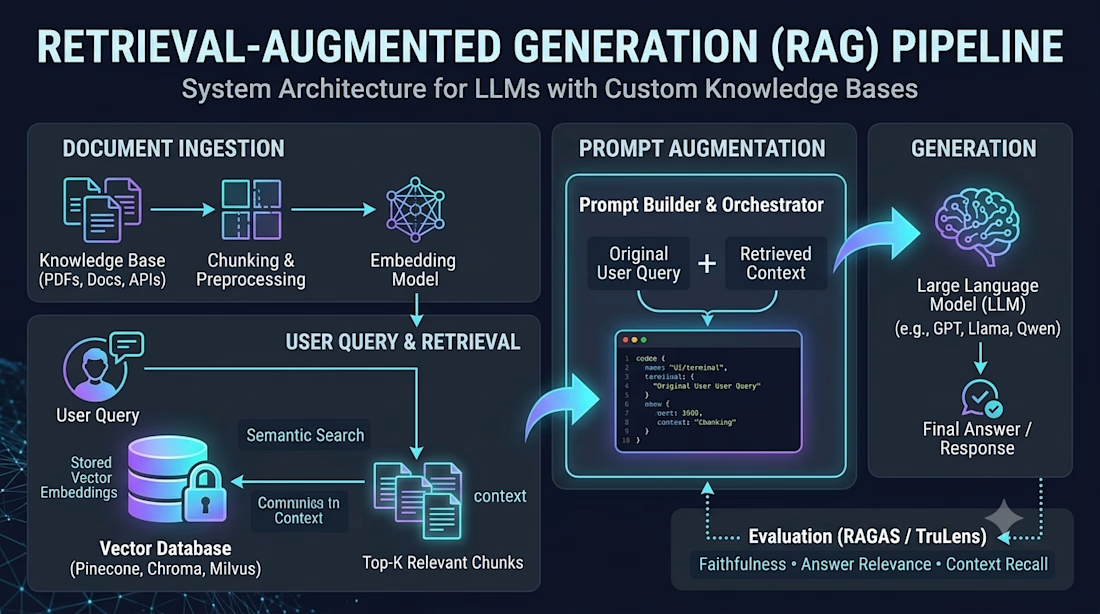
I put together this high-level architecture breakdown of a Retrieval-Augmented Generation (RAG) pipeline to visualize how we can ground large language models in custom, domain-specific knowledge bases.
While experimenting with these systems, here are the core stages I focus on to ensure accuracy:
1️⃣ Document Ingestion: Efficiently chunking and passing custom data (PDFs, APIs) through an embedding model into a vector database (like Pinecone or Chroma).
2️⃣ Semantic Search: Retrieving the 'Top-K' most relevant context chunks when a user submits a query.
3️⃣ Prompt Augmentation: Dynamically orchestrating the original query alongside the retrieved context.
4️⃣ Generation: Passing the enriched prompt to the LLM (like Qwen, Llama, or GPT) to generate a grounded response.
5️⃣ Continuous Evaluation: The most critical step. Using frameworks like RAGAS or TruLens to rigorously measure faithfulness, answer relevance, and context recall.
Building the pipeline is only half the battle; evaluating its true effectiveness is what makes it production-ready.
What frameworks are you currently preferring for your vector databases and RAG evaluation? Let’s discuss below! 👇
#GenerativeAI #MachineLearning #RAG #ArtificialIntelligence #LLM #DataScience


Your business doesn't need more AI tools.
It needs fewer repetitive tasks.
Think about the hours spent on:
→ Manual data entry
→ Repetitive follow-ups
→ Moving information between apps
→ Preparing the same reports every week
AI automation can connect these workflows, reduce manual work, and give your team more time to focus on what actually matters.
The goal isn't to automate everything.
It's to make work flow better.
What is one repetitive task you'd eliminate from your business?

Something I'm proud of: an AI agent that knows when to say no.
In our 60-second film, someone asks it to drop a database table. It refuses and hands the request to a person, with the full context attached.
Speed is easy to build. A limit is a design decision.
(Sample demo, not a live customer system.)