The network for creativity
Join 1.25M professional creatives like you
Connect with clients, get discovered, and run your business 100% commission-free
Creatives on Contra have earned over $150M and we are just getting started
Back to feedPost

How I Build Websites That Humans and AI Both Understand
A website now has two audiences. The person reading it, and the AI deciding whether to recommend it.
Most sites are built for one and invisible to the other. That's a problem, because more buyers are asking AI for recommendations before a human ever lands on your page.
Here's the shift. For years we built websites for people and search crawlers that mostly matched keywords. Now AI reads your site to understand it, summarize it, and cite it in answers. If it can't understand your page, it can't recommend you. And you'll never know you were skipped.
The good news is that what makes a site clear to AI is the same thing that makes it clear to humans. Structure.
So I build on semantic structure, not visual guesswork. That means real headings that describe what each section actually contains, not just big text styled to look like a title. It means proper schema markup that tells machines exactly what they're looking at: a product, a service, a review, a business. It means content organized as clear answers to real questions, so an AI can lift a clean response instead of guessing.
It also means clarity over cleverness. Vague marketing language gets skipped by AI and glazed over by humans. Specific, concrete claims get quoted by one and trusted by the other. Both audiences reward the same thing: say what you mean, plainly, and structure it so it's easy to find.
A page built this way works twice. Humans move through it effortlessly, and AI can actually parse, trust, and surface it.
Build for people and machines at once.
Because soon, the machine decides whether the person ever sees you at all.
The network for creativity
Join 1.25M professional creatives like you
Connect with clients, get discovered, and run your business 100% commission-free
Creatives on Contra have earned over $150M and we are just getting started







Related posts

Adding more keywords will not make AI recommend your brand
Businesses are starting to optimize pages for AI search, but many treat GEO like another keyword exercise.
The work we do looks different.
In one recent project, we improved direct-answer blocks, heading structure, FAQs, schema and overall content clarity. We also tracked visibility across Google AI Overview, ChatGPT, Perplexity, Copilot, Gemini and Grok.
After 4 months, TOP-10 AI Overview queries grew from 35 to 217, TOP-3 from 23 to 113, and TOP-1 from 12 to 35. Overall visibility increased 6.2×.
At the same time, citations fluctuated between platforms. That’s why GEO performance needs to be measured through visibility, citations and actual AI traffic separately.
The practical goal is simple: make your content easier for AI systems to understand, trust and use as a source.
If you want, send me one page from your site and I’ll tell you what I would change first for AI visibility.
#GEO #AISEO #SEO #ChatGPT #GoogleAIOverview

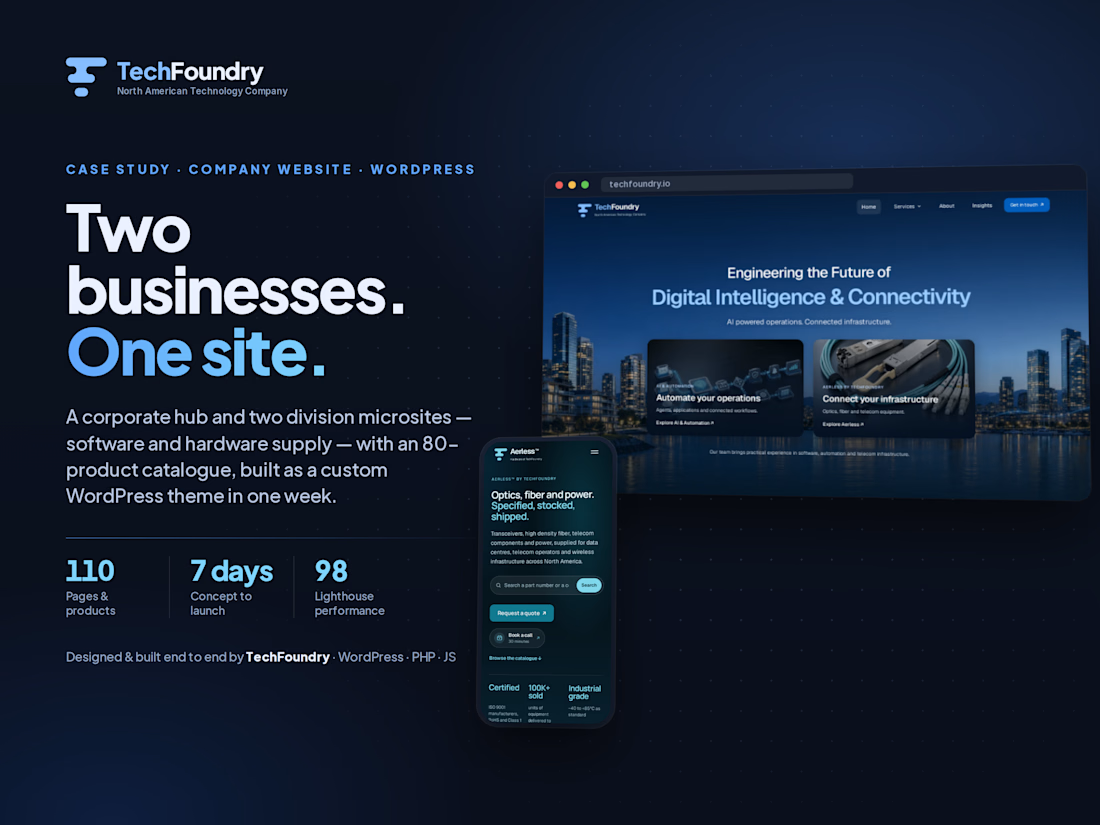
We rebuilt TechFoundry's website in a week. The brief that mattered most wasn't "make it look good". It was "make ChatGPT and Gemini able to find us".
Buyers ask an AI before they search now. So all 110 pages (26 pages, 80 Aerless™ hardware parts, 4 articles) are server-rendered with real content and structured data a model can cite: Product schema with SKU and MPN on every part, BlogPosting on articles, CreativeWork on case studies, and a robots.txt that lets AI crawlers in.
Three other decisions I'd make again.
1) One hand-coded WordPress theme, three "surfaces": corporate hub, /ai, /aerless. Each gets its own nav, palette and CTAs; the same codebase decides which company you're looking at. No page builder, no front-end framework. Homepage Lighthouse: 98 / 100 / 100 / 100.
2) Leads go where the team already is. Every form posts straight into a Microsoft Teams channel and creates a record in a lightweight CRM I built inside WordPress. Nothing lives only in an inbox.
3) Claude Code and ChatGPT alongside hand-written PHP and JS. That's how one person ships 110 pages in seven days.
What I'd fix on day one next time: reserve space for the animated heroes so mobile doesn't shift layout, and ship an llms.txt next to the sitemap.
If you're rebuilding a site this year: are you designing for AI search yet, or still just Google?

Appreciate the honesty on the mobile layout shift. Are you fixing it with explicit CSS aspect ratios to push that mobile score back above 90?

Made these animations with Claude for a B2B SaaS web design project.
Been experimenting with how AI can speed up the animation process while still keeping the interactions intentional and tied to the overall design.
Fun to see a simple idea turn into something that feels much more alive. ⚡


great designs