The network for creativity
Join 1.25M professional creatives like you
Connect with clients, get discovered, and run your business 100% commission-free
Creatives on Contra have earned over $150M and we are just getting started
Back to feedPost
Reality Check 🚀
Reality Check started with a question I kept asking myself while experimenting with AI design tools:
Can a real human actually survive this experience?
Today, AI can generate screens, assets, prototypes, and even complete user flows in seconds. But there is still one thing it doesn't tell us: how real people might experience what we create.
To explore that idea, I used ChatGPT, Claude, and Gemini for research, brainstorming, UX exploration, and prompt development. I then used Figma Make to transform those ideas into a working product.
My prediction is that Figma's next AI chapter will be less about generating designs faster and more about helping designers understand the humans behind those designs.
We already have AI that can create screens, assets, and prototypes.
The next frontier is AI that can simulate outcomes.
How will a stressed user experience this?
Where will someone lose trust?
What happens when real life interrupts the perfect workflow?
Reality Check explores those questions through AI-simulated personas with goals, limitations, emotions, and behavioral patterns.
The application allows designers to test a design against synthetic users before investing in usability testing and before releasing products to market.
Importantly, Reality Check is not intended to replace usability testing.
Nothing can replace observing real people interacting with a product.
Instead, it acts as a design reasoning and pre-validation layer that helps teams identify friction, confusion, trust issues, and usability risks earlier in the design process.
The core concept behind Reality Check is the Reality Gap.
AI Audit Score measures how technically strong a design appears.
Human Experience Score measures how successfully a simulated user can actually use it.
Reality Gap is the difference between those two numbers.
The larger the gap, the more a design appears successful on paper while struggling in real human conditions.
For the Makeathon MVP, I focused on one complete flow:
Upload a design.
Select a persona.
Run a simulation.
Reveal the Reality Gap.
Review AI-generated findings.
Looking ahead, the natural next step would be a native Figma plugin. Using the Figma Plugin API, Reality Check could analyze selected frames directly inside Figma without requiring exports, bringing simulation and feedback directly into the design workflow.
Design systems gave us consistency.
AI generation gave us speed.
Maybe the next evolution is empathy systems.
Figma make link so you can check the prompts I used: https://www.figma.com/make/ohZmHiN44nIa0ngZPdPHnz/Reality-check-app?t=1qZGasMWeVXNvtSW-1




really nice and useful!

Thank you Dylan 🙌
The network for creativity
Join 1.25M professional creatives like you
Connect with clients, get discovered, and run your business 100% commission-free
Creatives on Contra have earned over $150M and we are just getting started
Related posts

I built Chirp, a temporary shared room for small moments — 10-second sounds, photos, doodles, and stickers that disappear after 24 hours.
Most online spaces today feel public, permanent, and performative. I wanted to make the opposite: a private, playful, low-pressure room where people can leave tiny traces together without creating another profile, feed, or archive.
Anyone can create a room without logging in, share a unique link, and invite others to record short sounds, reply with audio, add photos, place stickers, or doodle on the canvas.
Chirp may look like a playful canvas, but it is not a productivity board or a persistent workspace. The 24-hour expiration is part of the design: because everything fades away, people can post more casually and treat the room like a shared moment, not a social feed.
I built Chirp with Figma Make to explore how Figma can be used to create an interactive, expressive, and temporary web experience.
Note: Chirp is an experimental prototype built for Config Makeathon. Rooms and uploaded content are temporary, so please don’t use it for sensitive information.
Live project:
https://chirp.figma.site/

Amazing!!!

FrameOrbit — Config Makeathon Submission 📸🌀
Sharing second project for the Config Makeathon: FrameOrbit.
https://cedar-thaw-04755246.figma.site/
Project published to the community.
FrameOrbit is a playful camera canvas experience where taking photos feels more spatial, visual, and alive.
The idea started from a simple question:
What if captured photos didn’t disappear into a hidden gallery, but stayed around your camera as part of the experience?
In FrameOrbit, the camera view sits in the center of a soft canvas. Every time the user captures a photo, it instantly appears as a framed image around the camera. As more photos are taken, the canvas starts to build a visual orbit of moments around the live camera view.
Users can:
Capture photos directly from the center camera frame
See each image appear instantly around the canvas
Apply different photo styles like Normal, Noir, Warm, Cool, Vivid, Fade, Retro, and Neon
Drag photos around the canvas
Tap any photo to open it in a cinematic full-screen viewer
Move between images using previous/next navigation
Save all captured images or reset the canvas
The goal was to make photo capturing feel less like a utility and more like a small creative ritual, a live memory board that grows with every shot.
Built with Figma Make, I focused on creating a polished interactive prototype with a soft visual system, floating photo cards, smooth viewer experience, and a simple flow that can be understood in seconds:
Capture → frame appears → build your orbit → explore your moments.
FrameOrbit turns the camera into a canvas. ✨
#ConfigMakeathon #FigmaMake #FrameOrbit #ProductDesign #UXDesign #UIDesign #CreativeTools #CameraApp #Prototype #Makeathon


Make sense

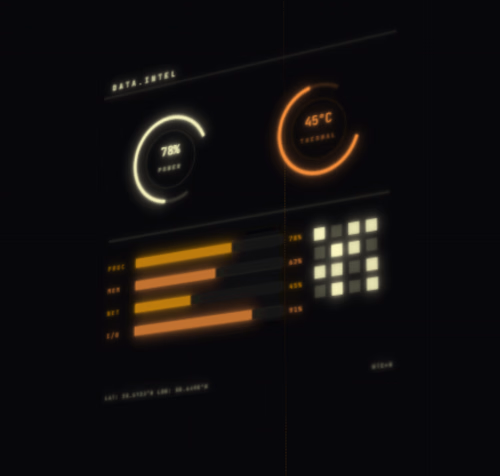
I wanted to build a Sci-fi HUD creation tool with plenty of customization options.
So I built the SINGULARITY HUD CREATION TOOL
Live site: https://singularityhud.figma.site/
GitHub Repository: https://github.com/nytrite/SingularityHudCreationTool
SINGULARITY is a notch web-based studio for making cool animated graphics, technical drawings, and futuristic interfaces.
It works in your browser and uses special technology to make smooth animations.
The studio has a professional look, with a dark theme, orange accents, and a clean, simple design.
This makes it easy for designers to create and animate graphics and export them in a ready-to-use format, such as MP4.
The tool is great for making all sorts of graphics from animated user interfaces to schematics and cinematic sci-fi interfaces.
It uses an animation engine that makes everything look smooth and realistic.
With SINGULARITY, designers can make high-quality motion graphics and HUDs quickly and easily.
My process:
Pen and paper → Figma make → Using Figma make to generate ideas → Prompting it out as perfectly as I can get it to work → Connected to Supabase → Deployed
Thank you!











Trending

Claude
Claude has entered the design space. How are you using Claude Design?

Contra University
Learn from expert creatives how to earn more using next-gen AI tools.

MagicPath
The canvas is infinite, and exploration is becoming the workflow. How are you using MagicPath?
creativeaiflow
Creative AI workflows are evolving. What tools do you use, and what are their strengths and weaknesses?
freelancerlife
Freelancer life is wins, pivots, and everything in between. What’s yours right now?