The network for creativity
Join 1.25M professional creatives like you
Connect with clients, get discovered, and run your business 100% commission-free
Creatives on Contra have earned over $150M and we are just getting started
Back to feedPost
Reality Check 🚀
Reality Check started with a question I kept asking myself while experimenting with AI design tools:
Can a real human actually survive this experience?
Today, AI can generate screens, assets, prototypes, and even complete user flows in seconds. But there is still one thing it doesn't tell us: how real people might experience what we create.
To explore that idea, I used ChatGPT, Claude, and Gemini for research, brainstorming, UX exploration, and prompt development. I then used Figma Make to transform those ideas into a working product.
My prediction is that Figma's next AI chapter will be less about generating designs faster and more about helping designers understand the humans behind those designs.
We already have AI that can create screens, assets, and prototypes.
The next frontier is AI that can simulate outcomes.
How will a stressed user experience this?
Where will someone lose trust?
What happens when real life interrupts the perfect workflow?
Reality Check explores those questions through AI-simulated personas with goals, limitations, emotions, and behavioral patterns.
The application allows designers to test a design against synthetic users before investing in usability testing and before releasing products to market.
Importantly, Reality Check is not intended to replace usability testing.
Nothing can replace observing real people interacting with a product.
Instead, it acts as a design reasoning and pre-validation layer that helps teams identify friction, confusion, trust issues, and usability risks earlier in the design process.
The core concept behind Reality Check is the Reality Gap.
AI Audit Score measures how technically strong a design appears.
Human Experience Score measures how successfully a simulated user can actually use it.
Reality Gap is the difference between those two numbers.
The larger the gap, the more a design appears successful on paper while struggling in real human conditions.
For the Makeathon MVP, I focused on one complete flow:
Upload a design.
Select a persona.
Run a simulation.
Reveal the Reality Gap.
Review AI-generated findings.
Looking ahead, the natural next step would be a native Figma plugin. Using the Figma Plugin API, Reality Check could analyze selected frames directly inside Figma without requiring exports, bringing simulation and feedback directly into the design workflow.
Design systems gave us consistency.
AI generation gave us speed.
Maybe the next evolution is empathy systems.
Figma make link so you can check the prompts I used: https://www.figma.com/make/ohZmHiN44nIa0ngZPdPHnz/Reality-check-app?t=1qZGasMWeVXNvtSW-1


really nice and useful!

Thank you Dylan 🙌
The network for creativity
Join 1.25M professional creatives like you
Connect with clients, get discovered, and run your business 100% commission-free
Creatives on Contra have earned over $150M and we are just getting started



Related posts

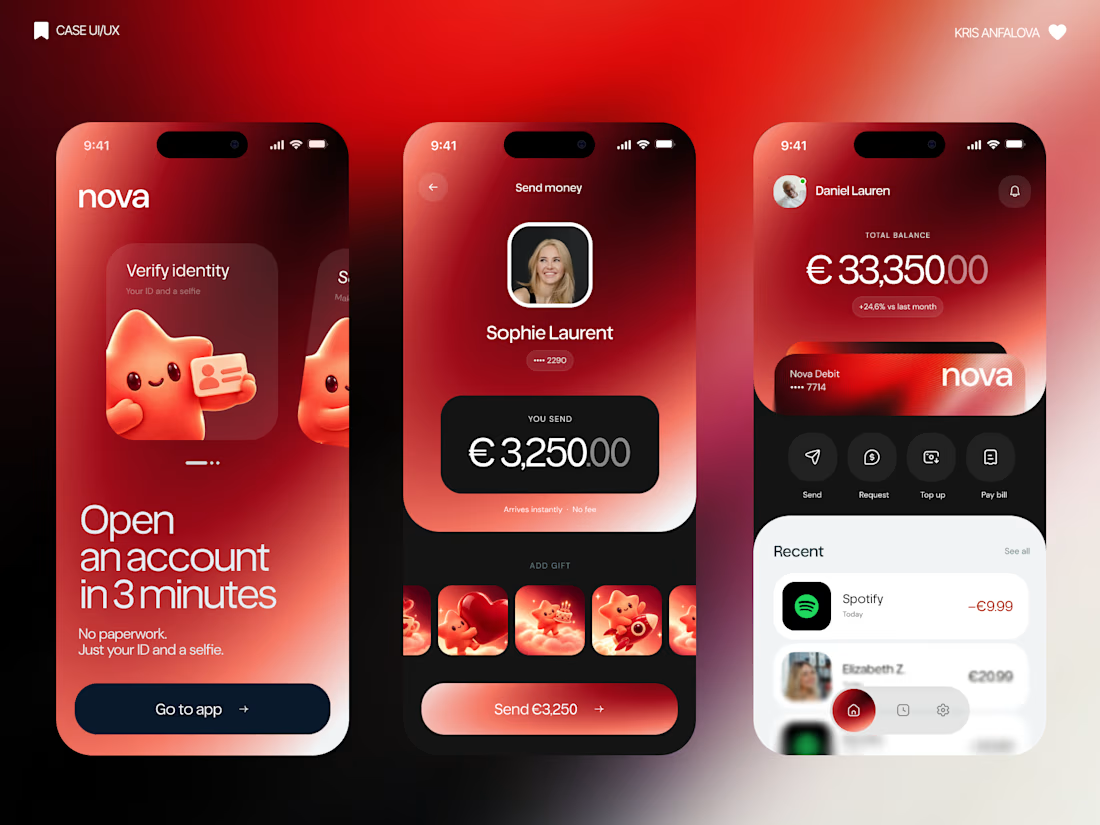
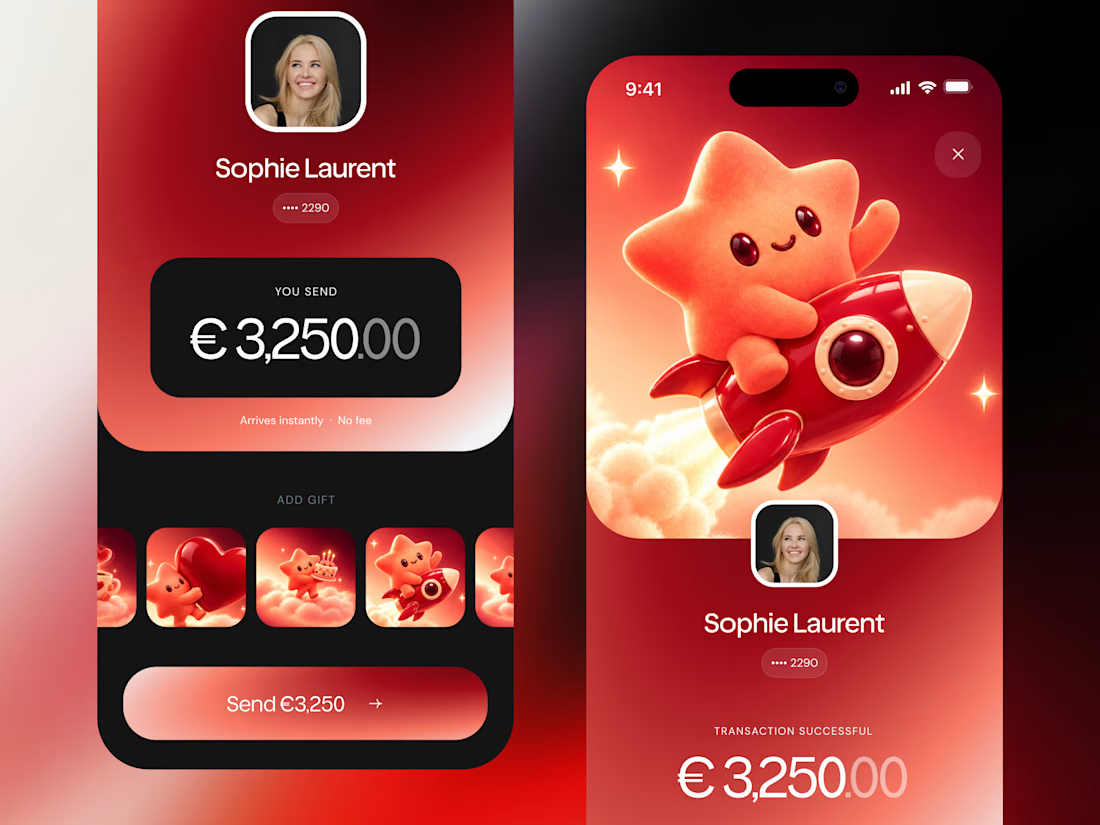
What if sending money felt a little more like giving a gift?
For Nova, I explored a banking app that brings payments, cards, and a bit of personality together. You can check your balance, browse recent transactions, send or request money, top up, and pay bills.
My favorite part is the digital postcard feature. Before sending a transfer, you can add a little illustrated card—a heart, a birthday greeting, or a playful character. A simple way to make birthday money or a thank-you feel more personal.
I carried that same 3D character into onboarding, pairing it with bold red gradients and large, clear payment details. There’s room for play, while the recipient and amount stay easy to check.
Would you add a postcard to a transfer? I’d love to know what occasion you’d use it for.



Did a motion for the Cockpit concept ⁕ 🔈 ON
Design & Creative Direction: Me
Motion & Sound: Claude Code
Cockpit is an AI agent management platform concept that helps teams:
- Set boundaries
- Monitor activity
- Manage approvals
- Track knowledge sources
- Measure performance and costs
It brings together five key AI UX challenges:
👉 Autonomy
👉 Observability
👉 Human Approvals
👉 Context
👉 Analytics
The idea is simple:
As AI agents become more capable, the experiences we design around them need to make their actions more transparent, predictable, and manageable.
Thanks!

Human approvals is the part most agent UIs skip. Good call making it one of the five challenges.

Login page idea design
A playful visual concept where the character literally “arms” himself depending on the strength of the password.
As the user creates a stronger password, the character progressively equips himself with more powerful protection and armor. The stronger the password, the better prepared and more protected he becomes.
The idea turns password security into a simple and engaging visual metaphor , instead of showing abstract security levels, the user can immediately see how their password makes the character stronger and safer.


Very cool, Anna!