The network for creativity
Join 1.25M professional creatives like you
Connect with clients, get discovered, and run your business 100% commission-free
Creatives on Contra have earned over $150M and we are just getting started
Back to feedPost

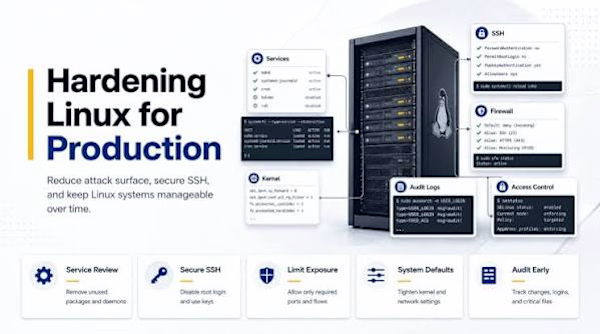
A high-traffic SaaS client required a comprehensive security overhaul of their production infrastructure. The goal was to systematically reduce the attack surface, mitigate vulnerabilities, and enforce strict access controls without disrupting live system performance. This project involved a top-to-bottom audit and the implementation of robust hardening techniques across the network, OS, and application layers to ensure resilience against zero-day exploits and unauthorized access


The network for creativity
Join 1.25M professional creatives like you
Connect with clients, get discovered, and run your business 100% commission-free
Creatives on Contra have earned over $150M and we are just getting started









Related posts

In security operations, every second matters. SentriGo is an AI-powered mobile app designed to help on-site guards detect, assess, and respond to potential threats in real time.
The experience follows a simple Scan, Classify, Alert workflow. Guards can capture a scene, receive AI-powered threat analysis with confidence scores and risk indicators, and connect with dispatch. A visual incident timeline keeps them informed about AI verification, incident status, and dispatcher responses.
A high-contrast dark interface, strategic color accents, large interactive elements, and clear hierarchy support fast decision-making in demanding environments.
Explore the project on Dribbble:
https://dribbble.com/shots/27820478-Mobile-App-Security-Guard-Assistant-App


The simple Scan, Classify, Alert workflow is perfect for guards under pressure. That high-contrast dark interface with the threat-level screen looks built for real field conditions.

Every SaaS launch video runs on the same skeleton: a hook, the product reveal, three benefits, a call to action.
So I built that skeleton once. SaaS Product is a 10-second, four-scene promo template for any digital product.
Nimble, a productivity app. HalalFX, a Premiere plugin. Lengw, a language-learning app. Three brands, one animation, nothing re-keyframed.
What you edit:
Every line of copy is live text, not outlines
The product screenshot and each logo sit in their own layers, sized to be swapped
Every editable layer is named "Edit …" so you know what is safe to touch
The motion stays exactly the same
Best for landing pages, product launches and social ads.
@SVGator

Amaizing dear


Great work!!