The network for creativity
Join 1.25M professional creatives like you
Connect with clients, get discovered, and run your business 100% commission-free
Creatives on Contra have earned over $150M and we are just getting started
Back to feedPost

Vendors were chasing down approvals for weeks.
The bottleneck: invoices landed in a shared inbox, and someone had to log into a system, find the right record, and click approve. With a busy team, that step got delayed constantly.
I built a one-click email approval flow. When a new invoice comes in, an automated email goes to the approver with a summary and two buttons: Approve or Reject. No login. No navigating to another system. One click from their inbox and it's done.
The click triggers a webhook that updates the invoice status, notifies the vendor, and logs the decision with a timestamp.
The client went from average 6-day approval cycles to same-day for anything under a threshold. The approvers barely noticed they were using a new system — it just showed up in their email like everything else.
That's usually the goal: make the automation feel invisible. The less friction, the higher the adoption.
The network for creativity
Join 1.25M professional creatives like you
Connect with clients, get discovered, and run your business 100% commission-free
Creatives on Contra have earned over $150M and we are just getting started

Challenges
View all


Related posts

If you run an agency or a B2B business, you know that finding qualified leads takes hours of manual work every single day. I had this exact problem, so I built an automated system to solve it.
I engineered an intent discovery pipeline using n8n and the DeepSeek API. It runs on a self-hosted VPS, pulls real-time data from platforms like Reddit and GitHub, scores the intent of every post using AI, and pings my phone with only the high-quality leads.
It completely eliminated manual prospecting for my own business.
I’m sharing the open-source repo with anyone who wants to see the code—just shoot me a DM.
But if you want a custom, fully integrated version of this built for your sales team without having to touch a single line of code, this is exactly what I do. I build robust n8n automations and AI agents that save hours of manual operations.




The trips ran daily. The invoicing ran monthly. Nobody calls that a problem, it is just how billing works.
At The Joshua Agency it took 30+ days to get from a completed trip to a cleared invoice. They run wheelchair, stretcher and sedan trips as a non-emergency medical transport operator across Alabama and five more states, so there is a lot of finished work sitting in that queue at any moment.
Six Make.com scenarios later, it takes 7.
What runs, every cycle:
Capture. Every completed trip as it closes. Nobody re-keys anything.
Check. Rates and trip detail before anything goes out. A wrong line item is not a small delay, it is a whole cycle lost.
Build. The invoice packet with the full breakdown attached.
Send. To the right payer, then track it until it clears.
Same trips, same team, same drivers. The waiting is what left.
Two things I would do the same way again:
Fix the checking step before the sending step. Everyone assumes the delay is getting invoices out the door. It usually is not. It is the back and forth afterwards, and that is caused by what was wrong when it went. Validate before you send and most of the chasing disappears on its own.
Measure the cycle, not the tasks. "Invoicing takes us two days" is the wrong number. The one that matters is days from finished work to cleared invoice, because that is the one the business actually feels. Most operators have never measured it, which is why it never gets fixed.
Figures in the image are illustrative and there is no passenger data on it, for obvious reasons.
If you run trips, jobs or site visits: do you know your number? Days from finished work to cleared invoice. Reply with it and I will tell you which step is eating it.


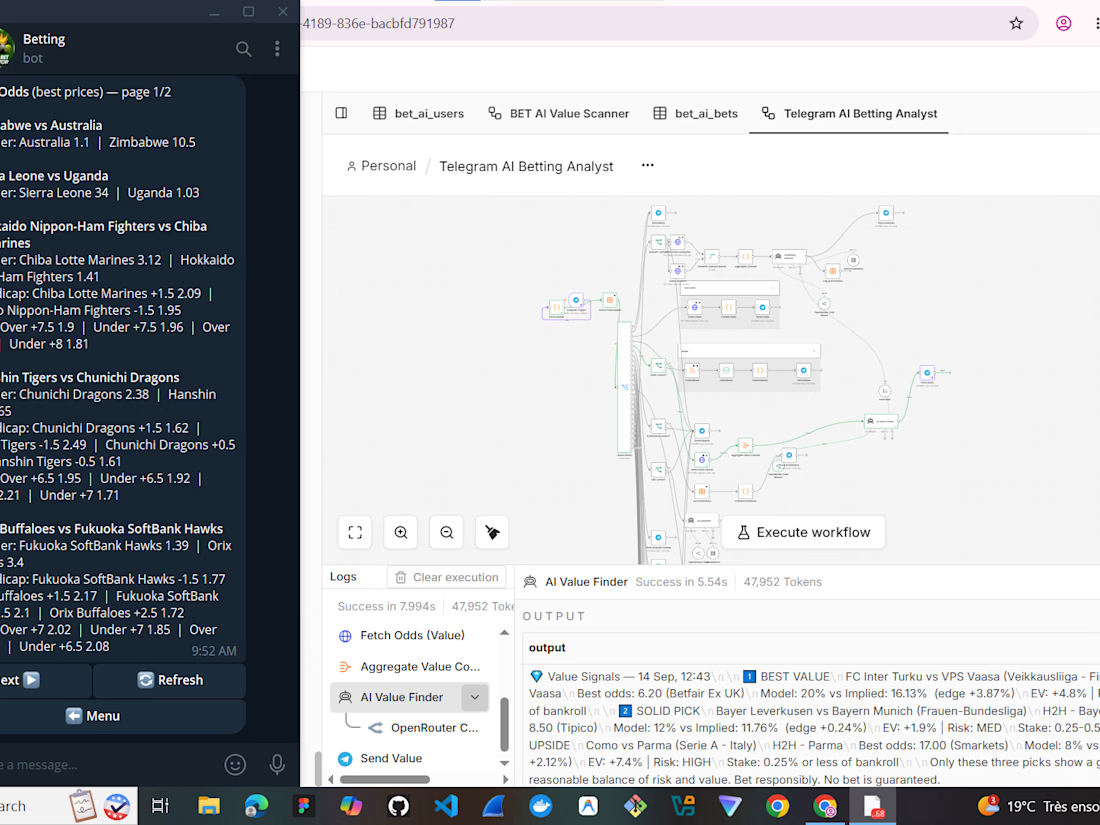
I built a fully automated Telegram AI Betting Analyst to process live sports data and find market edges. ⚡️
Instead of manually checking odds, this system centralizes the whole process:
→ Fetches and aggregates live odds via API
→ Routes data through an AI Value Finder to spot +EV (Expected Value) opportunities
→ Pushes real-time alerts and analysis directly to a Telegram bot UI
I handled the entire architecture in n8n, turning raw market data into an interactive, actionable dashboard right in the user's pocket.
#automatedworkflow #n8n #TelegramBot #AIAutomation #API
AI Agent DesignerAI Agent EngineerBusiness Workflow AutomationDockerN8NautomatedworkflowTelegram API